PlanX releases BaaS and IaaS infrastructure service architecture: building a unified financial backend for the next-generation trading platform
 Core Viewpoint

 From trading agreements to full-stack financial infrastructure, PlanX is enabling any platform with users, traffic, assets, or trading scenarios to quickly obtain complete trading capabilities without having to build complex trading systems from scratch.
PlanX today announced further upgrades to its infrastructure strategy, building a unified trading infrastructure for the next generation of digital financial markets around two core business models—BaaS (Backend as a Service) and IaaS (Infrastructure as a Service).

This strategy is based on a very clear judgment:
In the future, any platform that has users, traffic, assets, or trading scenarios should be able to provide trading services without first becoming a trading infrastructure company.
As digital assets, wallets, fintech platforms, AI Agents, communities, consumer applications, and various Web3 projects continuously embed trading capabilities into their products, the real constraint on industry development is no longer just the construction of front-end trading interfaces, but rather a highly complex financial infrastructure behind them.
A complete trading product is far more than just an interface with "buy" and "sell" buttons.
Every transaction involves a complex financial system that includes account systems, order processing, pricing, liquidity, market making, position management, margin, risk control, liquidation, profit and loss calculation, settlement, market data, system monitoring, and ongoing operations.
PlanX is building and providing this layer of capability.
Through PlanX, partners no longer need to independently build and maintain a complete trading infrastructure but can focus their resources on their areas of expertise—users, traffic, channels, products, communities, assets, and user experience.
The complex systems behind trading will be provided by PlanX.
From "Building an Exchange" to "Accessing Trading Capabilities"
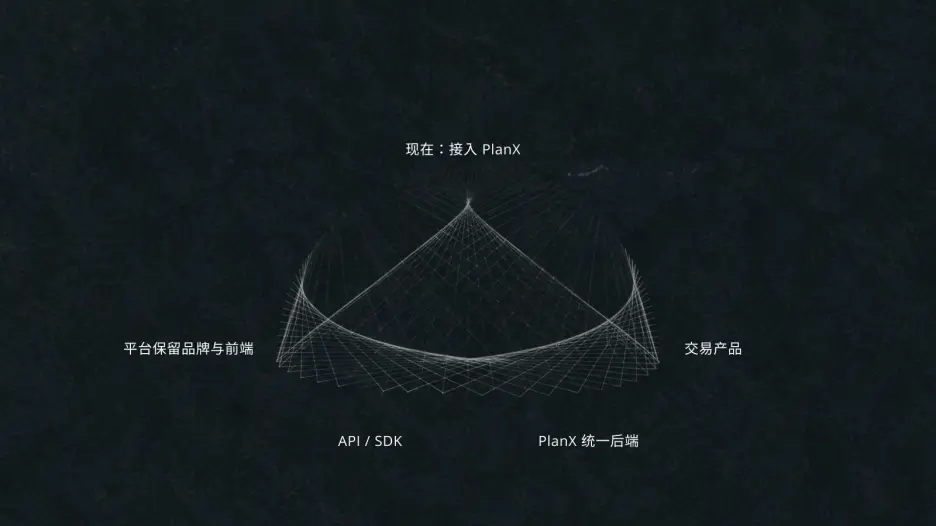
In the past, if a platform wanted to launch its own trading product, it often meant that it needed to build a complete exchange system.
The team needed to develop trading and execution systems, establish account and position systems, introduce market makers and liquidity, design risk control and margin mechanisms, build pricing, settlement, and data systems, while also forming a professional trading operation and risk management team.
For the vast majority of wallets, financial applications, Web3 projects, community platforms, and consumer products, this is a highly costly, time-consuming, and highly specialized project.
PlanX aims to change this model.
Wallets should not have to build an exchange to provide perpetual contract trading.
Communities should not have to develop their own trading engines to add trading functionality.
AI Agents should not have to independently build a complete financial backend to execute financial strategies.
Fintech applications should not have to build a complex trading infrastructure from scratch to add derivative products.
Similarly, asset issuers should not have to independently solve all issues related to liquidity, pricing, market making, risk, and settlement before creating a new market.
What PlanX does is abstract these complex capabilities into standardized infrastructure services.
Transforming "building an exchange" into "accessing trading capabilities."
BaaS: Providing Trading Backends for All Platforms with Users and Traffic
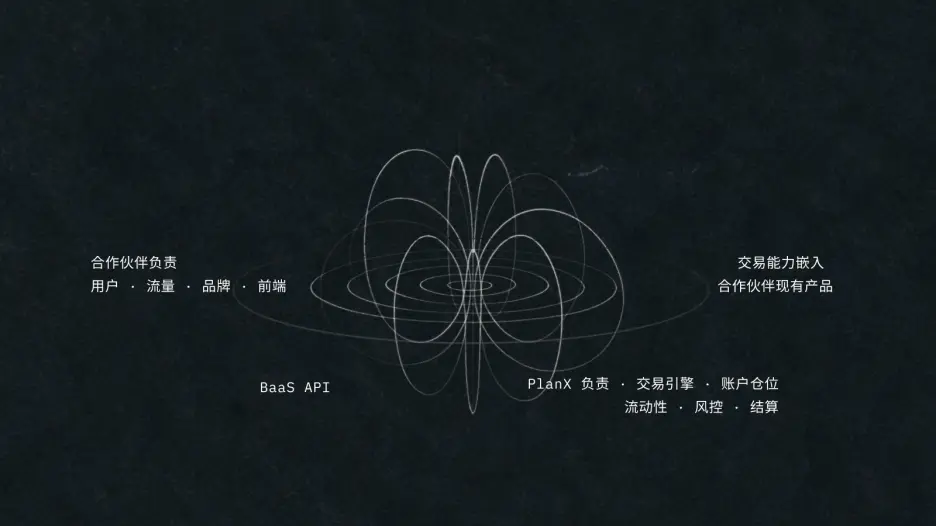
BaaS (Backend as a Service) is aimed at platforms that already have users, traffic, communities, or distribution channels and wish to directly integrate trading capabilities into their existing products.
Potential cooperation scenarios include:
Wallets · Trading Platforms · FinTech Applications · Telegram Bots · AI Agents · Communities · Brokers · KOL Platforms · DApps · Consumer Internet Applications
Through BaaS, partners can continue to use their own brands, front-end products, and user systems while integrating underlying trading capabilities with PlanX.
PlanX can provide a complete trading backend, including but not limited to:
Trading and Execution Systems Account and Position Systems Market Data Pricing Engines Liquidity Infrastructure Market Making Systems Margin Systems Risk Control Engines Liquidation Logic PnL Calculation Settlement Systems Trading API Monitoring and Operations Infrastructure
This means a clearer division of business responsibilities between the two parties:
Partners are responsible for users. Partners are responsible for traffic. Partners are responsible for brand and product experience. PlanX is responsible for everything behind trading.
Thus, platforms no longer need to think about "how to build an exchange," but only need to consider:
How to integrate trading capabilities into their products.
IaaS: Making Assets Easier to Become a Truly Tradable Market

If BaaS addresses "who provides the trading entry," then IaaS (Infrastructure as a Service) addresses another question:
What can be traded?
As financial markets gradually move towards being on-chain, digital, and programmable, more and more projects hope to transform assets, indices, market themes, event outcomes, or specific financial risk exposures into markets that can truly be traded by users.
However, creating a market is far more than just issuing a token or deploying a smart contract.
A truly sustainable market requires a complete pricing mechanism, liquidity, market making, trade execution, risk parameters, position management, and settlement systems.
The goal of IaaS is to allow project parties to build these complex systems independently.
Partners define "what is worth trading."
PlanX is responsible for making this market truly operational.
This infrastructure can serve various market forms in the future, including Crypto Assets, ecological assets, Synthetic Markets, Index, RWA-related products, Prediction-related Markets, and other programmable financial products, and can be deployed according to regulatory requirements in different markets and regions.
In this model:
Project parties create assets and markets. Platforms bring users and traffic. PlanX provides the financial infrastructure that connects the two.
An Infrastructure Layer Connecting Countless Trading Entrances
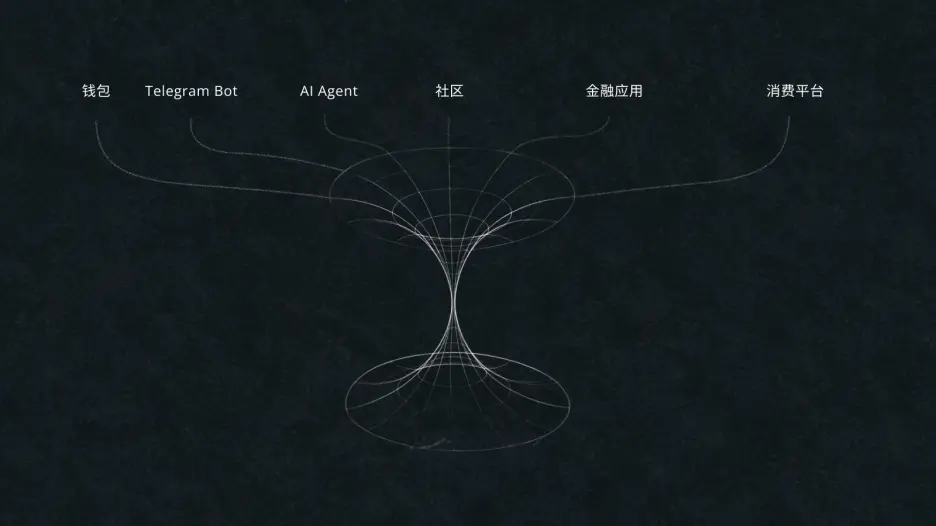
PlanX does not believe that all trading in the future will be concentrated in a few independent exchanges.
On the contrary, trading is gradually becoming a fundamental capability that can be embedded in any product.
Wallets can become trading entrances.
Telegram Bots can become trading entrances.
AI Agents can become trading entrances.
Communities can become trading entrances.
Fintech applications can become trading entrances.
Consumer internet platforms can also become trading entrances.
Where users ultimately complete transactions may undergo significant changes.
But there is no need to rebuild the financial infrastructure behind every trading entrance.
This is precisely the role that PlanX hopes to undertake.
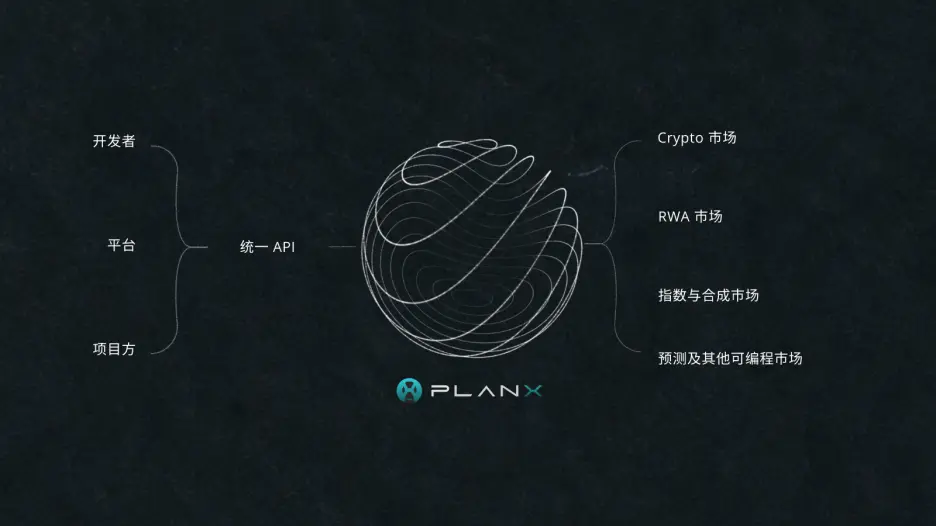
Different platforms can have completely different brands, users, front-end experiences, and business models, but at the underlying level, they can connect to the same trading, liquidity, market making, pricing, risk control, and settlement infrastructure.
The front end can be infinitely diverse, while the back end does not need to be redundantly built.
PlanX is Not Just Another Exchange
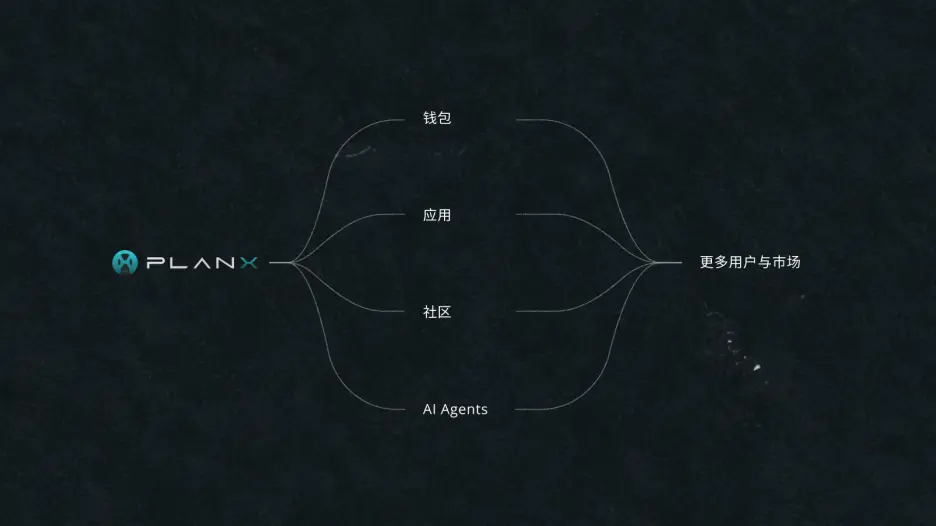
This also marks an important upgrade in PlanX's strategic positioning.
PlanX's goal is no longer just to serve as an independent trading entrance competing with other trading platforms for end users.
On the contrary, PlanX hopes to become the infrastructure used by other platforms to build trading businesses.
This means that PlanX's business boundaries are no longer limited to the trading volume generated by a single PlanX front end.
Every wallet integrated adds a new trading distribution channel.
Every application integrated adds a new trading entrance.
Every community integrated could form a new financial market.
Every AI Agent integrated adds a new automated execution entrance.
Every new asset could create a new trading market.
And PlanX is at the bottom of all these scenarios, providing them with unified financial infrastructure.
Therefore, PlanX is gradually evolving from a single trading product into a distributed financial trading infrastructure network.
Building a Unified Backend for Internet-Native Financial Markets
Over the past twenty years, internet infrastructure has undergone the same evolutionary process:
Businesses no longer need to build their own data centers to develop internet products;
They no longer need to build their own payment networks to accept payments;
And they do not need to build their own communication networks to add instant messaging to applications.
Complex capabilities will eventually be gradually infrastructure-ized.
PlanX believes that trading is also undergoing the same transformation.
In the future, developers, project parties, and internet platforms should not have to rebuild an entire trading system every time they create a new financial product.
They should be able to directly call upon financial infrastructure.
PlanX is building this infrastructure.
Through BaaS and IaaS, PlanX hopes to become the unified financial backend connecting applications, users, traffic, assets, and liquidity, allowing more platforms to enter the trading market at lower costs and shorter cycles, and create their own financial products and business models.
An infrastructure layer. Connecting any trading entrance. Connecting any distribution channel. Supporting the next generation of programmable financial markets.
About PlanX

PlanX is a trading infrastructure service provider for the next generation of digital financial markets.
Through BaaS (Backend as a Service) and IaaS (Infrastructure as a Service), PlanX provides complete backend capabilities for wallets, financial applications, AI Agents, communities, trading platforms, and asset project parties, including trading, liquidity, market making, pricing, risk management, accounts, positions, and settlement.
PlanX aims to further standardize, modularize, and infrastructure-ize complex trading systems, allowing partners to embed trading capabilities into their products, user systems, and business scenarios without having to build a financial backend from scratch.
PlanX ------ providing financial backends for every trading scenario.
 Risk warning



Popular articles