








HTX Ventures interprets the fusion of CeFi, DeFi, and TradFi: Institutional finance enters the modular division of labor stage

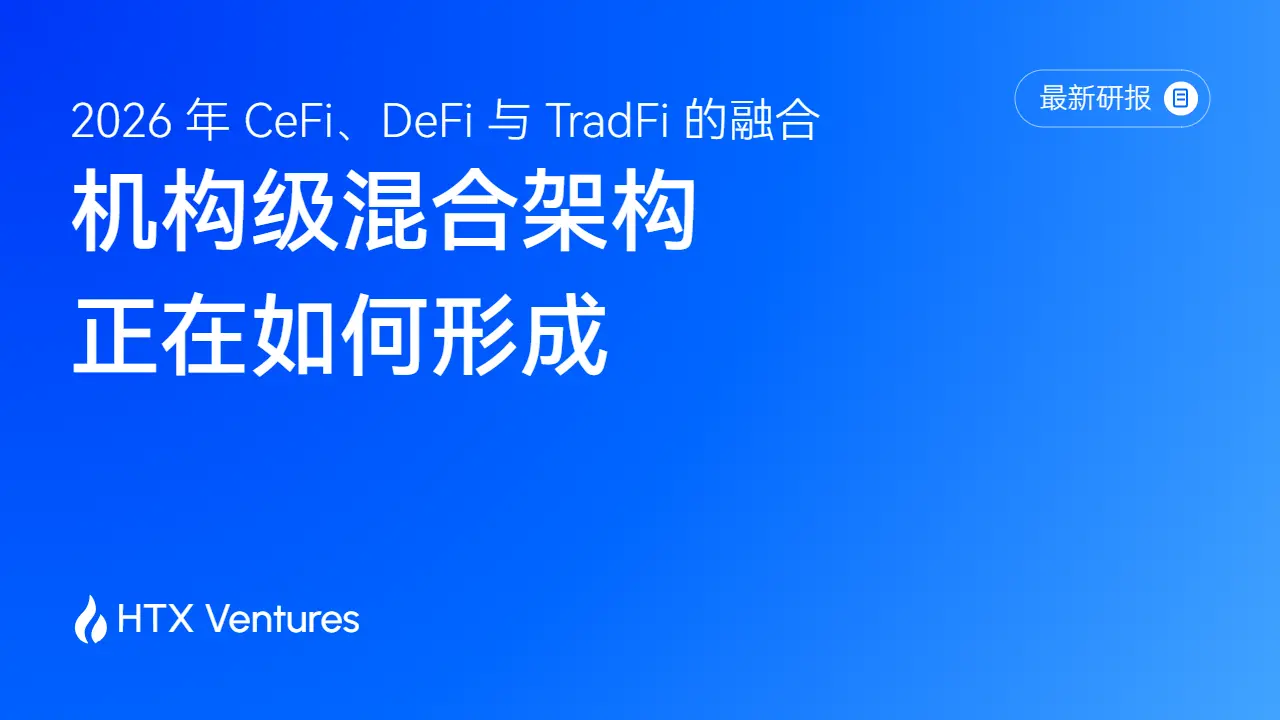
 Huobi HTX Global Investment Department HTX Ventures released the latest research report "The Integration of CeFi, DeFi, and TradFi in 2026: How Institutional-Level Hybrid Architecture is Being Formed."
Recently, HTX Ventures, the global investment department of Huobi HTX, released a new research report titled "The Integration of CeFi, DeFi, and TradFi in 2026: How Institutional-Level Hybrid Architecture is Forming." The report suggests that over the past few years, these three systems have completed institutionalization along their respective product lines: exchanges have developed institutional custody and prime brokerage services, DeFi protocols have introduced professional risk managers and Vault structures, and traditional financial institutions have continued to promote the tokenization of funds and government bonds. As we enter 2026, layers such as custody, collateral, execution, yield, and risk management are being split and specialized, with professional institutions from the three systems collaborating in a modular fashion.
Is the management of digital assets pointing to a longer-term market structural change? HTX Ventures believes that the changes on the demand side are structural, and the capabilities on the supply side are already in place. However, whether this architecture can be sustained depends on two conditions: whether short-term interest rates can cover intermediary costs and whether the framework for loss liability can be clarified.
Tokenized Funds Begin to Enter the Exchange Margin System
Institutions trading on exchanges need to pre-fund margin, which typically does not generate income while the funds are occupied. According to CryptoQuant data, in July 2026, the stablecoin reserves of centralized exchanges were approximately $61.8 billion. Based on a yield of 3.86% for 3-month U.S. Treasury bonds as of September 1, the annual interest income forgone by the entire industry is about $2.39 billion. In an era of near-zero interest rates, this opportunity cost can be ignored; however, as interest rates rise, it begins to be taken seriously by institutions.
Franklin Templeton's collaboration with leading exchanges on over-the-counter collateral is a representative case responding to this demand. Qualified institutional clients can use tokenized money market fund shares, BENJI, as trading margin: the shares are held by a third-party custodian, and the exchange records their mirrored value on a risk control ledger, while positions continue to transact on the exchange's matching engine, and fund shares continue to generate Treasury yields during the pledge period.
HTX Ventures believes this means that one of the largest markets for RWA in the future may be the collateral layer within the digital asset financial system. The turnover rate of tokenized government bonds and money market funds has been very low. According to rwa.xyz data, as of September 9, 2026, the total on-chain value of BENJI was approximately $687 million, with a monthly transfer amount of only about $18.17 million. If the primary use of such assets is to serve as collateral, the metric for measuring its success should shift to how many trading venues are willing to accept it as margin.
DeFi Yields Access Institutional Accounts Through Custodians and Trading Platforms
In the past, institutions wanting exposure to DeFi yields had to establish wallets, manage signature permissions, and choose protocols themselves, with operational complexity and internal risk control approvals being major obstacles. In the first half of 2026, this pathway was rewritten: Fireblocks embedded Aave and Morpho into its platform for over 2,400 institutional clients, while BitGo opened Aave, Spark, and Tesseract through the Narval gateway and collaborated with Morpho to launch an institutional Vault. On the trading platform side, some exchanges' lending products are backed by Morpho, which went live in early 2025 and had cumulatively lent about $2.3 billion by mid-May 2026. Institutions complete configurations on a familiar front end, while borrowing and yield generation occur in the background on the on-chain protocol.
After the access expansion, decisions on where to place funds in the lending market and how much exposure to take are made by professional risk managers such as Galaxy, Sentora, Steakhouse, and Gauntlet. According to DefiLlama statistics, this sector currently manages about $9.26 billion in funds. The report constructs a schematic model based on this: with a base yield of 3.86%, every $100 generates a yield pool of 386 basis points annually, with custodians, mirrored settlements, Vault infrastructure, lending protocols, and risk managers collectively taking about 100 basis points. Among them, risk managers estimate about 58 basis points based on a 15% performance fee, accounting for more than half of the intermediary layer's yield, but they do not bear custody responsibilities or provide capital compensation for losses. If short-term interest rates drop to 2.00%, the same fee structure would consume about 37.5% of total yields.
New Divisions Still Need to Be Tested by Loss Events
While the division of labor is theoretically clear, actual responsibility will only become evident during stress events. In November 2025, an external fund manager at Stream Finance caused a loss of about $93 million, with its interest-bearing stablecoin xUSD dropping approximately 77% within 24 hours. Due to xUSD being cyclically collateralized across multiple lending markets, this loss ultimately evolved into a cross-protocol debt exposure of about $285 million, while some markets hard-coded the oracle price of xUSD at $1, failing to trigger liquidation when it truly decoupled. In April 2026, the KelpDAO cross-chain bridge was attacked, with about $292 million of unsupported rsETH deposited into Aave to borrow real assets. Aave's own contracts had no vulnerabilities, yet $8.45 billion in deposits flowed out within 48 hours.
Both incidents exposed the same set of issues. There is a lack of buffers such as clearinghouses and settlement cycles on-chain; a single oracle misconfiguration can transmit losses across multiple protocols within hours; the parties collecting performance fees and those ultimately bearing the losses are not aligned, with protocol parties, risk managers, and custodians each able to find reasons to avoid responsibility.
The Three Systems are Piecing Together an Institutional Stack
HTX Ventures believes that if the above trends continue, the institutional digital asset market will gradually form a unified institutional-level stack: tokenized government bonds, money market funds, stablecoins, and mainstream crypto assets will enter a unified collateral management layer through qualified custodians, and then be deployed to exchanges, OTC desks, and DeFi lending markets based on demand, with risk managers, oracles, compliance, and monitoring integrated throughout the process. The restructuring of the architecture changes the transmission path of risks and the entities bearing losses, but the total amount of risk does not decrease as a result.
The report provides three indicators to observe in the next two quarters: whether the scale of risk managers can recover after the next major loss event, whether there are cases of the same tokenized collateral being accepted by more than two trading venues simultaneously, and whether the addition of new institutional clients for OTC collateral slows down when the 3-month Treasury yield falls below 3.00%. As a long-term research institution focused on institutional digital asset infrastructure, HTX Ventures will continue to track these indicators, using real data to verify and update its judgment on this round of integration.
About HTX Ventures
HTX Ventures is the global investment department of Huobi HTX, integrating investment, incubation, and research to identify the best and brightest teams worldwide. As an industry pioneer, HTX Ventures has over 11 years of blockchain construction experience and excels at identifying cutting-edge technologies and emerging business models in the field. To drive growth within the blockchain ecosystem, we provide comprehensive support for projects, including financing, resources, and strategic advice.
HTX Ventures currently supports over 300 projects across various blockchain sectors, with some high-quality projects already trading on Huobi HTX. Additionally, as one of the most active FOF funds, HTX Ventures invests in 30 top funds globally and collaborates with leading blockchain funds such as Polychain, Dragonfly, Bankless, Gitcoin, Figment, Nomad, Animoca, and Hack VC to build the blockchain ecosystem together. Visit us.
 Risk warning



Popular articles





