In less than two months since its launch, Robinhood Chain has set multiple record-breaking metrics
 Core Viewpoint

 The differentiated approach of Robinhood Chain: Stock memes are activating RWA liquidity.
Author: Nancy, PANews
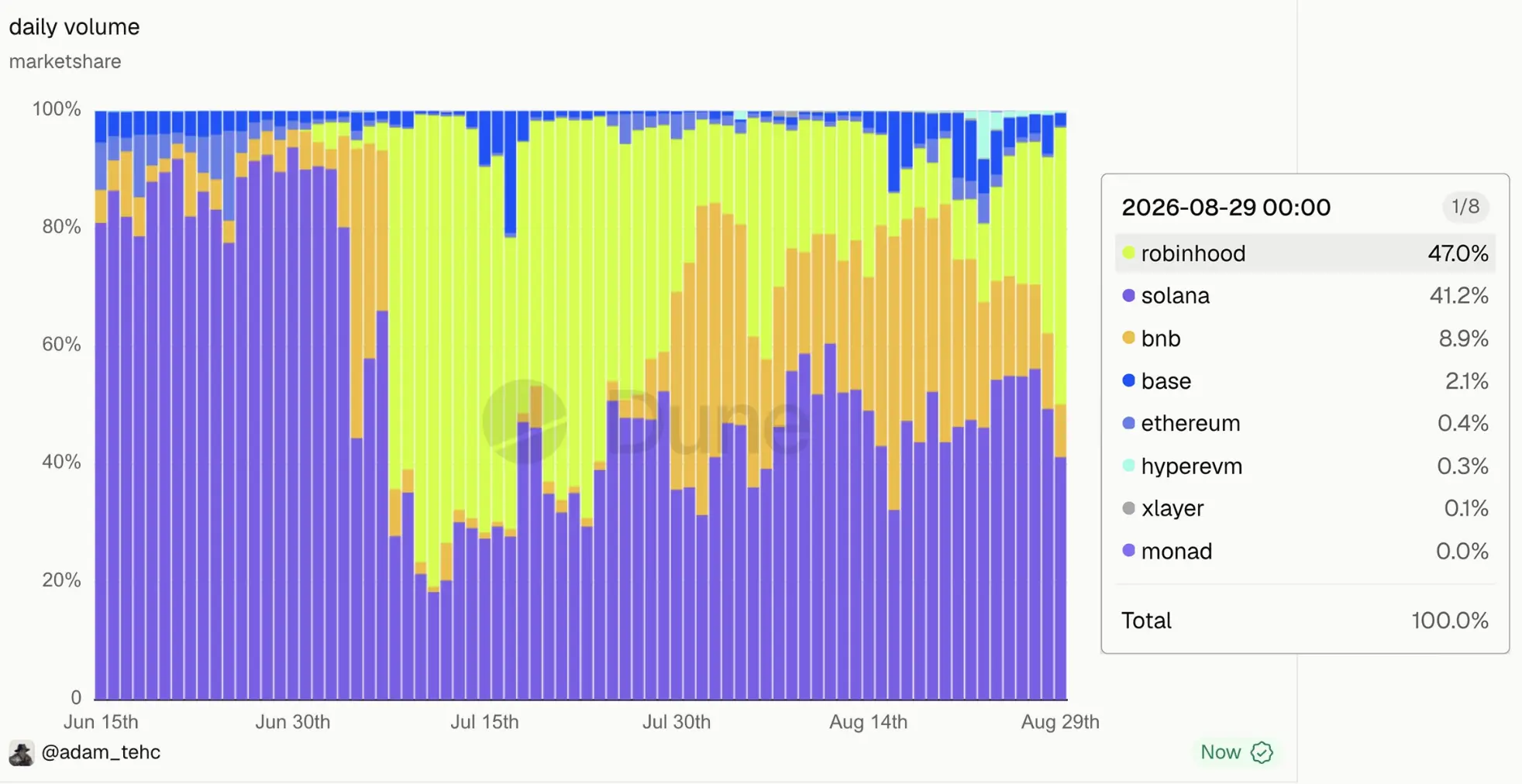
Last weekend, Robinhood Chain, which has been online for less than two months, experienced another peak of on-chain activity. Trading volume, active users, and several other core metrics have set new records, and protocol revenue has also significantly increased, surpassing many earlier L2s.
Such growth speed and sustainability are uncommon for a network still in its early stages. Behind Robinhood Chain's rapid accumulation of massive traffic in a short time, funds, users, and assets are flowing into the same chain through different entry points.
Launchpad Creates New Assets, Pons Becomes a Traffic Magnet
The earliest traffic entry point for Robinhood Chain was the Launchpad, which continuously generates trading demand by issuing new assets, allowing funds and liquidity to remain within the ecosystem. Currently, in the ongoing Launchpad battle, Pons is becoming the most watched player.
On one hand, Pons' on-chain data continues to reach new highs, becoming one of the main trading traffic entry points for Robinhood Chain, constantly capturing market attention.
According to Dune data, the latest daily token deployment for Pons exceeded 22,000, setting a new high since its launch, accounting for 67.8% of the daily token deployment on Robinhood Chain; daily trading volume exceeded $308 million, also breaking historical records, accounting for over 78.2% of the total chain trading volume. During the same period, the number of active wallets for Pons reached 115,000, more than six times that of the second-place Pools.
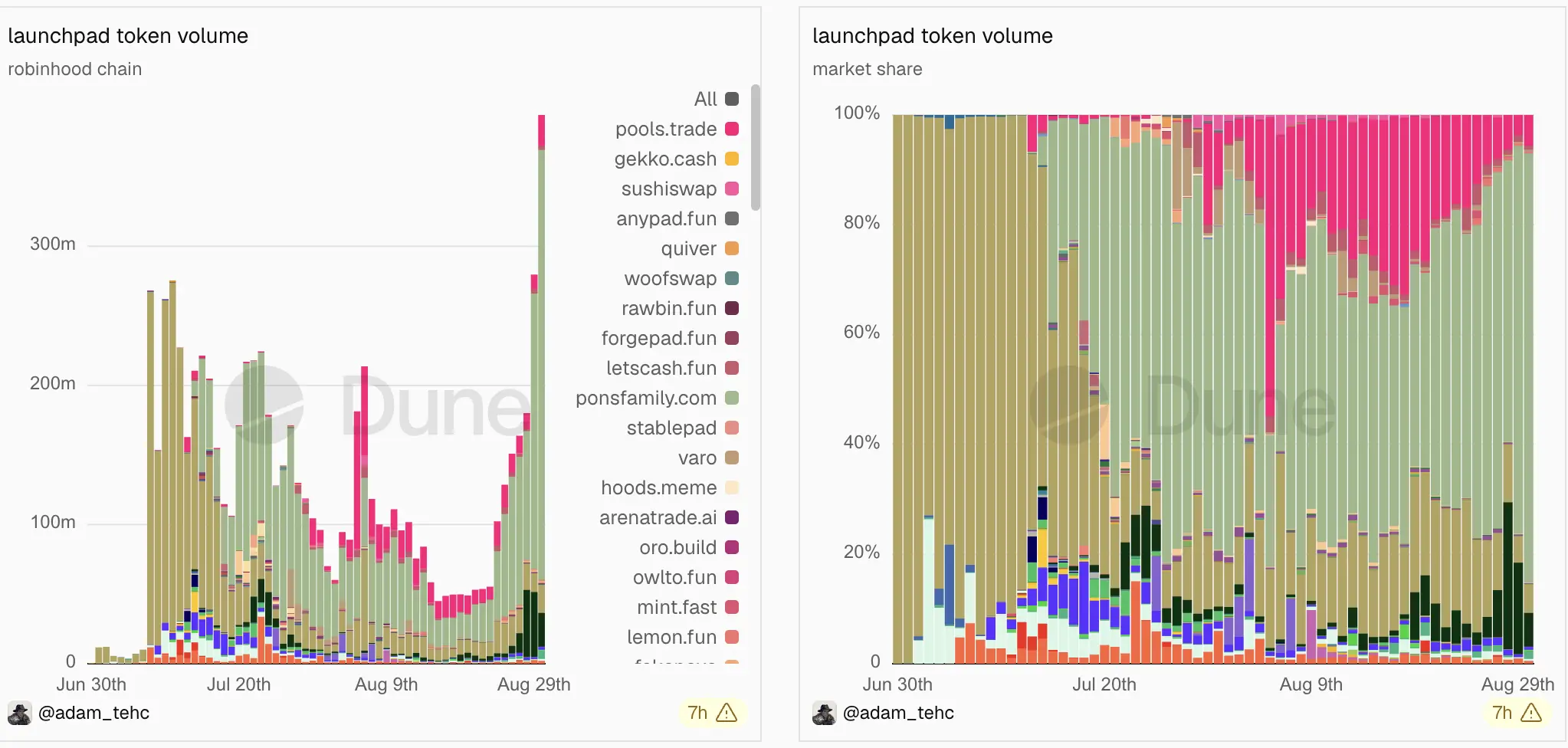
Moreover, Pons is further consolidating its ecological position through creator incentives. The platform allocates 70% of transaction fees to token creators to enhance the earnings expectations of issuers and stimulate more token issuance activities. Official data shows that in the past 47 days, Pons has paid approximately $20.93 million to token creators.
On the other hand, as trading traffic continues to flow to Pons, the fees captured by the platform are also continuously increasing, and through a buyback and burn mechanism, it feeds back into the PONS token, becoming a growth flywheel.
According to Pons' publicly disclosed economic mechanism, 80% of protocol revenue will be continuously used to buy back PONS through a TWAP mechanism and permanently destroy them. DeFillama data shows that Pons' cumulative revenue has exceeded $10.14 million, with daily revenue once surpassing $1 million, currently making it the second-highest revenue protocol on Robinhood Chain.
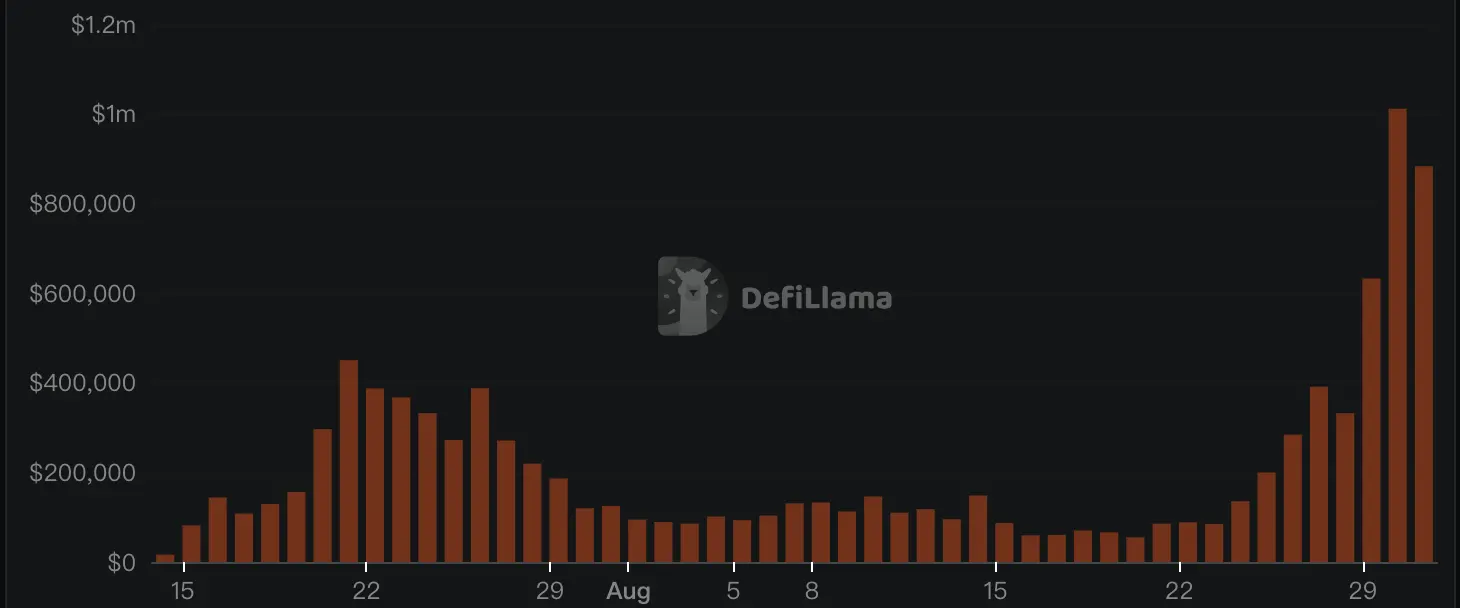
As protocol revenue continues to grow, the scale of PONS buybacks and destruction is also expanding. As of now, the officially disclosed cumulative destruction amount accounts for approximately 29% of its total supply.
This mechanism is beginning to change the market's pricing logic for the platform token PONS. Especially compared to the leading Launchpad in the Meme track, Pump.fun, Pons demonstrates stronger value capture capabilities in terms of protocol revenue buyback ratio, token destruction, and recent revenue growth. With PUMP already having a high market value, PONS' relatively low valuation leaves the market with greater imagination.
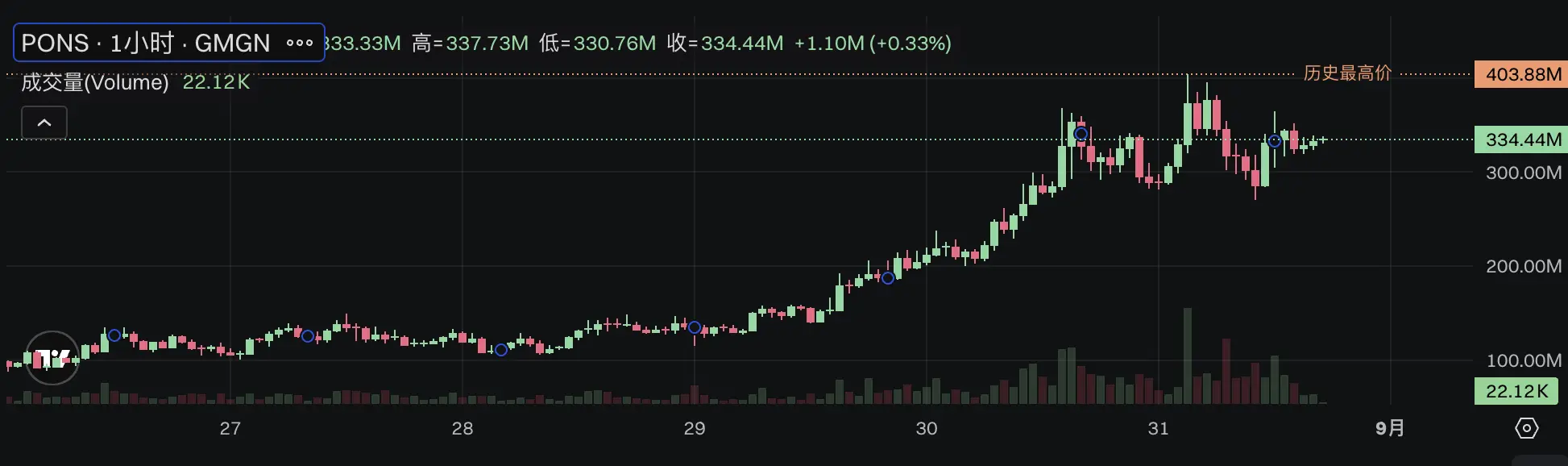
The PONS token has begun to rise continuously in recent times. GMGN data shows that PONS' market value has skyrocketed from less than $30 million a week ago, peaking at over $400 million, making it the highest-valued token on Robinhood Chain.
It can be said that Pons has become a major entry point for continuously producing new assets on Robinhood Chain.
Trading Terminal Opens Incremental Growth, Fomo Expands User Boundaries
If the Launchpad is responsible for creating assets and early liquidity, then the trading terminal is responsible for the trading demand generated by these assets.
Currently, the trading terminal on Robinhood Chain contributes nearly half of the total trading volume across the network. Dune data shows that the daily trading volume of the trading terminal accounts for 47% of the entire network, with a daily trading amount of approximately $280 million and over 110,000 daily active wallets, all setting new highs since its launch.
Among them, Fomo is one of the fastest-growing products. After the mainnet launch of Robinhood Chain, Fomo quickly became an important trading entry point on the chain. The Fomo team disclosed that on Robinhood Chain, one in every two active wallets comes from Fomo. Some popular token trading addresses often see Fomo users appearing at the top of the profit rankings.
Fomo attempts to transform complex on-chain trading into an experience closer to a social app, allowing users to swipe tokens, view trades, copy trades, and complete transactions directly in the information stream. This design lowers the participation threshold for on-chain trading and gives trading itself a stronger social attribute.
Moreover, the higher yield cases on the platform further enhance user attraction. According to Fomo's official disclosure, as of now, there have been 26 traders on the platform who have achieved profits exceeding $1 million, with 25 users on the profit leaderboard in the past 30 days achieving over $1 million in profits. Meanwhile, according to @0xAvast's analysis, in the past 30 days, only one wallet in the Pump application achieved over $1 million in PNL (unrealized profit); whereas on Fomo, users need to achieve over $1 million in PNL to enter the top 30 on the profit leaderboard.
From the user structure perspective, Fomo's significance lies not only in contributing trading volume but also in broadening the user boundaries of Robinhood Chain.
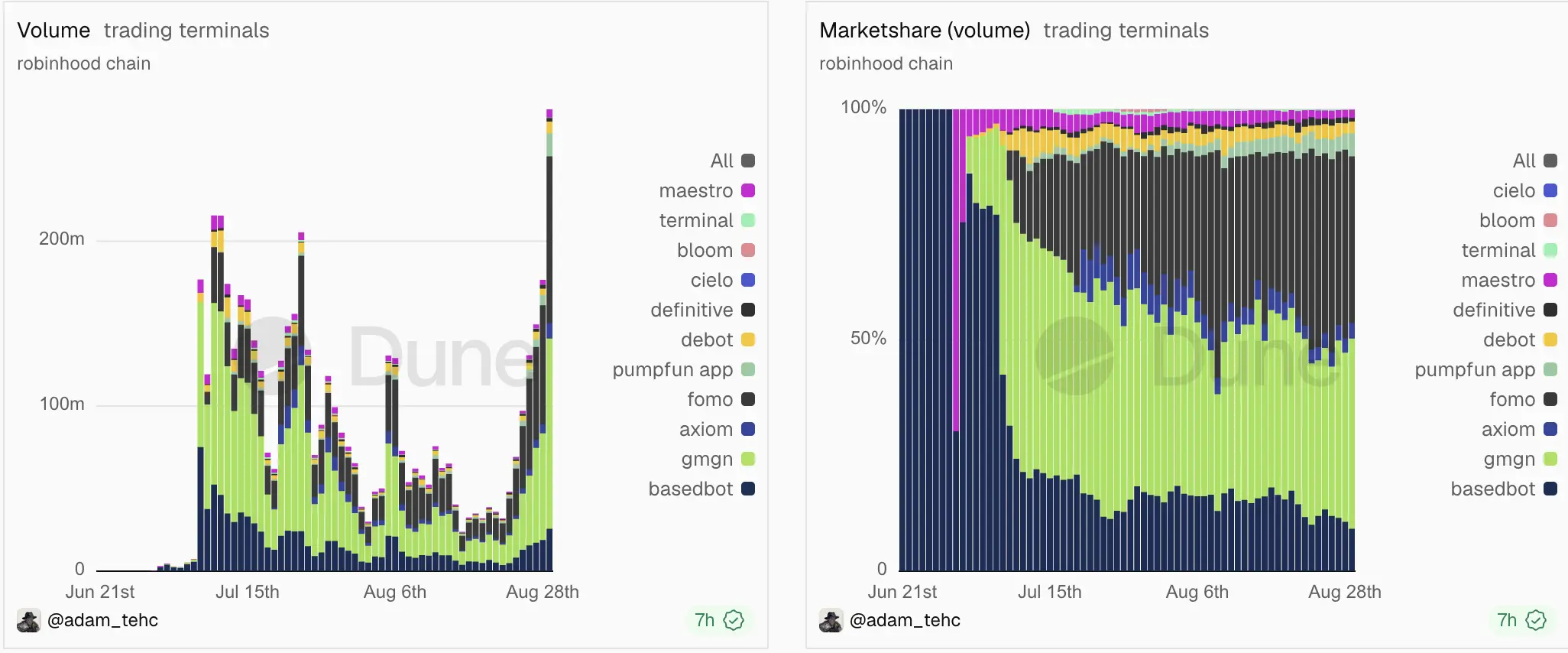
In terms of trading scale, Dune data shows that GMGN's latest daily trading volume on Robinhood Chain reached $1.115 billion, accounting for 41.2% of the entire network, ranking first; Fomo's daily trading volume is approximately $101 million, accounting for about 36%.
If we only look at trading amounts, GMGN is clearly larger. However, further breaking down the number of addresses reveals that the user profiles of the two are quite different. GMGN has approximately 17,700 daily active addresses, corresponding to an average daily trading amount of about $62,800 per address, mainly consisting of professional traders, high-frequency traders, and users with larger capital volumes. In contrast, Fomo has over 64,000 daily active addresses, but the average daily trading amount per address is only about $1,565, less than a fraction of GMGN, indicating a broader coverage of ordinary users.
However, Fomo CEO Se Yong recently revealed that the existing on-chain data may underestimate the platform's actual scale by about 20% to 40%, due to the significant difficulty of simultaneously collecting data from 6 to 7 chains. Moreover, Fomo adds about 40,000 new users daily from the App Store. He believes that this scale is unlikely to come entirely from existing crypto users, so a considerable portion may be new users who were previously inactive in the crypto market.
For Robinhood Chain, Fomo brings not just trading volume, but further expands on-chain trading from professional traders to a broader base of ordinary users.
Wealth Effect Diffusion, Token Listing Expectations Amplify Capital Games
For an early public chain, the wealth effect is often the best calling card, making it easier to attract funds and users to continue flowing in.
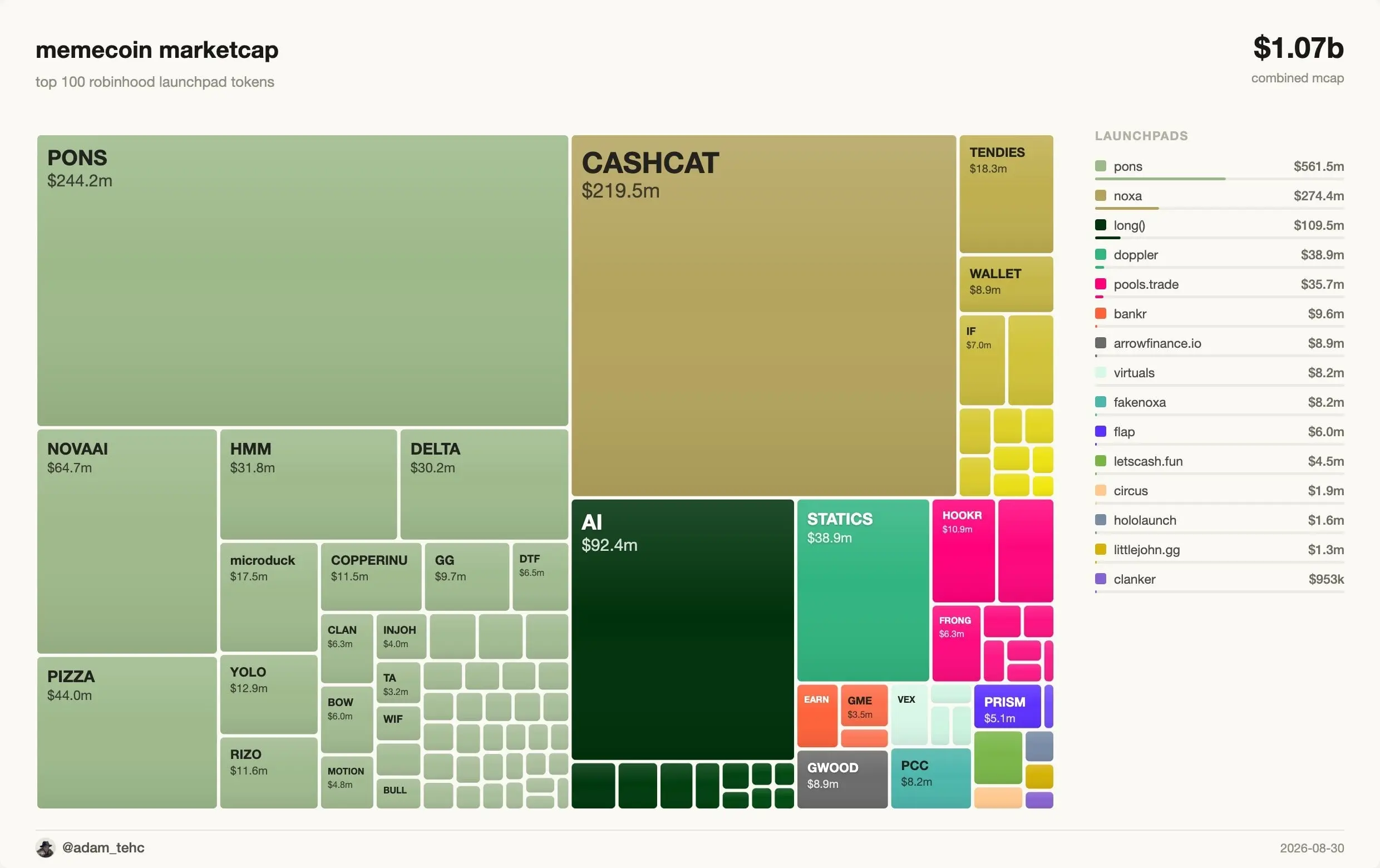
In recent days, tokens such as PONS, AI, and NET on Robinhood Chain have continued to rise, with some assets even reaching historical highs. Dune data shows that the total market value of the top 100 tokens on Robinhood Launchpad has surpassed $1 billion, rising 123% in the past 6 days.
There have already been several high-yield cases on-chain. For example, according to on-chain analyst @ai_9684xtpa, one address bought PONS at a low point 46 days ago, investing only $115,000, and is currently up over $2.82 million, with a return rate of 2456.6%. The address that cleared its CASHCAT position made a profit of about $598,000.
Moreover, KOL holdings further amplify market attention. For instance, crypto KOL Bonkguy previously spent 67,304 USDG to buy 10.96 million PONS, and has not sold yet, with the holding value approaching $3.8 million; Ansem invested approximately $57,600 to buy NET from the DeFi protocol NetNet Capital and over $21,000 in the Artificial In token AI; him accepted about 40% of the token allocation from the community token COPPERINU and emulated ANSEM's token strategy, manually airdropping to the community, quickly boosting the market value.
Market expectations for token listings on Robinhood are continuously raising the attention on on-chain tokens. After Robinhood listed CASHCAT, the token's market value surged significantly. For the market, once a token gains Robinhood's attention or even lists on its trading platform, it may attract greater user traffic, trading entry points, and brand exposure, enticing funds to bet in advance. This is consistent with previous market expectations for MEME listings on Binance from the BSC chain.
Stock Meme Enters Liquidity Pools, RWA Becomes Programmable Building Blocks
Stock Meme is becoming a new differentiated play for Robinhood Chain, also opening new liquidity entry points for tokenized stocks. Currently, related tokens such as CASHCAT, STONKBROKER, INDEX, and microduck on Robinhood Chain have gained some market attention, and some leading assets have already reached a high market value.
Unlike traditional Meme coins that mainly rely on narratives, community sentiment, and capital games, some stock Memes are beginning to attempt to combine Meme assets with tokenized stocks, introducing new on-chain traffic for stock tokens that originally lacked use cases.
Crypto analyst Qinbafrank pointed out that on Robinhood Chain, there are already plays that use stock tokens and Meme coins to form LP pools. Trading these Memes directly generates trading volume for stock tokens while locking some stock tokens into LP pools, which is one of the reasons why the trading volume of tokenized US stocks on Robinhood Chain later surpassed some competing products on Solana.
It is worth noting that Robinhood has not made "using stocks to create Memes" an official product. Robinhood CEO Vlad Tenev previously mentioned in a podcast that developers created liquidity pools that the team initially did not anticipate, combining Memes, crypto assets, and stock tokens, with Memes becoming the entry point that directs users to real stock tokens, a development that even exceeded the company's expectations.
From this perspective, this can be seen as a natural result of permissionless deployment on-chain. Qinbafrank believes its significance mainly lies in several aspects:
First, RWA has finally found a usable cold start. Previously, the use cases for stocks on-chain were limited; now, Memes first attract users, fees, and attention, and then feed back trading volume to stock tokens.
Second, stock tokens are beginning to truly become "programmable building blocks." In the past, tokenized stocks mostly stayed at the level of "can be bought and sold, can be viewed," but now more on-chain combinations are emerging, and in the future, they can also be combined with lending, indices, Agents, and other products. The industry is shifting from "putting stocks on-chain for exhibition" to "using stocks as DeFi primitives." This is the direction that tokenization should truly take: combinable, rather than just creating another on-chain brokerage page.
Third, the paired assets for on-chain liquidity are becoming more diverse. In the future, the quoted assets for Memes may not only be ETH, SOL, BNB, or stablecoins; stocks, government bonds, gold, and other real-world assets may also become new liquidity pairing assets.
More importantly, the boundaries between the crypto and stock markets are being blurred. What it truly stimulates may not be TVL, but user mindset. Users can now first encounter the high-volatility speculation of crypto-native assets and the traditional pricing anchor of US stocks in the same pool, connecting speculative traffic with real financial assets. This will also reinforce a trend: high-quality financial assets will continue to be broken down into tokens, repriced, redistributed, and recombined on-chain.
He pointed out that Robinhood Chain also provides a reference sample for other traditional finance: when TradFi goes on-chain, it doesn't necessarily have to start as a serious financial special zone. First, let the chain come alive, then embed its assets into existing speculation and DeFi behaviors, which may be faster than "first compliance, then waiting for people to come."
From this perspective, it is not difficult to understand why Robinhood Chain's recent popularity continues to rise. Continuous token issuance creates new assets, trading continues to bring traffic, the wealth effect attracts more funds, and RWA provides new asset combination methods. These plays allow more users and funds to enter Robinhood Chain, gradually forming a growth flywheel.
 Risk warning


Popular articles