The founder clashed over the weekend, what is Solana anxious about?
 Core Viewpoint

 In the current mainstream narrative, it seems impossible to find a closed loop that can directly increase the value of SOL.
Author: Zhou, ChainCatcher
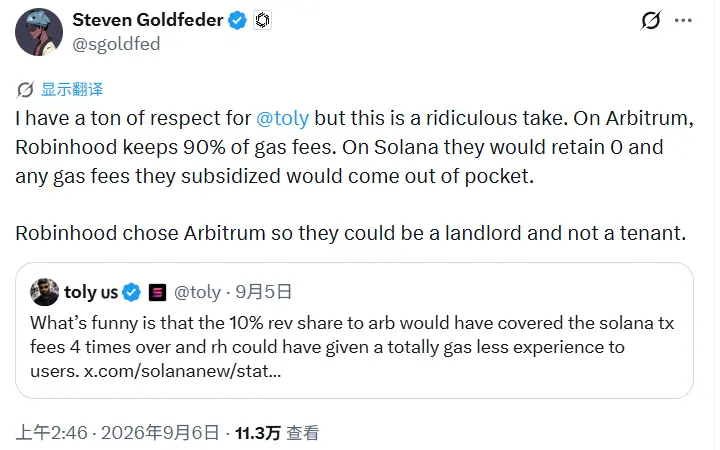
Last weekend, Arbitrum co-founder Steven Goldfeder clashed with Solana co-founder Toly over the fee model of Robinhood Chain, arguing about whether a 10% share should be collected, and whether the fees charged by the sequencer count as a disguised MEV protection fee.
This debate occurred against the backdrop of Robinhood Chain's daily transaction fees soaring to $6 million, with infrastructure tokens like HOOD, ARB, and UNI all experiencing significant increases. Toly initiated the debate, expressing some dissatisfaction that is difficult to explain solely through a technical dispute; it seems more like an outward expression of his own anxiety.
Many KOLs lamented that Solana's biggest loss in this round is the lack of its own top exchange, leaving it in a somewhat awkward position.
Setting aside who is right or wrong in this argument, is there still a solid reason for holders and potential investors to be bullish on Solana?
Why Did Robinhood Chain Choose Arbitrum? How Is This Calculated?
According to market news, Robinhood evaluated both Solana and Arbitrum during the project initiation phase and ultimately chose Arbitrum, which allows for independent chain deployment.
Under the Arbitrum architecture, Robinhood can retain about 90% of the Gas revenue; if it were on Solana, the retention rate would be 0, and it would have to cover the Gas fees itself.
According to Arbitrum's official AEP terms, the Orbit chain needs to transfer 10% of its net protocol revenue to the Arbitrum Foundation, with 8% going to the DAO treasury and 2% to the developer guild, and there are no automatic dividends, buybacks, or cash distributions to ARB holders. Arbitrum co-founder Steven Goldfeder summarized this choice in one sentence: be a landlord, not a tenant.
Solana co-founder Toly questioned the landlord model's cost-effectiveness, stating on X that the 10% taken from Robinhood's fees by Arbitrum, by his estimation, is enough to cover four times the total transaction fees across the Solana network. If Robinhood were deployed on Solana, it could achieve an almost zero Gas fee experience, and revenue could still be collected at the application front end, with reference numbers suggesting a fee collection of 50 to 80 basis points.
According to data from Blockworks, the average transaction fee on Robinhood Chain once surged to $0.40, over 100 times that of Solana and more than double that of Ethereum. Toly believes that relying on network congestion for fees is not a healthy business model.
On September 6, Steven posted that one cannot only compare surface-level fees; Arbitrum One and Robinhood Chain actively prevent front-running and most harmful MEV. Some chains that claim low fees actually impose higher costs on retail investors due to front-running and sandwich attacks. He would rather pay a clear fee upfront than incur hidden losses for lower apparent fees.
Toly responded that Arbitrum's current bid-ask spread is worse, and fees are higher. The 10% share taken from fees, when converted into basis points, has already exceeded ten times the loss rate from sandwich attacks, not accounting for the impact of the spread.
This MEV debate has also drawn technical skepticism from peers. Curve Finance founder Michael Egorov believes that front-running protection should not be a problem for the infrastructure layer to solve. Toly responded that competition is the only way to ensure that infrastructure provides the service quality that applications truly need while reducing the unwanted portion of MEV.
Meme Token Strategies Being Replicated
After the launch of a platform called Pons on Robinhood Chain, many compared it to Pump.fun on Solana.
According to public data, Pons token has increased over 20 times in the past month, with daily meme coin trading volume in September already exceeding Pump.fun, reaching about $500 million.
Recently, the trend of pairing memes with stocks has become even hotter. Long.xyz, launched on Robinhood Chain on July 14, facilitates trading between community tokens and stock ticker tokens, such as AI/NVDA, SPACEHOOD/SPCX, BONER/HIMS. It does not have its own platform token, and holding paired community tokens does not represent equity in the corresponding companies.
Following this, Bankr emerged as an AI-driven token creation platform, supporting over 90 stock and ETF tickers as pricing assets, such as LEVE/AAPL and SPX690/SPY. Its own token BNKR launched with only $50,000 in liquidity, serving as a proof of concept for this model.
There are also similar products on BSC called Flap, which similarly bind meme coins to stock tickers and distribute stock-related rewards to holders.
On the Solana side, the corresponding product is StonkFun, also known as LaunchOnSF, which allows users to create tokens paired with other assets, including tokenized stocks and ETFs, such as STONK paired with the tokenized product SPYx that tracks the S&P 500 index.
On September 4, the official Solana X account responded to a StonkFun post, expressing support for the Stonk token. The market cap of STONK rose to about $140 million that day, with a 24-hour increase of over 250%. However, the fee revenue from the StonkFun platform over the past 30 days was only $1.23 million, less than Pons' daily revenue.
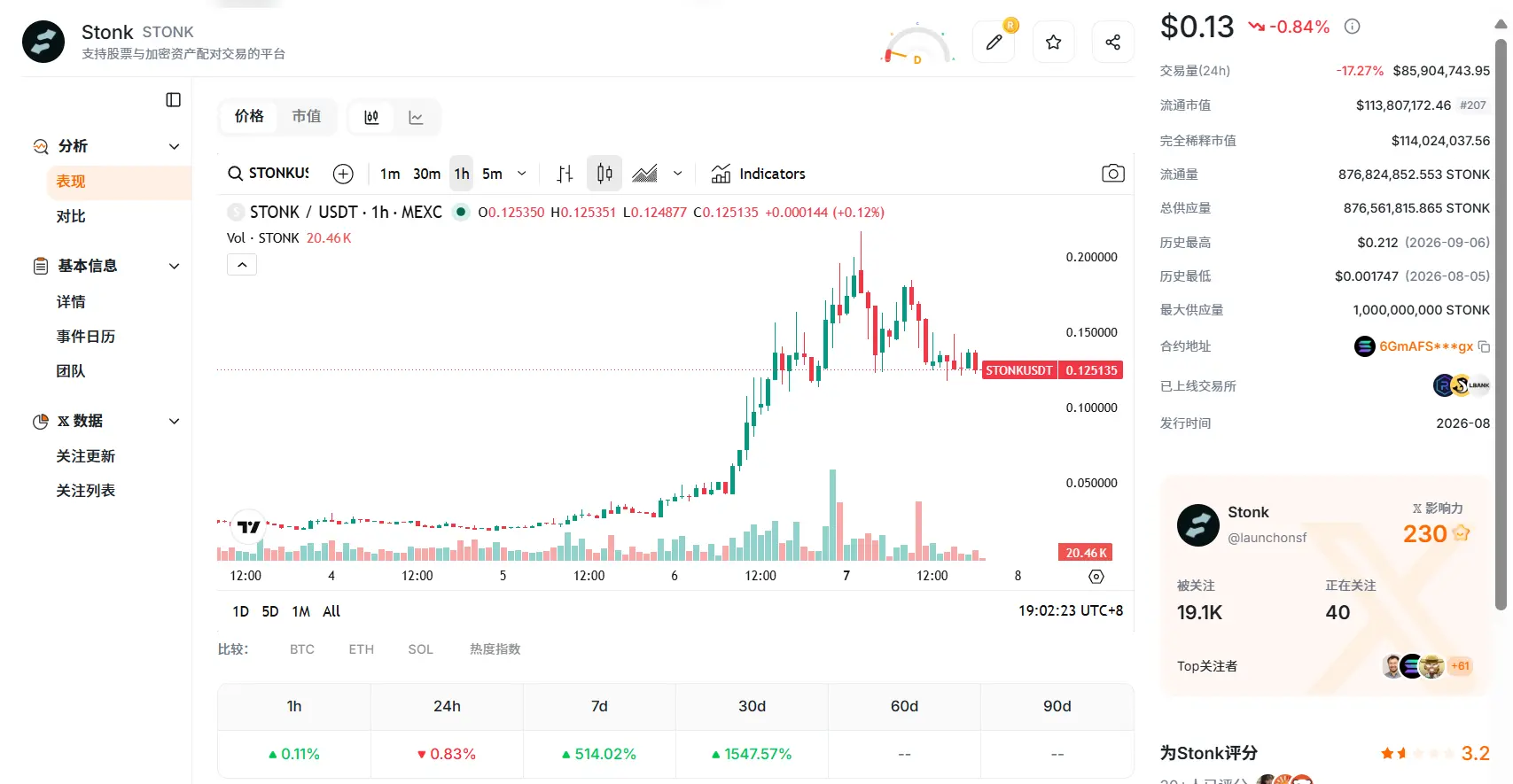
Market analysis indicates that ordinary meme and USD token pairings have become difficult to attract speculative funds; only narratives and stock ticker pairings can re-attract this group of users. If Pump.fun does not follow up on this feature, StonkFun's current leading position may be hard to maintain.
Crypto KOL Haotian believes that Solana's advantages lie in capital efficiency and high load capacity. New platforms like pump, gmgn, and fomo are essentially new entry points for Solana. The lack of a top exchange at the exit end is not a critical issue because when a market cycle reaches the point where it relies solely on CEX for realization, the market itself is often nearing its end.
He believes that the real capital amplifiers in this round are new super entry points like fomo, pump, and Robinhood Wallet. For a CEX to become an entry point, it must have the ability to absorb the fermentation of on-chain narratives, which Base and BSC have already validated over an entire cycle; new narrative fermentation always occurs on-chain.
Some users argue that rather than saying Solana lacks its own exchange, it is more accurate to say that Solana will ultimately become a place where various exchanges compete for traffic.
Stablecoins, Payments, Prediction Markets, Are Key Links Missing?
The replication of meme strategies is just a superficial phenomenon. A deeper issue is that public chains like Robinhood Chain, built by giants themselves, are gradually reclaiming the segments that originally relied on Solana.
Public information shows that Circle's own public chain Arc is scheduled to launch on the mainnet on September 16. When USDC is settled on Ethereum or Solana, the fees flow to the validators and seekers of those chains, and Circle itself does not receive this portion of revenue. Once Arc is live, USDC will become a native Gas token, allowing this revenue to go to Circle's own accounts.
Currently, Arc has secured founding validators from institutions like Blackstone, DTCC, and Visa, raising $222 million with a valuation of $3 billion.
Robinhood is launching its own chain, and Circle is also launching its own chain. These giants are no longer satisfied with placing assets and traffic on other chains; they are choosing to reclaim the settlement layer for themselves.
From the perspective of several major crypto tracks, Solana does not lack products but lacks settlement, issuance, and entry points, which may still be in their own hands. This is also the more fundamental source of anxiety behind Toly's proactive initiation of the debate.
According to DefiLlama data, Solana's DEX trading volume in the past 24 hours was about $1.961 billion, with a cumulative total of about $65.028 billion over 30 days, ranking first among all chains, while Ethereum was about $837 million and Base about $567 million during the same period.
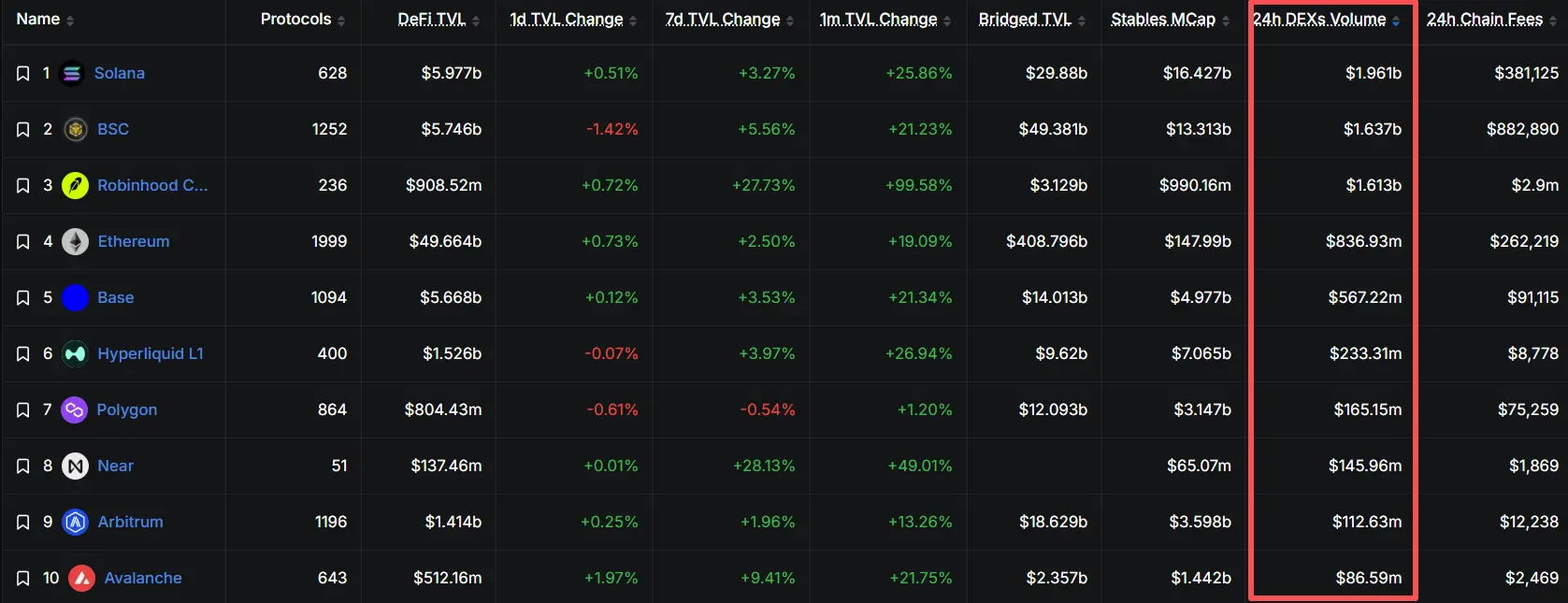
However, Robinhood Chain has only been online for two months, and its 24-hour DEX trading volume has already reached $1.613 billion, ranking third after Solana and BSC, with the gap to Solana narrowing significantly.
In terms of exchanges, Backpack, which has obtained a VARA license in Dubai, has stock tokens and perpetual products on Solana, but its scale is far from the levels of Binance, Robinhood, or Coinbase.
Robinhood Chain has already proven that retail investors are concentrated in brokerage apps, not on public chain websites. Solana cannot obtain sequencer revenue and cannot claim to own this group of users.
Crypto KOL Christine stated that the L2s that survive often rely on exchanges, and newcomers have learned the meme strategies from Solana, with stronger backgrounds.
In this round of popular tracks—valuation and narrative of prediction markets—there has not been a return to SOL. Polymarket is deployed on Polygon, and Kalshi is a licensed fiat platform. Solana's own product is Forecast, which launched on June 4, with its predecessor Jup Predict accumulating a trading volume of about 17 million USD, showing a significant scale gap. The derivatives protocol within the ecosystem, Drift, experienced a security incident of 285 million USD in April this year.
In terms of payments, Visa, PayPal, and Western Union are all using Solana for settlements. PayPal has designated Solana as the default network for PYUSD, citing faster settlements and lower fees, but currently, Ethereum still accounts for about 73.74% of the PYUSD supply, while Solana accounts for about 20.76%, and the identity of the default network has not yet translated into a leading position in terms of volume.
x402 was initially proposed by Coinbase and later governed by the Linux Foundation, with Solana being one of the connected chains; currently, there has been no separate revenue or burn returning to SOL.
In terms of stablecoin supply, USDC, USDT, and PYUSD are all running on the Solana chain, but the issuance rights lie with Circle, PayPal, and Western Union, with fees going to the issuers. According to Visa Onchain Analytics data, in July this year, the monthly settlement volume for Solana and Base was nearly tied, both around 286 billion USD. By August, Base's share surged to 29.67%, while Solana dropped to 7.05%, quickly falling behind in just one month.
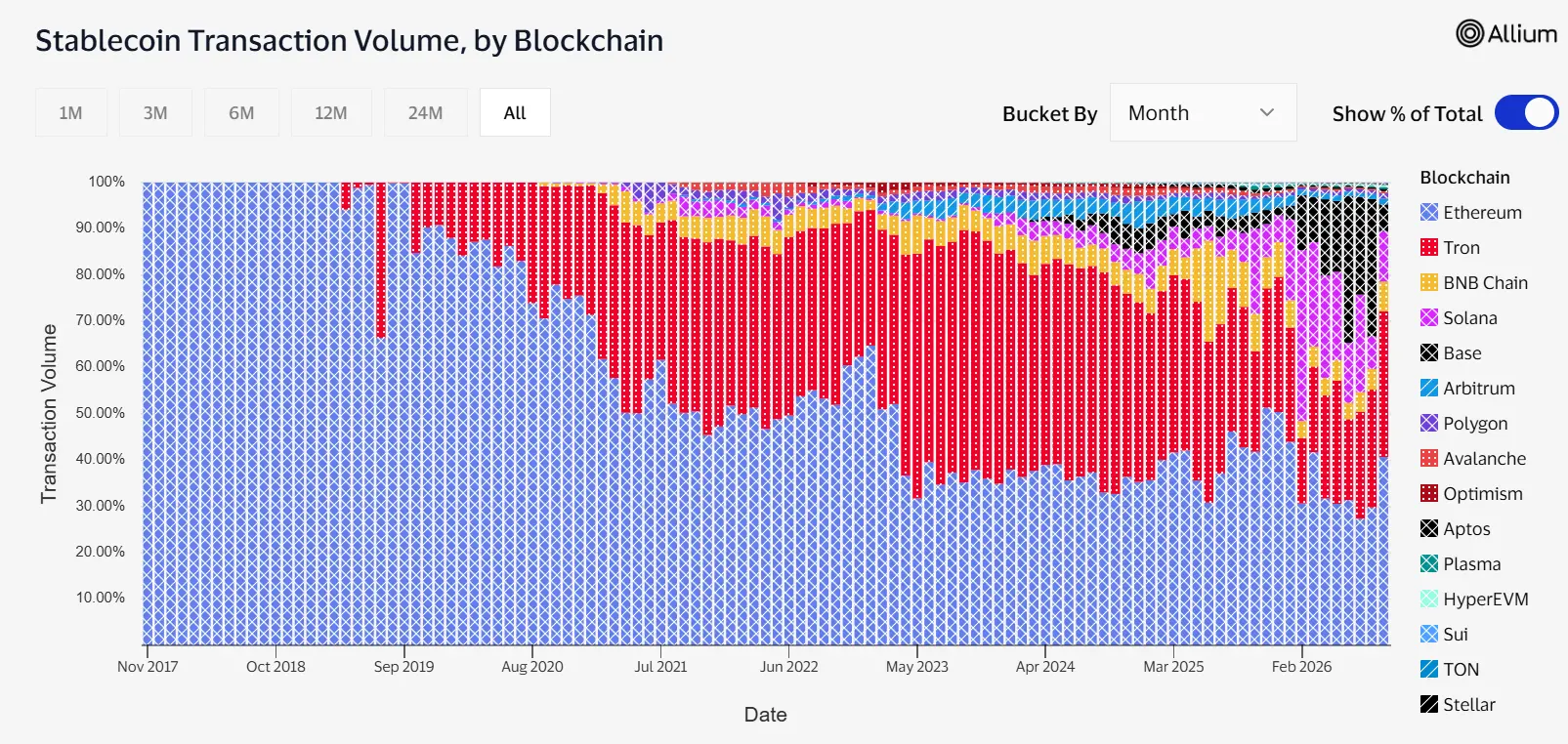
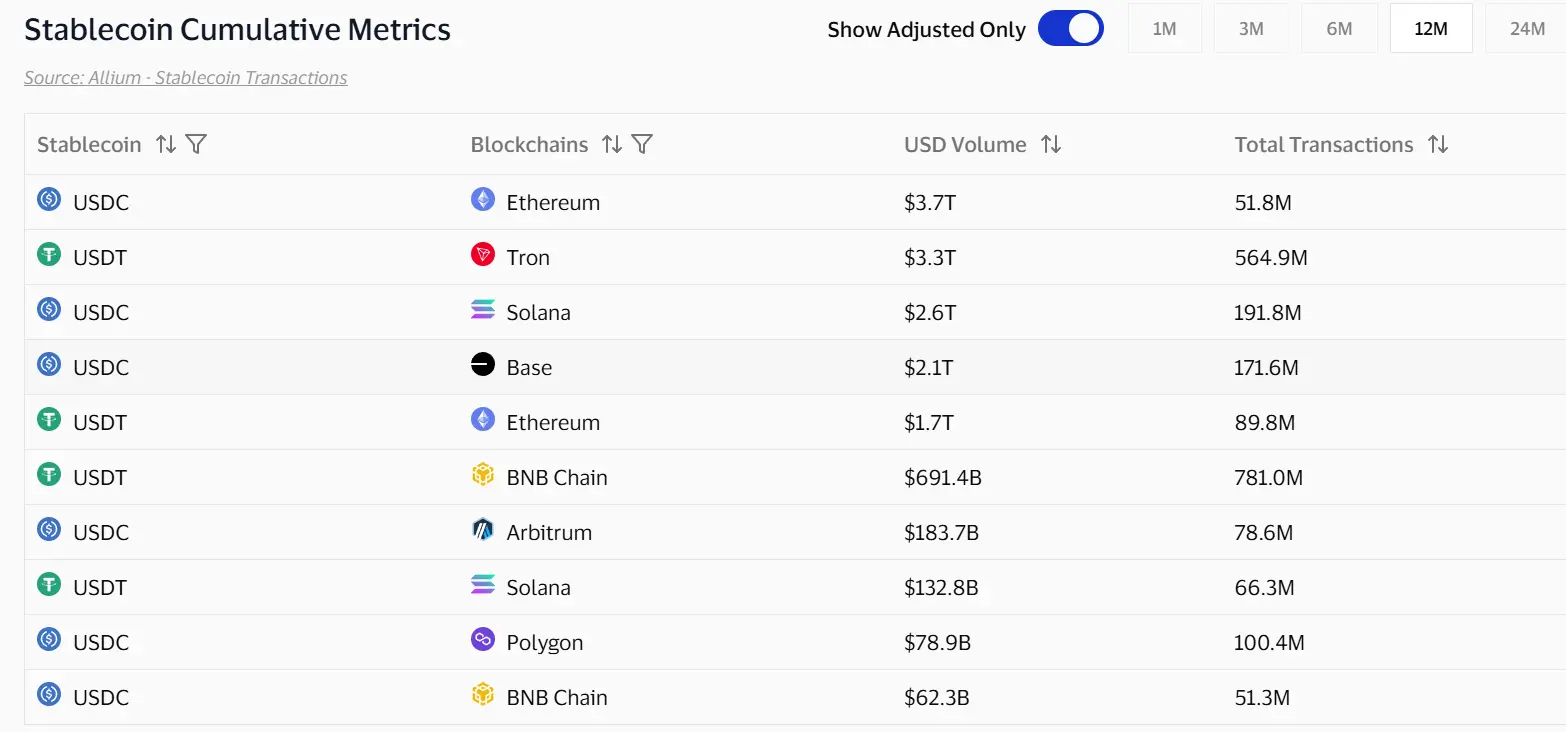
In terms of cumulative settlements, Solana's USDC cumulative settlement volume over the past 12 months still stands at 2.6 trillion USD, higher than Base's 2.1 trillion USD, but the momentum has reversed recently.
However, when counting the number of transactions, Solana had 47.29 million transactions in August, accounting for 20.43%, ranking third after BNB Chain and Tron, while Base only had 12.11 million transactions. The amount has fallen behind, but the number of transactions remains superior, indicating that Solana has more high-frequency small transfers, which have not translated into a share of settlement amounts.
Last week, Lily Liu, chair of the Solana Foundation, published an article stating that the internet capital market will become the largest capital market in the world. She mentioned integrating stablecoins, institutional asset migration, blockchain infrastructure, and AI as the narrative support for Solana that is worth holding long-term.
However, in comparison, despite the fact that most products on the Solana chain are complete, and DEX trading volume even leads, it still lacks issuance rights, settlement rights, and entry points. In the current popular narratives, it seems difficult to find a closed loop that can directly appreciate SOL.

 Risk warning



Popular articles