On the eve of the non-farm payrolls, Waller's speech shifted to a dovish tone, leading to a significant rise in technology growth stocks such as Tesla, SpaceX, and Oracle. Next week's CPI will be a key variable
 Looking ahead to next week's CPI announcement, the marginal upward risk of energy prices on the August CPI has not actually been alleviated. If the situation in the Strait of Hormuz fluctuates or even impacts shipping traffic, imported inflationary pressures may become more pronounced.
Last night, the U.S. stock market "celebrated," following the positive market signals released by the previous day's "mini non-farm" data. Federal Reserve Governor Waller's speech last night once again conveyed a dovish signal, indicating that the conditions for interest rate hikes are slowing down. The three major indices collectively rose, with gold, silver, Bitcoin, and other safe-haven and alternative assets rising in tandem. Technology growth stocks saw particularly significant gains, while the AI hardware supply chain clearly underperformed the market. On the surface, this appears to be a broad-based rally across all assets, but upon dissecting the driving logic, it becomes evident that it is essentially a macro sentiment recovery driven by the marginal dovish statements from Federal Reserve officials and the decline in U.S. Treasury yields, rather than a substantial improvement in fundamentals or industry trends. With the FOMC meeting approaching, trade data and geopolitical situations indicate that inflation pressures have not truly dissipated. The upcoming August CPI data, to be released next week, may become a key variable in testing whether this round of recovery can continue.
I. Market Review: Structural Divergence Beneath the Surface Rally
As of the close of the U.S. stock market on September 3, the Dow Jones Industrial Average rose about 580 points, up about 1.08%, closing at 53,656 points; the Nasdaq Composite Index rose about 1.2%, closing around 26,572 points; the S&P 500 Index rose about 1.04%, closing at 7,743 points; the Nasdaq 100 Index also rose over 1%. At the individual stock level, there was a clear structural divergence: first, traditional tech giants and related growth stocks led the gains, with Tesla and SpaceX concept stocks closing up about 6%, Oracle, Dell Technologies, and Meta closing up over 4%, and Microsoft closing up over 3%; second, the AI hardware supply chain collectively weakened, with the Philadelphia Semiconductor Index performing flat, Broadcom closing down 6%, and the storage and optical communication sectors also underperforming the market; third, the software sector showed divergence, with Snowflake surging over 20% due to better-than-expected performance (management attributed growth to increased penetration of AI products), representing one of the few fundamentally driven rallies.
In terms of asset linkage, gold and silver rose about 3% in tandem, Bitcoin broke through the $80,000 mark, the 10-year U.S. Treasury yield fell about 5 basis points to around 4.75%, and the U.S. dollar index weakened. The improvement in risk appetite also transmitted to leading indicators in the Asia-Pacific market—Hong Kong stock futures rose nearly 1%, and the FTSE China A50 futures index rose about 0.3%.
II. Understanding Waller's Statement: Rate Hikes Slow but Inflation Concerns Unresolved
The direct trigger for this round of market activity was Federal Reserve Governor Waller's latest public statement last night: unless the upcoming inflation data surprises, he tends to support keeping interest rates unchanged. This statement quickly reflected in interest rate futures pricing, with traders' bets on the probability of a rate hike in the coming weeks dropping sharply from 63.2% the previous day to 50.4%, a decline of over 12 percentage points.
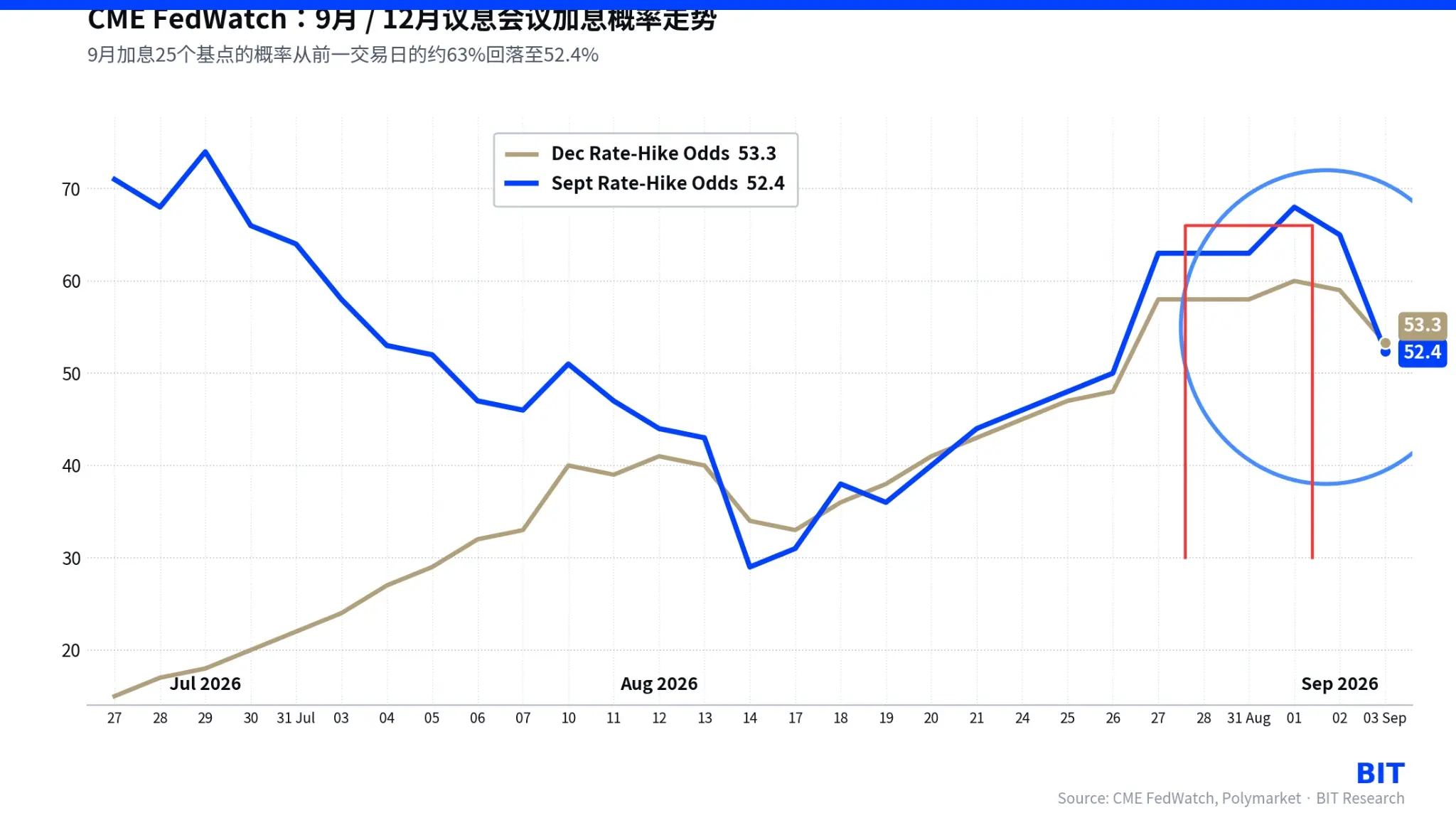
It should be noted that this is not an unconditional dovish signal, but rather closer to a middle state of "slowing rate hikes, unresolved concerns." For some time, market worries about a rate hike in September have been intensifying, with the core logic being that the pace of inflation decline may be interrupted—any marginal rebound in the August CPI reading, even if not significantly exceeding expectations, would be enough to tilt the policy balance back toward tightening. Waller's statement, in fact, represents a marginal easing of these concerns, as he clearly linked the next rate decision to the upcoming August CPI data, while also expressing cautious optimism about recent signs of inflation improvement and the soon-to-be-released employment data. In other words, the Federal Reserve's current policy reaction function has not changed; inflation remains a priority, but there is a slight increase in tolerance for "data surprises" in the short term. This means that whether this round of sentiment recovery can continue heavily depends on whether next week's data can validate this optimism, and the core variable of inflation itself has not been truly resolved.
III. The Essence of Structural Divergence: Valuation Responds to Macro Sentiment Recovery, Not Industry Logic
From the perspective of asset pricing, the stocks that led the gains last night, such as Tesla, SpaceX concepts, Oracle, Dell, Meta, and Microsoft, generally exhibit characteristics of long-duration, high-valuation growth stocks, whose pricing is significantly more sensitive to U.S. Treasury yields than value or cyclical assets. After Waller's statement drove yields down, the discount rate assumptions for these assets improved, providing direct support for valuations—this is essentially a liquidity and interest rate expectation-driven valuation recovery, rather than a substantial change in industry fundamentals.
In contrast, the pricing logic of the AI hardware supply chain is still more anchored in capital expenditure rhythms and industry competition dynamics, with relatively weak correlation to short-term interest rate changes. Broadcom closed down 6% to $346.49—despite the company reporting third-quarter revenue of $29.6 billion (an 86% year-over-year increase) and AI revenue of $16.7 billion (a 221% year-over-year increase), accounting for 56% of total revenue, the performance itself was quite impressive. However, the fourth-quarter revenue guidance of $34.8 billion was slightly below the market expectation of $35.05 billion, leading the market to reassess its replacement potential and progress against Nvidia in the customized AI chip ASIC field. The improvement in the liquidity environment could not offset such specific negative information. The market's voting with its feet reflects lingering concerns about the "increasing revenue without increasing profit" fundamentals.
Snowflake's counter-trend surge provides a meaningful contrasting example: in the same macro environment, its gains primarily stemmed from the verification of its AI product monetization capabilities, representing a typical "fundamentally driven" increase. This indicates that the current market logic for AI-related industries has entered a performance realization phase, moving past the narrative-driven and interest rate-sensitive stage. Actual data needs to speak for itself.
IV. Inflation Pressures Persist: Dual Signals from Trade Data and Geopolitical Oil Prices
Waller's statement temporarily eased market anxiety about rate hikes, but if we zoom out to look at the fundamentals, concerns supporting inflation and the threats from external factors such as war have not been resolved:
From the perspective of trade data, the U.S. July import and export data is an important reference for judging the August CPI trend. The trade deficit in goods further widened that month, with the core driving force coming from domestic import demand: capital goods imports maintained a high growth rate, reflecting that corporate capital expenditure willingness has not been significantly suppressed by high interest rates, and there was no obvious weakening in residential import demand, indicating that domestic demand resilience is generally stronger than previously expected. Meanwhile, export performance was relatively weak, and the pace of decline in import prices has slowed compared to before. Overall, the current U.S. economy presents a pattern of "support from domestic demand, weak external demand," and has not entered a recessionary cooling phase, which constitutes a realistic basis for the risk of a marginal rebound in the August CPI.
Another clue is the geopolitical transmission chain of oil prices. The previously brokered temporary ceasefire between the U.S. and Iran broke down in mid-August, and this week has been tumultuous, with military confrontations between the U.S. and Iran in the Strait of Hormuz escalating: on August 31, the U.S. launched a new round of strikes against Iran, pushing oil prices up in a single day; from September 1 to 2, the U.S. further expanded the scope of its strikes, destroying about 100 military targets within Iran, and for the first time used a "tanker-for-tanker" reciprocal countermeasure, hitting two Iranian government tankers moored near the Iranian coast; Iran retaliated by launching about 25 ballistic missiles and dozens of drones at a U.S. military base near Jordan, but most were intercepted or missed. As a result, Brent crude oil briefly surged to around $97 per barrel, while WTI remained above $90 per barrel, only because the market interpreted the U.S. military action as "restrained," combined with OPEC+'s September production increase plan, did the upward momentum not further expand, with oil prices overall showing high-level consolidation rather than a downward trend.
Looking ahead to next week's CPI release, the marginal upward risk of energy prices on the August CPI has not actually been resolved. If the situation in the Strait of Hormuz fluctuates or even impacts shipping passage, imported inflation pressures may become more pronounced.
It is noteworthy that last night's rise in gold and other safe-haven assets, despite oil remaining at high levels, was fundamentally driven by the liquidity expectations improvement brought about by Waller's statement, temporarily overshadowing the potential negative of rising energy costs—however, this "interest rate-friendly hedge against energy risks" combination is not stable. Once next week's CPI confirms that energy components are materially driving overall inflation, the market's previous optimistic pricing of Waller's dovish signal will face correction pressure. In other words, the easing of macro sentiment is real, but the deeper issue of inflation remains unresolved.
V. Outlook for Next Week's CPI: Three Scenarios and Asset Pricing Paths
The upcoming August CPI data will be the most important focus before the Federal Reserve's FOMC meeting in September. Looking back at the previously released July data, the CPI year-on-year was 3.4%, and the core CPI year-on-year was 2.5%. Although there was a marginal easing compared to before, there is still a significant gap from the 2% policy target, indicating that the inflation foundation is not solid. Considering factors such as domestic demand resilience and geopolitical oil price risks, after the release of next week's CPI, the market will likely interpret it along the following three paths:
CPI exceeds expectations: The pace of inflation decline is materially interrupted, and the market will raise the probability of rate hikes in September and beyond. The gains brought about by the expectation recovery will face significant retracement risks, with long-duration growth stocks, precious metals, and crypto assets being the first to come under pressure.
CPI roughly meets expectations: The Federal Reserve will likely continue its "wait and see" policy path, but officials' statements are expected to remain cautious, with the November meeting continuing to be viewed as a potential policy observation window, and risk assets will likely maintain a volatile pattern.
CPI significantly below expectations: The trend of inflation decline is reaffirmed, and the consensus expectation for relaxed conditions for rate hikes will be further solidified, potentially opening up discussions in the market for a more accommodative policy path within the year. The current recovery trend is expected to gain further support from the fundamentals, with both the duration and space for continuation potentially exceeding current expectations.
It is important to emphasize that the nature of this rebound is closer to a phase of expectation repair. The Federal Reserve has not signaled any intention to initiate a rate-cutting cycle, and the overall stance of monetary policy remains tight. Until the August CPI data is released, there remains significant uncertainty in the direction of overseas markets, with implied volatility at relatively high levels, and the risks of short-term fluctuations and retracements should not be underestimated.
Disclaimer: This article is for reference only and does not constitute any investment advice or product offer. Data is as of the close of the U.S. stock market on September 3, 2026 (Eastern Time), sourced from public information, and our company does not guarantee its accuracy or completeness. The article contains forward-looking judgments, and actual results may differ significantly. Investment involves risks, and prices can rise or fall; past performance does not represent future performance, and investors may lose all principal. Product availability is subject to local laws and regulatory restrictions. Please assess independently and consult independent professional advice.
 Risk warning



Popular articles