Google is digging deep for electricity, and the stock prices of Planet Labs and Fervo Energy have risen! Warren Buffett rarely supports tech stocks; what exactly does he see in Google?

 Warren Buffett rarely publicly supports a tech stock; which layer of moat in the AI competition is he interested in regarding Google?
On September 24, the yield on 30-year U.S. Treasury bonds reached a new high since 2004, while the Nasdaq Composite Index slightly rose by 0.01% to close at 26,939.373. Oracle fell by 3.47% due to a "force majeure" notice. On the same trading day, Google made progress in two completely opposite directions: its partner Fervo Energy achieved the world's first utility-scale enhanced geothermal power generation at the Cape Station geothermal power plant located 2,000 meters underground in Utah; meanwhile, Google confirmed that the first experimental satellite of Project Suncatcher, equipped with self-developed chips, will launch ahead of schedule on October 1. What exactly is forcing the world's second-largest tech company to seek power from both the Earth's core and orbit? Warren Buffett rarely publicly supports a tech stock; which layer of Google's moat in the AI race has caught his attention?
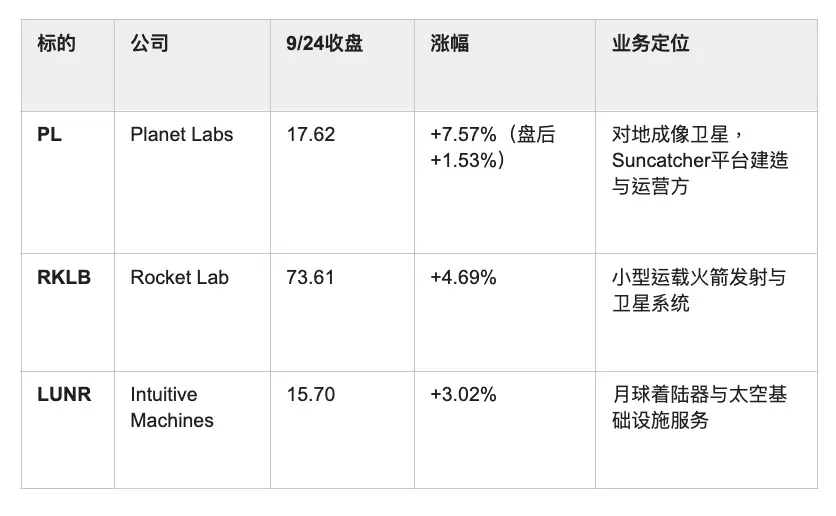
1. Google Sends Self-Developed TPU Chips to Space Ahead of Schedule? Satellite Manufacturer Planet Labs Rises 7.57%
The experimental satellite's scheduled launch aims to complete hardware verification of the minimum viable product
According to a report by The New York Times, confirmed by Google, the first experimental satellite of Project Suncatcher is scheduled to launch on October 1 as part of the Transporter-18 rideshare mission, but this mission is an unplanned hardware verification step. The satellite is equipped with four self-developed TPU chips and powered by 1 kilowatt of solar energy, with computing power roughly equivalent to a ground data center server, designed to operate in orbit for about a year and handle simple AI queries. Google has been quite restrained in its statements about the project, emphasizing that there will be no commercially available output in the short term. The originally planned two prototype satellites for laser networking testing in collaboration with Planet, set for 2027, will still proceed as planned, with expectations that orbital computing costs may reach parity with ground costs by the mid-2030s.
The unit power efficiency of self-developed TPU chips is the key prerequisite for achieving orbital computing power
Google's ability to extend computing power into space relies on its self-developed TPU (Tensor Processing Unit) ASIC chips, customized for neural network matrix operations. In the orbital environment, where only 1 kilowatt of power is available and heat dissipation is extremely difficult due to the vacuum and lack of air convection, AI computing power per unit of power is the only hard physical constraint. The self-developed TPU sacrifices general flexibility for extremely high energy efficiency, allowing Google to deploy computing power under extreme physical conditions, turning vertically integrated chip capabilities into a tangible strategic advantage in space.
Planet Labs is responsible for satellite construction and operations, and is opening up a new business line
The satellites for Project Suncatcher are not directly manufactured by Google but are constructed and operated by Planet Labs (NYSE: PL), a company specializing in Earth imaging. Planet has a mature satellite production line and operational capabilities in orbit, establishing a clear division of labor where "Google provides chips, Planet provides satellites." For Planet, which has a market capitalization of just over six billion dollars, this collaboration directly opens up an incremental business channel for "space data centers," and on the same day, its stock price surged by 7.57% on September 24 and continued to rise in after-hours trading.
Space concept stocks collectively strengthened, reflecting overall investor interest in this theme.
2. Extracting Green Power from Deep Within the Earth: Fervo Energy Surges Over 11% Pre-Market
Geothermal power plant successfully achieves First Power, marking a milestone in the enhanced geothermal industry
On September 24, geothermal innovation company Fervo Energy (NASDAQ: FRVO) announced that its Cape Station in Beaver County, Utah, achieved First Power, becoming the world's first enhanced geothermal (EGS) project to reach a utility-scale generation milestone. Following the announcement, FRVO surged over 11% pre-market, closing up 2.20%. The first phase of the project is planned for a capacity of 100MW, with the first 33MW GeoBlock module set to begin commercial operations on October 1, and a second phase of 400MW is also under construction, with a potential development scale exceeding 4GW. The technology significantly reduces development costs by introducing oil and gas horizontal drilling techniques.
Google Secures Massive Power Supply and Enjoys Capital Appreciation at the Equity Level
Google is not only a core electricity customer of Fervo Energy but also an important strategic shareholder. The two companies began their collaboration with a pilot project in Nevada, where Google participated in Fervo's $462 million Series E financing and signed the world's largest enhanced geothermal power purchase agreement for 396MW in early September 2026, with an additional option for about 600MW, bringing the potential total scale close to 1GW. After Cape Station achieved its first power generation, Google benefits on two levels: securing stable, zero-carbon baseload power for its data centers and indirectly benefiting as a shareholder from the project's progress. According to stockanalysis.com, as of September 24, 2026, 13 analysts covering FRVO primarily rated it as a buy, with an average target price of $40.75; different data platforms may have varying statistics. Institutional ratings represent their own views and do not constitute investment advice.
3. Warren Buffett Rarely Publicly Supports: The Pricing Power Logic Behind Heavy Investment in Alphabet
Berkshire Significantly Increases Holdings in Alphabet, Becoming the Third Largest Position in Its Portfolio
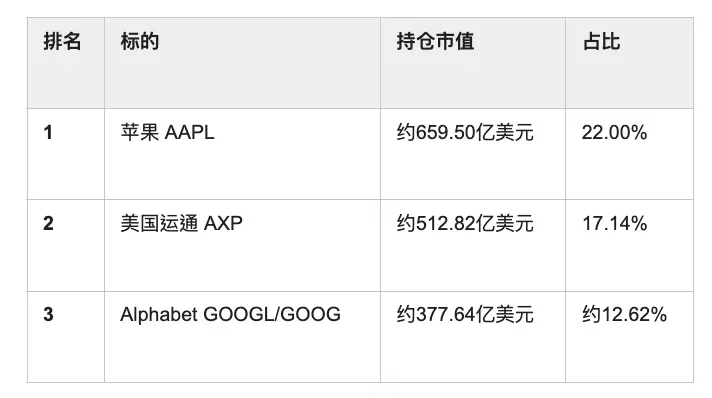
Berkshire Hathaway significantly increased its holdings in Alphabet in the second quarter. The 13F filing shows that Berkshire increased its holdings of Class A shares (GOOGL) by 45% to 78.79 million shares and Class C shares (GOOG) by 83%, with a total holding of 106 million shares; at the same time, Berkshire also acted as a cornerstone investor in Alphabet's $84.75 billion AI financing with a $10 billion allocation. This series of actions made Alphabet the third largest holding in Berkshire's portfolio, surpassing Coca-Cola, which it has held for decades. Buffett has previously stated that this company is more likely to be a winner than 90% to 95% of the stocks promoted by Wall Street.
Berkshire's latest top three holdings (as of the second quarter 13F filing submitted on August 14, 2026, with holdings data as of June 30, 2026)
Vertical integration shapes a deep moat, turning competitors' costs into Google's assets
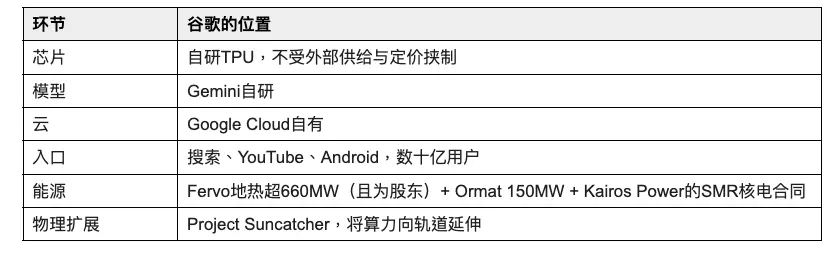
Among major tech giants, Google is one of the few companies that has integrated the AI industry chain from chips, models, cloud infrastructure, consumer entry points all the way down to underlying energy and physical expansion. While the entire industry is queuing for computing power chips, electricity supply, and data center land, Google has developed its own TPU, built its own data centers, invested in geothermal and nuclear power, and extended computing power into space exploration. This ability to transform industry development bottlenecks into its own balance sheet pricing power advantage, combined with its approximately 17 times price-to-earnings ratio, may be an important consideration for Berkshire's decision to increase its holdings.
4. Negative Case Raises Warning: Oracle's "Force Majeure" Exposes Delivery Risks
Oracle Issues Force Majeure Notice, Raising Concerns Over High-Leverage Computing Projects
On the other end of the rapid expansion of AI infrastructure, delivery risks have begun to emerge. Oracle issued a formal notice invoking force majeure to Stack Infrastructure, affecting the Project Jupiter mega data center project that provides computing power for OpenAI. This project employs a highly leveraged SPV (special purpose vehicle) off-balance-sheet financing structure, bundling debt with private equity. Although Oracle insists that the project is still progressing as planned,
Delivery delay risks have led to widespread pressure on related industry chain stocks
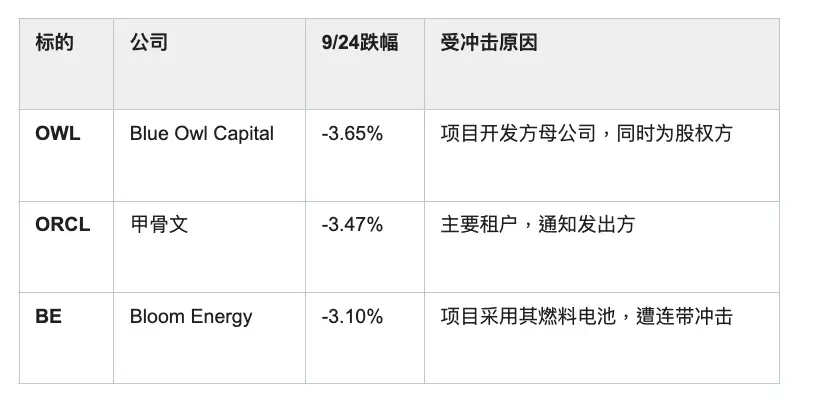
Concerns over the inability to deliver the Project Jupiter project on time quickly spread to surrounding supply chains. On September 24, the parent company of the project developer, Blue Owl Capital, fell by 3.65%, Oracle closed down 3.47%, and Bloom Energy, which provides fuel cells for it, also suffered a related decline of 3.10%. This case reflects the potential risks of relying on high-leverage off-balance-sheet financing to build computing power, contrasting with Google's model of advancing with its own balance sheet and equity in power.
Disclaimer
This article is compiled and written by this platform based on publicly available information. The market data, corporate announcements, and news reports cited are sourced from Futu Holdings, Google's official blog, Fervo Energy press releases, Bloomberg, The New York Times, Berkshire Hathaway's 13F filings, and public disclosures from major financial media. This platform has made every effort to verify its accuracy but makes no express or implied guarantees regarding the completeness, timeliness, or accuracy of the information.
The content regarding Oracle's force majeure notice is based on media reports from informed sources, and Oracle officially insists that the project is still progressing as planned and has not commented on the notice itself. The subsequent developments of related matters remain uncertain, and readers should exercise caution. The public statements attributed to Buffett are sourced from his public interviews in July 2026. The institutional ratings and target prices mentioned are independent views of the respective research institutions and do not represent the position of this platform, nor do they constitute any recommendations.
The market data contained herein reflects the closing prices of U.S. stocks on September 24, 2026; the holdings data comes from Berkshire Hathaway's second quarter 13F filing submitted on August 14, 2026, with holdings as of June 30, 2026. All analyses, judgments, and expectations represent views at the time of writing and may be adjusted with changes in market conditions, policy directions, and data. This platform assumes no obligation to update. Daily price changes only reflect market performance on a specific trading day and do not represent any trend judgment.
The content of this article is for reference and discussion only and does not constitute any investment advice, offer, or invitation to offer, nor does it constitute a recommendation for any financial products, securities, or derivatives. The companies and subjects mentioned are merely examples to illustrate industry phenomena and do not constitute a recommendation for any specific stock. Relevant subjects may have significant volatility risks, and some companies mentioned have not yet achieved profitability; past performance does not represent future returns. Investors should operate at their own risk based on this information. Readers should consider their own financial situation and risk tolerance before making any investment decisions and consult qualified professionals.
 Risk warning