








U.S. Treasury yields hit a 24-year high at 5.34%, while Accenture surged 16%: On the same night, two historical records in different directions

 What is truly noteworthy this night is that while the bond market set a record, the AI industry chain has run out an independent market trend.
On October 1, the U.S. stock market saw two opposing historical records.
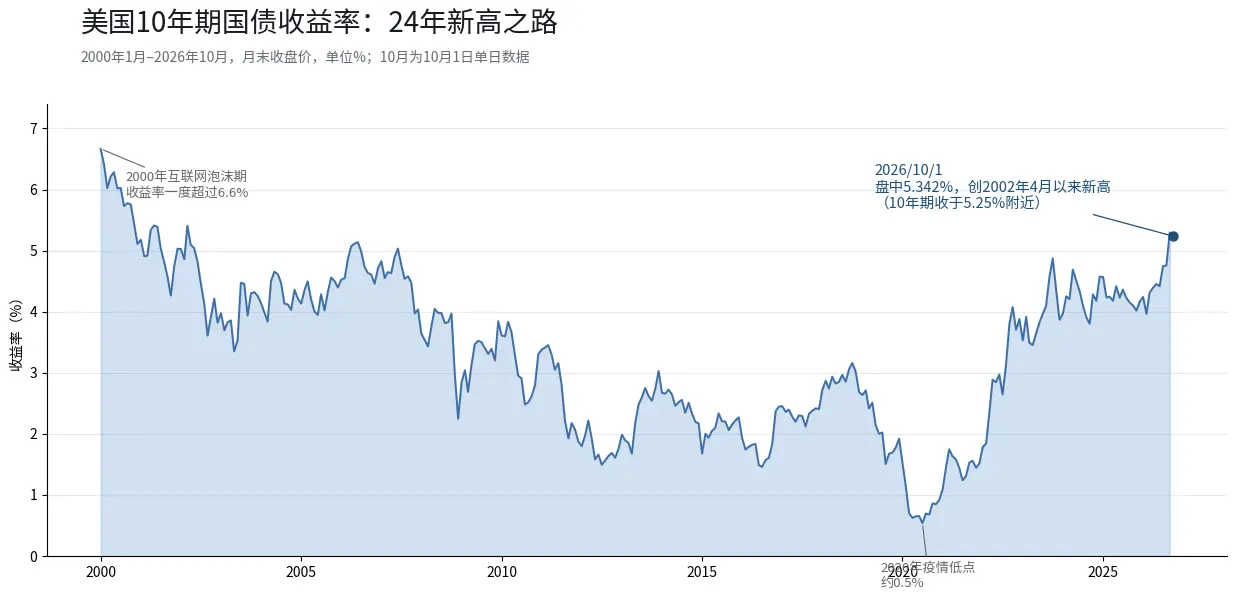
On one side is the bond market. The yield on the 10-year U.S. Treasury surged to 5.342% during the day, reaching its highest level since April 2002; the 30-year yield broke above 5.6%, also a level not seen in nearly 24 years. The S&P 500 index fell nearly 1% from its peak during the day, and the Dow Jones Industrial Average dropped more than 1% from its intraday high.
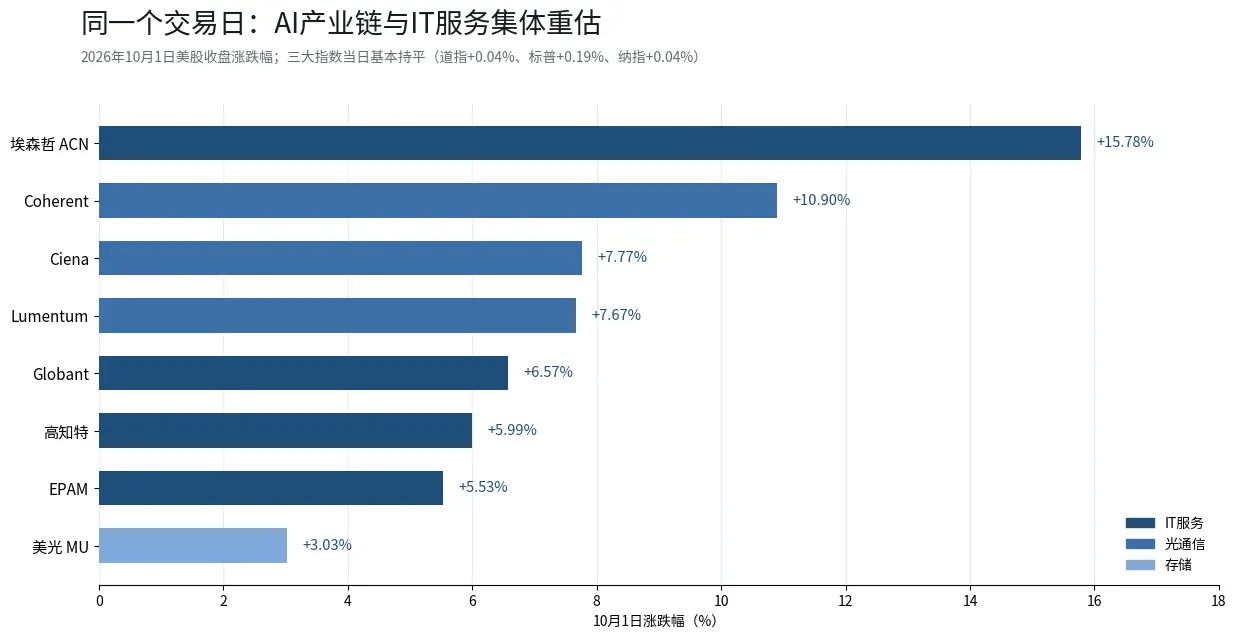
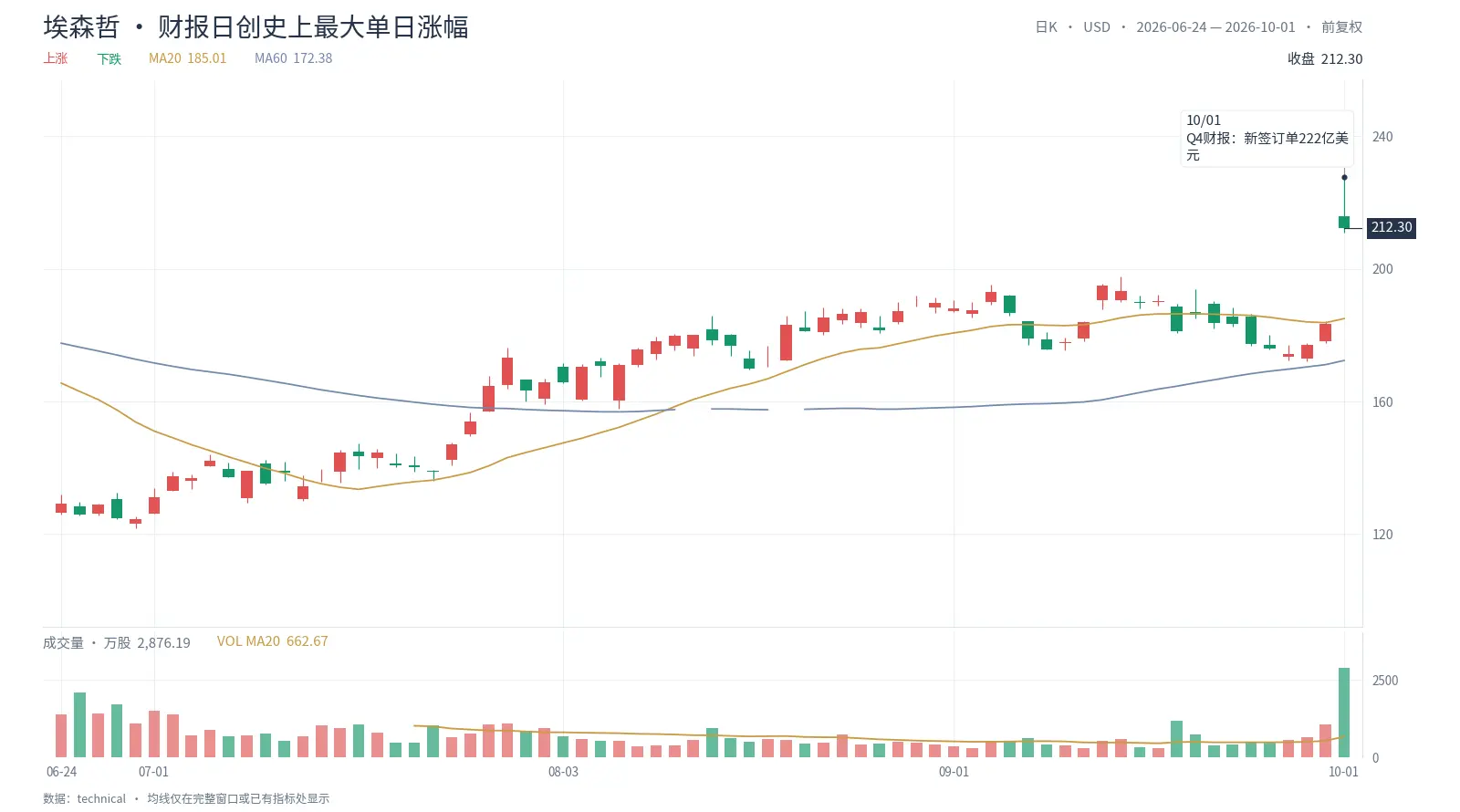
On the other side is a sector in the stock market. IT service giant Accenture (ACN) surged by 24% at one point during the day, marking the largest single-day increase in the stock's history, closing with a nearly 16% gain. The optical communication sector collectively exploded, with Coherent rising 10.90%, Ciena up 7.77%, and Lumentum increasing 7.67%.
After peaking, U.S. Treasury yields fell back, with the 10-year yield ultimately closing around 5.24%. The three major indices turned from decline to increase: the Dow rose 0.04%, the S&P 500 gained 0.19%, and the Nasdaq increased 0.04%.
However, the calm at the close masked the intense volatility during the day. What truly deserves attention that night is that while the bond market set records, the AI industry chain ran an independent trend.
1. Accenture's $84.5 billion order answers the market's biggest concern
One of the important reasons for Accenture's surge is that its AI business data alleviated market worries about whether "AI will disrupt the IT consulting industry."
First, let's look at the quarterly numbers. In the fourth fiscal quarter, revenue was $18.7 billion, exceeding the upper limit of the company's previous guidance (about $18.4 billion), representing a year-over-year increase of 6% in dollar terms; adjusted earnings per share were $3.29, compared to $2.25 in the same period last year. More importantly, the orders: new signed orders in the fourth fiscal quarter reached $22.2 billion, a year-over-year increase of 4%, surpassing market consensus expectations, corresponding to a book-to-bill ratio of 1.2; the quarter recorded 141 customer orders of at least $100 million, setting a record for the highest number in a single quarter.
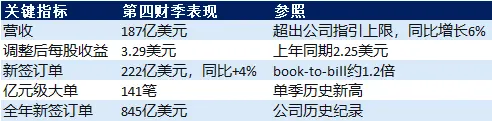
Looking at the entire year, new signed orders for fiscal year 2026 reached a record $84.5 billion, with adjusted earnings per share for the year at $13.97, an 8% year-over-year increase, and the announcement of a historic shareholder return plan of $11.5 billion. CEO Julie Sweet stated, "AI is now embedded in all our work, and demand is surging." The company disclosed that nearly 100 new clients initiated their first advanced AI projects during the quarter, with the total number of such clients exceeding 400 for the year; revenue from eight emerging AI/data partners grew more than double in fiscal year 2026, with related orders increasing more than threefold.
The significance of this data lies not in Accenture itself. These figures reflect, to some extent, that AI-related demand on the enterprise side remains resilient. The market had previously worried: if AI can automatically complete consulting and analysis work, will consulting firms like Accenture, which charge by headcount, be replaced? Accenture's order data alleviated this concern to some extent—some enterprise clients still need external professional support when advancing AI implementation.
Accenture's stock surge drove global IT service stocks higher: Globant rose 6.57%, Capgemini increased 7.38%, Cognizant gained 5.99%, and Infosys and EPAM Systems rose over 5%. The entire IT service sector was repriced.
2. The surge in optical communication is the next bottleneck for AI infrastructure
The surge in the optical communication sector is not an isolated event. Coherent launched its PhotonLink integrated optical platform for AI infrastructure that day, igniting market expectations for next-generation data center networks.
Some market views suggest that as AI data centers upgrade from 800G to 1.6T optical modules, the importance of optical communication in data transmission within AI computing clusters is increasing. Computing chips address the question of "how fast can calculations be done," while optical communication addresses "how fast can data run." As GPU clusters scale from thousands of cards to hundreds of thousands, the bandwidth and latency of optical communication directly determine the utilization of the entire cluster.
Data also supports this point. Storage chips strengthened on the same day: SK Hynix rose over 5%, Micron Technology increased over 3%, and SanDisk gained 2.75%. Micron disclosed after the market on September 30 that the committed amount of long-term supply agreements with clients had increased to $32 billion, a significant rise from the $22 billion disclosed in June, with the number of strategic partnership agreements increasing from 16 to 26, and over 75% of planned capacity for fiscal year 2027 has been locked in by clients. The simultaneous strength of optical communication and storage chips was interpreted by some market participants as a sign that AI infrastructure demand is extending to supporting areas like optical interconnect and storage.
3. Why the intense volatility in the bond market did not suppress these two sectors
The key to understanding that night lies in recognizing that the impact of rising U.S. Treasury yields on different sectors is varied.
When U.S. Treasury yields hit new highs during the day, the impact was greatest on high-valuation, unprofitable growth stocks, as their valuations heavily rely on the discounting of future cash flows, and even minor changes in the denominator can be amplified. However, Accenture and the optical communication sector share a common characteristic: their increases are anchored by performance data and industry orders, not purely by valuation expansion.
Accenture's order data represents real contracts. Micron's $32 billion supply agreement is a tangible commitment. The demand for optical communication comes from data center capital expenditures, and the capital expenditures of data centers are derived from budgets already announced by cloud vendors. These disclosed orders and agreements provide a certain level of support for the fundamentals of the related companies. In the market performance that day, this somewhat buffered the valuation pressure brought by rising interest rates.
Fundstrat economic strategist Hardika Singh raised a thought-provoking question in a report: the U.S. stock market is near historical highs, but government bond yields are simultaneously at their highest levels in decades, raising doubts about how long this rally can last. Some investors even expect that a prolonged high-interest-rate environment may break the market rule of "no choice but stocks" that has prevailed for decades.
However, the market that night showed a certain degree of differentiation: the high rates had different impacts on various assets. Some AI-related companies with order or performance support performed relatively well, while some high-valuation assets faced greater pressure.
4. Why the Federal Reserve's "patience" is more important than the new highs in U.S. Treasury yields
The retreat of U.S. Treasury yields from the 24-year high of 5.34% was directly triggered by the remarks of Federal Reserve Vice Chair Jefferson. He stated that after raising rates by 25 basis points in September, the Federal Reserve can remain patient before deciding whether to raise rates further.
Market expectations for an October rate hike subsequently cooled significantly. According to CME FedWatch, the market's expectation of the Federal Reserve holding steady in October rose from about 49% the previous day to about 63%, with the probability of a rate hike falling below 40%.
However, the statement from Minneapolis Fed President Kashkari formed a counterpoint. He believes that to curb demand as the economy enters 2027, further rate hikes may still be necessary, but there is uncertainty about whether the next action will be in October.
The difference in attitudes between the two Federal Reserve officials reflects the current core contradiction in the market: economic data remains resilient, but the impact of high rates on the market and economy is accumulating. On October 1, the number of initial jobless claims in the U.S. fell to 197,000, below the expected 200,000; the September ISM Manufacturing PMI slightly decreased from 54.6 to 54.5, but the input price index rose significantly. The economy is not weak, but inflationary pressures have not disappeared either.
5. What to watch next
The first observation: whether U.S. Treasury yields can stabilize below 5.2%. 5.34% is a 24-year high; if this level is repeatedly tested without breaking, the selling pressure in the bond market may be released in stages. However, if subsequent economic data continues to be strong, there remains the possibility of further increases in yields.
The second observation: the performance realization rhythm of the AI industry chain. The order data from Accenture and Micron indicate that AI demand on the enterprise side is still expanding, but the surge in the optical communication sector is more driven by expectations. The next verification point is whether the actual landing data of data center capital expenditures can keep pace with the rise in stock prices.
The third observation: two key data points before the October monetary policy meeting. Before the Federal Reserve's monetary policy meeting at the end of October, there are two critical data points: September non-farm payrolls and CPI. If employment data weakens, the probability of a rate hike may further decline, potentially providing some support for high-valuation assets; if inflation data exceeds expectations, U.S. Treasury yields may have further upward potential.
In summary: Accenture's $84.5 billion order data reflects, to some extent, that enterprise AI-related demand remains resilient. The rise in optical communication stocks reflects the market's growing attention to the demand for optical interconnect in AI infrastructure. The bond market set a 24-year record, but these two directions both set their own records on the same night.
Data explanation:

Disclaimer: The content of this article is for general information and market commentary purposes only, compiled based on publicly available information as of the time mentioned in the article. Relevant market data, expectations, and probabilities may change with market conditions. The views and investment strategies quoted from third-party institutions, analysts, or others only represent the views of the relevant third parties at a specific time and do not represent the views or recommendations of BIT. This article does not constitute investment advice, investment research, an offer, solicitation, or recommendation for any securities, investment products, or trading strategies, nor should it be the basis for any investment decisions. Financial markets carry risks, and securities prices and market performance may fluctuate; past performance and historical market trends do not represent or guarantee future results. Investors should independently assess the relevant risks based on their own circumstances and seek professional advice when necessary.
 Risk warning

Popular articles





