Bitget x Reality x Keyring: Achieving a decentralized stock basis strategy with rToken

 Bitget is collaborating with Keyring to develop a rules-based stock basis index and is leveraging Reality's rToken to build a related on-chain lending market.
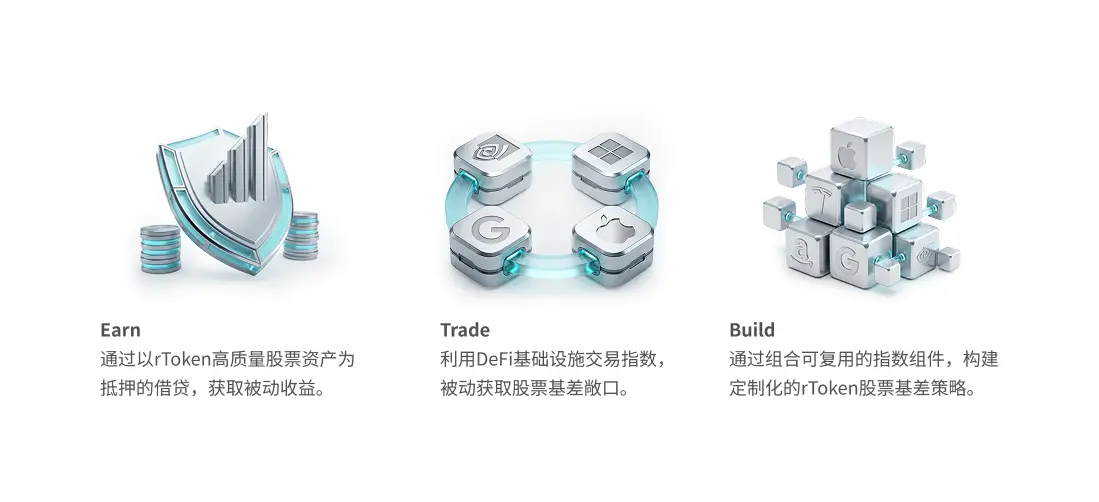
Bitget is collaborating with Keyring to develop a rule-based stock basis index and is leveraging Reality's rToken to build a related on-chain lending market.
Reality provides tokenized stock exposure, while Keyring is responsible for developing the index methodology and constructing the related lending market. The index aims to combine rToken holdings with hedging stock perpetual contract positions to capture funding rates and basis opportunities. Some products are planned to be distributed through Bitget's wealth management, subject to product review results, qualification requirements, and availability.
This collaboration integrates Reality's tokenized stock infrastructure, Keyring's rule-based investment strategies and lending market, IPOR Fusion's on-chain vault infrastructure, and 1Token's portfolio management and risk monitoring tools. The parties involved will jointly explore how these components can support the development of on-chain stock basis products while addressing operational, liquidity, and risk management challenges faced by strategies across traditional and decentralized markets.
Bitget and Reality: Stock Basis Strategies
Reality provides on-chain stock exposure through its rToken. Traders can purchase rToken through the Bitget exchange or Bitget Wallet X, or directly through Reality's request for quote (RFQ) service.
Reality's rToken constitutes the on-chain stock position in basis trading and can also serve as collateral in the related lending market. Reality's RFQ service and Bitget Wallet support the acquisition of rToken liquidity and trading execution infrastructure, allowing eligible participants and vaults to gain tokenized stock exposure, subject to applicable settlement conditions.
Tokenized stocks allow stock exposure to be directly integrated with decentralized lending and investment infrastructure, making it easier for on-chain strategies to participate in basis trading. Unlike traditional stocks, which typically require separate brokers and financing arrangements, rToken can serve both as a stock position in basis trading and as collateral in the on-chain lending market. This enables investors to combine tokenized stock holdings with hedging perpetual contract positions while utilizing decentralized infrastructure to manage financing and execute rule-based strategies.
Using rToken for Stock Basis Trading
Risk premium is the additional return traders receive for taking on a certain type of risk, above the risk-free rate. Basis refers to the price difference or discrepancy between the spot price and the total return of the corresponding contract or perpetual contract.
Stock basis trading aims to capture the funding costs paid by long positions to short positions.
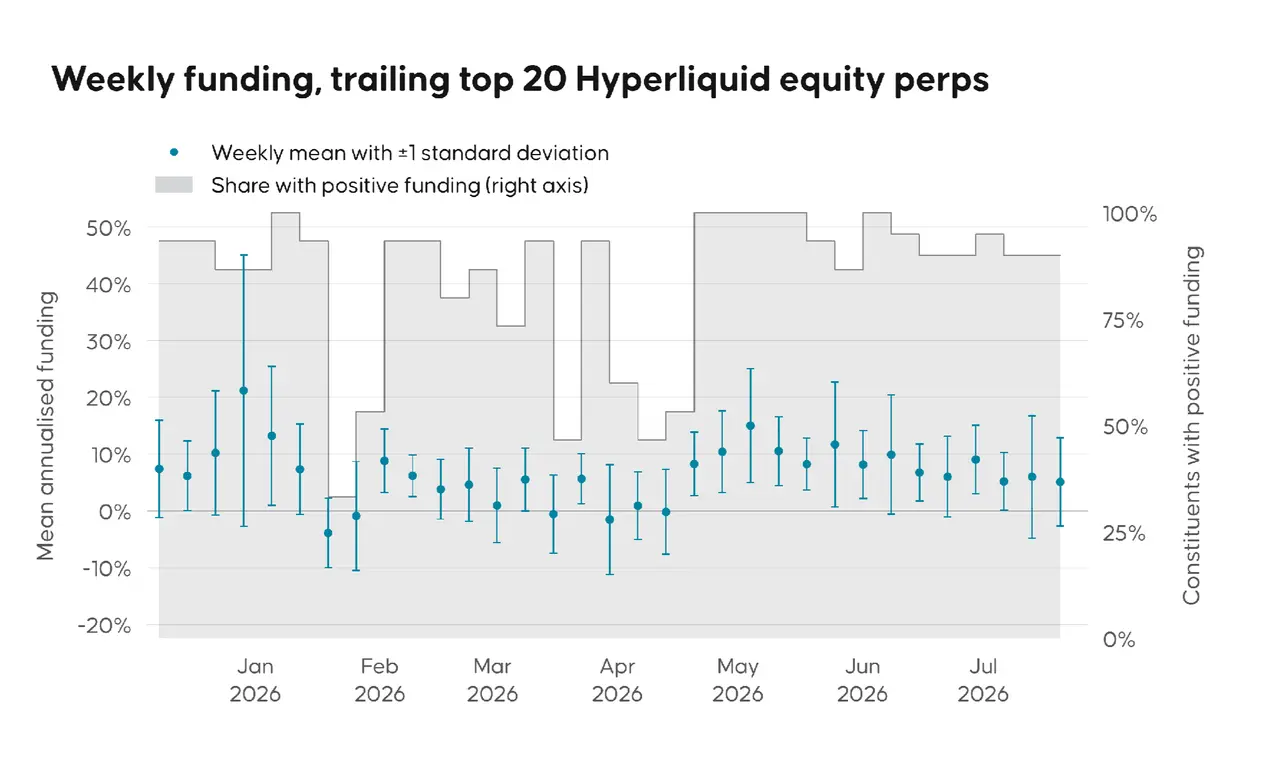
Source: Keyring Research, January--July 2026
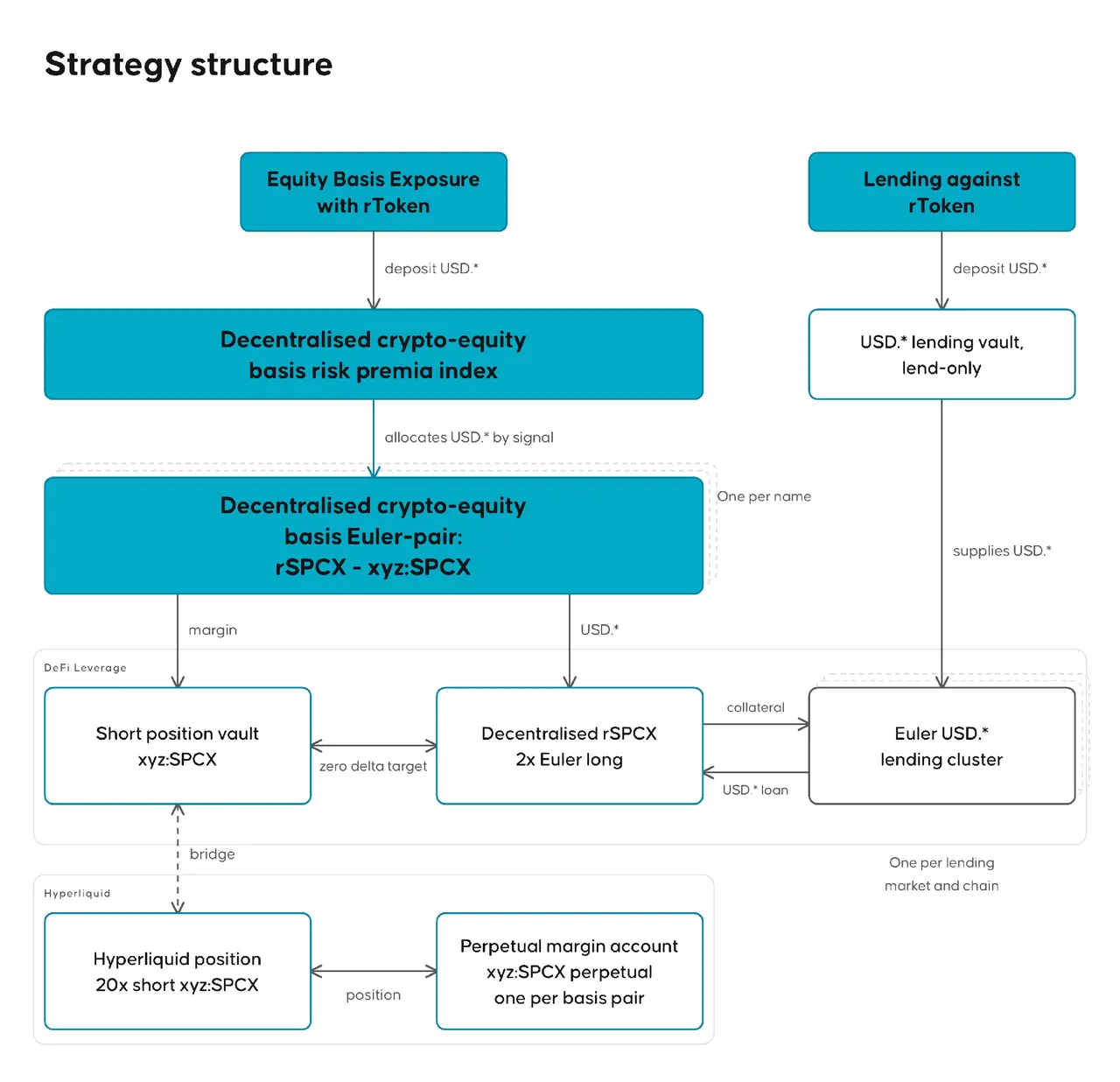
When the funding rate is positive, traders can earn funding fees by holding the corresponding rToken and shorting its perpetual contract. This operation aims to hedge stock price exposure, thereby constructing a delta-neutral basis trade.
Decentralization of Basis Trading
"Stock basis strategies have traditionally relied on centralized exchanges to manage spot and derivative positions within a unified margin framework. Cross-margin mechanisms allow the profits and collateral value of one position to support the margin requirements of other positions in the portfolio, reducing the need to maintain collateral buffers for each individual trade.
However, concentrating custody, trade execution, and margin management in a single intermediary introduces counterparty risk and operational risk. The collapse of several large centralized market participants has prompted the market to focus more on structures that can separate these functions while still maintaining capital efficiency for managing hedged positions.
Decentralized lending and trade execution infrastructure provide an alternative option, allowing tokenized stock collateral, financing arrangements, and derivative exposures to be managed across multiple interconnected protocols. While this approach can reduce reliance on a single intermediary, it also introduces risks associated with smart contracts, cross-chain bridges, price oracles, and liquidity fragmentation. Therefore, effective risk management requires reliable collateral valuation, sufficient margin buffers, and coordinated execution across trading venues."
Lending Market as a Source of Leverage
Lenders deposit stablecoins into a lending pool. Borrowers purchase Reality's rToken and deposit it as collateral. The lending pool lends stablecoins based on the rToken collateral. Borrowers pay interest to the lending pool, which distributes the interest to lenders after deducting fees. If the loan size is too large relative to the collateral value, the lending pool can sell the collateral.
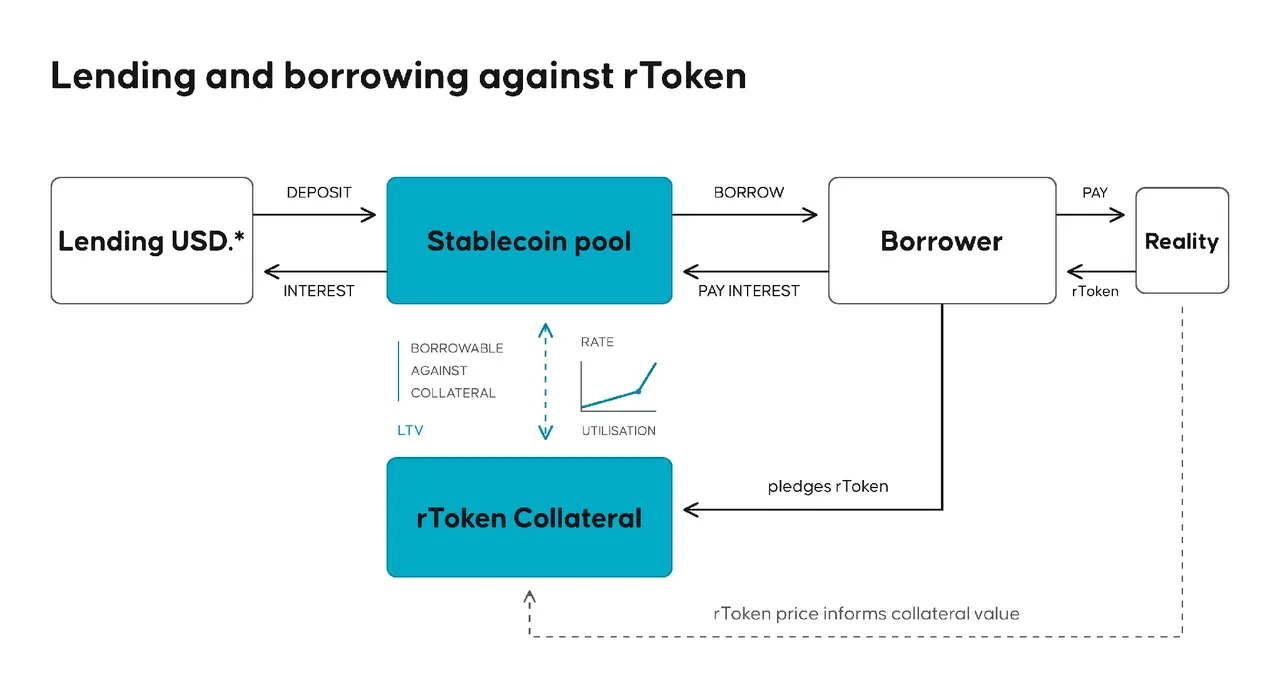
This structure can serve as a source of leverage, allowing borrowers to establish larger positions using collateral assets listed in the market. This practice is commonly referred to as "looping" in the DeFi industry, enabling borrowers to gain leveraged exposure to tokenized stocks without needing to open a margin account on an exchange.
The financing function of this collateral lending structure is similar to repos in traditional markets, allowing investors to obtain financing based on their tokenized stock holdings.
For eligible Bitget users, the proposed lending structure is expected to generate returns from over-collateralized loans using rToken as collateral, with specific return levels depending on borrowing demand, applicable fees, collateral valuation, and liquidation risks. Keyring introduces an institutional-grade risk framework (i.e., ISDA standardized initial margin model parameters) into its decentralized lending framework, providing a structured approach to collateral and margin requirements.
Stablecoin lending and stock basis index exposure are two distinct products. Stablecoin lenders earn interest paid by borrowers after deducting applicable fees. In contrast, index investors receive the net performance of the rToken and perpetual contract combination strategy, including gains and losses from funding fees and basis, after deducting financing and trading execution costs. The index performance shown below does not represent the returns earned by stablecoin lenders.
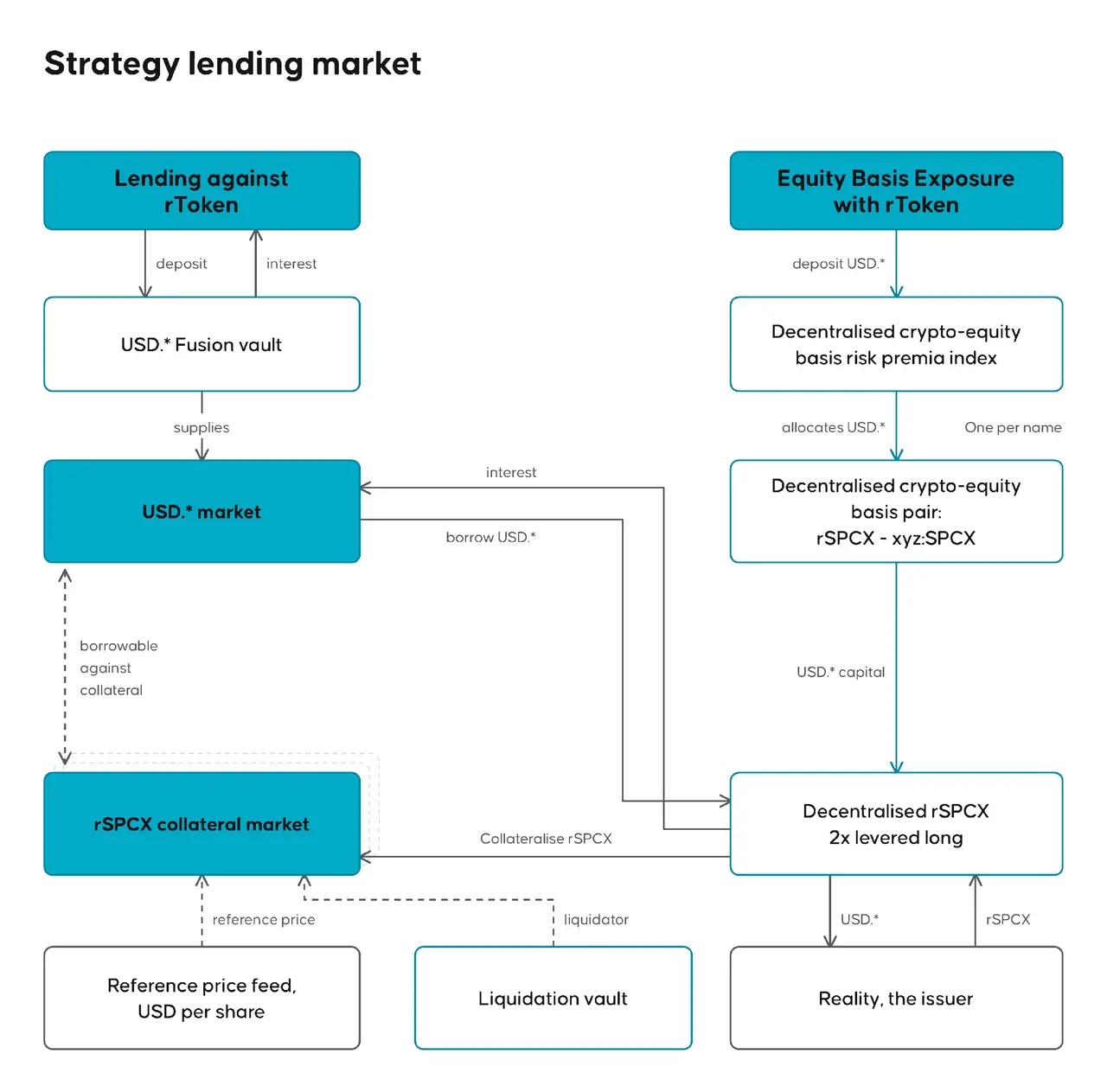
One key issue to focus on is that the value of rToken positions in the lending market needs to be balanced against short positions on Hyperliquid, and the lending market must be able to accurately value the rToken price. This is precisely why cross-margin mechanisms are crucial in any market.
Reality's rToken price oracle uses official price sources during regular trading hours for U.S. stocks and uses Hyperliquid's quotes outside of those hours. This price data supports collateral valuation; cross-venue margin hedging depends on the specific applicable market and account arrangements. The basis strategy also requires coordinated management of lending positions and perpetual contract margins.
For example, if the U.S. stock market is closed and the corresponding perpetual contract price drops significantly, the collateral valuation of rToken may also decline due to its oracle using Hyperliquid's quotes outside of regular trading hours. Even if the underlying stock does not trade during this period, it may reduce the borrowing capacity of the lending position and potentially trigger liquidation. Meanwhile, the profits generated from the short perpetual contract position do not automatically offset the decline in collateral value across protocols. This highlights the importance of coordinated margin management, reliable price data sources, and sufficient liquidity for position management during market volatility.
The liquidation process utilizes Keyring's [un]wind product and connects with Reality RFQ to coordinate collateral redemption and debt repayment. Settlement may need to be completed over multiple trading days during regular trading hours for U.S. stocks. This mechanism aims to support the orderly liquidation of large rToken positions, with specific outcomes depending on redemption capacity, settlement timing, and the final amount recovered.
On-Chain Index Strategies
Reality's rToken provides on-chain stock holdings for these index strategies.
Quantitative Investment Strategies (QIS) are a popular product class traditionally created by investment banks, aimed at clients who wish to transparently capture known market inefficiencies (i.e., risk premiums).
Smart contracts can automate parts of index calculation, trade execution, and risk management that traditionally relied on centralized financial intermediaries. They provide a programmable framework for implementing rule-based strategies, enabling automated execution, transparent risk parameter settings, and integration with decentralized financial infrastructure. IPOR's Fusion vault infrastructure executes pre-defined investment authorizations through smart contracts, enforcing the range of assets allowed for trading, authorized markets, risk limits, and trading execution rules. This ensures that the strategy is fully programmable while strictly adhering to the established rulebook.
In strategy construction, a common challenge faced by QIS is how to ensure that the strategy can correctly capture potential risk premiums in a scalable manner. For this purpose, a simple and robust rulebook is essential.
Decentralized and Robust Strategy Rulebook
The index follows a rule-based methodology built around three core steps:
Identify eligible tokenized stocks and the corresponding perpetual contract market scope.
Rank eligible basis opportunities from the past three weeks.
Allocate funds based on pre-defined portfolio construction, liquidity, and risk management constraints.
The complexity lies in how to respond to unforeseen events in a decentralized and trustless manner. For example, setting margin buffer rules for cross-chain bridge failures is one such instance; additionally, how to account for trading costs and properly handle slippage and execution issues is another example.
The following analysis is based on simulated net funding cost returns from December 15, 2025, to October 19, 2026, assessing the historical performance of the rule-based stock basis index. The dataset is divided into an in-sample range used to determine strategy parameters and an out-of-sample range used to evaluate performance beyond the initial calibration window. The simulation considers trading constraints, execution costs, financing assumptions, and portfolio concentration limits.
The above results are derived from historical simulations and are sensitive to the assumptions made, which may not reflect actual trading execution or future market trends.
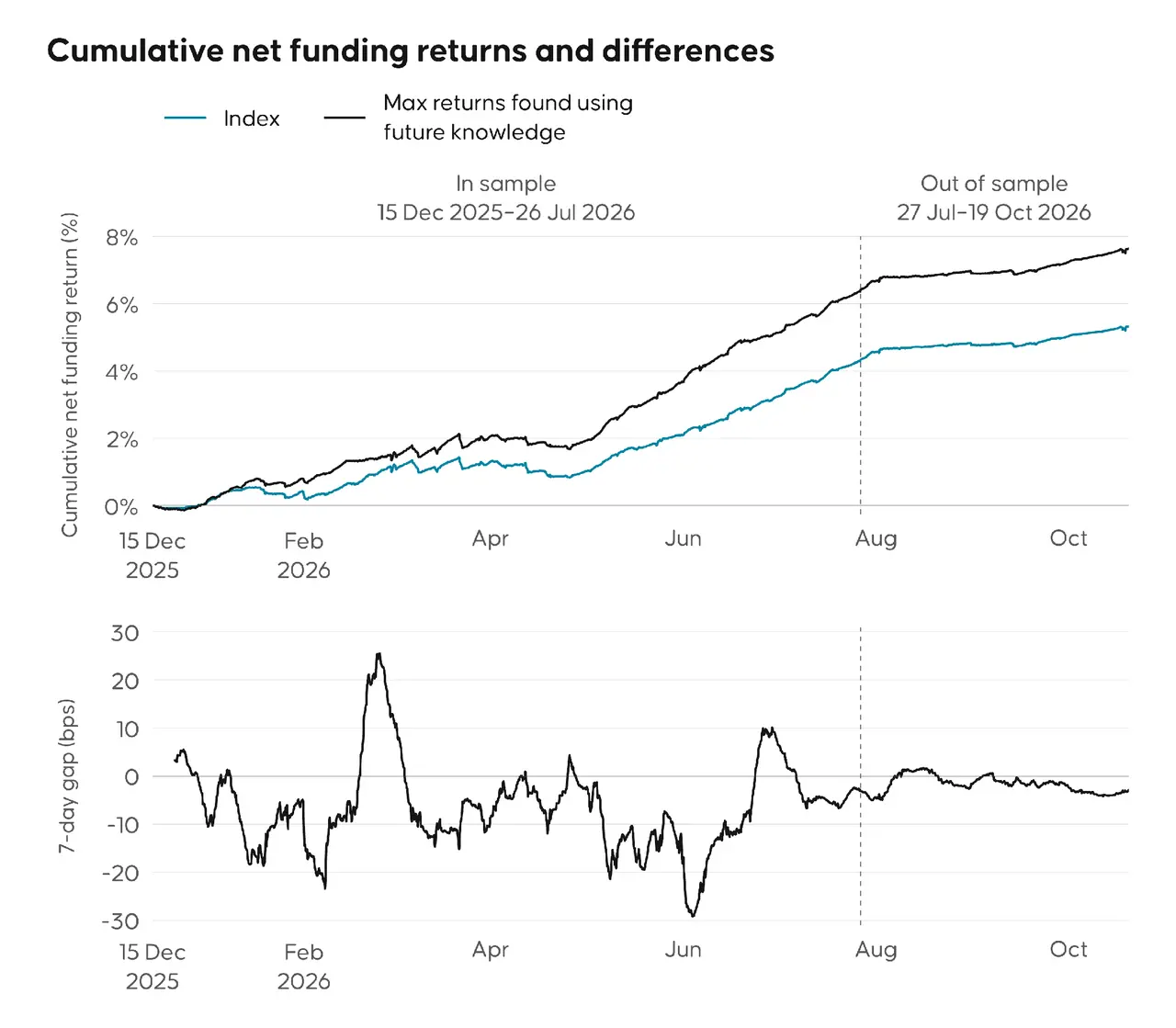
The index is also compared to a theoretical maximum return portfolio constructed using future market information. This hypothetical benchmark measures the highest cumulative return achievable under the trading constraints set by the model (including daily volume limits, slippage, concentration limits, and margin requirements). Since it relies on information that investors cannot access at the time of trading, it can only serve as a retrospective reference and does not represent a practically investable strategy.
It is important to note that the index always maximizes asset allocation, so this signal does not include any tactical risk overlay mechanisms. This means that when the funding rate turns significantly negative (as in April), even the optimal portfolio will incur losses, as there is no premium to capture at that time. It is also worth noting that in certain cases (such as March and July), the performance of the optimal portfolio may lag behind our index. Due to daily trading limits, establishing and closing positions takes time, so options that could enhance overall returns throughout the period may instead lead to reduced returns in a specific week. Under the simulation assumptions, the index recorded a Sharpe ratio of about 6 in the in-sample range and over 9 in the out-of-sample range. The simulated maximum drawdown is approximately 60 basis points, occurring in the in-sample range. The above results reflect outcomes under the historical dataset and modeling assumptions and should not be interpreted as a prediction of future performance.
The annualized net return of the simulated index is approximately 7% in the in-sample range and about 4% in the out-of-sample range; while the theoretical maximum return portfolio has annualized returns of approximately 11% and 5% in the corresponding ranges. These results account for modeled trading execution costs and financing costs and do not represent the actual returns received by investors. Analysis shows that before deducting applicable strategy costs, the gross funding cost premium is about 11% to 14%. The simulation assumes a trading execution cost of 20 basis points for each rebalancing, with a complete round-trip trade costing about 40 basis points, while assuming an annual financing cost of 6% for leveraged positions. Under the model assumptions, for every 10 basis points reduction in trading execution costs, the strategy's annualized return is expected to increase by about 1 percentage point; and for every 1 percentage point reduction in financing costs, there could be an additional increase of about 1 percentage point.
Additionally, there is the impact of capital dilution. Specifically, when slippage increases, the strategy cannot fully utilize 100% of the capital, leaving some funds idle. For this reason, and due to the need for margin buffers, the strategy holds about 25% of its capital in cash at any given time, which could potentially contribute an additional +1% to overall returns by earning risk-free interest rates.
The simulation assumes a loan-to-value (LTV) ratio of 50% for borrowing against rToken as collateral, with tokenized stock positions eligible for up to 2x leverage. The corresponding Hyperliquid perpetual contract positions are modeled with leverage ranging from 8x to 20x, depending on the margin buffer requirements determined by stressed market scenarios. Under these assumptions, the average nominal exposure of rToken is about 1.5 times the capital allocated to the basis strategy. For example, a capital allocation of $100 million corresponds to an average rToken exposure of about $150 million. These leverage assumptions increase the strategy's sensitivity to margin requirements, liquidity constraints, and adverse market fluctuations.
Composable Index to Help You Build Your Own Strategy
Keyring has created multiple "modular basis pair" index components based on Reality's rToken. Each component can be used independently, allowing managers to build systematic strategies with differentiated risks, returns, and allocation objectives.
Trade the index. A common practice is for managers to use a "risk overlay" mechanism to adjust their exposure in the stock basis index based on changes in market conditions. For example, momentum indicators like Bollinger Bands can be used to identify trends in funding rates, providing reference for allocation decisions. These methods are for illustrative purposes only and do not guarantee improved performance.
Trade basis pairs. Managers can also build strategies around individual rToken basis pairs and seek to outperform the index by trading these basis pairs. Statistical arbitrage techniques can utilize principal component analysis (PCA), which assumes that the movements of basis pairs exhibit some typical "structure," known as covariance relationships. If the covariance matrix contains several key directional drivers, we can calculate these principal components (mathematically referred to as eigenvectors) and trade against the noise fluctuations that occur around these main directions. This is a common type of strategy known as statistical arbitrage, often operated by hedge funds, but one must be cautious of the associated trading costs!
Such trading is suitable for professional investors, and executing such trades on-chain requires a clear understanding of cross-protocol rToken holdings, perpetual contract hedging, and collateral status. Tools like 1Token help consolidate these positions into a unified investment portfolio view, allowing managers to monitor profits, losses, and margin status throughout the trading process. The index and related lending markets are planned to be offered through Bitget Wealth Management.
About Bitget
Bitget is the world's largest panoramic exchange (UEX), serving over 125 million users, with over 2 million cryptocurrency tokens listed and supporting trading of over 500 tokenized stocks, ETFs, commodities, foreign exchange, and precious metals (such as gold). Its ecosystem aims to assist users in achieving "smart" trading through AI agents. Bitget collaborates with strategic partners like MotoGP™ to promote the widespread adoption of cryptocurrency. Upholding a strategy of global impact, Bitget partners with UNICEF to provide blockchain education support to 1.1 million people by 2027. Bitget leads the tokenized TradFi market, offering the industry's lowest fees and highest liquidity across 150 regions worldwide.
Risk Warning: Digital asset prices are volatile and may experience significant fluctuations. Investors are advised to only invest funds they can afford to lose. The value of any investment may fluctuate, financial goals may not be achieved, and the principal investment may not be recoverable. Independent financial advice should always be sought, and personal financial circumstances and experience should be fully considered. Past performance is not indicative of future results. Bitget assumes no responsibility for any potential losses. Nothing in this document constitutes financial advice. For more information, please refer to the Terms of Use.
About Reality
Reality is a compliant real-world asset (RWA) issuance platform for global markets, part of the Bitget ecosystem. We collaborate with licensed brokers from major exchanges like Nasdaq and the New York Stock Exchange to purchase and custody underlying assets, subsequently issuing corresponding rights on-chain. This connects traditional capital markets with on-chain infrastructure, enabling global users to participate in real-world assets in an institutional manner.
About Keyring
Keyring is the trust layer of the on-chain market.
Keyring Connect verifies participants' qualifications while protecting personal data.
Keyring Structuring builds a permissioned credit market supported by tokenized assets and index strategies.
Keyring Unwind allows investors to open and close leveraged positions in tokenized assets at scale and coordinates redemptions and debt repayments through smart contracts.
Important Statement
Keyring.Network (Cayman) Limited ("Keyring") operates as a permissioned access portal for decentralized protocols and other decentralized finance ("DeFi") applications. Keyring provides zero-knowledge verification services, allowing verified users to interact with smart contracts while protecting their privacy.
Keyring is not:
A financial intermediary, broker-dealer, or investment advisor;
A custodian of user funds or digital assets;
A counterparty to any transactions between users and DeFi protocols; or
A guarantor of protocol performance or investment outcomes.
Interacting with DeFi protocols through Keyring involves significant risks, including smart contract exploitation, market volatility, and the potential total loss of digital assets. Participants interact directly with the relevant protocols and assume full responsibility for all outcomes. Access may be restricted in regions where local laws or sanctions prohibit use. Global users must ensure compliance with all applicable laws and regulations in their jurisdiction. By using Keyring services, participants acknowledge the above risks, voluntarily assume full responsibility for their actions, and agree that Keyring's liability (if any) is limited to the maximum extent permitted by law.
About 1Token's 1ndex
1Token is a global technology service provider for digital asset investment managers, covering the Asia-Pacific region, Europe, and North America. The company provides technical support for over $20 billion in assets managed by more than 100 institutional clients and has obtained SOC 2 Type I and Type II certifications.
Its award-winning Crypto Asset Management (CAM) system connects with CeFi and DeFi trading venues via API, integrating portfolio management, trade execution, risk control, fund operations, and reporting functions into a unified environment. The platform provides real-time position, risk exposure, and performance analysis support for front office teams; portfolio operations, risk monitoring, shadow NAV, and investor activity management support for middle office teams; and trade reconciliation, valuation, and profit and loss (P&L) reporting support for back office teams.
1ndex, as 1Token's research and data platform for tracking, analyzing, and evaluating digital asset investment strategies, effectively complements the above infrastructure.
1ndex: https://1ndex.1token.tech/
1Token: https://1token.tech/
About IPOR Fusion
IPOR Fusion, developed by IPOR Labs AG (headquartered in Zug, Switzerland), is an on-chain vault infrastructure designed specifically for institutional-grade on-chain yield strategies. Its modular architecture provides deterministic risk management, client-isolated independent vaults, built-in compliance mechanisms, and achieves flexible configuration through composable modules called Fuses, while integrating with mainstream on-chain protocols.
 Risk warning Risk warning

Popular articles