AMD surged 10% in after-hours trading but gave back half: the tug-of-war between earnings report fulfillment and election suspense

On Tuesday, the growth expectations for AI computing power companies were revised upward, while the policy uncertainties brought by the midterm elections have not yet fully materialized. During the day session, chip stocks rebounded, with the Nasdaq rising 0.83% and the S&P 500 up 0.36%, ending a three-day decline. After the market closed, AMD reported its third-quarter results, providing a guidance of $17 billion for the fourth quarter and for the first time clearly stating that total revenue growth will exceed 80% by 2027. After hours, the stock initially rose over 10%, but later narrowed to around 5%.
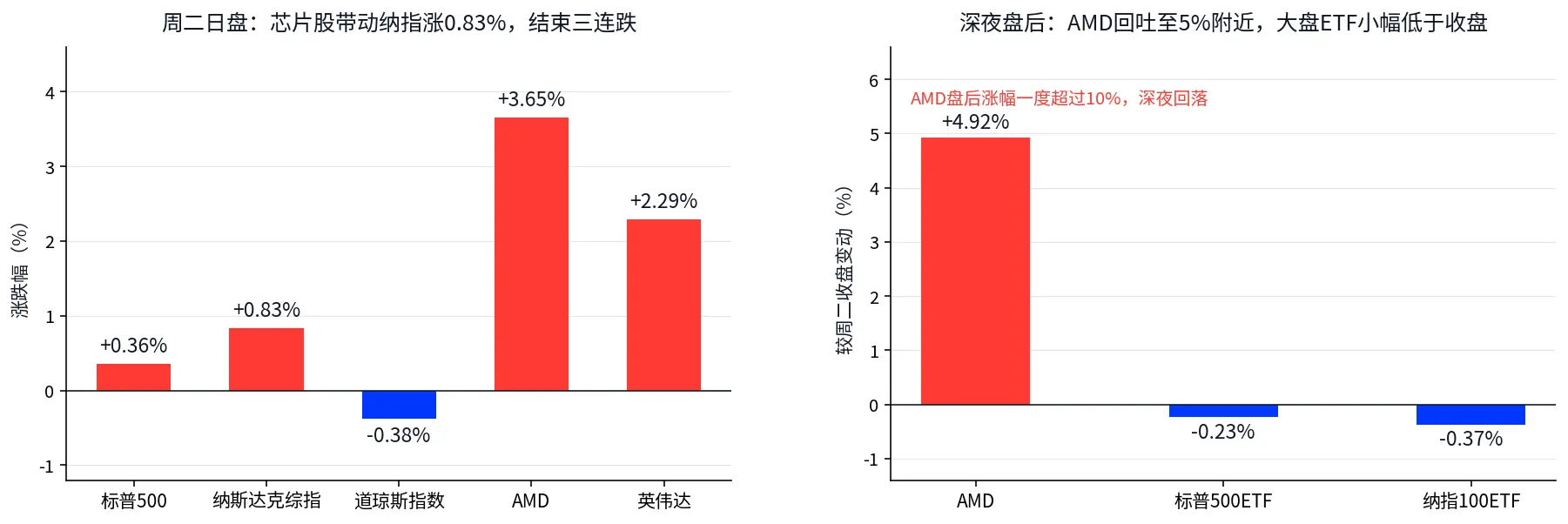
Comparison of AMD's and the U.S. stock market's fluctuations after the day session and late-night session on Tuesday.
1. AMD pushes growth expectations to 2027, with data centers expected to account for over 80%
The incremental aspect of this financial report is extending growth expectations from the next quarter to 2027, and whether this path can be established depends on delivery, profit margins, and cash flow.
Third-quarter revenue was $13.38 billion, a year-on-year increase of 45%, exceeding the previous guidance upper limit. Data center revenue was $8.55 billion, a year-on-year increase of 97%, accounting for 64% of total revenue, compared to 47% a year ago. The overall gross margin was 56%, an increase of 1.9 percentage points year-on-year, with operating profit of $3.9 billion, a year-on-year increase of 75%. Revenue from the client and gaming segment was $3.7 billion, a year-on-year decrease of 8%, while the embedded segment grew 29% to $1.1 billion.
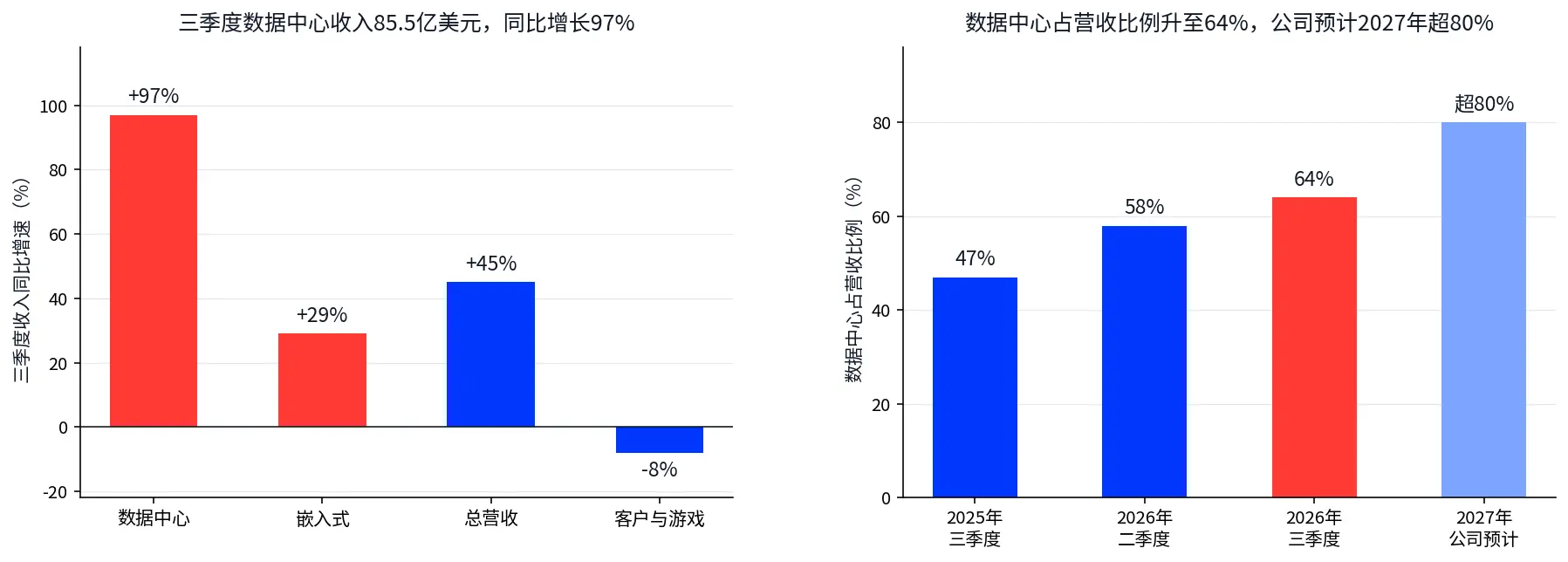
Third-quarter segment growth rates and changes in the proportion of revenue from data centers; the company expects this proportion to exceed 80% by 2027.
The guidance is more aggressive than the current quarter. The fourth-quarter revenue guidance is $17 billion, with a fluctuation of 3%, corresponding to a year-on-year growth rate of about 66% and a quarter-on-quarter growth of about 27%, with the data center segment expected to grow about 50% quarter-on-quarter, while the client and gaming segment is expected to decline over 20% quarter-on-quarter. The company expects the full-year data center segment revenue in 2026 to more than double from 2025. For 2027, the company expects total revenue growth to exceed 80%, which is more than double the long-term financial model growth rate provided on the analyst day in November 2025. By then, data centers will account for over 80% of total revenue, with server revenue doubling year-on-year.
Product progress aligns with guidance. The MI455X began mass delivery in the third quarter, and the first batch of Helios racks for Anthropic, Meta, Microsoft, OpenAI, and Oracle has gone live. The company expects a significant increase in Helios deployments in the fourth quarter, with partners like HPE, Dell, Lenovo, and Supermicro starting shipments.
The most critical number to track in this financial report is actually free cash flow. Free cash flow in the third quarter was $554 million, about 4% of the quarterly revenue. The company's explanation is that inventory and capacity investments have increased, including backend capacity locked in for data center demand. The more aggressive the guidance, the greater the cash consumption, and the realization of the 80% growth rate in 2027 depends on the supply chain and cash collection rhythm not encountering issues simultaneously. When assessing the credibility of this path, cash flow is a data point that issues warnings earlier than revenue figures.
2. Stock initially rose over 10%, then retraced half of the gains: What is the market digesting?
The after-hours surge was supported by the financial report, while the late-night retracement remains unclear whether it was due to profit-taking or changes in election pricing, as the overlap in timing cannot be attributed solely to one cause.
Multiple media snapshots in the early after-hours trading showed AMD rising between 7% to 11%. The after-hours quote at 19:52 Eastern Time was $507.70, up about 4.9% from the close of $483.90, with a cumulative trading volume of 35.17 million shares, exceeding the average daily trading volume over the past three months (about 20.67 million shares). During the same period, the after-hours quote for the S&P 500 ETF was $752.65, down about 0.2% from the close, and the Nasdaq 100 ETF was down about 0.4%. The 10-year U.S. Treasury yield was around 4.95%, basically unchanged from the close.
The timeline is as follows: predictions for Georgia's seats appeared at 19:18 Eastern Time, more than half an hour before the aforementioned after-hours quote, while AMD's retracement occurred between evening and night, overlapping with the window for ballot counting. Existing public data cannot separate the two explanations, and the pricing of futures and spot markets before and after Wednesday's opening will provide a clearer observation window.
3. The suspense of election night lies in the Senate: The House has been priced in, and a sweep is a tail risk
The Democrats securing the House is close to the market's baseline scenario, while control of the Senate remains uncertain, and securing both chambers is a tail risk that requires close attention.
According to CNBC and IBD's live coverage on election night, after the financial reports were released, futures rose, with S&P 500 futures briefly up 0.2% to 0.3%, Nasdaq 100 futures up 0.5% to 0.55%, and Dow futures slightly down, with reports clearly stating that futures were mainly following the after-hours financial reports. In terms of predictive markets, Kalshi priced the probability of the Democrats winning the House at about 94% (November 2), while CNBC reported that the pricing for the Senate Democratic contract exceeded 70%.
The first batch of heavyweight seat predictions came from Georgia. Decision Desk HQ predicted at 19:18 Eastern Time that incumbent Democratic Senator Ossoff would defeat Republican candidate Collins for re-election, just minutes before the state's polling stations closed, and the Associated Press had not yet followed up that evening. Georgia was one of the Democratic seats that Republicans most wanted to flip, and holding it is a plus for the Democrats' Senate path. The remaining suspense is concentrated on seats in Ohio, Maine, Texas, and other states, and results may not all be finalized that night. In 2020, Georgia's two Senate seats were not decided until the second round of voting in January 2021. In 2022, Senate control was not settled until December. Delays in vote counting are common in U.S. midterm elections.
Institutions have provided judgments on both possible outcomes for Wednesday. JPMorgan provided two scenarios: if the Democrats secure both chambers, the S&P 500 would likely drop about 0.5% on Wednesday; if the Republicans hold both chambers, it could rise by up to 1%. Citigroup's strategy team believes that if the Republicans lose the House but hold the Senate, it could actually be a tailwind for the stock market until the end of the year. These are just the views of relevant institutions. Previously, Man Group estimated that S&P 500 options priced in only about 1.2 times the usual daily volatility for the day after the election, provided that results could be announced quickly. Looking at these factors together, the market on election night generally thought: the House's control is basically reflected in the price, while the Senate is mostly a baseline scenario, with the real surprise being one party sweeping both chambers.
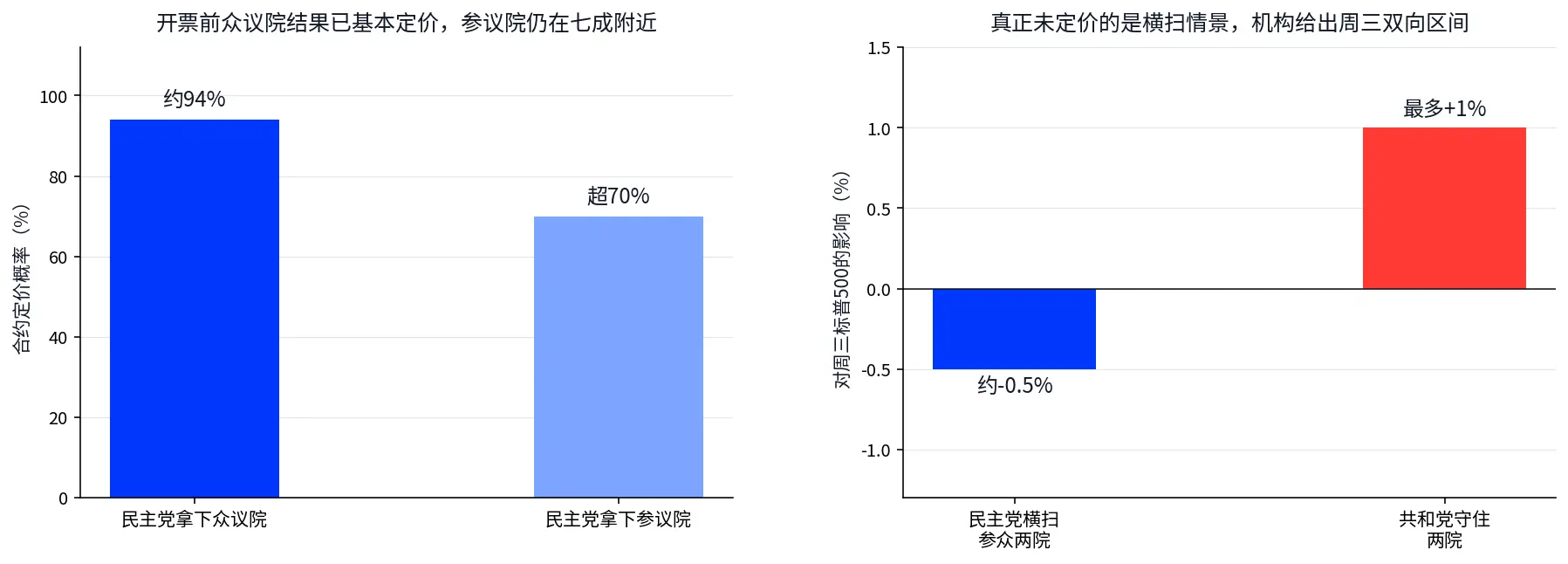
The probability of the Democrats securing the House has been priced in at around 94%, with institutions providing a scenario range for Wednesday between -0.5% and +1%.
4. What is the valuation premium for AMD buying? The next verification will be in the fourth-quarter financial report
The guidance was provided after the stock price had cumulatively dropped 17.6% over two days, and whether the premium can hold depends on whether the fourth-quarter data center growth and cash flow can be realized item by item.
Last Friday (October 30), AMD dropped 10.9%, and on Monday it fell another 7.5%, totaling about 17.6% over two days. At that time, the market attributed the decline to Intel's weaker outlook and concerns about the rhythm of computing power chain orders. It is precisely because it had already dropped so much that this better-than-expected financial report and relatively high guidance seemed more significant. The market had previously focused on the fourth-quarter guidance and the ramp-up of new products, and neither of these disappointed.
There are two tracking points. The first is whether the guidance for about 50% quarter-on-quarter growth in the data center for the fourth quarter can be realized, which will be first verified when the fourth-quarter financial report comes out at the end of January next year; in the same report, it is also important to see if the full-year data center revenue doubles in 2026. During this interim period, it is crucial to monitor the shipment rhythm of Helios and changes in the supply chain.
5. Hong Kong stocks saw a net buy of HKD 23.42 billion: The inflow is concentrated at the index level
The net buy of HKD 23.42 billion on a single day interrupted a continuous outflow over 14 trading days, with purchases concentrated in broad-based ETFs, which is not enough to confirm a comprehensive recovery of risk appetite at the individual stock level.
On November 3, the Hang Seng Index rose 0.57% to close at 23,525.97 points, and the Hang Seng Tech Index rose 0.74%, marking the third consecutive day of gains for Hong Kong stocks. Southbound funds had a net buy of HKD 23.42 billion throughout the day, with purchases totaling HKD 59.434 billion and sales totaling HKD 36.013 billion, marking a single-day high since May 16. Among the actively traded stocks, the Tracker Fund of Hong Kong saw a net buy of HKD 16.507 billion, the Southbound Hang Seng Tech ETF HKD 4.315 billion, and the Hang Seng China Enterprises Index HKD 4.309 billion, totaling about HKD 25.1 billion, which is higher than the total net buy for the day, indicating that some individual stocks were still experiencing net selling during the same period. The total trading volume for southbound funds was HKD 95.447 billion, accounting for about 40% of the total trading volume of HKD 236.404 billion in the Hong Kong stock market.
On the same day that the U.S. stock market was pricing in the elections and financial reports, some funds chose to buy into the index in the Hong Kong stock market. The concentrated inflow into broad-based ETFs is more akin to an adjustment of exposure to the overall market, interpreted as a stock-picking judgment on Hong Kong tech stocks, but existing data is insufficient. Whether the inflow can continue will depend on whether southbound funds maintain net inflows over the next three trading days.
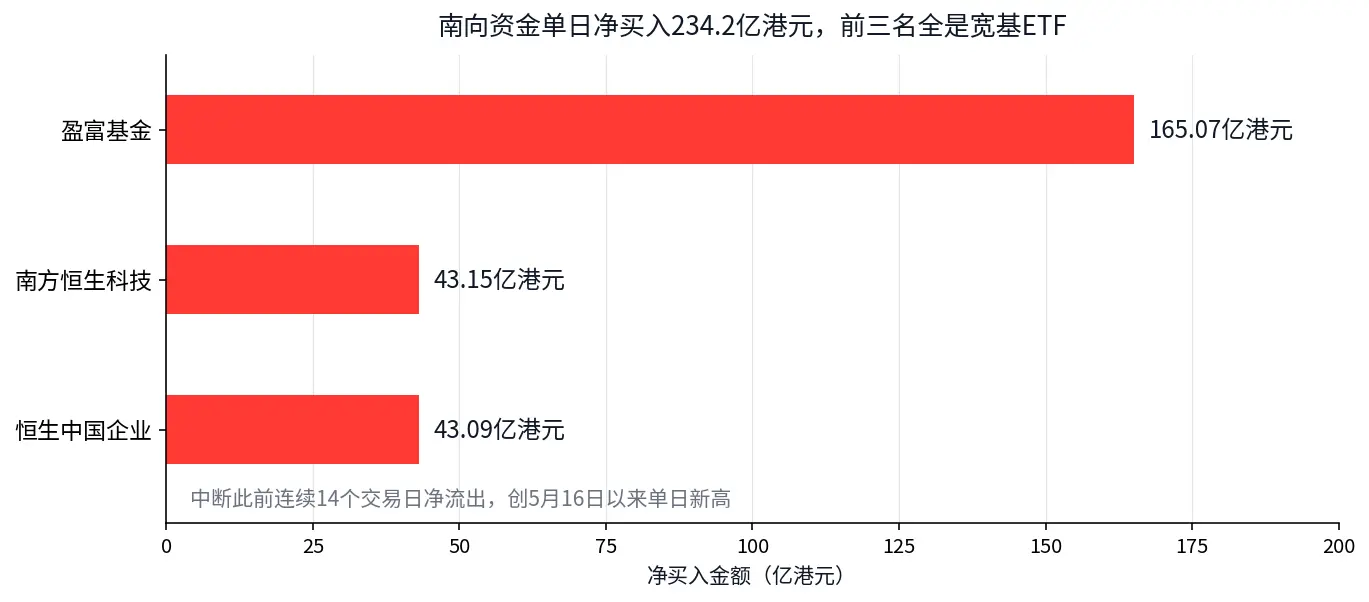
Southbound funds had a net buy of HKD 23.42 billion in a single day, with the top three net buys all being broad-based ETFs.
6. The next macro verification point: Friday's non-farm payrolls and interest rate expectations
The impact of non-farm payrolls on interest rate expectations depends on whether the Senate control has been determined before Friday.
On November 6 at 21:30 (Beijing time), the U.S. will release the October non-farm employment report, with the market expecting about 63,000 new jobs, compared to 29,000 in September. If the Senate control is clear before this, the non-farm payrolls will more directly reflect on asset prices. If key seats are still undecided, the market will have to digest two uncertain timelines simultaneously. On the AMD side, the next hard verification point will be the fourth-quarter financial report around the end of January next year, with prior observation points being the shipment rhythm of Helios and supply chain dynamics.
Both the election results and the realization of company guidance have uncertainties, and the price fluctuations of related assets are worth monitoring.
In conclusion: Three sets of numbers will determine how to view the market going forward
The first set is AMD's $17 billion, about 50% quarter-on-quarter growth in data centers, and total revenue growth exceeding 80% by 2027: they represent the growth commitments made by the company, corresponding to the verification windows for the fourth-quarter financial report and 2027 operational performance. The next step is to observe whether revenue, delivery, profit margins, and free cash flow can all be realized together.
The second set is the 94% and over 70% from election night: the transfer of the House is close to the market's baseline scenario, while the Senate still has uncertainties. One of the biggest potential variables in the market is whether the Democrats can secure both chambers and whether the final results can be determined in the short term.
The third set is the HKD 23.42 billion from southbound funds: purchases concentrated in broad-based ETFs cannot be directly equated with a comprehensive strengthening of Hong Kong tech stocks. The fund flows and buying structure over the next three trading days will determine whether this inflow has sustainability.
The short-term observation sequence is: first, see if the election results are finalized, then observe how Friday's non-farm payrolls change interest rate expectations; for AMD, the core verification points are the fourth-quarter data center growth and cash flow, while for Hong Kong stocks, observe whether southbound funds can maintain net inflows. All three require subsequent data verification and cannot conclude based solely on one trading day's gains or losses.
Disclaimer: The content of this article is for general information and market commentary purposes only, compiled based on publicly available information as of the time mentioned in the text. Relevant market data, expectations, and probabilities may change with market conditions. The views and investment strategies cited from third-party institutions, analysts, or other individuals only represent the opinions of the relevant third parties at a specific time and do not represent the views or recommendations of BIT. This article does not constitute investment advice, investment research, an invitation, solicitation, or recommendation for any securities, investment products, or trading strategies, nor should it be used as the basis for any investment decision. Financial markets carry risks, and securities prices and market performance may fluctuate; past performance and historical market trends do not represent or guarantee future results. Investors should independently assess the relevant risks based on their own circumstances and seek professional advice when necessary. BIT's Hong Kong stock trading services are not available to residents of Hong Kong or users in other restricted jurisdictions.
 Risk warning Risk warning