BTC $76,927.89 -0.47%
ETH $2,507.19 -0.86%
BNB $720.78 -1.69%
XRP $1.35 -1.16%
SOL $100.19 -1.36%
TRX $0.3395 +0.05%
DOGE $0.0835 -1.26%
ADA $0.2047 -1.82%
BCH $223.66 -3.35%
LINK $11.35 -1.47%
HYPE $77.77 -1.73%
AAVE $124.88 -0.81%
SUI $0.7131 -1.92%
XLM $0.1779 -1.30%
ZEC $1,120.58 -2.07%
AAPL $332.66 -0.13%
AMZN $255.62 -0.31%
GOOGL $338.82 -0.07%
MSFT $493.53 -0.20%
META $646.27 -0.16%
NVDA $215.87 -1.61%
TSLA $365.17 +0.01%
SNDK $1,583.59 -2.85%
INTC $99.76 -3.01%
SPCX $149.74 -0.23%
MU $944.05 -3.01%
AMD $506.18 -1.99%
BTC $76,927.89 -0.47%
ETH $2,507.19 -0.86%
BNB $720.78 -1.69%
XRP $1.35 -1.16%
SOL $100.19 -1.36%
TRX $0.3395 +0.05%
DOGE $0.0835 -1.26%
ADA $0.2047 -1.82%
BCH $223.66 -3.35%
LINK $11.35 -1.47%
HYPE $77.77 -1.73%
AAVE $124.88 -0.81%
SUI $0.7131 -1.92%
XLM $0.1779 -1.30%
ZEC $1,120.58 -2.07%
AAPL $332.66 -0.13%
AMZN $255.62 -0.31%
GOOGL $338.82 -0.07%
MSFT $493.53 -0.20%
META $646.27 -0.16%
NVDA $215.87 -1.61%
TSLA $365.17 +0.01%
SNDK $1,583.59 -2.85%
INTC $99.76 -3.01%
SPCX $149.74 -0.23%
MU $944.05 -3.01%
AMD $506.18 -1.99%

fud

FUD is an abbreviation for "Fear, Uncertainty, and Doubt," referring to the act of influencing public perception of something by spreading fear, uncertainty, and doubt. In the cryptocurrency field, FUD is often used to describe actions that attempt to influence market sentiment and price fluctuations by disseminating negative information. This strategy may be employed by competitors, market manipulators, or the media to achieve specific economic or strategic objectives.
All
Article
Flash

Ledger CTO responds to vulnerability FUD: The issue was fixed before it was disclosed, and users can safely use it by updating in a timely manner

Ledger's Chief Technology Officer Charles Guillemet stated that there has recently been "FUD" targeting Ledger in the market, as a smart contract security company claimed to have discovered vulnerabilities in the Ledger Ethereum application. Guillemet mentioned that there indeed were vulnerabilities related to certain Clear Signing processes in the Ledger Ethereum application, but these vulnerabilities were discovered by Ledger's security research team Donjon using AI-driven vulnerability research tools, and the fixes were completed and deployed two weeks ago. Users can obtain protection by timely updating their Ledger device firmware and applications.The relevant security company contacted Ledger's bug bounty program only after the fixes were completed, did not follow responsible disclosure processes, and did not communicate with the bug bounty team, yet implied in subsequent content that the issue had not been resolved. This approach is not true security research but rather a way to create panic for attention. AI is changing the cybersecurity landscape, and both attackers and defenders can enhance efficiency with AI, but AI-driven security research can only truly enhance the security of the entire ecosystem when basic security principles such as responsible disclosure and pre-release verification are followed.Guillemet finally reminded Ledger users to keep their device firmware, Ledger applications, and related software up to date to automatically receive the latest security fixes and research results. Users should not be influenced by the related "FUD" and should timely update their software and maintain safe habits.

Santiment: The Bitcoin long-short ratio surged to 2.23, reaching a new high for the year, which may indicate a short-term correction

The crypto sentiment platform Santiment published an analysis stating that the ratio of positive to negative comments about Ethereum has shifted from a strong FOMO sentiment in late April to a clear FUD sentiment now. Harvard University completely liquidated its $87 million Ethereum ETF one quarter after buying in; researchers from the Ethereum Foundation announced their resignations; and David Hoffman publicly stated his exit from the Ethereum project. The Santiment team interprets this trend as a mildly bullish signal, similar to the significant rise that followed the mid-2023 market sentiment low.Despite the panic sentiment, the number of non-bearish wallets for Ethereum remains as high as 192.92 million, more than three times Bitcoin's approximately 59 million. The activity in DeFi and staking trading surged at the beginning of the year and has since normalized, but the creation of new wallets continues to maintain a healthy growth rate. Fundamental data such as holders and activity do not support the claim that "the Ethereum network is dying." Additionally, the long-to-short ratio for Bitcoin has reached 2.23, the highest level since 2026. Previously, the highest daily long-to-short ratios often resulted in short-term price corrections, while extremely low short ratios indicate a local bottom. The current optimism stands in stark contrast to the outflow of short funds from ETFs, thus caution is warranted.

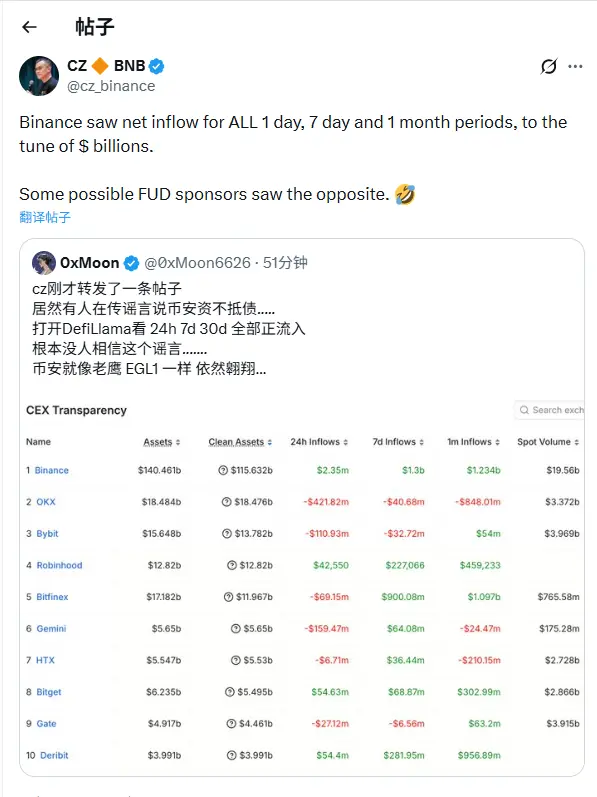
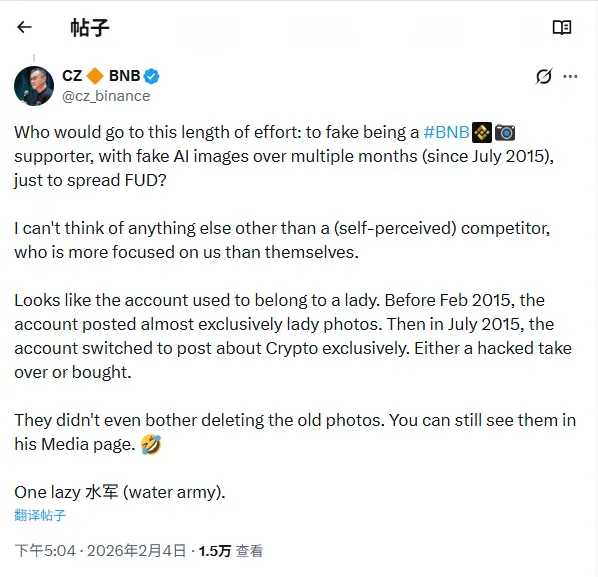
CZ responds to FUD: Binance did not sell $1 billion worth of Bitcoin, the SAFU fund will gradually buy Bitcoin over the next 30 days

CZ issued a response stating that over the past two days, some rather imaginative FUD has been observed, and he clarified each point:Regarding a circulating Polymarket screenshot that asked, "Will someone throw something at CZ's face during the crypto event in 2026," CZ stated that this event does not exist on Polymarket or any prediction market, and there is no so-called $7 million trading volume; the related screenshot is fabricated.On the claim that "CZ canceled the super cycle," CZ bluntly said this is an overinterpretation. He only mentioned that he is "not as confident as before."Concerning the rumor that "Binance sold $1 billion in Bitcoin," CZ clarified that it was Binance users who sold, not Binance itself. Changes in Binance wallet balances typically occur only when users withdraw funds; many users still keep their assets on Binance as a wallet after trading.Additionally, in response to the doubts about the SAFU fund not buying BTC, CZ stated that Binance has clearly mentioned it will complete the conversion within 30 days, suggesting that Binance's initial plan might be to gradually complete the purchases within these 30 days; then, close to the end of the 30 days, or on a weekly basis, transfer the funds to the corresponding addresses. Of course, it is impossible to see them buying through DEX. Considering Bitcoin's market cap of about $1.7 trillion, the impact of buying $1 billion in Bitcoin in batches over 30 days on the Bitcoin price and whether it enhances market confidence is left for the market to judge.

Former Citibank crypto research head: Arthur Hayes missed 3 key points in the FUD about Tether

In response to Arthur Hayes' doubts about USDT operations, former Citibank crypto research head Joseph stated on the X platform that @CryptoHayes' analysis missed several key points:Disclosure of assets ≠ total corporate assetsUSDT discloses reserves based on the "matching principle," but its undisclosed balance sheet includes equity investment income, mining operations, corporate reserves, and potential Bitcoin holdings, with remaining profits distributed to shareholders in the form of dividends.Ultra-high profit margins and equity valueTether holds $120 billion in U.S. Treasury bonds (with an annual yield of 4%), generating an annual net profit of about $10 billion starting in 2023 (with only 150 employees), making it the world's most efficient money printer;The equity valuation could reach $50-100 billion (recently planning to raise $20 billion for a 3% equity stake, with a high valuation but strong fundamentals).Comparative advantages of bank-level reservesTraditional banks maintain only 5-15% liquid assets, while USDT's collateralization rate is clearly higher.Key difference: banks have central bank lender of last resort support, while USDT relies on its own asset liquidity.Conclusion: Tether not only will not face a crisis but also controls the strongest profit engine in the crypto world.Subsequently, Tether CEO Paolo Ardoino expressed his gratitude for the support in the comments section.
app_icon
ChainCatcher Building the Web3 world with innovations.