Scan to download
BTC $77,217.06 -0.01%
ETH $2,120.84 +0.27%
BNB $655.90 +1.21%
XRP $1.36 +1.79%
SOL $85.67 +1.60%
TRX $0.3625 +0.15%
DOGE $0.1056 +1.29%
ADA $0.2458 +1.43%
BCH $378.64 +1.31%
LINK $9.55 +1.52%
HYPE $58.72 +7.27%
AAVE $88.23 +0.27%
SUI $1.11 +1.82%
XLM $0.1480 +3.21%
ZEC $636.91 -3.32%
BTC $77,217.06 -0.01%
ETH $2,120.84 +0.27%
BNB $655.90 +1.21%
XRP $1.36 +1.79%
SOL $85.67 +1.60%
TRX $0.3625 +0.15%
DOGE $0.1056 +1.29%
ADA $0.2458 +1.43%
BCH $378.64 +1.31%
LINK $9.55 +1.52%
HYPE $58.72 +7.27%
AAVE $88.23 +0.27%
SUI $1.11 +1.82%
XLM $0.1480 +3.21%
ZEC $636.91 -3.32%

supervision

Hainan Local Financial Supervision Bureau: Beware of the chaos of "pseudo exchanges" and reiterate the prohibition of RWA tokenization business within the territory

According to Hainan Daily, the Hainan Provincial Local Financial Supervision Administration has issued a risk warning regarding trading venues. Recently, the Hainan Provincial Local Financial Supervision Administration learned from relevant channels that certain entities are promoting under names such as "Hainan International Data Asset Exchange," "Hainan Data Exchange," and "Hainan Marine Exchange," claiming to legally conduct businesses related to RWA (Real World Assets) and RDA (Real Data Assets).Market entities are conducting business in violation of regulations under the guise of trading venues without approval, which is suspected of illegal financial activities and endangers public property safety. In response, the Hainan Provincial Local Financial Supervision Administration has the following risk warnings:Currently, there is no approved establishment of the "Hainan International Data Asset Exchange" within our province. The establishment of trading venues in our province must be approved by the provincial government (the list of approved trading venues can be found in the appendix). Without approval from the competent authorities, market operators are not allowed to use terms such as "exchange" or "trading center" in their registered names, nor can they engage in activities related to trading venues.The People's Bank of China, the China Securities Regulatory Commission, and eight other departments jointly issued a notice on further preventing and addressing risks related to virtual currencies, clearly stating that the regulation of the tokenization of Real World Assets (RWA) follows the principle of "strictly prohibited domestically, strictly regulated overseas." It emphasizes that conducting tokenization activities of Real World Assets (RWA) within the country, as well as providing related intermediary and information technology services, is suspected of illegal activities such as unauthorized issuance of token vouchers, unauthorized public issuance of securities, illegal operation of securities and futures businesses, and illegal fundraising, which should be prohibited.We urge investors to establish a correct investment perspective.

The Shanghai State-owned Assets Supervision and Administration Commission held a central group study meeting focusing on the development trends and response strategies of cryptocurrencies and stablecoins

ChainCatcher news, according to Caixin, the Shanghai Municipal State-owned Assets Supervision and Administration Commission held a central group study meeting on July 10, focusing on the development trends and response strategies of cryptocurrencies and stablecoins.He Qing, Secretary of the Party Committee and Director of the Municipal State-owned Assets Supervision and Administration Commission, pointed out the need to fully implement the spirit of the 12th Municipal Party Committee's 7th Plenary Session, adhere to innovation-driven development, maintain a keen awareness of emerging technologies, and strengthen research and exploration of digital currencies.We should adhere to the integration of production and data, exploring the application of blockchain technology in areas such as cross-border trade, supply chain finance, and asset digitization.We should maintain a proactive attitude, enhance our strategic agility and initiative, further promote the deep integration of technology, finance, and industry, better leverage the important role of state-owned assets and enterprises in technological innovation, industrial control, and security support, and make new and greater contributions to the construction of Shanghai's "Five Centers."

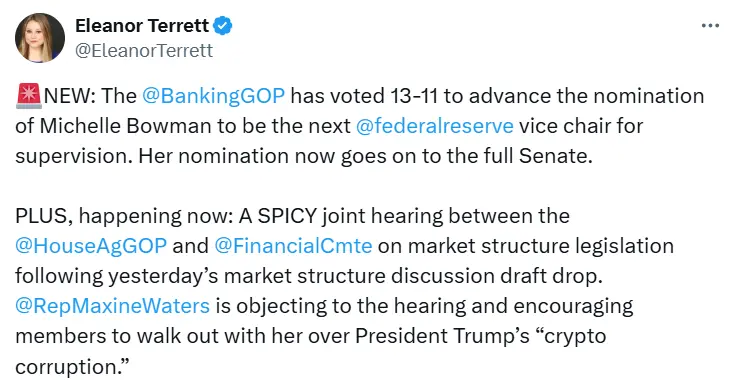
The new Vice Chair for Supervision of the Federal Reserve will lead the direction of cryptocurrency regulatory policy

ChainCatcher news, according to CoinDesk, earlier today the U.S. Senate confirmed that Federal Reserve Governor Michelle Bowman has been promoted to Vice Chair for Supervision. The new Vice Chair will have a say in both the banking access for cryptocurrencies and the issuance of stablecoins. The position of Vice Chair for Supervision was established after the 2008 global financial crisis to help the Federal Reserve focus on its regulatory responsibilities, distinct from its more well-known role in managing U.S. monetary policy.The banking sector has always been a pain point for the cryptocurrency industry. Previously, the Federal Reserve and the other two major banking regulators took a highly cautious approach to the crypto space, but in April of this year, they lifted previous restrictions on banks providing services to the crypto industry. The Federal Reserve's potential regulatory role for stablecoin issuers remains unclear, and related regulatory legislation is still under discussion.Republican lawmakers are working to exclude the Federal Reserve from stablecoin regulatory responsibilities, but the latest legislation under consideration still stipulates that the Federal Reserve will regulate stablecoins issued within banks and assess whether foreign regulatory bodies are adequately equipped to handle issuers outside the U.S.

The Central Commission for Discipline Inspection again discusses the case of Yao Qian using virtual currency for power and money transactions, emphasizing the importance of technological supervision in the financial sector

ChainCatcher News: The website of the Central Commission for Discipline Inspection and the National Supervisory Commission of China recently published an article pointing out that the integrity risks in the construction of financial information systems are becoming increasingly prominent, especially the issues of "difficult management, difficult supervision, and difficult accountability" caused by high professional and technical barriers.During the investigation of the corruption case of Yao Qian, the former director of the Science and Technology Supervision Department of the China Securities Regulatory Commission (CSRC), the discipline inspection and supervision team stationed at the CSRC discovered that he used virtual currency for power-for-money transactions, which were highly concealed and difficult to gather evidence. Yao Qian accepted huge bribes through his position, providing assistance to others in the procurement of information systems, involving project contracting, fund allocation, and other aspects.In response to the issues exposed by the case, the discipline inspection and supervision team proposed supervision opinions to the CSRC Party Committee, urging the strengthening of integrity risk prevention and control in information system procurement, and reinforcing system construction and implementation. At the same time, it emphasized the need to strengthen the education, management, and supervision of professional and technical personnel, especially the "top leaders," to correct the erroneous thinking of some cadres who believe their integrity risks are low, and to enhance their political awareness and discipline consciousness.In November last year, Yao Qian was subjected to disciplinary review and supervisory investigation by the discipline inspection and supervision team stationed at the CSRC and the Shantou Municipal Supervisory Commission in Guangdong Province for serious violations of discipline and law. This case further highlights the importance of integrity risk prevention and control in the field of financial technology supervision.

Bloomberg: Trump's tariff policy is definitely not beneficial for the cryptocurrency market, and the U.S. system lacks effective oversight of the president

ChainCatcher news, Bloomberg has questioned a series of actions taken by Trump in the cryptocurrency space since he took office, stating that President Trump and his entourage seem eager to establish their crypto empire. The family not only hopes to pave the way for the U.S. to support cryptocurrencies through more favorable regulations but also aims to secure a place in the positive outcomes.Based on the current (volatile) spot prices, the TRUMP holdings of entities related to Trump have an estimated book value of about $14.9 billion, with risks that are equally incredible. As token buyers and industry insiders see their opportunity to please Trump, the likelihood of quid pro quo and corruption will certainly increase. Additionally, moral hazard is also present.When Eric Trump tweeted a friendly suggestion that Ethereum is worth buying, he was by no means a neutral observer—when he removed the phrase "you can thank me later" from his post on X, he seemed to realize this. Meanwhile, the company has transferred most of its reserves to Coinbase Global Inc., and although it denied any plans to sell, it is difficult to assess what specific insider information might be involved. Trump's tariff policies are certainly not favorable to the crypto market, and the impact of Eric Trump's endorsements is similarly limited.Bloomberg believes that without effective enforcement and strengthening of regulations, oversight of the president's actions will become ineffective, and currently, Trump seems unencumbered by any constraints.

The Central Bank of Russia tightens regulations on digital assets and implements stricter standards for foreign exchange business supervision

ChainCatcher news, the Central Bank of Russia has introduced regulations to manage foreign exchange operations involving digital rights. According to Russian law, digital rights include electronic records such as cryptocurrencies, tokenized securities, and digital tokens. These rights represent claims or obligations related to assets or services. The new decree will take effect on January 11 and outlines the obligations of residents engaged in such transactions, aiming to clarify and strengthen the oversight of digital assets used for trade and payment purposes.A key requirement outlined in the regulation is that foreign trade contracts involving digital rights settlements must be registered with authorized banks. The document states: "Foreign trade contracts, including those settled using digital rights, must be registered with authorized banks. The registration thresholds for these contracts remain unchanged: import contracts exceeding 3 million rubles and export contracts exceeding 10 million rubles."In addition to registration, the Central Bank of Russia also explained: "The regulation specifies the documents and information that residents must provide to banks, including transaction data related to the transfer or receipt of digital rights as a means of payment under foreign trade contracts, as well as data related to other foreign exchange operations involving digital rights."By defining these requirements, the Central Bank of Russia aims to integrate digital rights into the broader financial system while reducing the risks associated with their use.

TD Cowen: Federal Reserve Vice Chair for Supervision Barr Resigns, Uncertain Outlook for Stablecoin Regulation

ChainCatcher news, Jaret Seiberg of TD Cowen Washington Research Group stated that the resignation of Federal Reserve Vice Chair Barr "is not as much of a victory for big banks as it appears on the surface."Seiberg noted in a report on Monday: "The Democrats will retain their majority on the Federal Reserve Board until early 2026, and given the need to confirm new regulatory officials, it is hard to see significant progress on regulatory easing this year."Barr has called for regulation of stablecoins over the past year and stated that stablecoins "borrow the trust of central banks." "The Federal Reserve is very eager to ensure that any issuance of stablecoins operates within an appropriate federal prudential regulatory framework so that they do not threaten financial stability or the integrity of the payment system," Barr said at a conference in Washington, D.C. in October 2023.For years, lawmakers have been working on legislation to regulate stablecoins, but the crux of the issue lies in how to allocate regulatory authority between state and federal levels. (The Block)In news from yesterday, Federal Reserve's Barr announced that he will resign from the position of Vice Chair for Supervision on February 28, 2025. The Federal Reserve's statement indicated that Barr will continue to serve as a governor of the Federal Reserve but does not intend to engage in significant rulemaking until a successor to the vice chair position is determined. Barr stated in the announcement that the "controversy" surrounding his position could distract the Federal Reserve's focus.
app_icon
ChainCatcher Building the Web3 world with innovations.