



What incremental value has Web3 created for brands?

 Summarize the issues of past IP-related NFTs while identifying some real values and opportunities.
*Written by: STARZQ, RUBY WANG, Web3Brand
The market has been extremely bearish for the past two weeks, and there has been a lot of discussion about whether "NFTs are dead." I also wrote a tweet titled Where are Crypto/NFTs now, and do they have a future? to express my views. It is no exaggeration to say that NFTs have reached a crossroads:
From a pessimistic perspective, the bubble of IP-type NFTs represented by PFPs has burst, reaching nearly the lowest point in the past 18 months.
From an optimistic perspective, the industry will have a clearer understanding of the value of NFTs, and past experiences will help future builders avoid detours.
I firmly believe in the value of NFTs, but value requires time and opportunity to be realized. As an "optimistic pessimist," my view is that this industry needs time (at least 2-5 years), needs value (not just narratives), and needs talents who have operated real business cases. All three are essential for the next bull market to erupt.
Ten months ago, I wrote the article Creating the Soul of a Web3 Brand: 3 Questions - Why, What, How, analyzing how to establish a Web3 brand. The "Why" and "What" still hold true today, but unfortunately, in terms of "How," many cases have not emerged.
What are the reasons behind this? How can more brands get involved? What experiences and opportunities are worth referencing for future projects?
This is a suitable time for review and summary, and I hope this article can serve as a "bridge," summarizing the issues of past IP-type NFTs while also identifying some real values and opportunities to assist the builders in this industry.
1. What Were the Issues with Past IP-Type NFTs?
TL;DR
Conflict between time and value
Ambiguity in investment identity
Conflict between income and environment
Conflict between scale and scarcity
Conflict between community stability and price volatility
1.1 Conflict Between Time and Value
Ruby elaborated on this in her article Time and Patience are the Rarest Resources for Brands two weeks ago.
Many IPs (e.g., BAYC/Azuki) proclaim to be the "Disney of the new era," seeing the value of top IPs multiplied by the financial aspect of NFTs combined with community attributes, believing they can create high-value, highly sticky IPs in a shorter time. However, they overlook that building an IP requires time and cost.
Disney's first well-known IP, Mickey Mouse, debuted in 1928 and became a main IP by 1937 (producing 12 related films annually), taking 10 years.
In the era of the internet and social media, Pop Mart was founded in 2010 and gained nationwide recognition by 2015, taking 6 years.
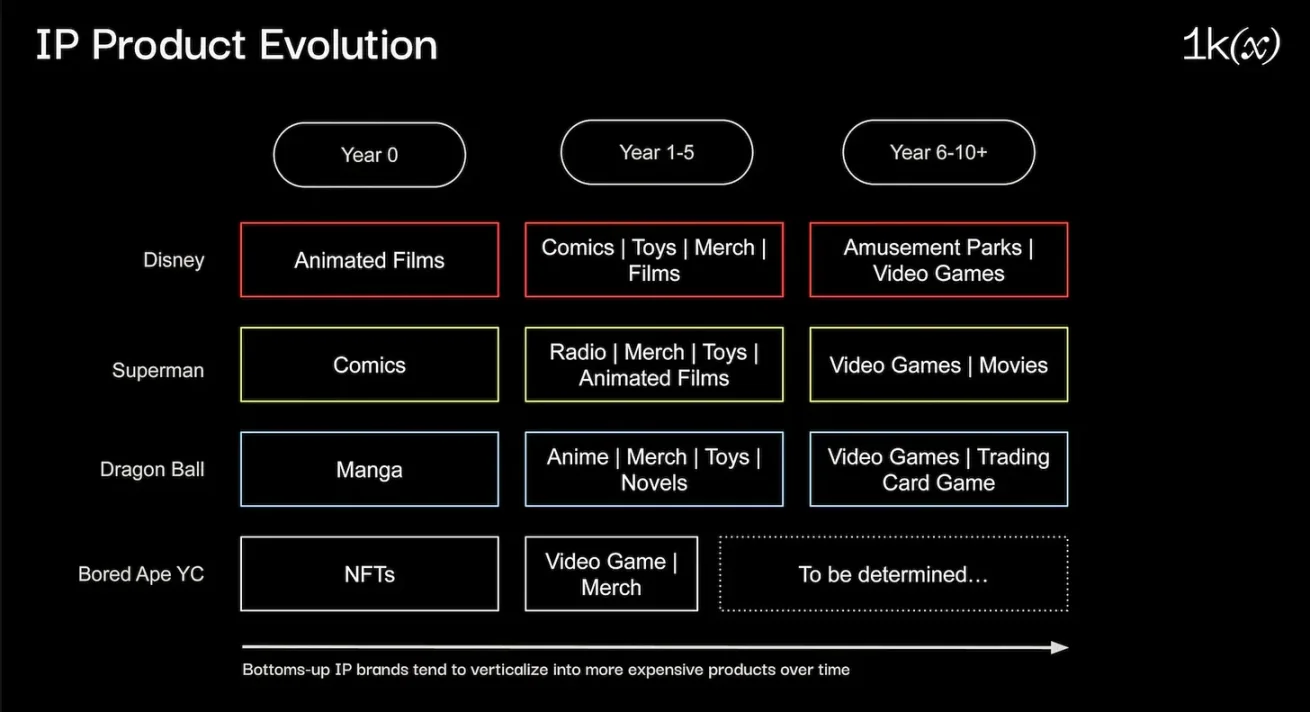
Let's look at the time and cost required to produce different types of content (from the 1kx report, link at the end):
Games: Creating a AAA-level video game takes 5-6 years, over 100 employees, and more than $80 million in investment.
Animation: Producing a 12-episode animated series requires tens of millions of dollars in investment and several years.
Movies: Producing a high-quality film typically requires $50 million to $100 million and several years.
It can be seen that even if NFTs accelerate fundraising and dissemination cycles, the content production cycle cannot be compressed. We can conclude that the creation of IP and content requires a reasonable cycle of 5 years; everything must develop in accordance with basic laws.
Moreover, even if this funding and time cost is invested, the probability of success should also be mentioned. For example, a common saying in the film industry is that one film makes a profit, two break even, and seven lose money.
However, current NFT players have overly high expectations and cannot wait that long, hoping project teams can provide good news every month or even every week to boost floor prices; project teams also ride the wave or half-heartedly use hype to raise prices.
But after the hype, there is often a mess left behind, hurting players and the industry.
Investing in IP is undoubtedly a form of venture capital. In this industry, the exit cycle for dollar funds is 5-8 years, and innovative companies also need 5-8 years to turn valuation into value; this setting makes sense.
1.2 Ambiguity in Investment Identity
This is the second issue currently faced by IP-type NFTs. Project teams often rely on selling NFTs for the first round of fundraising, while buyers view NFTs as a hybrid of consumption and investment. In fact, NFTs possess "investment" attributes.
However, from a functional design perspective, NFTs are almost not directly linked to the project's value. IP authorization counts as one (most people find it hard to use, but it's better than nothing), and value realization relies entirely on the project team's "empowerment." Here are two issues:
In the "Conflict Between Time and Value" section above, project teams do not have enough time to create actual value and often empower through "nested dolls." Once the nesting fails, a collapse occurs.
Project teams have no responsibility to provide "empowerment." You think you are buying stocks, but in reality, it is just a small image.
Leonidas shared a particularly insightful observation: the value of art collectibles comes from the past, while the value of stocks is priced in the future. Clarifying one's identity as a collector or investor is crucial.
Buyers hold an "investment identity" that lacks confirmation from off-chain laws and on-chain contracts, leaving their rights unprotected, and project teams rug-pulling has become the norm.
1.3 Conflict Between Income and Environment / Conflict Between Scale and Scarcity / Conflict Between Community Stability and Price Volatility
I have elaborated on these three points in the article Companies Need to Build on Things Beyond NFTs, quoting directly:
1.1 NFTs cannot serve as a primary source of income because they are too reliant on the macroeconomic environment.
For example, in a bear market, no one trades, and project teams cannot earn royalty income.
1.2 NFTs need to have scarcity, but companies/communities need scalability; these two are inherently conflicting.
If users must purchase NFTs to use products, it clearly limits the company's growth.
1.3 Communities built on NFTs are unsustainable because when prices drop, people's attention also wanes.
Countless communities are active when prices rise but dwindle and fall silent when prices drop.
Azuki's recent Elemental release hit all three points:
No royalty income in a bear market, leading to the launch of new projects.
The new project was intended to expand the circle, but because it resembled the OG too much, it affected the scarcity of the first generation.
Price fluctuations directly caused the community's largest split and loss.
2. Web3 Brand: 3 Questions That Must Be Answered
For Web3 brands to be widely adopted, the following three questions must be answered so that brands and users can form a healthy relationship, driving the brand forward while enhancing user experience and rights.
What incremental value does Web3 create for users?
What incremental value does Web3 create for brands?
How can brands better distribute this incremental value?
In the previous article Creating the Soul of a Web3 Brand: 3 Questions - Why, What, How, I analyzed more from the user's perspective. Web3 undoubtedly enhances user rights, creating new assets and identities for users, meeting the "sovereign individual" demand for a triad of "consumption + assets + digital identity."
However, for the whole thing to work, the second and third questions also need to be answered because:
Ultimately, user rights are still provided by brands. If brands cannot benefit from Web3, they naturally cannot provide more rights to users. Many friends face this soul-searching question when communicating with brands: Why should I use Web3, what are the benefits? (This month, I also discussed this issue intensively with several group friends.)
Attached is a comment from a certain big shot: "Why is everyone more positive about AI than Web3? Because AI is a technology that improves efficiency and benefits everyone; but if Web3 only makes value distribution fairer without increasing value, the value of merchants/brands/platforms/governments is reduced. Why should they embrace it?"
When brands benefit from Web3, if the distribution is done well, they naturally become more attractive to users; but if the distribution is poor, it often backfires. A recent typical case is Azuki Elemental, where the project team raised 20,000 ETH but did not provide matching benefits to holders (especially for Azuki OG holders and BEANZ holders), leading to the largest community FUD and a significant split and loss.
In the past 10 months, we have researched and interviewed many projects, and at this time, we will sort through and attempt to answer these two questions:
What incremental value does Web3 create for brands?
How can brands better distribute this incremental value?
Due to space limitations, this article will first answer the question "What incremental value does Web3 create for brands?" and next time we will address "How can brands better distribute this incremental value?"
3. What Incremental Value Does Web3 Create for Brands?
I have summarized four relatively solid incremental values:
Higher transparency in fundraising
Lower-cost customer acquisition
More effective user loyalty
Community
Let's elaborate on these points.
3.1 Higher Transparency in Fundraising
For small and medium brands/individual creators, the first round of startup funding is always challenging. In the past, these roles mainly relied on crowdfunding platforms for fundraising, but they encountered the following issues, which became user concerns about this form of crowdfunding (thanks to Felix Wu, founder of Elephant Point):
Users do not gain any "ownership" through crowdfunding; their rights depend solely on the project team's documentation, and whether users are given rights relies on the project team's conscience.
Since users do not have "ownership," project teams have no responsibility to provide sufficient transparency, making it difficult for supporters to understand how funds are used and the project's progress.
Crowdfunding platforms generally have regional restrictions, and user payments are often tied to identity verification, making global crowdfunding challenging.
Web3 can better solve the above three problems:
NFTs provide ownership of assets, and combined with tokens and DAOs, users can become "shareholders" of the project, entitled to enjoy corresponding rights.
Based on ownership + on-chain data, users can fully understand the movement of every fund.
NFTs/blockchain inherently support global payments, easily facilitating global crowdfunding.
At the same time, Web3 also offers additional benefits to both users and project teams.
Users:
Asset liquidity: Since users own the assets, they can trade them, increasing liquidity; they can also enjoy returns from asset appreciation.
Interactivity: Crowdfunding typically only provides access to a product or service, while NFTs can exist in various forms such as virtual goods, artworks, virtual land, game items, etc., providing more interactivity and practicality.
Project teams:
- Royalties: When NFTs are traded in the secondary market, project teams can earn royalty income from each transaction.
Two typical crowdfunding cases:
The documentary "Ethereum: The Infinite Garden" raised 1,035 ETH on Mirror. The documentary is completed and in editing. All supporters will receive different levels of NFTs, and their names will be included in the credits. The successful fundraising of over 1,000 ETH was significantly aided by the efforts of community OGs and members.
In a previous introduction of BlackBird, Gertrude's (a Jewish community restaurant in New York City) raised $55,000 through membership NFTs. Members are divided into three levels: gold, diamond, and pearl, providing a range of cool privileges for the restaurant's future best customers, from SMS concierge service to personalized pilot jackets, and even dinner parties cooked by meme king Eli.
Many project teams issuing NFTs are essentially crowdfunding, but the user rights part is very ambiguous, which is also a major reason for rug pulls and disputes. I will continue to elaborate on this in the next article "How Brands Can Better Distribute These Incremental Values."
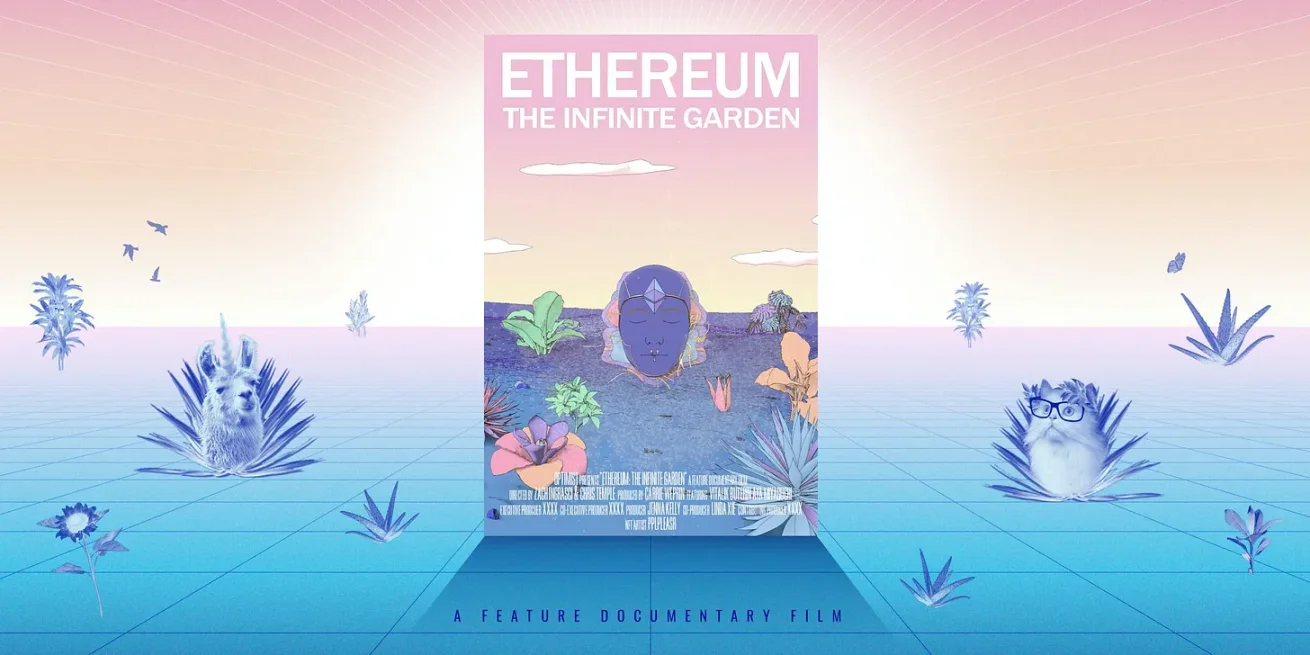 Documentary "Ethereum: The Infinite Garden"
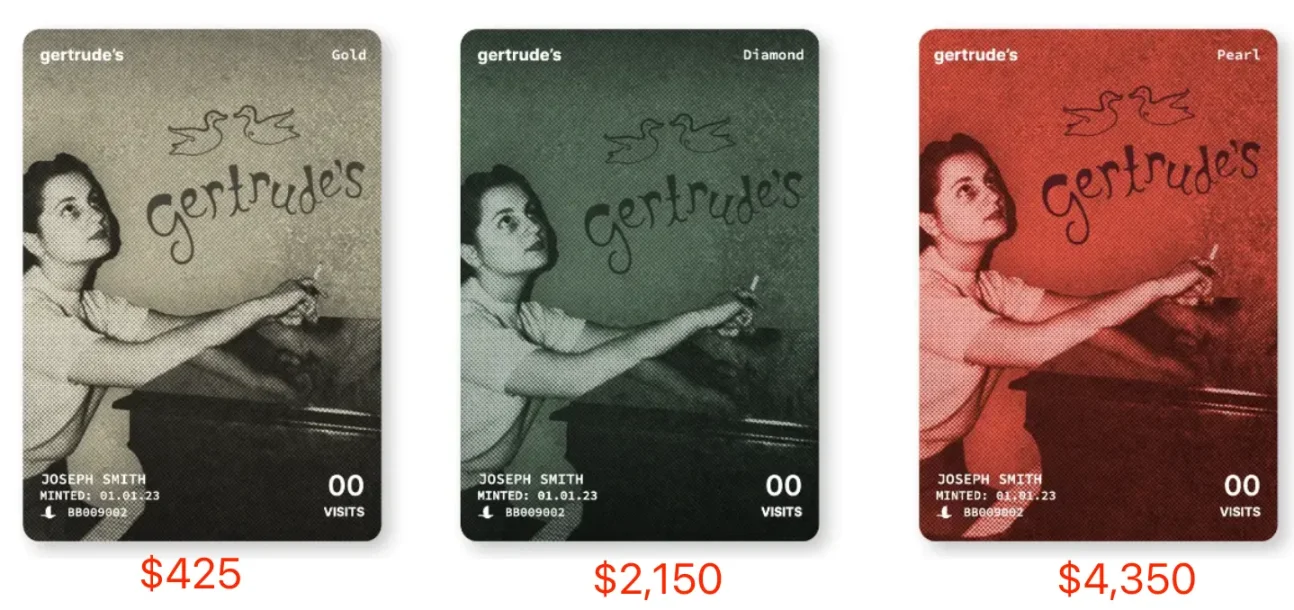 Gertrude's (a Jewish community restaurant in New York City) membership NFT
3.2 Lower-Cost Customer Acquisition
For Burger King, what is the most precise, efficient, and low-cost way to acquire customers?
Get the customers from McDonald's across the street to come in.
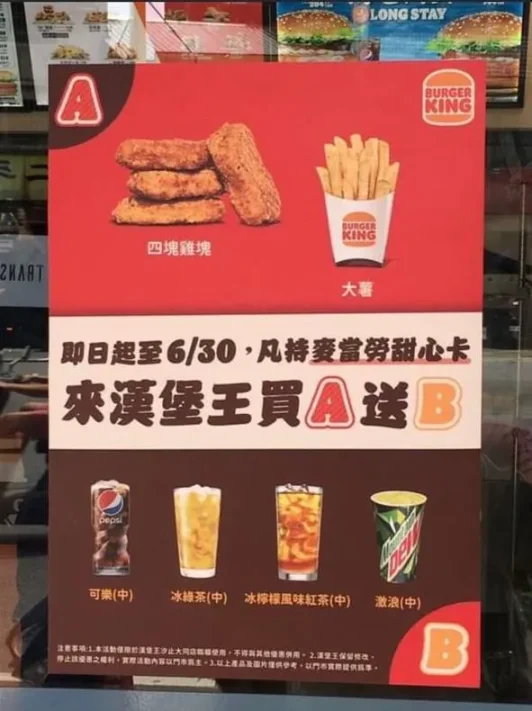
Thanks to lman for sharing this interesting case
What we have been talking about, Open Loyalty, has been practiced by offline merchants at an ultra-low cost. Similar cases are numerous:
Zhejiang Province: Friends from Sichuan can enter a scenic spot for free with their ID.
Restaurant A: Hold a badge from a certain big company to get a 10% discount.
Store B: Hold a certain passport to enjoy specific discounts.
The McDonald's Sweetheart Card, ID, big company badge, and passport are essentially tokens that identify user identities, helping merchants find precise customers more accurately and at a lower cost.
Offline merchants' Open Loyalty: The foot traffic outside the store is a public membership pool; I can obtain the most precise users through some form of user identity verification.
By turning these physical tokens into NFTs/SBTs, customer acquisition efficiency can be further enhanced:
Users cannot carry their McDonald's Sweetheart Card, ID, big company badge, and passport every day, but NFTs can be stored directly on their phones.
If you are an online business, asking users to provide physical tokens is very cumbersome.
Physical tokens also carry the risk of forgery, while NFTs inherently support on-chain verification, making forgery difficult.
NFTs are a digital representation of membership identity, making it easier for brands to manage CRM.
NFTs also possess liquidity and can bridge online and offline, making them more attractive to users.
Of course, brands may worry that this opens up their membership to others. In fact:
If you are an offline merchant, the moment a customer walks out the door, whether you open it or not, they are a "public member."
If you are a restaurant brand, you cannot expect users to consume in your store for every meal.
If you are a small or medium brand, your top priority should be to consider acquiring new customers through collaboration rather than confining existing customers.
In the current fiercely competitive brand environment, customers cannot be "contained"; enhancing your product competitiveness is the essence.
Moreover, offline merchants have more motivation to try Web3 because:
Acquiring users through centralized online platforms is inefficient and costly; there is a steep conversion rate between users obtaining coupons online and consuming offline, and they need to pay a tax to the platform.
In reality, their customers are right outside the door; they just need better rights design and identity verification to access them. Web3 is the best way to do this now.
This week, lman and I also discussed this topic in depth:
Transitioning from [centralization] to [decentralization] is difficult because it involves a redistribution of interests.
However, moving from [decentralization A] to [decentralization B] is relatively easy; technological upgrades bring value increases. Offline commerce is essentially a decentralized physical world and an excellent place to practice on-chain digitization and open loyalty.
Writing this, I better understand why Ben Leventhal wants to create a Web3 "Dazhong Dianping" BlackBird, establishing a "public points alliance in the restaurant industry," which perfectly combines all the above features: offline, dining, small and medium brands.
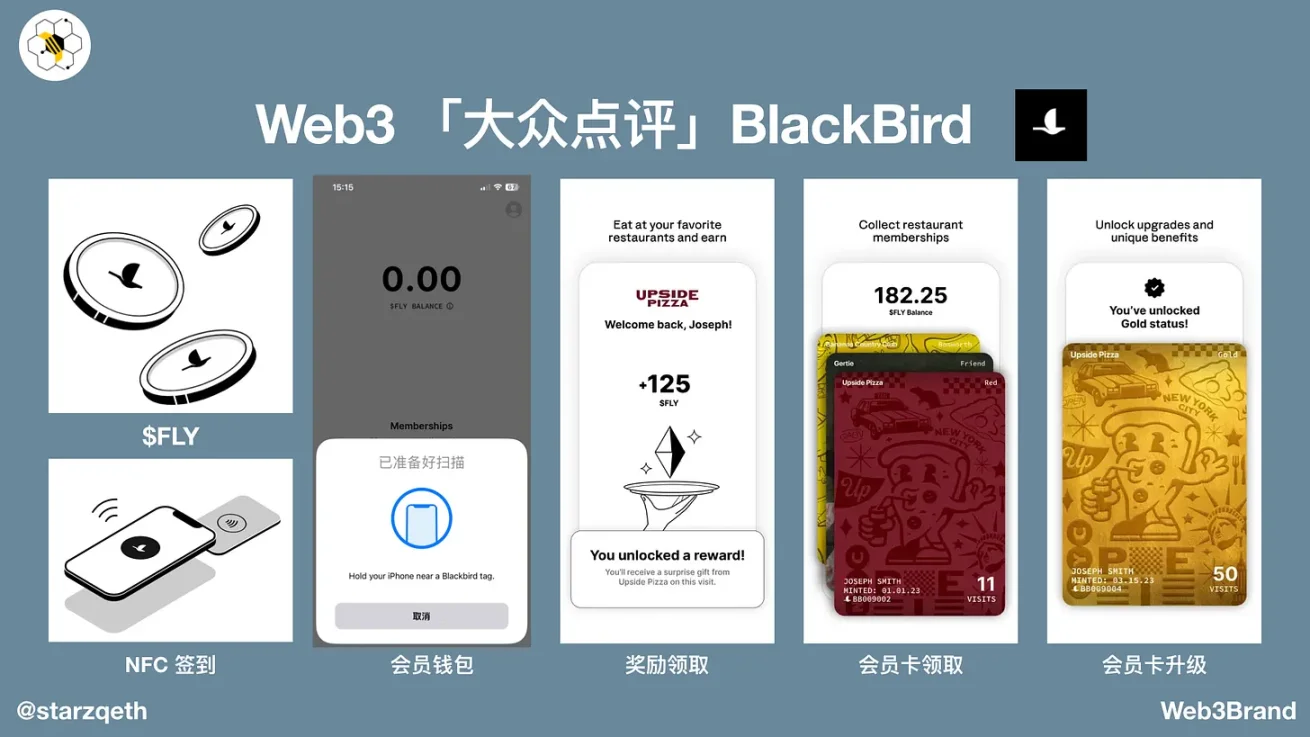
3.3 More Effective User Loyalty
We have written many articles and cases about user loyalty, and its effectiveness is reflected in the following three aspects:
Creating a win-win situation for brands and users: By using NFTs, brands can unlock external positivity, turning points from brand liabilities into user assets, enhancing user stickiness.
Turning passive marketing into active exploration: NFT + participate-to-earn encourages brands to gamify the process, making content consumption a fun activity.
Brand collaboration reduces costs and increases efficiency: Tokens are the new API.
Let's elaborate on each point.
3.3.1 Creating a Win-Win Situation for Brands and Users: Unlocking External Positivity Through NFTs, Turning Points from Brand Liabilities into User Assets, Enhancing User Stickiness
The more active users are, the more points they should enjoy; however, in traditional loyalty programs, points are liabilities for brands, and brands limit the quantity and speed at which users can redeem points, resulting in highly active users not enjoying matching rights.
Starbucks allows users to exchange points for NFTs in its new Web3 loyalty program, Odyssey; at the same time, Starbucks' brand power brings external buyers for NFTs, becoming an additional asset for users. The transaction itself also brings enjoyment, and the money earned from selling NFTs can even incentivize users to embark on more Odyssey journeys.
A user who earned $79 stated that it was just enough for him to buy gift cards and coffee during another Starbucks Odyssey journey. When his points reach 500, he can redeem them again for NFT stamps, creating an infinite collection game.
Starbucks also tested the paid NFT Siren Collection, with a mint price of $100 and a quantity of 2k, selling out in 18 minutes, with the floor price once exceeding $600.
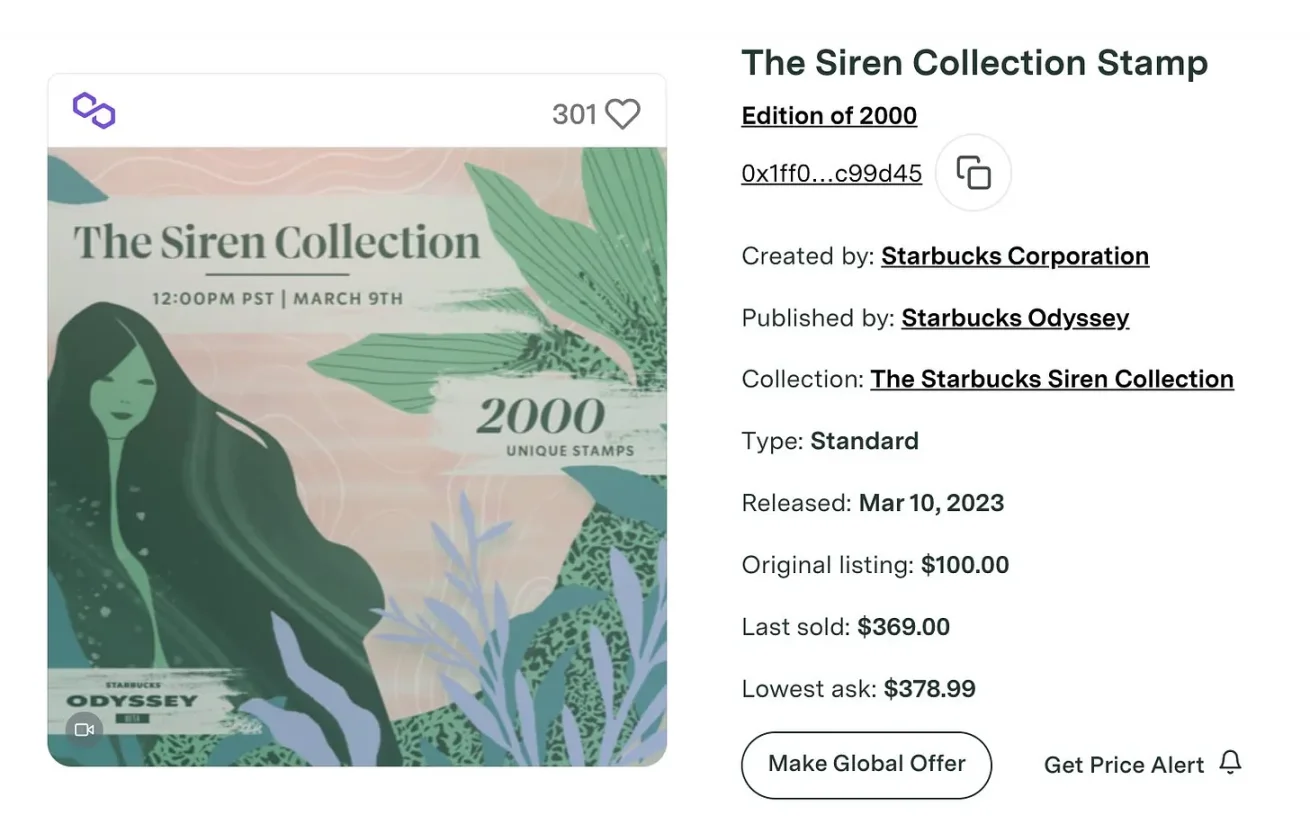
Starbucks Paid NFT Siren Collection
The value anchors behind these NFT prices are:
The market recognizes the value of Starbucks membership, attracting external partners (such as Michelin restaurants, Burger King, or Netflix) to create a new game layer on top of traditional loyalty programs, rewarding user participation in a different way and experience. The first external co-branding is Aku, and Starbucks Odyssey will launch "Aku Adventure" on July 17, where Odyssey members complete tasks with Aku and receive NFTs designed by Aku.
Starbucks can create more gamified experiences based on NFTs, empowering NFTs to create value. For example, when launching the second paid NFT First Store Collection, users with two Starbucks stamps (NFTs) can mint three hours early, encouraging users to actively collect stamps.
NFTs are also collectibles, and users who enjoy collecting stamps are also part of the buying market.
3.3.2 Turning Passive Marketing into Active Exploration: NFT + Participate-to-Earn, Encouraging Brands to Gamify the Process and Make Content Consumption Fun
Directly quoting Joe, co-founder of Forum3:
When you enter your first Starbucks journey, it will take you on a tour of their coffee farm in Costa Rica and ask questions to earn points and rewards. This experience is really cool and super fun. The feedback has been excellent: people say, "I didn't know I wanted to learn this or needed to watch this video, but it was really cool. I feel like I learned something and fell in love with the Starbucks brand."
Interestingly, these content snippets existed before Odyssey, but no one paid attention, interacted, or communicated. When you package it as an incentive rather than just a sales pitch, the entire experience changes completely.

3.3.3 Brand Collaboration Reduces Costs and Increases Efficiency: Tokens Are the New API
In the Web2 or traditional business world, user data is stored in various brands' centralized servers like isolated islands. For two brands to collaborate, they need to connect through APIs, also known as API integration. The biggest obstacle here is that only a few brands have the development and business capabilities to create and integrate APIs, limiting user choices and raising data privacy issues.
Take Starbucks' rewards together program launched at the end of 2022 as an example. The first partner was Delta Airlines. If you are a member of either Starbucks or Delta Airlines, you can connect your Starbucks account with your Delta Airlines account. Every time you complete certain actions in Starbucks or Delta Airlines, you will receive rewards from both sides. For example, for every $1 spent at Starbucks, you accumulate stars while also earning 1 mile in Delta Airlines rewards; after booking a Delta flight, you can earn double stars on qualifying purchases at Starbucks.
This is a typical joint loyalty system, "Your membership is my membership." However, they took years to establish this joint loyalty system because different companies have their own databases, tech stacks, and infrastructures, and must build APIs to allow external access to their data, which requires time, manpower, and funding, and the design and interaction of APIs require extensive discussion and communication between both parties.
Starbucks is already a very strong international brand in IT capabilities, and if it is this challenging for them, it will be even harder for other brands.
Victor, CEO of Smart Token Labs, shared an interesting little story that inspired him to achieve "user-side integration" through Web3, using tokens as integration points to connect various third-party services at almost zero cost:
A few years ago, Victor's wife was the head of APAC Partnerships at Booking.com. At that time, she wanted to collaborate with some attractions in Singapore to offer discounts to users who had already purchased tickets. However, these attractions had no capability to open their data, and the collaboration fell through.
If these tickets were NFTs, the collaboration would be very simple. In other words, Booking could directly provide permissionless benefits to these users.
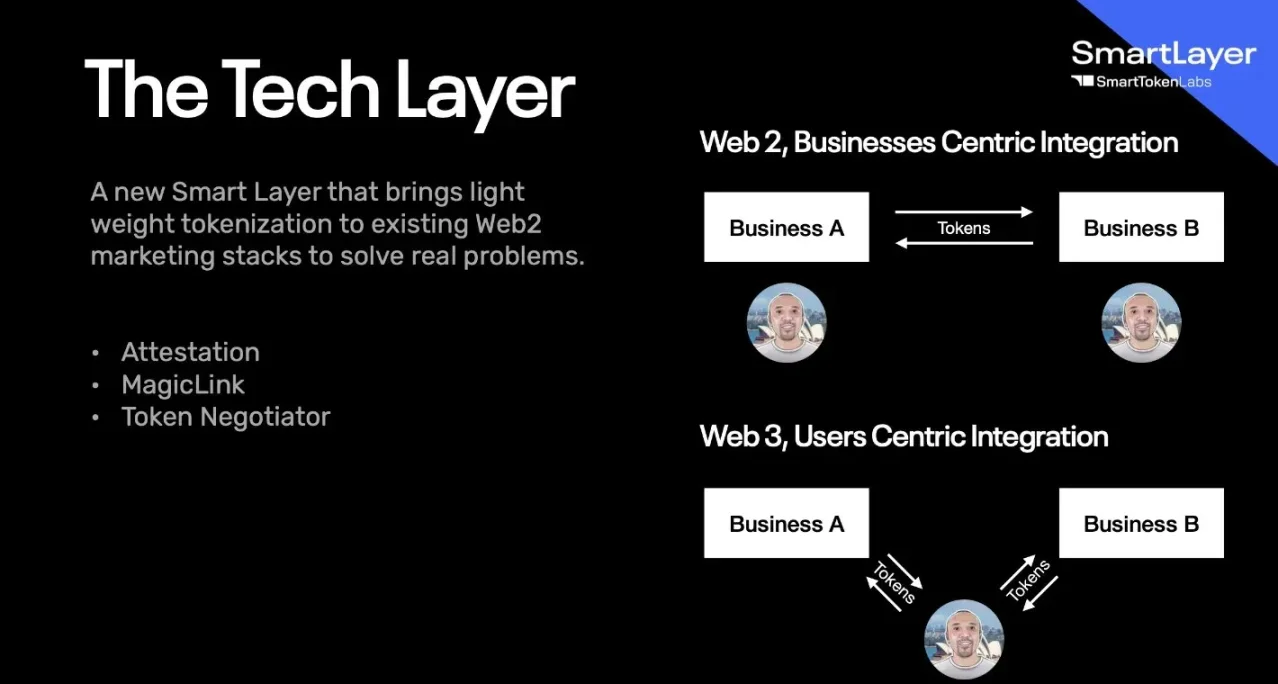
NFTs have brought about a paradigm shift in "integration," transforming the brand-centric API integration of Web2 into user-centric token integration in Web3. Based on the open model, open data, and open consensus mechanism of NFTs or blockchain, everyone can play the same game, making collaboration exceptionally simple. One-sided cooperation can even be established without communication, as data reading is permissionless.
User-centric token integration brings at least two benefits:
The threshold for brand collaboration is greatly lowered.
Since it is user integration, brands must provide user rights, enhancing user experience.
In our previous article Achieving Zero-Cost Permissionless Benefits Through Off-Chain NFTs, we also shared corresponding cases. At the Ethereum EDCON 2023 held in Montenegro from May 19-23, attendees verified ticket ownership at a very low cost (through off-chain NFTs provided by Smart Token Labs) and could claim various benefits provided by third parties on the conference's official website and offline, achieving Open Loyalty. For specific details, please refer to the articles in the appendix.
- Another case is the recently concluded Montenegro EDCON, where ticket tokenization allowed attendees to receive at least 25 benefits, from free minting of EDCON-related derivatives like Cool Cat to the opportunity to obtain 50 'Njegusi Prosciutto' from one of the famous local Montenegrin restaurants.
3.4 Community
When I wrote the article Creating the Soul of a Web3 Brand: 3 Questions - Why, What, How ten months ago, "community" was the key difference between Web3 and Web2 brands and also the core competitiveness of Web3 brands.
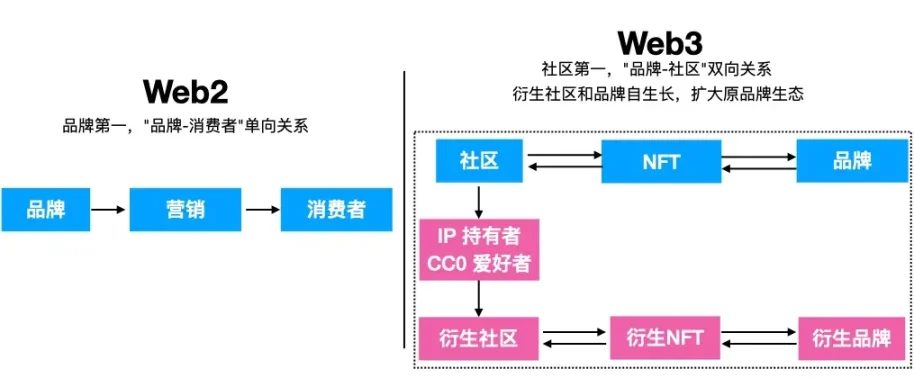
However, looking back, the vast majority of project teams have benefited from the community more than they have given back to it; coupled with the extreme price volatility of NFTs, this leads to a series of community issues, including backlash against project teams.
Nonetheless, it is undeniable that the community is the greatest leverage that Web3 brands can utilize. In this article, I also separate these two aspects, answering "What benefits does the community bring to brands?" and "How to distribute benefits and operate the community more healthily?"
The greatest benefit that Web3 communities bring to brands is the incubation and dissemination of brands/IPs.
Based on the community, brands/IPs can be incubated quickly: by issuing NFTs, funds can be raised while quickly testing the stickiness and audience of the IP, iterating broader products and experiences.
Compared to Web2 IPs, Web3 IPs have lower starting personnel numbers, lower capital costs, higher capital utilization efficiency, faster iteration, and lower time costs (IP-type NFT projects have all benefited from this, with typical cases being Yuga Labs/BAYC derivative brands).
Incubation does not even need to be completed by the official; project teams do not need to rack their brains for ideas; they just need to provide good toolkits and reasonable incentive mechanisms, and the community will spontaneously create, even turning into new physical products (for example, the previously introduced FWB x Taika).
Based on the community, IP and brand dissemination can occur more rapidly.
Frank and Kevin, the founders of Degods and Moonbirds, both mentioned in an interview that NFT holders are more like brand advocates and disseminators (affiliates). The emergence of de-id is also based on this thinking.
Daniel, the new CEO of Yuga Labs and former Blizzard executive, also believes that achieving low marketing costs through tight community word-of-mouth dissemination is very important in the gaming industry: "If influencers on social media do not give you high praise, your game is unlikely to have a future."
A report from 1KX states: "We believe that when consumers own their assets in a mutually beneficial environment, they will be incentivized to promote intellectual property because it becomes a place where holders feel valued, ultimately leading to deep loyalty, commitment, and promotional motivation."
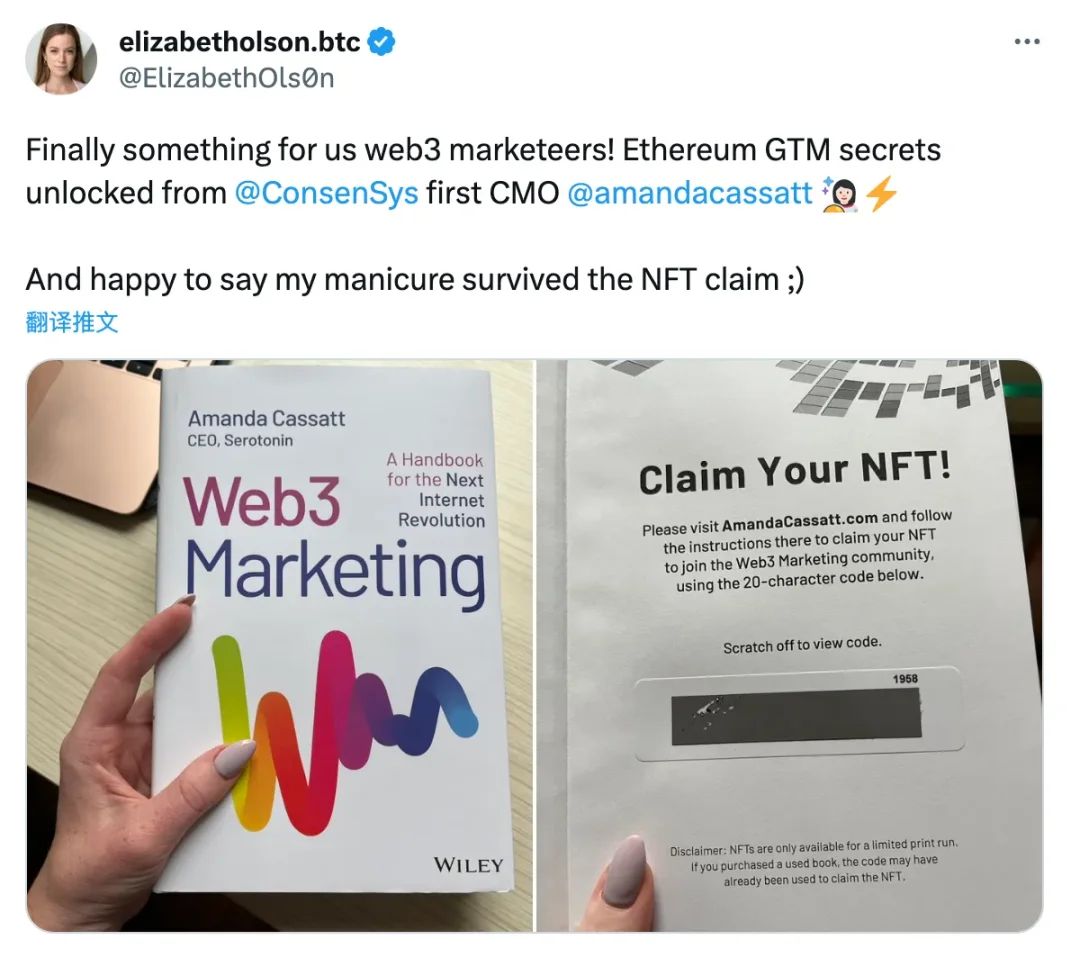
Additionally, based on NFTs, brands can establish more direct relationships with users, especially for categories with longer chains, without relying on any third-party platforms.
For example, the publishing industry's chain is very long: author → publisher → channel agent → channel distribution. Authors can hardly know who their readers are. Of course, including a WeChat QR code in the book is one method, but it requires manual verification, which is inefficient and almost impossible for co-branding. Moreover, if any keywords trigger a ban on WeChat, recovering it is nearly impossible.
The method used by Web3 Marketing is that each book has a scratch-off code, and readers can mint an NFT on the official website by spending gas, then verify this NFT through collab land to enter the official Telegram reader group, which currently has 197 members. Since the reader's identity is represented by the NFT, it does not rely on any IM platform and is also very convenient for subsequent co-branding collaborations.
The film industry also faces the same pain points, with longer distribution chains. Last year, Netflix's "Love, Death & Robots" included a QR code at the end to claim NFT Easter eggs, making it easy to form an audience group later (but I am also curious why nothing was done afterward).
Conclusion
I have organized the above four incremental values of Web3 for brands and corresponding cases into a Notion page. I will continue to update and iterate this page in the future, and I welcome you to bookmark and share it. I hope this lengthy article can help friends communicate and onboard with brands; )
Bear markets are suitable for building, and we look forward to seeing more brands enter Web3 exploration and expand the Open Loyalty ecosystem.
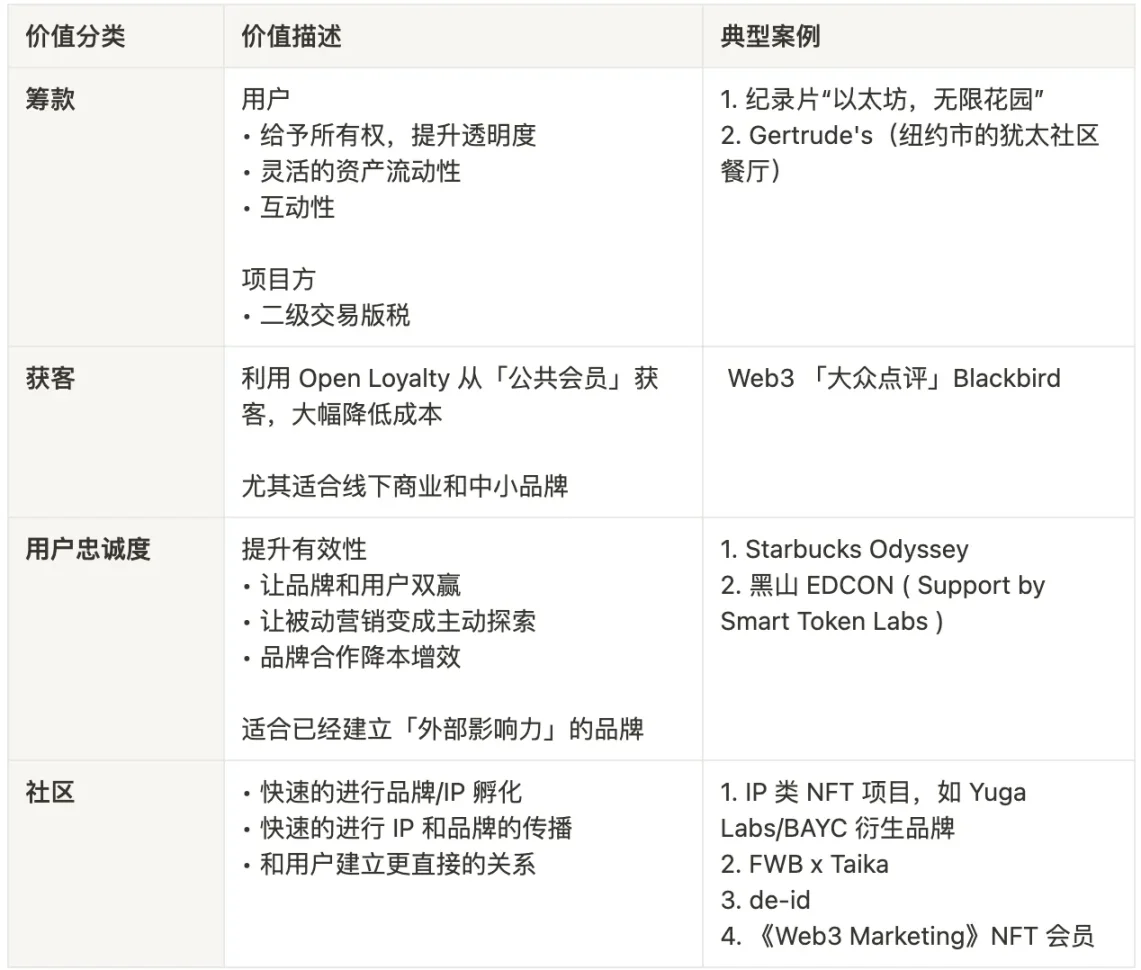
After answering the question "What incremental value does Web3 create for brands?", the next question to address is "How can brands better distribute this incremental value?" so that brands and users can form a healthy relationship, driving the brand forward while enhancing user experience and rights.
In the next article, I will further explore how Web3 brands can share incremental value more healthily and the characteristics of brands we see in the next cycle. Stay tuned.
 Предупреждение о рисках
 Предупреждение о рисках

Популярные статьи