








Bitcoin may face "the final drop": The real scenario of liquidity tightening is unfolding

 Liquidity vacuum and BTC under pressure
Author: ET, Researcher at SoSoValue Community
I. Introduction
While investors are still searching for emotional and technical explanations for the decline of Bitcoin, the real answer has quietly been written into the financial system's ledger: U.S. dollar liquidity is experiencing a structural tightening. This is specifically manifested in:
- The Treasury General Account (TGA) balance nearing $1 trillion, significantly siphoning off market liquidity;
- Short-term funding market pressures sharply rising, with the SOFR--FDTR spread once widening to +30bp;
- The Federal Reserve being forced to restart temporary repurchase operations (Overnight Repo), injecting nearly $30 billion in liquidity into the market—this is the first occurrence since the repo crisis in 2019.
This liquidity "vacuum" is not coincidental; it is primarily caused by the government shutdown. The Treasury has been preemptively "sucking up funds" due to the budget impasse and potential government shutdown risks, locking cash into the TGA account through extensive bond issuance, directly withdrawing reserves from the banking system, and the available "market dollars" are decreasing, naturally putting pressure on risk assets—Bitcoin has become the earliest and most sensitive victim.
However, the script is not entirely pessimistic. Historical experience shows that every time the Treasury replenishes its inventory and liquidity is extremely tight, it often signals the proximity of a reversal.
As of November 5, the number of days the U.S. government has been shut down has reached a historical peak, and pressures on finance, the economy, and people's livelihoods are sharply accumulating. SNAP food assistance is restricted, some airport security checks and federal air traffic control services have been temporarily suspended, and public and business confidence is declining simultaneously. Against this backdrop, signs of easing in the bipartisan standoff have emerged, especially as U.S. stocks have recently corrected from their highs, which will help accelerate the resolution of the government shutdown issue.
The market expects that the Senate may push for a compromise plan before the Thanksgiving recess on November 15, ending the government shutdown. At that time, the Treasury will restart spending, and the TGA balance is expected to decline from its high, liquidity will return, and risk appetite will rebound. Bitcoin may be in the "final drop" phase of this adjustment—at the intersection of fiscal spending recovery and the onset of future interest rate cuts, a new liquidity cycle will also restart.
II. BTC Facing U.S. Dollar Liquidity Shock
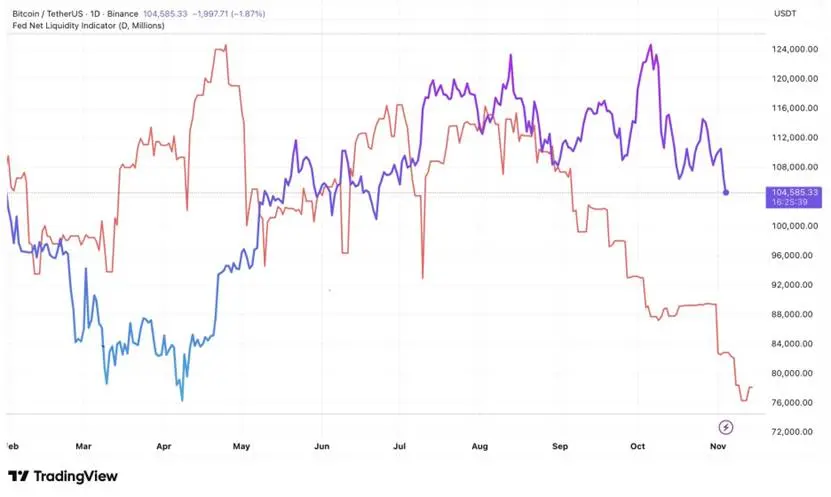
As a non-yielding asset, BTC is very sensitive to liquidity, and tight U.S. dollar liquidity often puts downward pressure on BTC. This is one of the reasons for BTC's notable weakness since mid-October, especially against the backdrop of the Nasdaq reaching historical highs.
As shown in Figure 1, as of October 31:
- The SOFR--FDTR spread turned positive, peaking at +30bp → The interbank true funding cost is higher than the policy interest rate ceiling, indicating banks are borrowing at higher costs, reflecting liquidity tightness;
- RRP balance rose to $50.3 billion → The market is once again seeking collateral liquidity from the Fed;
Figure 1: SOFR--FDTR Spread and RRP Balance
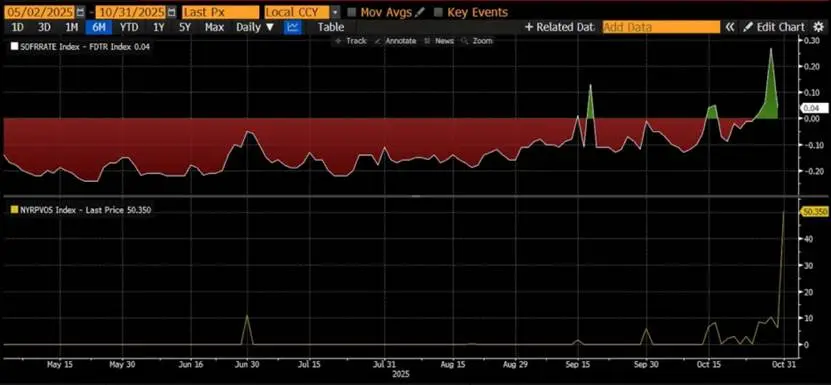
This indicates that there are clear signs of tension in the U.S. short-term funding market, forcing the Federal Reserve to restart temporary repurchase operations (Overnight Repo Operations), injecting nearly $30 billion in liquidity into the market on October 31.
This is the first occurrence of such operations since the 2019 repo crisis, marking a shift of liquidity shortage from a temporary phenomenon to a structural issue.
Overall, while macro money supply (M2) remains loose, the safety cushion of bank reserves is being rapidly depleted, and the upward trend in market borrowing rates indicates that liquidity pressure is no longer a mere expectation but a current reality.
Therefore, subsequent observations of liquidity conditions will be an important reference for judging BTC price trends.
Figure 2: BTC Price and Fed Liquidity
III. Breakdown of U.S. Dollar Liquidity
U.S. dollar liquidity = Bank reserves + Circulating cash = Total size of the Fed's balance sheet − ON RRP (Overnight Reverse Repo) − Treasury's TGA account
This is the core framework for observing the "disposable dollar balance in the U.S. financial system." It reveals:
Total U.S. dollar liquidity = Fed's "supply side" - Treasury and money market's "absorption side."
The specific components are as follows:
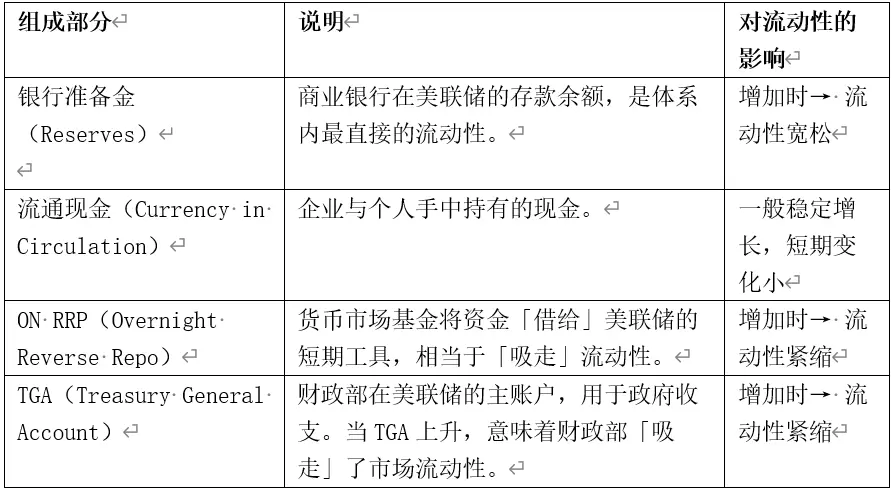
1. Logical Relationship
This formula actually describes the flow of funds between the Fed, the Treasury, and the money market:
Fed expands balance sheet → Increases reserves and cash → Liquidity increases, such as during QE (Quantitative Easing) when the Fed purchases assets to increase bank reserves.
TGA rises → Treasury issues bonds to absorb funds → Liquidity decreases when the government increases bond issuance and tax revenues flow into TGA, market funds are "sucked away."
ON RRP rises → Money market funds deposit idle cash with the Fed → Liquidity decreases, equivalent to money funds "parking" market funds at the Fed, no longer circulating in the banking system.
Thus:
Liquidity ↑ = Fed assets ↑ + TGA ↓ + RRP ↓
2. Practical Application
This indicator is key to observing the liquidity cycle of risk assets:
When TGA + RRP both decline → Bank reserves surge → U.S. dollar liquidity loosens → Usually accompanied by rising risk assets (stock market, Bitcoin).
When TGA is replenished and RRP rises → Liquidity is withdrawn → Risk assets come under pressure.
Specific examples:
In the second half of 2023: After the debt ceiling was lifted, TGA was replenished → Liquidity tightened temporarily → U.S. stocks and crypto assets experienced volatility.
In early 2024: RRP rapidly declined, funds flowed back to banks → Reserves rebounded → Market risk appetite increased.
3. Extended Observation: Connection with the Market
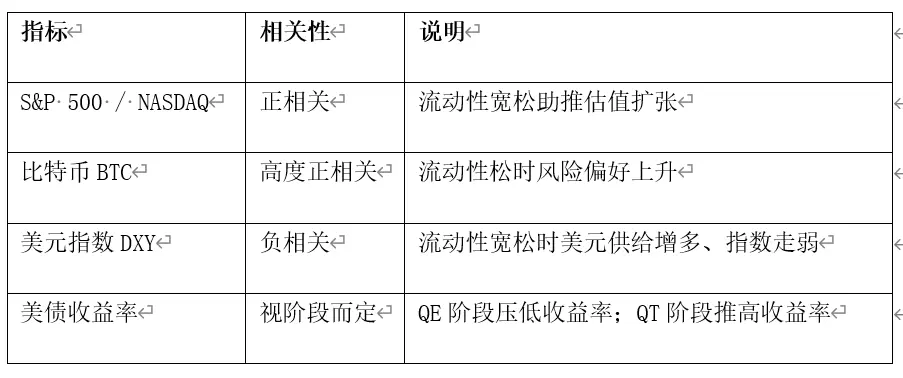
4. Conclusion
This formula essentially represents the liquidity balance equation of the entire U.S. dollar system.
The Fed determines the "total supply."
TGA and ON RRP are two "liquidity valves" that determine how much money can flow into the financial market.
Therefore, when analyzing the trends of risk assets, it is more important to observe the changes in RRP + TGA than to look solely at the Fed's balance sheet, as they are the true drivers of short-term U.S. dollar liquidity.
IV. Recent Liquidity Tightening Reasons—TGA Continues to Absorb Funds
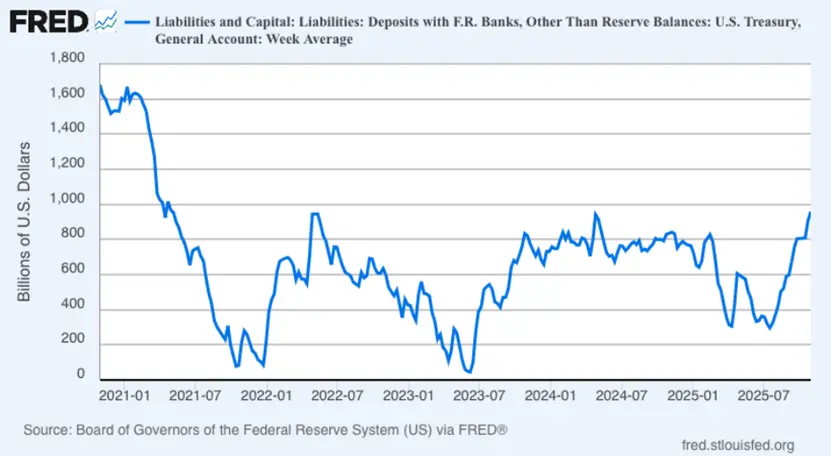
Figure 3: Changes in the U.S. Treasury's TGA Account Balance
1. Indicator Interpretation
The above chart shows the balance of the U.S. Treasury's main account at the Fed, the TGA (Treasury General Account). The horizontal axis represents time (2021-2025), and the vertical axis represents amounts (in billions of dollars). This line reflects the Treasury's absorption or release of liquidity and is an important adjustment valve for U.S. dollar liquidity. Below is a complete professional interpretation combining recent government shutdown risks and fiscal operations.
The fluctuations of this line represent the Treasury's "sucking up funds from the market (TGA rising)" or "releasing funds to the market (TGA declining)."
TGA rising → Government absorbs market liquidity (bank reserves decrease)
TGA declining → Government releases market liquidity (bank reserves increase)
Therefore:
TGA ≈ Inverse indicator of market dollar liquidity
When TGA rises, market funds become tight; when TGA declines, market funds become loose.
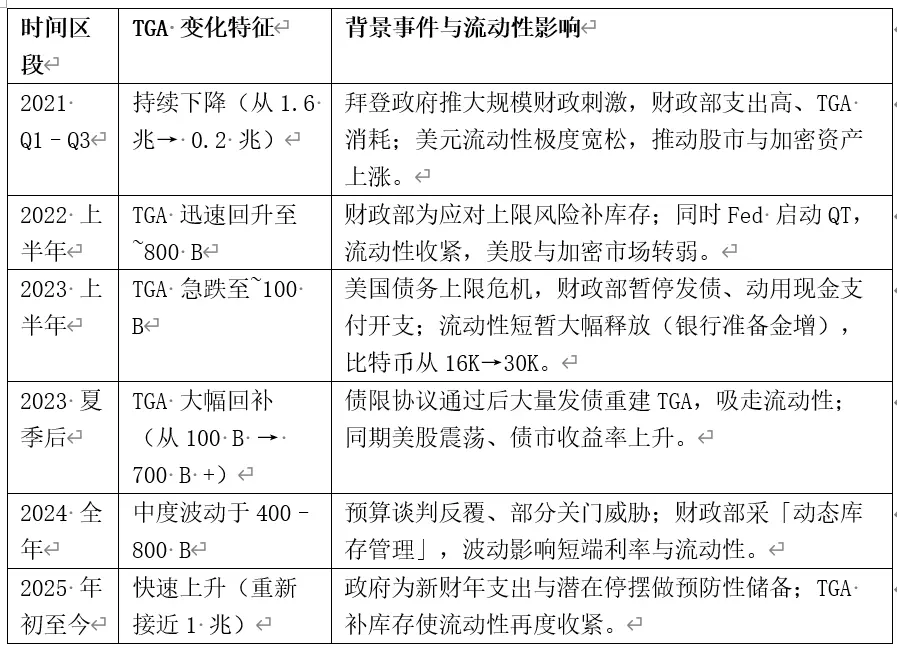
Combining time and events: The liquidity rhythm from 2021 to 2025
2. Structural Linkage with "Government Shutdown"
Before the shutdown: The Treasury raises TGA in preparation for emergencies.
When the congressional budget impasse approaches and shutdown risks rise, the Treasury will preemptively issue bonds to raise funds and increase the TGA balance, ensuring that there is still cash available for essential expenditures during the government shutdown.
During this phase, the market will experience short-term liquidity tightening and rising short-term interest rates.
During the shutdown: Spending is paused, and debt issuance is restricted.
During the shutdown, some government payments are paused, and the TGA level remains stable or slightly decreases, but due to the lack of new Treasury bond supply in the market, money market fund demand surges towards ON RRP.
This creates a "structural liquidity mismatch": neutral in total but tight at the short end.
After the shutdown ends: Supplemental appropriations and salary payments → TGA drops sharply.
After the government resumes spending, TGA declines, and liquidity is instantly released. Bank reserves rise, repo market pressures ease, and risk assets often rebound during this phase.
For example, after the debt ceiling was lifted in 2023, BTC surged sharply, and the Nasdaq rebounded.
V. The Federal Reserve in Action: Liquidity Injection
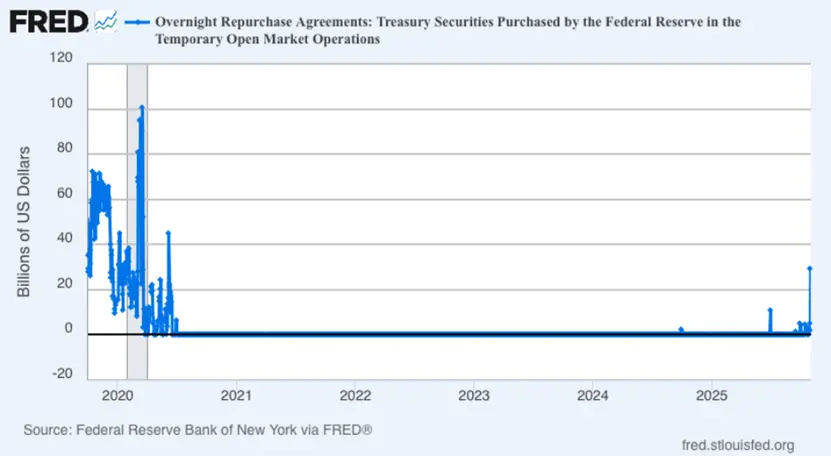
Figure 4: Fed ON RPs (Overnight Reverse Repo)
1. Indicator Interpretation
Source: FRED (New York Fed)
Latest data (October 31, 2025): $29.4 billion
For comparison: The peak in September 2019 was $49.75 billion.
This indicator represents the Fed providing overnight cash to primary dealers through temporary repurchase operations (collateralized by U.S. Treasuries), which is a direct liquidity injection method.
This tool has been long unused since the pandemic, and its restart carries significant policy signaling implications.
2. Three Key Observations
Policy Background: The Fed's action is a response to the "real shortage" in the short-term funding market. Although QT is set to stop, the continuous decline in reserves has led to increased borrowing pressures. The restart of ON RPs represents: "The Fed is shifting from passive balance sheet reduction to active liquidity management."
Scale Characteristics: While $29.4 billion is lower than the crisis levels of 2019, its symbolic significance is strong, indicating that the liquidity gap has surpassed the Fed's observation threshold. If the scale of operations continues to rise in the next two weeks, it can be seen as a "quasi-policy shift."
Market Mechanism:
Banks and money market funds are forced to raise financing rates due to reserve shortages;
The Fed releases liquidity through repos, temporarily suppressing SOFR and repo spreads;
If this behavior continues, it will create a "mini QE effect."
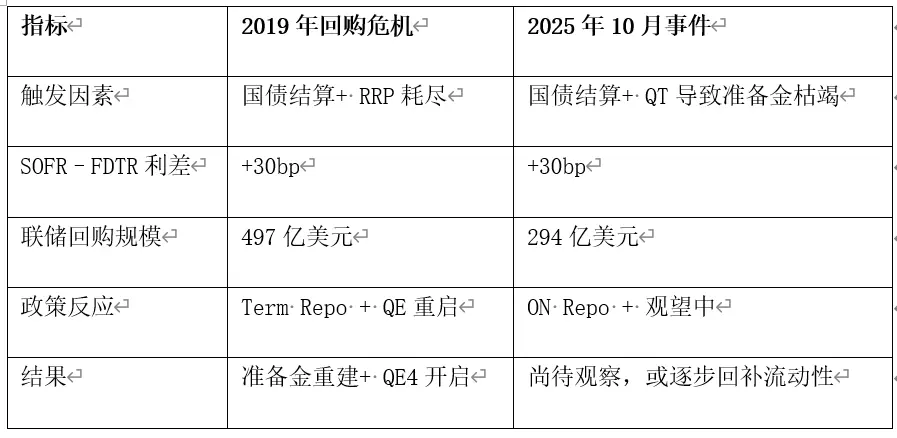
3. Historical Comparison: 2019 vs. 2025
VI. Conclusion
Currently, the TGA account is nearing $1 trillion, which is the main reason for recent liquidity tightening. Following the reopening of the government and the resumption of spending, TGA will decline, U.S. dollar liquidity will recover, and risk assets like BTC are expected to gain support;
Before the government reopens, the Fed will continue to release liquidity through repos, temporarily suppressing SOFR and repo spreads to alleviate market liquidity tightness;
Betting on the prediction websites is focused on mid-November, specifically between November 10 and November 15, with institutions like Goldman Sachs expecting the government to reopen within two weeks;
Therefore, BTC is likely undergoing a "final drop," as the reopening of the government and future interest rate cuts are certain, although the timing may have uncertainties.
 Risk warning Risk warning




Popular articles





