Bitwise: Bitcoin is experiencing its IPO moment, and the sideways movement or decline may be a "gift."
 Core Viewpoint

 The sideways movement is the stage of chip transfer after the IPO.
Original author: Matt Hougan, Chief Investment Officer of Bitwise; Translation compiled by: Jinse Finance*
The consolidation of Bitcoin indicates that its IPO moment has arrived—this is also the reason why the allocation ratio of BTC is expected to increase.
Jordi Visser is one of my favorite macro thinkers, and I read every article he writes.
In his latest article (see Jinse Finance's previous report "The Silent IPO of Bitcoin"), he explores a core question: despite the continuous good news—strong ETF inflows, breakthrough regulatory progress, and sustained institutional demand—why does Bitcoin still frustratingly remain in a consolidation or even a downward trading pattern?
This is the best analysis I have read about the current state of the Bitcoin market in the past six months, and I strongly recommend you read it.
Visser believes that Bitcoin is undergoing a "silent IPO," transforming from a crazy idea into a mainstream success story. He points out that typically, when stocks complete an IPO, they often consolidate for 6 to 18 months before starting an upward trend.
Take Facebook as an example; it went public on May 12, 2012, at a price of $38 per share, and for more than a year afterward, its stock price remained stagnant or even declined, only returning to the IPO price of $38 fifteen months later. Google and other high-profile tech startups exhibited similar trends.
Visser states that consolidation does not necessarily indicate a problem with the asset itself. This situation often arises because founders and early employees are cashing out—those who bet on the startup when the risks were extremely high are now reaping hundredfold returns and naturally want to realize their profits. The process of insiders selling and institutions taking over takes time; only when this ownership transfer reaches a certain balance can the stock price begin to rise again.
Visser notes that this is very similar to the current situation with Bitcoin. Those early believers who bought Bitcoin when its price was $1, $10, $100, or even $1,000 now hold epoch-making wealth. As Bitcoin enters the mainstream—ETFs are listed on the NYSE, large companies are establishing Bitcoin reserves, and sovereign wealth funds are entering the market—these investors can finally cash in on their returns.
Kudos to them! Their patience has been richly rewarded. Five years ago, if someone sold $1 billion worth of Bitcoin, it could have thrown the market into chaos; but now, a diversified buyer group and ample trading volume can absorb such large transactions more smoothly.
It should be noted that on-chain data shows a complex composition of sellers, so Visser's analysis is only part of the current market drivers, but it is a crucial part that deserves our consideration regarding its implications for the future market.
Here are two core points I extracted from this article:
Point One: Strong Bullish Potential
Many cryptocurrency investors felt frustrated after reading Visser's article: "The early OGs are selling Bitcoin to institutions! Do they know something we don't?"
This interpretation is completely wrong.
The selling by early investors does not mean the journey of an asset is coming to an end; it merely opens a new phase.
Looking again at Facebook: indeed, its stock price remained below $38 for a year after the IPO, but it has now risen to $637, an increase of 1576%. Back in 2012, if I could buy all Facebook shares at $38, I would do so without hesitation.
Of course, if I had invested during Facebook's Series A funding, the return might have been higher, but it also came with much greater risk.
The same goes for Bitcoin today. In the future, it may be difficult to see Bitcoin achieve a hundredfold return in a year again, but once this "chip transfer phase" is completed, its upward potential remains substantial. As Bitwise pointed out in its report "The Long-Term Capital Market Hypothesis for Bitcoin," we believe Bitcoin will reach $1.3 million per coin by 2035, and I personally think this prediction is still conservative.
I would like to add one more point: the Bitcoin that remains after the early OGs finish selling has a key difference from companies after their IPO—companies need to continue growing after completing an IPO. The reason Facebook could not jump from $38 to $637 overnight was that its revenue and profits at the time were insufficient to support such a valuation; it needed to expand revenue, develop new business lines, and focus on mobile, all while facing risks.
But Bitcoin is not like that. Once the early OGs finish selling, Bitcoin does not need to do anything further. It needs to grow from a market cap of $2.5 trillion to a gold-level market cap of $25 trillion, and all it requires is widespread acceptance.
I am not saying this will happen overnight, but it is entirely possible that it could grow faster than Facebook.
From a long-term perspective, the consolidation of Bitcoin is a "gift"—a great opportunity to buy more chips before it restarts its upward trend.
Point Two: The Era of 1% Bitcoin Allocation is Over
As Visser mentioned in the article, companies that have completed an IPO carry far less risk than in the startup phase. Their equity distribution is broader, they are subject to stricter regulations, and they have more opportunities for business diversification. Investing in Facebook after its IPO is far less risky than funding a college dropout working out of a party house in Palo Alto.
The same is true for Bitcoin. As Bitcoin transitions from early adopters to institutional investors and matures as a technology, it no longer faces existential risks like it did a decade ago, and its maturity as an asset class has significantly increased. This is clearly reflected in Bitcoin's volatility—since the Bitcoin ETF began trading in January 2024, its volatility has decreased significantly.
Historical Volatility of Bitcoin
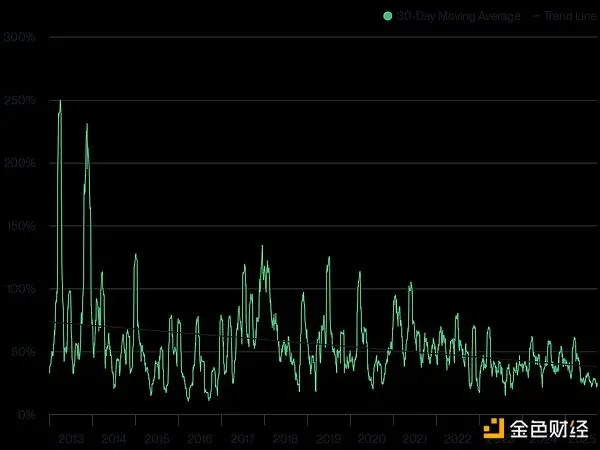
Data source: Bitwise Asset Management, data range from January 1, 2013, to September 30, 2025
This brings an important insight for investors: in the future, Bitcoin's return may be slightly lower than before, but its volatility will decrease significantly. As an asset allocator, my response to this change is not to sell—after all, we predict that Bitcoin will still be one of the best-performing major assets globally over the next decade—but to increase holdings.
In other words, lower volatility means that holding more of this type of asset will be safer.
Visser's article has further convinced me of a trend—over the past few months, Bitwise has held hundreds of meetings with advisors, institutions, and other professional investors, and we have found that the era of 1% Bitcoin allocation is completely over. More and more investors need to consider 5% as the starting point for BTC allocation.
Bitcoin is experiencing its IPO moment. If history is any guide, we should welcome this new phase by increasing our holdings.
 Risk warning Risk warning