Silver crisis, when the paper system begins to malfunction
 Core Viewpoint

 When the music stops, only those holding real money can sit down peacefully.
Author: Xiao Bing, Deep Tide TechFlow
In the precious metals market of December, the protagonist is not gold; silver is the most dazzling light.
From $40, it surged to $50, $55, and $60, crossing one historical price level after another at an almost uncontrollable speed, hardly giving the market a chance to breathe.
On December 12, spot silver once touched a historical high of $64.28 per ounce, before plummeting sharply. Since the beginning of the year, silver has accumulated an increase of nearly 110%, far exceeding gold's 60% rise.
This is a rise that seems "extremely reasonable," yet it also appears particularly dangerous.
The Crisis Behind the Rise
Why is silver rising?
Because it seems worth rising.
From the explanations of mainstream institutions, everything appears reasonable.
The Federal Reserve's renewed expectations for interest rate cuts have reignited the precious metals market, with recent employment and inflation data being weak, leading the market to bet on further rate cuts in early 2026. As a high-elasticity asset, silver reacts more violently than gold.
Industrial demand is also contributing to the surge. The explosive growth of solar energy, electric vehicles, data centers, and AI infrastructure has fully demonstrated silver's dual attributes (precious metal + industrial metal).
The continuous decline in global inventories has further exacerbated the situation. The output from mines in Mexico and Peru in the fourth quarter fell short of expectations, and the amount of silver bars in major exchange warehouses has decreased year by year.
……
If we only look at these reasons, the rise in silver prices is a "consensus," or even a delayed value reassessment.
But the danger in the story lies in:
The rise in silver seems reasonable, but it is not solid.
The reason is simple: silver is not gold; it lacks the consensus that gold has and is devoid of a "national team."
Gold remains strong enough because central banks around the world are buying it. Over the past three years, global central banks have purchased more than 2,300 tons of gold, which is listed on the balance sheets of various countries as an extension of sovereign credit.
Silver is different. Global central bank gold reserves exceed 36,000 tons, while official silver reserves are almost zero. Without central bank support, when the market experiences extreme volatility, silver lacks any systemic stabilizers and is a typical "island asset."
The disparity in market depth is even more pronounced. The daily trading volume of gold is about $150 billion, while silver is only $5 billion. If gold is likened to the Pacific Ocean, silver is at most Poyang Lake.
It has a small volume, few market makers, insufficient liquidity, and limited physical reserves. Most critically, the primary trading form of silver is not physical but "paper silver," with futures, derivatives, and ETFs dominating the market.
This is a dangerous structure.
Shallow waters are prone to capsizing; when large funds enter, they can quickly stir the entire surface.
And what has happened this year is precisely this situation: a sudden influx of funds has rapidly pushed up a market that was already shallow, pulling prices away from the ground.
Futures Squeeze
What has caused silver prices to deviate from their track is not the seemingly reasonable fundamental reasons mentioned above; the real price war is in the futures market.
Under normal circumstances, the spot price of silver should be slightly higher than the futures price. This is easy to understand, as holding physical silver incurs storage costs and insurance fees, while futures are merely contracts and thus naturally cheaper; this price difference is generally referred to as "spot premium."
However, starting from the third quarter of this year, this logic has been inverted.
Futures prices have begun to systematically exceed spot prices, and the price difference is growing larger. What does this mean?
Someone is crazily pushing up prices in the futures market. This "futures premium" phenomenon typically occurs under two circumstances: either the market is extremely bullish about the future, or someone is squeezing positions .
Considering that the improvement in silver's fundamentals is gradual, with photovoltaic and new energy demand not skyrocketing in a few months and mine output not suddenly depleting, the aggressive performance in the futures market resembles the latter: there is capital pushing up futures prices.
An even more dangerous signal comes from the anomalies in the physical delivery market.
Data from the world's largest precious metals trading market, COMEX (New York Mercantile Exchange), shows that the physical delivery ratio in precious metals futures contracts is less than 2%, with the remaining 98% settled in cash or through contract rollovers.
However, in recent months, the physical delivery volume of silver on COMEX has surged, far exceeding historical averages. More and more investors no longer trust "paper silver"; they are demanding to withdraw real silver bars.
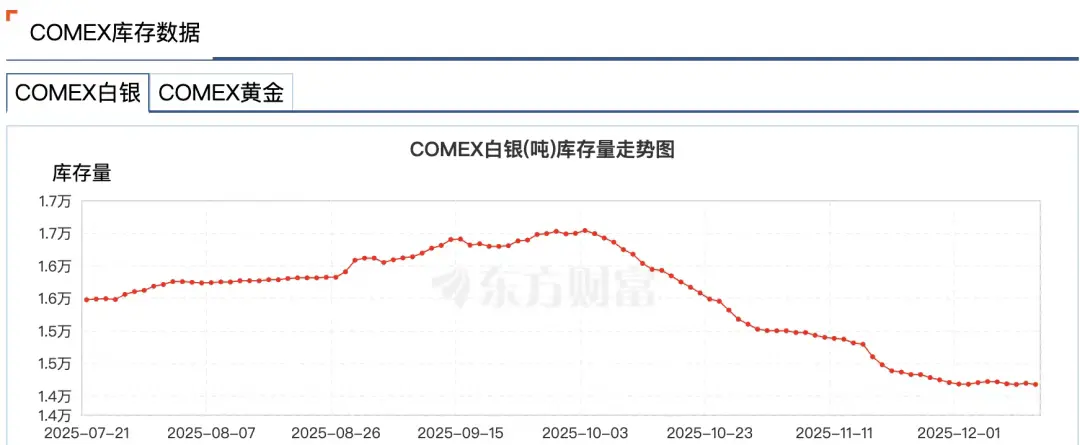
A similar phenomenon has also appeared in silver ETFs. As a large amount of capital flows in, some investors have started to redeem, requesting physical silver instead of fund shares. This "run-like" redemption has put pressure on the ETF's silver bar reserves.
This year, the three major silver markets—New York COMEX, London LBMA, and Shanghai Metal Exchange—have all experienced a wave of redemptions.
Wind data shows that during the week of November 24, silver inventories at the Shanghai Gold Exchange fell by 58.83 tons, down to 715.875 tons, marking a new low since July 3, 2016. COMEX silver inventories plummeted from 16,500 tons in early October to 14,100 tons, a drop of 14%.
The reasons are not hard to understand. During the dollar's interest rate cut cycle, people are reluctant to settle in dollars, and another hidden concern is that exchanges may not have enough silver available for delivery.
The modern precious metals market is a highly financialized system, where most "silver" is merely a number on a balance sheet, while real silver bars are repeatedly mortgaged, leased, and derived globally. One ounce of physical silver may correspond to dozens of different rights certificates.
Veteran trader Andy Schectman cites London as an example, stating that the LBMA has only 140 million ounces of floating supply, but daily trading volume reaches 600 million ounces, with over 2 billion ounces of paper claims existing on that 140 million ounces.
This "fractional reserve system" operates well under normal conditions, but once everyone wants physical silver, the entire system can face a liquidity crisis.
When the shadow of a crisis looms, a strange phenomenon often appears in financial markets, commonly referred to as "pulling the plug."
On November 28, CME experienced a nearly 11-hour outage due to "data center cooling issues," setting a record for the longest downtime in history, causing COMEX gold and silver futures to fail to update normally.
Notably, the outage occurred at a critical moment when silver was breaking through historical highs, with spot silver surpassing $56 and silver futures exceeding $57.
Market rumors speculated that the outage was to protect commodity market makers exposed to extreme risks, potentially facing significant losses.
Later, data center operator CyrusOne stated that the major disruption was due to human operational errors, further fueling various "conspiracy theories."
In short, this market driven by futures squeezing has destined silver to experience extreme volatility; silver has effectively transformed from a traditional safe-haven asset into a high-risk target.
Who is the Market Maker?
In this squeeze drama, one name cannot be overlooked: JPMorgan Chase.
The reason is simple: it is internationally recognized as the silver market maker.
For at least eight years, from 2008 to 2016, JPMorgan manipulated gold and silver market prices through traders.
The method is simple and crude: placing large orders to buy or sell silver contracts in the futures market, creating a false supply-demand illusion, inducing other traders to follow suit, and then canceling orders at the last moment to profit from price fluctuations.
This practice, known as spoofing, ultimately led JPMorgan to incur a $920 million fine in 2020, setting a record for the largest single fine by the CFTC.
But true textbook market manipulation goes beyond this.
On one hand, JPMorgan depressed silver prices through massive short selling and spoofing in the futures market; on the other hand, it accumulated physical metals at the artificially low prices it created.
Since silver prices approached $50 in 2011, JPMorgan began hoarding silver in its COMEX warehouses, increasing its holdings while other large institutions were reducing their silver positions, at one point accounting for 50% of COMEX's total silver inventory.
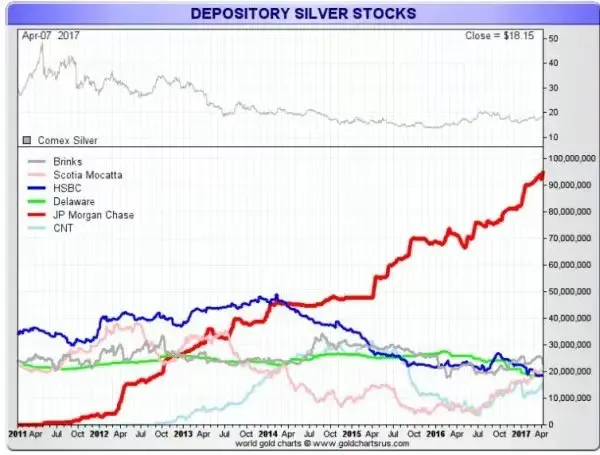
This strategy exploits the structural flaws in the silver market, where paper silver prices dominate physical silver prices, and JPMorgan can influence paper silver prices while being one of the largest holders of physical silver.
So what role does JPMorgan play in this round of silver squeezing?
On the surface, JPMorgan seems to have "turned over a new leaf." After the settlement agreement in 2020, it underwent systematic compliance reforms, including hiring hundreds of new compliance officers.
Currently, there is no evidence that JPMorgan is participating in the squeeze, but in the silver market, JPMorgan still holds significant influence.
According to the latest data from CME on December 11, JPMorgan holds approximately 196 million ounces of silver in the COMEX system (proprietary + brokerage), accounting for nearly 43% of the exchange's total inventory.
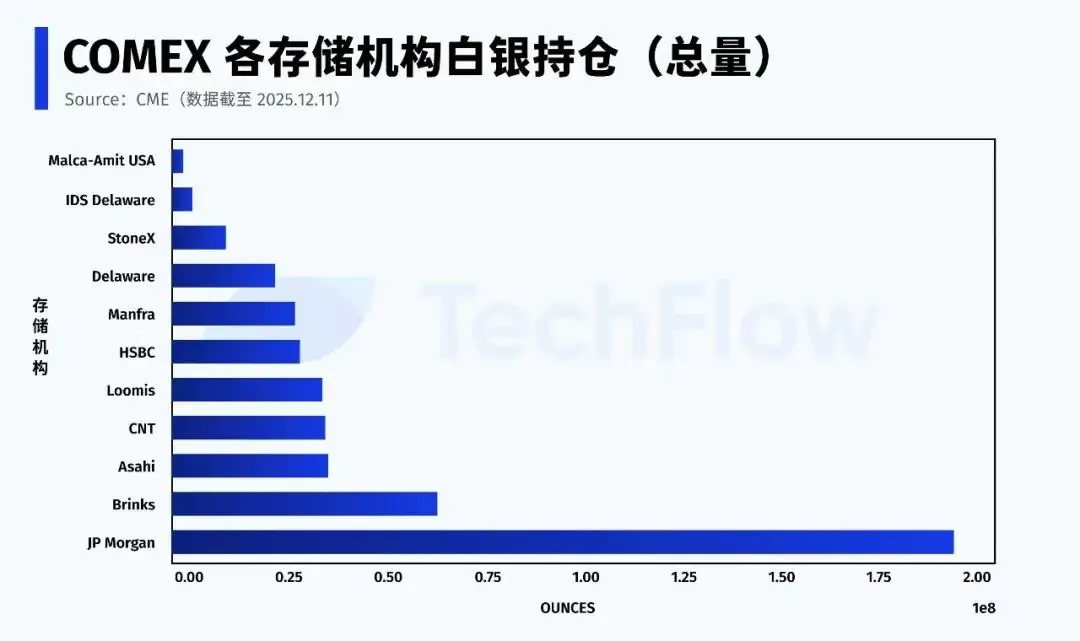
Additionally, JPMorgan has a special identity as the custodian of the silver ETF (SLV), which, as of November 2025, holds 517 million ounces of silver, valued at $32.1 billion.
More critically, in the portion of Eligible silver (i.e., deliverable but not yet registered as deliverable), JPMorgan controls more than half of the scale.
In any round of silver squeezing, the real game in the market revolves around two points: first, who can provide physical silver; second, whether and when these silvers are allowed to enter the delivery pool.
Unlike its previous role as a major short seller of silver, JPMorgan now sits at the "silver gate."
Currently, the deliverable Registered silver accounts for only about 30% of the total inventory, while the bulk of Eligible silver is highly concentrated in a few institutions, meaning the stability of the silver futures market effectively depends on the choices of a very small number of nodes.
The Paper System is Gradually Failing
If we were to describe the current silver market in one sentence, it would be:
The market is still ongoing, but the rules have changed.
The market has undergone an irreversible transformation, and trust in the "paper system" of silver is collapsing.
Silver is not an isolated case; similar changes have occurred in the gold market.
Gold inventories on the New York Mercantile Exchange have been continuously declining, with Registered gold repeatedly hitting low levels, forcing the exchange to allocate gold bars from "Eligible" that were originally not intended for delivery to complete transactions.
Globally, capital is quietly undergoing a migration.
Over the past decade, the direction of mainstream asset allocation has been highly financialized, with ETFs, derivatives, structured products, and leveraged tools—all things that can be "securitized."
Now, more and more capital is beginning to withdraw from financial assets, seeking physical assets that do not rely on financial intermediaries or credit endorsements, with gold and silver being typical examples.
Central banks are continuously and massively increasing their gold holdings, almost without exception choosing physical forms. Russia has banned gold exports, and even Western countries like Germany and the Netherlands are demanding the return of gold reserves stored overseas.
Liquidity is giving way to certainty.
When gold supply cannot meet the enormous physical demand, capital begins to seek alternatives, and silver naturally becomes the first choice.
The essence of this movement towards physical assets is the weak dollar and the reallocation of monetary pricing power in the context of de-globalization.
According to a Bloomberg report in October, global gold is shifting from the West to the East.
Data from the CME and the London Bullion Market Association (LBMA) shows that since the end of April, more than 527 tons of gold have flowed out of the vaults of the two largest Western markets, New York and London, while at the same time, gold imports from major Asian gold-consuming countries like China have increased, with China's gold imports in August reaching a four-year high.
To respond to market changes, JPMorgan has moved its precious metals trading team from the U.S. to Singapore by the end of November 2025.
Behind the surge in gold and silver is a return to the concept of "gold standard." While it may not be realistic in the short term, one thing is certain: whoever holds more physical assets will have greater pricing power.
When the music stops, only those holding real gold and silver can sit down peacefully.
 Risk warning
 Risk warning