The $6 billion business of stablecoin wealth management: Where do the returns come from, and where do the risks go?
 Core Viewpoint

 Revealing the new and old logic behind high returns for you.
Original Author: Muyao Shen
Original Compilation: Shenchao TechFlow
Introduction: The collapse of BlockFi and Celsius in 2022 brought the crypto lending industry to a standstill, but now, a "transparent, non-custodial" Vault model is making a comeback with an asset scale of $6 billion.
This article delves into this new business model: how it avoids the black-box risks of traditional centralized lending through smart contracts, and how it might repeat the mistakes of Stream Finance under the pressure of seeking high yields.
As the Genius Act pushes for the mainstream adoption of stablecoins, is the Vault a cornerstone for the maturation of crypto finance, or is it the next shadow banking crisis dressed in a cloak of transparency?
This article will reveal the new and old logic behind high yields.
Full text as follows:
When the crypto platform Stream Finance collapsed at the end of last year (resulting in approximately $93 million in user fund losses), it exposed a familiar fracture point in digital assets: when the market turns to volume, the so-called "safe yield" promises often crumble.
This failure was unsettling not only because of the losses incurred but also due to the mechanisms behind it. Stream had touted itself as part of a new generation of more transparent crypto yield products, aiming to avoid the hidden leverage, opaque counterparty risks, and arbitrary risk decisions that had plagued centralized lending institutions like BlockFi and Celsius.
Instead, it demonstrated how quickly the same dynamics—leverage, platform risk exposure, and centralized risk—can return when platforms begin to chase yields, even if the market infrastructure appears safer or the transparency seems reassuring.
However, the broader promise of safer crypto yields still exists. According to industry data, Vaults—on-chain investment pools built around this concept—currently manage over $6 billion in assets. Crypto asset management firm Bitwise predicts that as demand for stablecoin yields grows, the asset scale in Vaults could double by the end of 2026.
"Safe" Yield Trading in Cryptocurrency Reaches $6 Billion
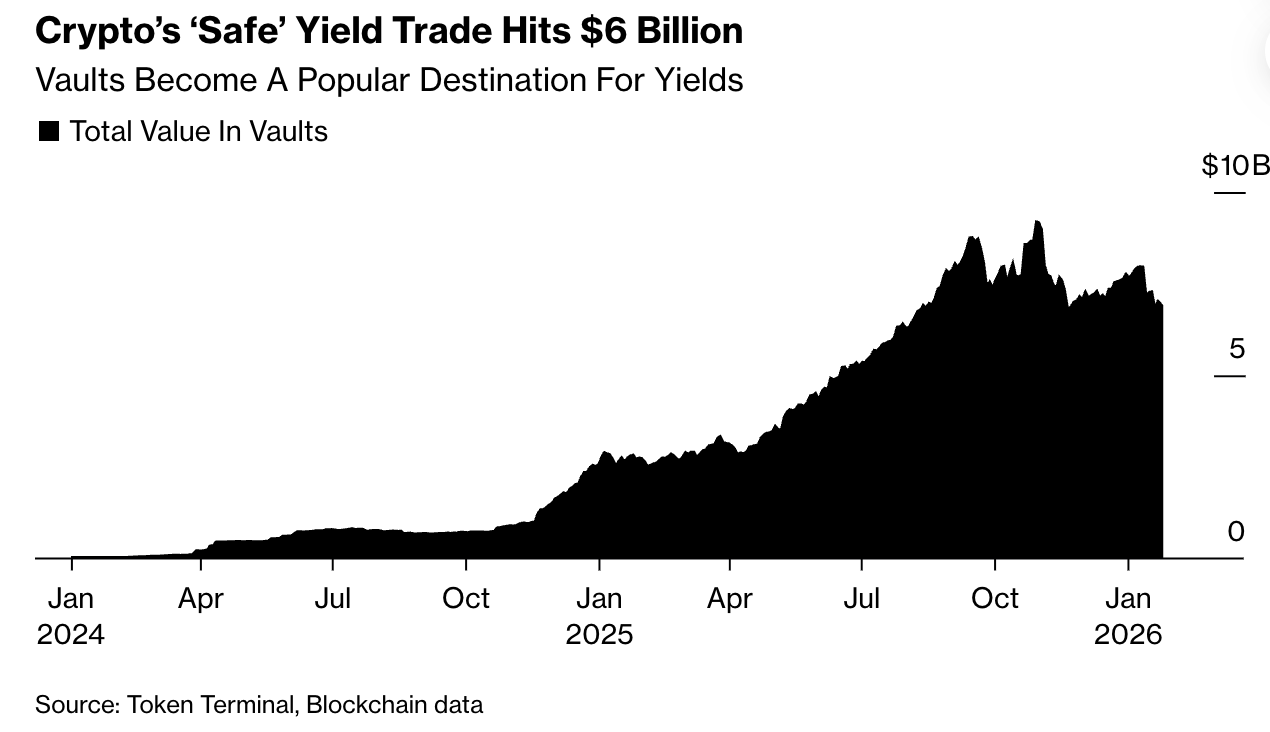
At a fundamental level, Vaults allow users to deposit cryptocurrencies into a shared pool, where the funds are invested in lending or trading strategies aimed at generating returns. What sets Vaults apart is their marketing approach: they are promoted as being completely severed from past opaque lending platforms. Deposits are non-custodial, meaning users never hand over their assets to the company. Funds are held in smart contracts that automatically deploy capital based on preset rules, with key risk decisions clearly visible on the blockchain. Functionally, Vaults resemble familiar components in traditional finance: pooling funds, converting them into yields, and providing liquidity.
But their structure has distinct crypto characteristics. All of this occurs outside the regulated banking system. Risks lack capital reserve buffers and regulatory oversight—they are embedded in software, and as market fluctuations occur, algorithms automatically rebalance positions, liquidate collateral, or unwind trades to realize losses automatically.
In practice, this structure can yield uneven results, as curators (the companies designing and managing Vault strategies) compete on returns, and users find themselves assessing how much risk they are willing to take.
"Some participants will do terribly," said Paul Frambot, co-founder of Morpho, the infrastructure behind many lending Vaults. "They may not survive."
For developers like Frambot, this churn is less a warning signal and more a characteristic of an open, permissionless market—where strategies are tested in public, capital flows rapidly, and weaker methods are replaced by stronger ones over time.
The timing of this growth is not coincidental. With the passage of the Genius Act, stablecoins are moving toward financial mainstream. As wallets, fintech apps, and custodians compete to distribute digital dollars, platforms face a common challenge: how to generate yields without putting their own capital at risk.
Vaults have become a compromise. They provide a way to generate yields while technically keeping assets off the company's balance sheet. One can think of it as a traditional fund—but without needing to relinquish custody or wait for quarterly disclosures. This is how curators pitch the model: users retain control over their assets while benefiting from professionally managed strategies that run automatically on-chain.
"The role of curators is similar to risk and asset managers, like BlackRock or Blackstone do for the funds and endowments they manage," said Tarun Chitra, CEO of crypto risk management firm Gauntlet, which also operates Vaults, "but unlike BlackRock or Blackstone, it is non-custodial, so asset managers never hold users' assets; assets are always in smart contracts."
This structure aims to correct the recurring weaknesses in crypto finance. In previous cycles, products marketed as low-risk often concealed borrowed funds, reused customer capital without disclosure, or heavily relied on a few fragile partners. The algorithmic stablecoin TerraUSD provided yields close to 20% by subsidizing returns through high-risk bets. Centralized lending institutions like Celsius quietly funneled deposits into high-risk wagers. When the market turned to volume, damages spread rapidly—often without warning.
Today, most Vault strategies are more restrained. They typically involve floating-rate lending, market-making, or providing liquidity to blockchain protocols, rather than pure speculation. The Steakhouse USDC Vault is an example, lending stablecoins against its described blue-chip cryptocurrencies and tokenized real-world assets (RWAs), offering about 3.8% returns. Many Vaults are intentionally designed to be "boring": their appeal lies not in excessive returns but in the promise of earning yields through digital cash without relinquishing custody or becoming a creditor to a single company.
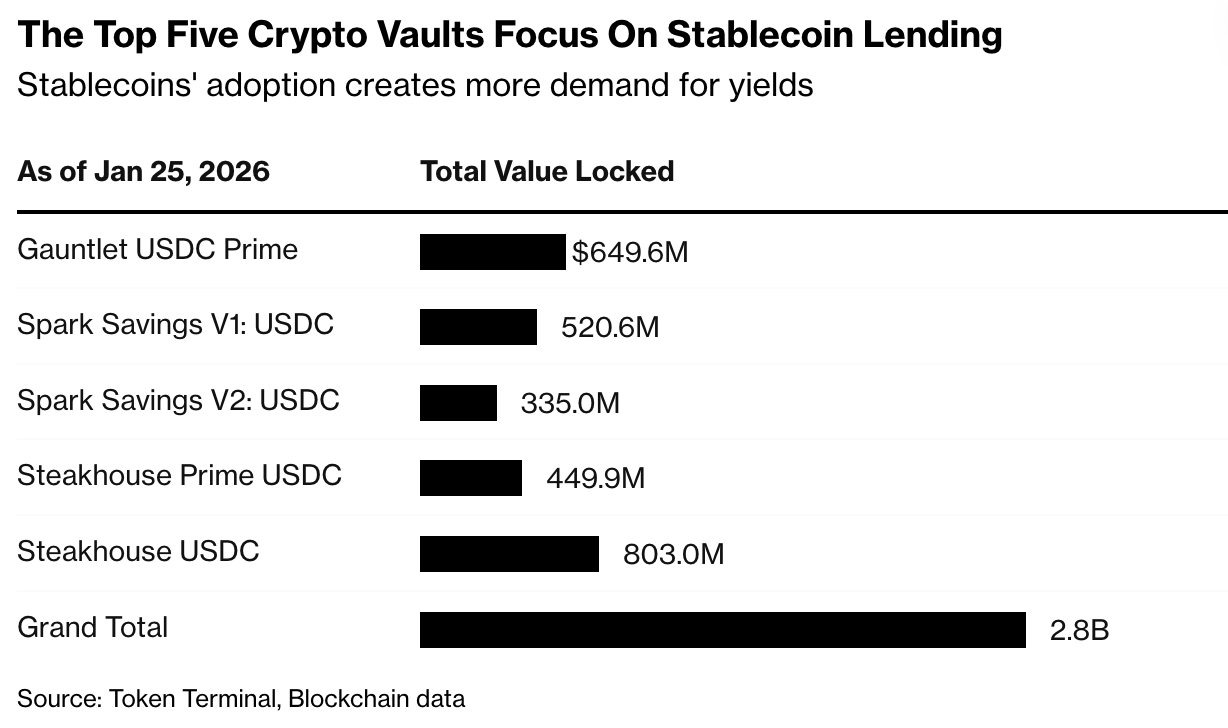
"People want yields," said Jonathan Man, portfolio manager and head of multi-strategy solutions at Bitwise, which has just launched its first Vault. "They want their assets to work for them. Vaults are just another way to achieve that."
If regulators take action to prohibit direct yield payments on stablecoin balances (a proposal raised in market structure legislation), Vaults may gain even more momentum. If that happens, the demand for yields won't disappear; it will simply shift.
"Every fintech company, every centralized exchange, every custodian is talking to us," said Sébastien Derivaux, co-founder of Vault curator Steakhouse Financial. "Traditional financial firms are too."
But this restraint is not hard-coded into the system. The pressures shaping this industry come from competition, not technology. As stablecoins gain popularity, yields become the primary means to attract and retain deposits. Underperforming curators risk losing capital, while those offering higher returns can attract more funds. Historically, this dynamic has driven non-bank lending institutions (in both the crypto space and beyond) to loosen standards, increase leverage, or shift risks off-platform. This shift has already reached large consumer-facing platforms. Crypto exchanges Coinbase and Kraken have both launched products providing retail customers access to Vault-like strategies, with advertised yields of up to 8%.
In summary, transparency can be misleading. Public data tools and visible strategies build confidence—and confidence attracts capital. But once the funds are in place, curators face pressure to deliver returns, sometimes reaching for off-chain trades that are difficult for users to assess.
Stream Finance later exposed this fracture point, having advertised returns of up to 18%, only to report severe losses related to an unnamed external fund manager. This incident triggered a sharp withdrawal across the entire Vault industry, with total assets dropping from a peak of nearly $10 billion to about $5.4 billion.
Supporters of the model argue that Stream is not representative. Stream Finance did not respond to a request for comment via X direct message.
"Celsius, BlockFi, all of these, even Stream Finance, I kind of categorize them all as failures of disclosure to the end user," said Man of Bitwise. "People in crypto tend to focus more on what the upside might be and less on what the downside risks are."
This distinction may prove important at present. Vaults were established to address the failures of the last cycle, with a clear goal of making risks visible rather than hidden. The unresolved question is whether transparency alone is enough to constrain behavior—or, as seen in previous shadow banking cases, whether clearer structures merely make it easier for investors to endure risks until the music stops.
"Ultimately, it’s about embracing transparency while also ensuring that there is appropriate disclosure for any type of product—whether DeFi or non-DeFi," Man said.
 Risk warning
 Risk warning