Tron Industry Weekly Report: May Non-Farm Payrolls Disrupt BTC, Launching the 60,000 Defense Battle, Detailed Explanation of AI Computing Power Network Kaisar & RWA Infrastructure Network AWARP
 The popularity of RWA (Real World Assets) has further increased, especially as the tokenization of U.S. Treasury bonds, stocks, and commodities becomes a focal point of institutional discussions; AI Agent + Crypto has entered the application implementation stage, with market attention shifting from purely AI concepts to payment, trade execution, and on-chain collaboration infrastructure;
# I. Outlook
## 1. Summary of Macroeconomic Trends and Future Predictions
Last week, the main theme of the global macro market was "U.S. economic resilience exceeding expectations + global inflation expectations resurfacing + rising U.S. Treasury yields." The U.S. added 172,000 non-farm jobs in May, far exceeding the market expectation of 80,000-90,000, with the unemployment rate holding steady at 4.3%, indicating that the U.S. labor market remains strong. The market's expectations for the Federal Reserve to cut interest rates this year further cooled, and even began to reprice future rate hike risks, supporting U.S. Treasury yields and the U.S. dollar index. Meanwhile, energy prices remain a focal point for the global market. The disturbances in oil supply due to the Middle East situation have not completely subsided; although oil prices have retreated from previous highs, the rise in energy prices has started to transmit to inflation in Europe and the U.S. The inflation rate in the Eurozone rose to 3.2% in May, with the market generally expecting the European Central Bank to adopt a more hawkish stance at the June meeting. Gold remains at high levels, while U.S. Treasuries and global stock markets face certain pressures.
Next week, the global market will enter "Inflation Verification Week." The U.S. will release CPI and PPI data for May, which is the most important data window before the FOMC meeting on June 17. If inflation continues to exceed expectations, the market will further delay the timing of the Fed's interest rate cuts, putting upward pressure on U.S. Treasury yields and potentially maintaining the strength of the U.S. dollar; conversely, if inflation shows a significant decline, it may alleviate recent market concerns about "re-inflation."
## 2. Market Changes and Warnings in the Cryptocurrency Industry
Last week was a clear risk release week for the cryptocurrency market. Bitcoin (BTC) quickly dropped from around $73,000 in early June, falling below $60,000 on June 5 for the first time since October 2024, with a weekly decline of about 13%-20%. The core pressure came from a decline in risk appetite in the U.S. stock market, disturbances from oil prices and geopolitical risks, continuous outflows from the U.S. spot Bitcoin ETF, and concentrated liquidations of leveraged long positions. Around June 4, BTC fell below $62,000, triggering over $1.5 billion in leveraged liquidations within 24 hours, with BTC and Ethereum (ETH) accounting for the majority; as of the evening of June 7, BTC returned to around $62,900 but still has not escaped the weak range.
The upcoming week is expected to focus on "fluctuation recovery + macro data verification." The key variables are the U.S. CPI and PPI for May, as well as the market's repricing of U.S. Treasury yields and risk asset valuations; if inflation data is lower than expected and ETF outflows slow down, BTC may first recover to the $65,000-$68,000 range. However, if ETF outflows continue significantly or CPI/PPI reinforce tightening expectations, the $60,000 support may still be repeatedly tested, and if broken, the market will refocus on the $55,000-$58,000 area. For altcoins, funds are likely to remain cautious, with a few strong narratives in AI, stablecoins, and RWA potentially seeing structural rebounds, but overall still dependent on whether BTC can stabilize above $60,000.
## 3. Industry and Sector Hotspots
Last week, the focus in the cryptocurrency industry clearly shifted from "asset speculation" to "financial infrastructure upgrades." The most attention-grabbing sectors are concentrated in four directions: stablecoin payments and settlements continue to heat up, with institutions and markets beginning to focus on the practical applications of stablecoins in cross-border payments, B2B settlements, and on-chain dollar systems; the heat for RWA (real-world assets) further increased, especially the tokenization of U.S. Treasuries, stocks, and commodities becoming a focal point for institutional discussions; AI Agent + Crypto has entered the application landing phase, with market attention shifting from purely AI concepts to payment, trading execution, and on-chain collaboration infrastructure; at the same time, specialized DeFi and derivatives infrastructure continue to gain attention, including unified margin, prime brokerage, on-chain derivatives settlement, and institutional-level trading systems, reflecting that the market is transitioning from a retail-driven phase to one driven by institutionalization and capital efficiency. Overall, this week, industry funds and narratives are more focused on the four major sectors of stablecoins, RWA, AI Agents, and institutional-level DeFi, while the heat of high-volatility narratives like Meme and SocialFi is significantly weaker than the aforementioned directions.
# II. Market Hotspot Sectors and Potential Projects of the Week
## 1. Overview of Potential Projects
1.1. Analysis of Total Financing of $4 Million, Participated by MEROV Capital, Stone Block, and Unicorn Venture ------ A Decentralized GPU Computing Network for AI and Machine Learning: Kaisar Network
- Introduction
Kaisar is a decentralized GPU network designed to provide nearly unlimited computing power support for machine learning (ML) and AI applications.
Its core mission is to build a scalable, easily accessible, and highly efficient computing network by integrating independent data centers, crypto miners, and idle GPU resources from ordinary households.
Kaisar plans to aggregate over one million GPUs from these different sources to form a powerful and decentralized AI computing infrastructure.
- Brief Overview of the Protocol Framework
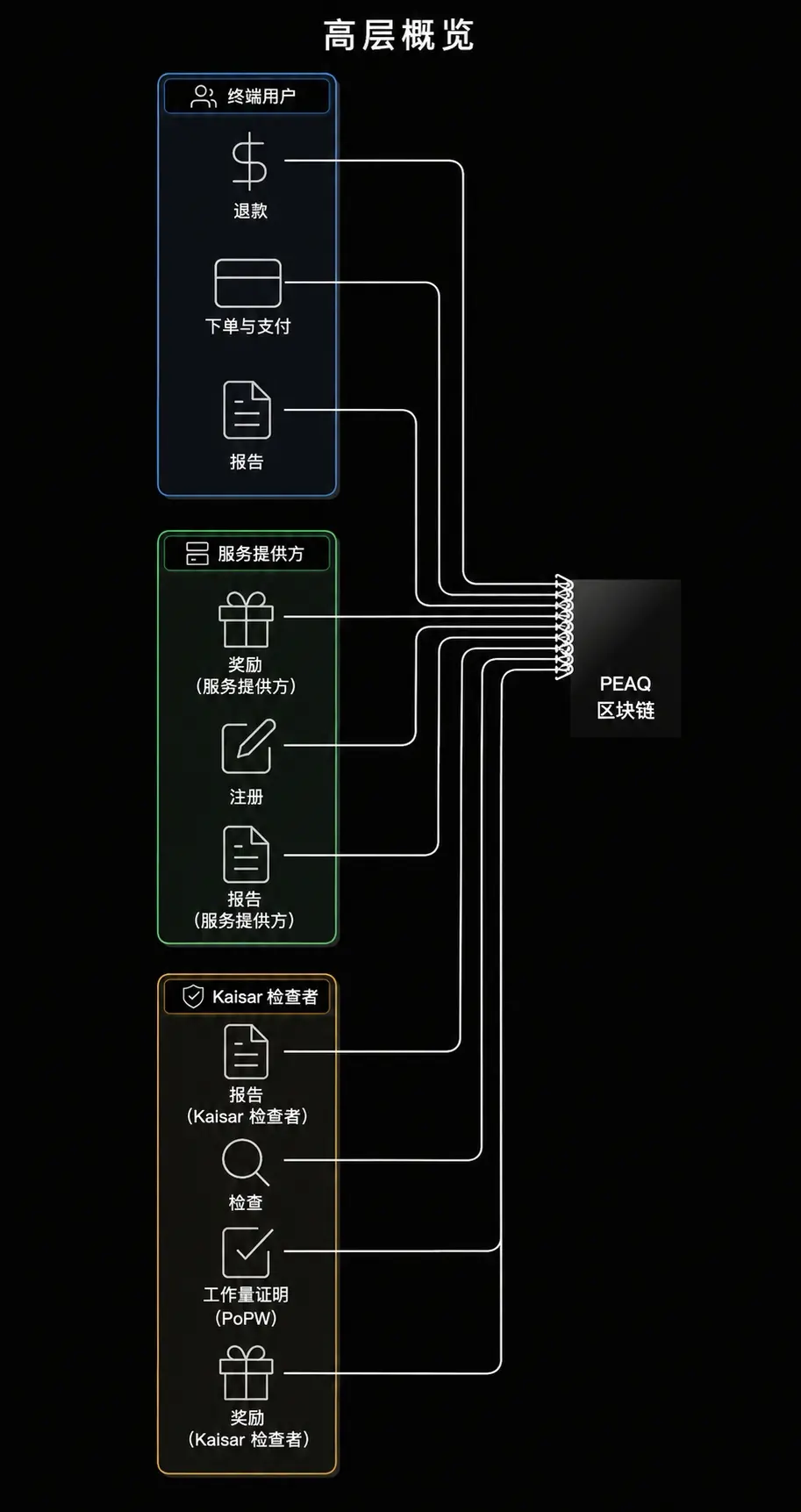
1.1 Key Components
Kaisar Zero Node
Kaisar Zero Node is a Chrome browser extension launched by Kaisar.
It allows users to:
Track key metrics such as device location and online duration
Participate in the decentralized AI computing network
Monetize idle hardware resources
Support the operation of decentralized infrastructure
Essentially, it is a lightweight entry point for ordinary users to access the Kaisar network.
Kaisar OneNode
Kaisar OneNode is Kaisar's GPU scheduling and management system, used to optimize AI computing power utilization in a decentralized manner.
Its system consists of:
Provider (resource provider)
Checker (verification node)
Explorer (data platform)
These components work together and run on the PEAQ Blockchain to ensure network performance and reliability.
Kaisar Provider
The Provider is responsible for supplying GPU computing resources to the network.
These resources can come from:
PCs
Laptops
GPU servers
Bare metal GPU devices
Providers need to continuously report the status of their devices to the PEAQ Blockchain and receive rewards based on their contributions.
Kaisar Checker
Kaisar Checker (verification node) is responsible for verifying the authenticity and availability of the resources provided by the Provider.
Its main tasks include:
Checking GPU performance
Verifying resource status
Submitting Proof of Physical Work (PoPW)
The results are then written to the PEAQ Blockchain, and rewards are granted.
In simple terms:
The Checker acts as a "computing power audit node" within the Kaisar network.
Kaisar Explorer
Kaisar Explorer is an advanced web data platform.
Its functions include:
Real-time viewing of on-chain data
Checking network operational status
Browsing node and GPU resource status
The entire Kaisar network operates on the PEAQ Blockchain.
PEAQ is a multi-chain Layer 1 blockchain optimized for DePIN, supporting:
Over 100,000 TPS
Extremely low transaction costs
Interoperability with ecosystems such as Polkadot, Cosmos, Solana, BNB Chain, and Ethereum through Wormhole
Kaisar Cloud (End Users)
Kaisar Cloud is aimed at users renting GPU computing power.
End users can:
Rent GPUs within the Kaisar network
Complete orders using on-chain payments
Manage cancellation and refund processes
All interactions are completed directly through the blockchain.
1.2 Kaisar Network Overview
1.2.1 Kaisar Cloud (End User Process)
Order & Payment
Users submit GPU rental requests and complete payments through their wallets.
Connect Container / Cluster
After payment is completed, users will automatically connect to the GPU container or cluster provided by the Provider.
Reporting
Users' GPU usage will continuously sync to the PEAQ Blockchain.
Refund
If a refund is needed:
The system completes the refund through the PEAQ consensus mechanism
The refund will be converted into platform points
Users can use these points for discounts or benefits on future service purchases
1.2.2 Kaisar Provider (Resource Provider Process)
Register
Providers need to:
Register GPU devices on the PEAQ Blockchain
Connect their wallets
Pay the Worker registration fee
The entire process is deeply integrated with the PEAQ network.
Providing Services
After registration, Providers will open their GPU computing power to end users in the network.
Report
Providers need to continuously sync GPU usage and operational status to the blockchain.
Reward
Providers receive on-chain rewards based on their resource contributions and operational reports.
1.2.3 Kaisar Checker (Verification Node Process)
Checking
Checkers will continuously verify whether the GPU resources provided by Providers are real and valid.
Proof of Physical Work (PoPW)
Checkers will send performance testing tasks to Workers and update verification results on-chain.
Its core role is:
To prove that these GPU resources genuinely exist and can operate normally.
Report
Checkers will sync resource status and detection results to the PEAQ Blockchain.
Reward
Checkers receive on-chain rewards based on their verification and auditing contributions.
2.1 Kaisar Process
The overall process of Kaisar encompasses the complete journey from wallet connection, container purchase, to GPU service deployment and final usage. The entire system operates collaboratively through blockchain, Checker nodes, and Worker nodes to ensure the security, authenticity, and availability of resources during the deployment process.
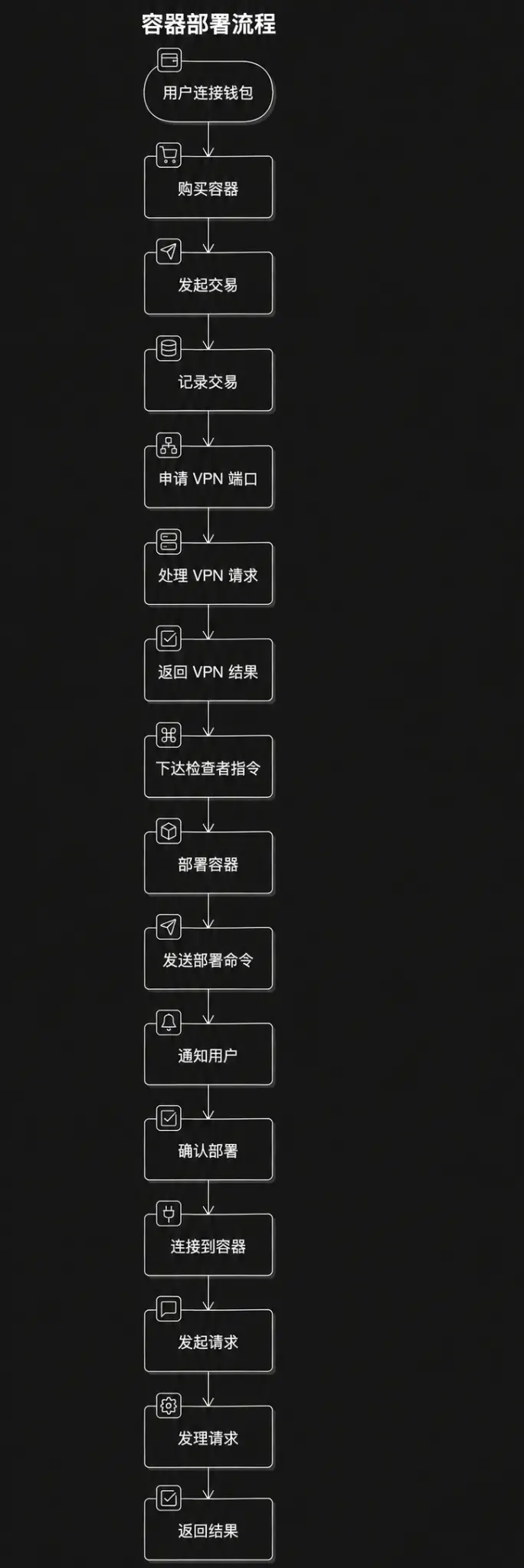
2.1.1 Initiating the Deployment
Connect to Wallet
End users first need to connect their wallet through the Console Portal to start the deployment process.
Buy New Container
Subsequently, users can purchase new GPU container services in the Console Portal.
2.1.2 Transaction Handling
Issue Transaction
The Console Portal will send a transaction request to the blockchain to record this purchase action.
Transaction Details
The blockchain is responsible for recording transaction details and ensuring the integrity and security of transaction data.
2.1.3 Container Deployment
Request to Expose Ports
The Console Portal will send a request to the VPN system to open the required network ports for the new container.
Deploy New Container
Then, the Console Portal will notify the Checker node to start the deployment process.
The Checker will further issue deployment instructions to the Worker Node and complete the container deployment on the corresponding GPU device.
2.1.4 Notification & Connection
Deployment Confirmation
Once the container deployment is complete, the system will send a deployment success notification to the user.
Connect to Container Service
Users can then connect to the newly deployed GPU container service.
2.1.5 Service Utilization
Request to Container Service
Users can continuously send AI or computational task requests to the GPU container.
Request Result
After the container service completes the computation, it will return the results to the user.
2.2 Architecture Layers
Kaisar Network adopts a layered architecture design, with the overall process starting from front-end user requests, passing through the security layer, API gateway, back-end services, and GPU infrastructure, ultimately completing AI computing power scheduling and task processing.
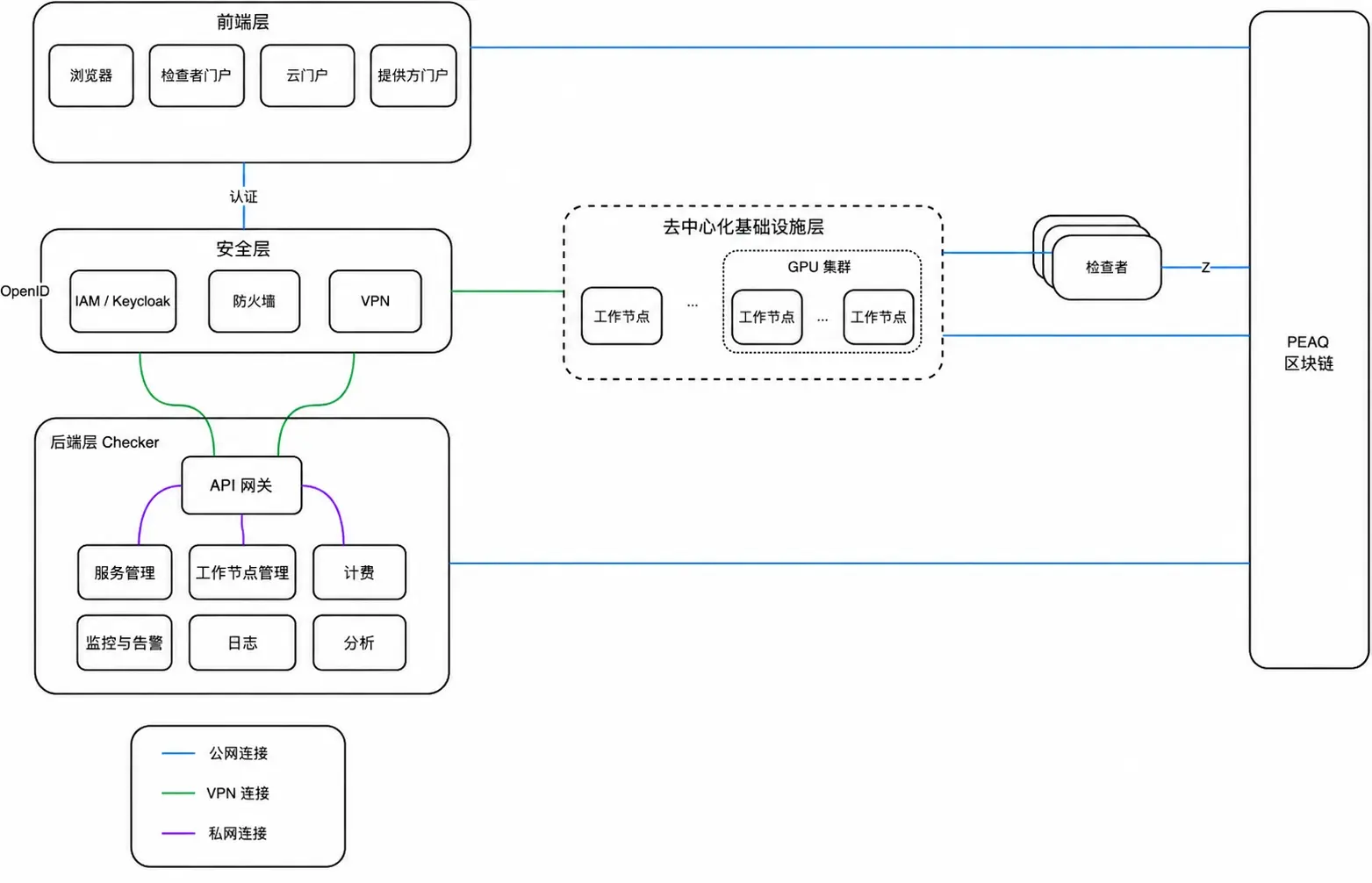
The overall process is as follows:
- Users access the network through different entry points based on their identity:
Explorer: Public data platform for viewing network capacity, statistics, and reports
Kaisar Cloud Portal: For GPU users (GPU Consumer)
Worker Portal: For GPU providers (GPU Provider)
All requests first pass through the VPN and Firewall to ensure network access security, while the IAM identity system verifies user permissions.
The requests then enter the API Gateway. This gateway operates in a clustered mode to achieve high availability and load balancing.
The API Gateway will distribute requests to different back-end service modules using a Round-Robin mechanism, including:
Service Management
Worker Management
Billing
Monitoring & Alert
Logging
Analytics
These services support multi-instance operation to enhance concurrent processing capabilities.
The system will route tasks to the corresponding modules based on the request type. For example, GPU computing tasks will be distributed to the GPU Cluster through Worker Management.
Certain operations that require immutable records or higher security will further interact with the PEAQ Blockchain.
After the request is completed, the results will be returned to the front-end interface through the API Gateway. For asynchronous tasks, the Portal will maintain a connection with the API Gateway via WebSocket and receive results in real-time upon task completion.
2.2.1 Security Layer
The security layer is used to ensure access security and permission control for the entire Kaisar network.
Main technical components include:
MESH VPN: Achieves secure communication
Firewall: Controls network traffic
Wallet Login: Completes identity authentication and authorization through the wallet
The MESH VPN has the following characteristics:
High robustness
The network can still operate normally even if some nodes fail.High scalability
Adding new nodes does not significantly affect overall performance.Low latency
Direct connections between nodes reduce data transmission paths.Load balancing
Network traffic can be automatically distributed to avoid congestion.
2.2.2 Backend Layer
The backend layer is responsible for supporting the core business logic and GPU management of the Kaisar Network.
Providers
Responsible for providing GPU computing resources and connecting to the network as Worker Nodes.
Technology stack includes:
Docker
Kubernetes
Cluster / GPU Management
Used for unified management of Worker Node clusters.
Mainly implemented based on Kubernetes.
Fault Monitoring
Continuously monitors the status and anomalies of GPU resources through Kaisar Checker Nodes.
Autoscaling
The system dynamically adjusts computing resources based on GPU demand.
Technology stack includes:
Kubernetes
HPA (Horizontal Pod Autoscaler)
2.2.3 Infrastructure Layer
The infrastructure layer is responsible for actual GPU computing resources and task scheduling.
GPU Pool
Composed of a large number of GPU devices used to execute AI and computational tasks.
Technology stack includes:
Nvidia GPU
CUDA
Orchestration
Used for unified management of GPU resource pools and task scheduling.
Technology stack includes:
Kubernetes
Docker
2.2.4 Frontend Layer
The frontend layer is responsible for user interaction and system display.
Authentication Service
Achieves user identity authentication and permission management through wallet integration.
Logging Service
Responsible for recording system behavior and on-chain logs.
Console Portal
Serves as the main user interaction interface for:
GPU service purchase
Resource management
Network operations and monitoring
- Core Workflows
3.1 Kaisar Checkers
Kaisar Checkers are responsible for detecting the status of GPU/CPU devices provided by Providers, including:
Uptime
Bandwidth
Performance
And submit proof of device operation to the blockchain to receive rewards. Their core goal is to ensure the authenticity, stability, and service quality of Container services in the Kaisar network.
Detection Mechanism
Checkers will perform detection in the following scenarios:
During registration: Verify Container configuration
In standby state: Random checks
In running state: Real-time analysis of service quality and performance
Detection methods include:
Directly reading GPU/Container performance data
Simulating real user running test tasks
Based on the results:
Verify node authenticity
Affect resource scheduling priority
Penalize low-quality services
After completing the task, the Checker will sign the results with a private key and submit them to the blockchain, with most nodes agreeing on the results receiving rewards.
Workflow
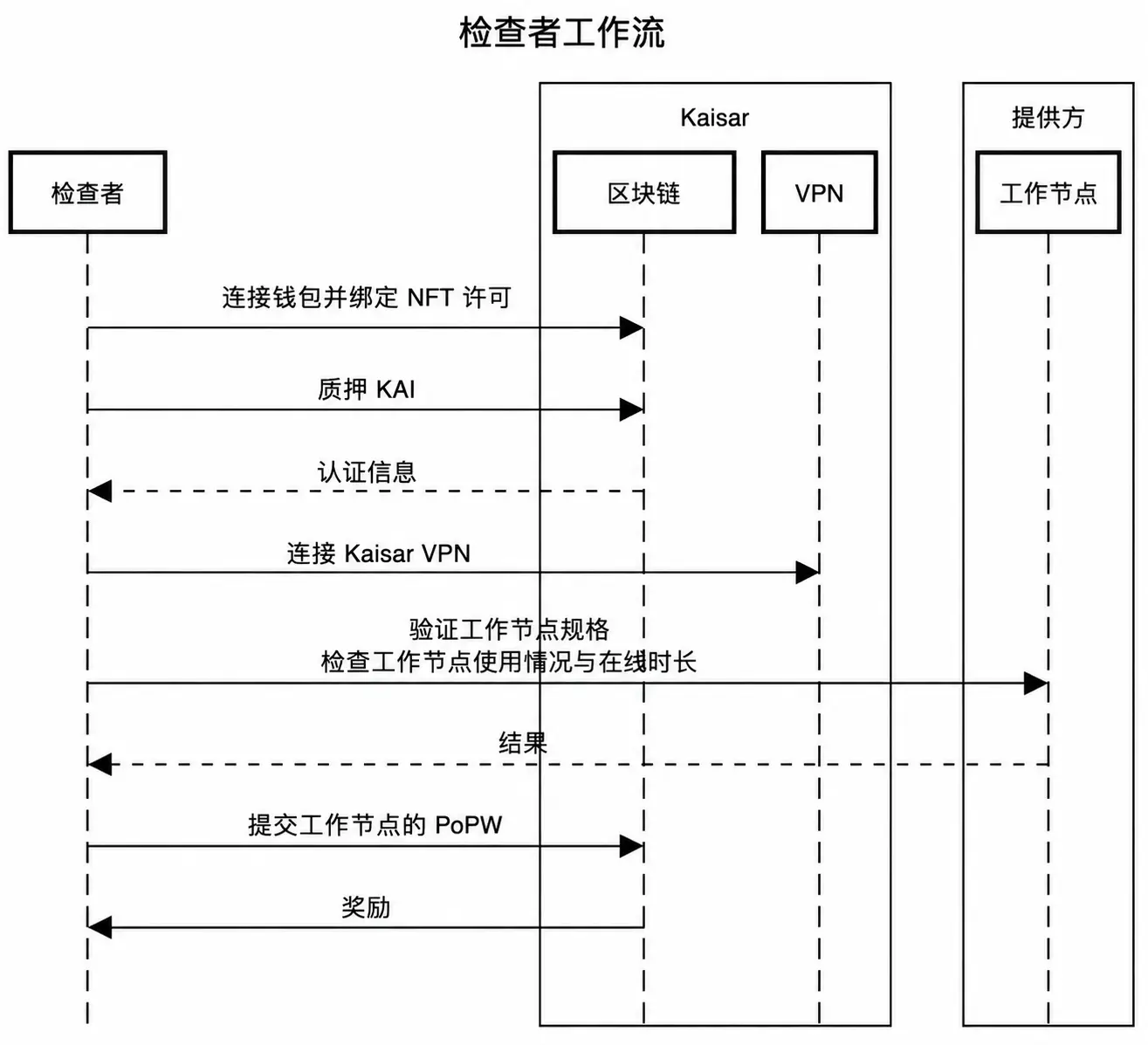
Checker connects to the wallet holding the NFT License
Stake KAI Token
Obtain network certification information
Connect to Kaisar VPN
Query Worker Node workload
Submit PoPW (Proof of Physical Work) to the blockchain
Receive on-chain rewards
3.2 Kaisar Cloud
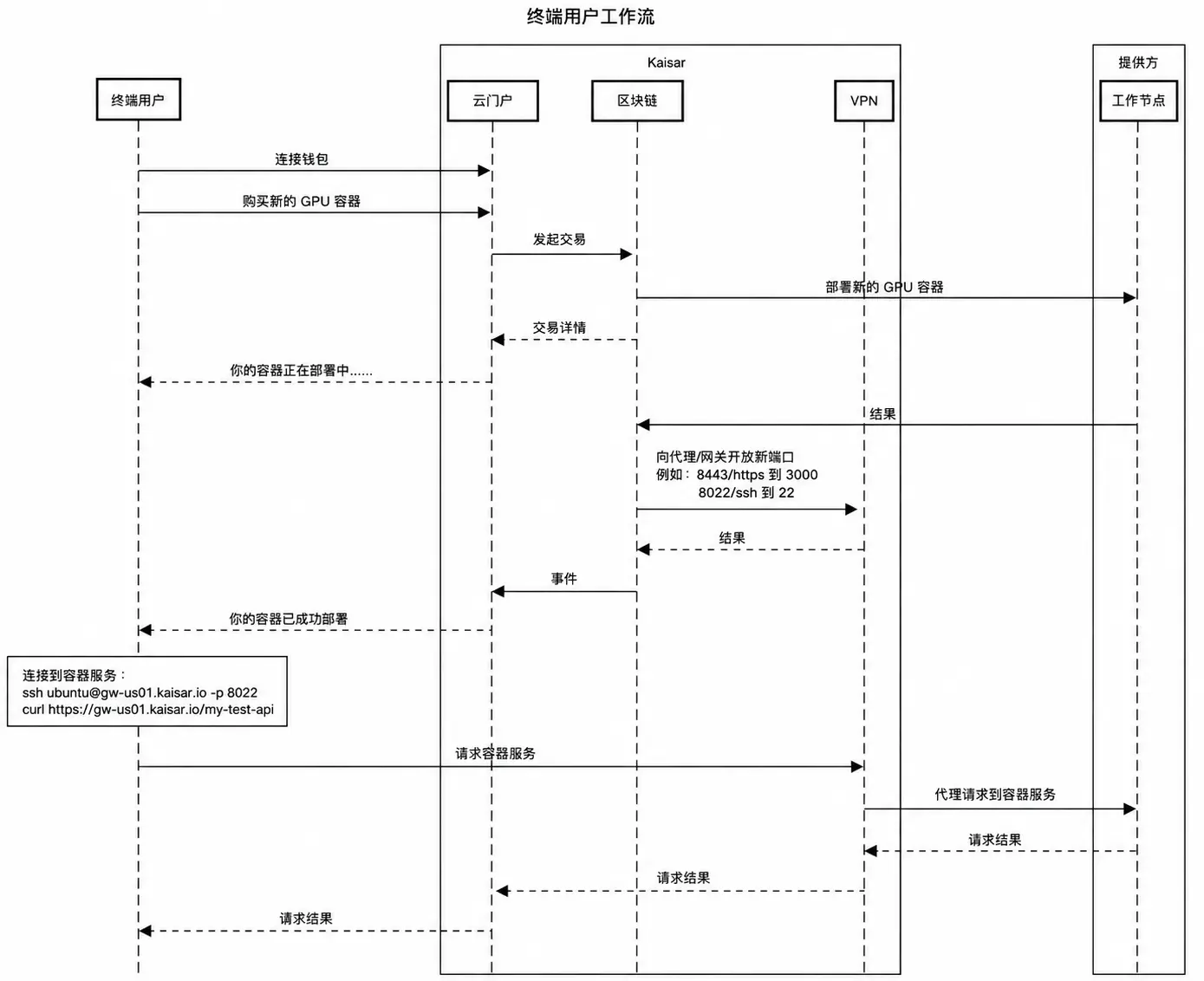
End users connect their wallets through the Console Portal and pay for GPU computing power. The system will then:
Create a new Container
Collaborate with VPN, blockchain, and Checker nodes
Send deployment requests to the Provider's Worker Node
Complete GPU Container deployment
Once the deployment is complete, users will receive:
"Container is deploying…"
"Your Container has been deployed successfully."
And status notifications. End users can use the GPU computing services provided by the Provider.
Supported Container Types
Worker Node (Single Node GPU Container)
Worker Cluster (Multi-Node GPU Cluster)
Mobile Node (Mobile Resource Node, support in the future)
3.3 Kaisar Providers
Providers provide actual GPU/CPU physical devices to the Kaisar Network, also known as Containers. This is the core execution layer for actual AI computation, rendering, and application running.
Provider Requirements
Containers need to meet:
High availability
Fast startup capability
Sufficient GPU/CPU performance
Stable low-latency network environment
The system will dynamically select the most suitable Container based on:
Performance
Latency
Cost
User experience
Worker Node Registration Process
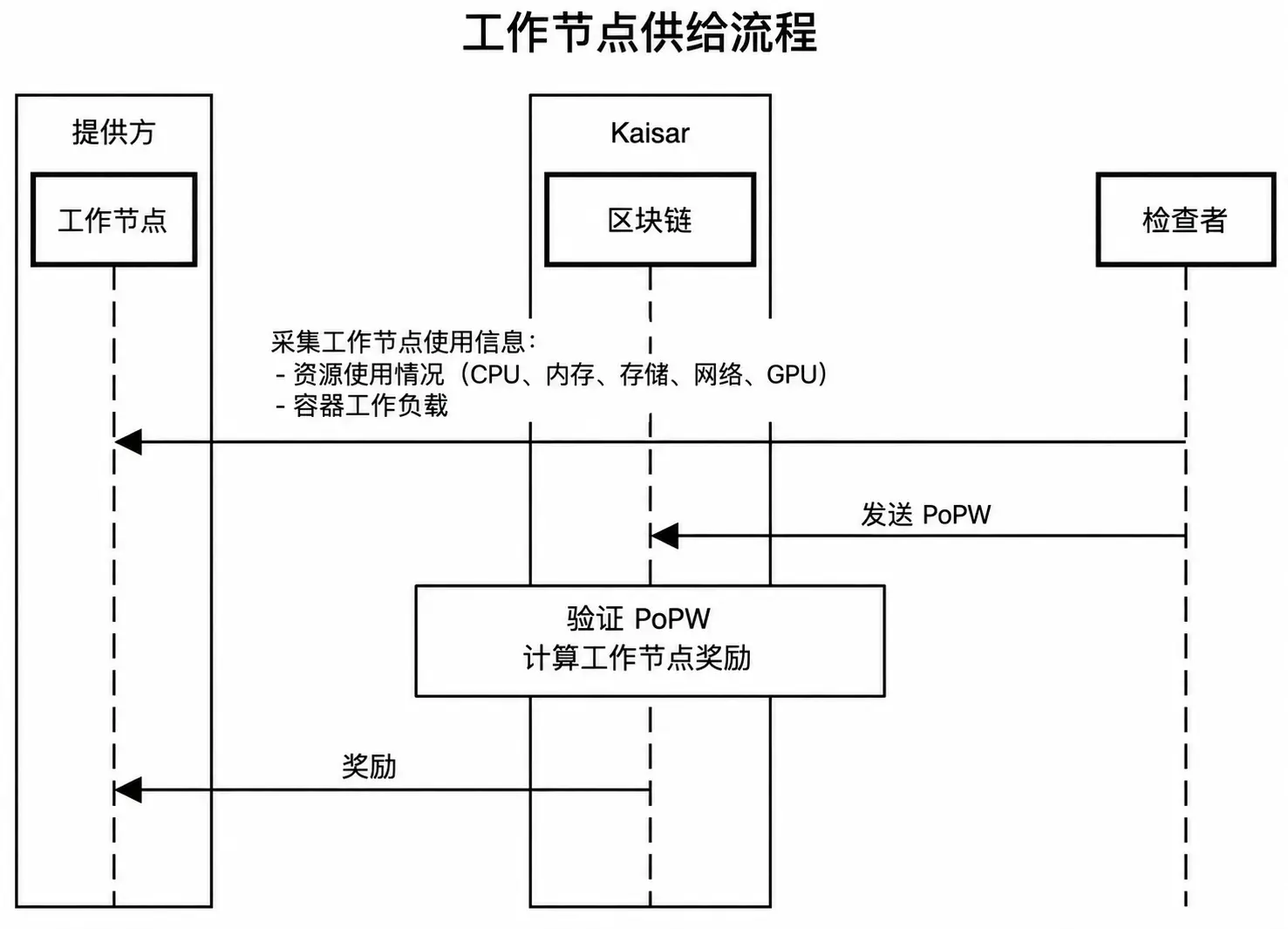
Provider registers a new Worker Node
Request is sent to the Kaisar Network
Console Portal returns the initialization script
Worker Node executes the script and connects the wallet
The node requests Peer information from the blockchain
Executes Benchmark testing tasks
Submits performance results
Completes node registration
Tron Comments
Kaisar's advantage lies in its attempt to build a decentralized GPU computing network aimed at AI and machine learning scenarios, integrating independent data centers, miners, and individual idle GPU resources, combined with the PEAQ blockchain, Checker verification mechanism, and Kubernetes scheduling system, to achieve on-chain scheduling, authenticity verification, and automated scaling of GPU resources. Meanwhile, its Containerized deployment and Worker Cluster design also enhance the scalability of AI inference and distributed computing scenarios.
However, its disadvantages are also evident, including high dependence on the stability of GPU nodes, network bandwidth, real-time scheduling efficiency, and resource quality control. Although the Checker and PoPW mechanisms enhance credibility, they also increase system complexity. Additionally, the decentralized GPU market itself is highly competitive, and long-term solutions are still needed for stability of computing power supply, low-latency experience, and real developer demand realization.
2. Key Project Details of the Week
2.1. Brief Analysis of Animoca's Lead Investment --- Sovereign-Level On-Chain Financial and RWA Infrastructure Network AWARP for Southeast Asia and Emerging Markets
Introduction
AWARP is building "sovereign-level" on-chain financial infrastructure for Southeast Asia and emerging markets, focusing on Laos and the ASEAN region.
Its core directions include:
RWA (Real World Assets) tokenization
Compliant stablecoin settlement
Cross-border payments
Digital identity (Digital ID)
National-level public chain infrastructure
Through LADT, AWARP is promoting the on-chain tokenization of assets such as minerals, renewable energy, and AI data centers, while strengthening the construction of on-chain clearing, liquidity networks, and compliant payment systems.
Core Element Analysis
USDA Analysis
USDA is a stablecoin launched by the Laos National Digital Technology Group (LADT) in collaboration with NewPay, adopting a 1:1 peg to the US dollar, fully backed by US dollar deposits, US Treasury bonds, and cash equivalents. Its core goal is not merely to issue a stablecoin but to attempt to build a regional-level digital financial infrastructure that integrates Web2 payment systems and Web3 on-chain finance around the Southeast Asian market. USDA supports direct minting through US dollars and some ASEAN fiat currencies (such as Lao Kip, Thai Baht, Singapore Dollar, Vietnamese Dong, etc.) and plans to gradually expand to markets such as Laos, Cambodia, Thailand, Vietnam, and Indonesia for cross-border payments, mobile payments, on-chain clearing, and digital asset circulation.
Its core advantage lies in having a strong real business foundation and government resource support. LADT is jointly promoted by the Laos Ministry of Finance, Ministry of Science and Technology, and Lao NewPay United Technology, and has been authorized by the Laos government and central bank, possessing the right to issue stablecoins while participating in local digital financial legislative construction. As the main application carrier of USDA, NewPay has become Laos's leading digital payment platform, covering over 100,000 merchants and 1 million consumers, providing more than 30 types of life services, including government services, QR code payments, and utility bill payments, playing an important role in Laos's mobile payment infrastructure.
In terms of economic model, USDA does not adopt the traditional pure on-chain DeFi circular model but emphasizes the integration of "real cash flow + on-chain finance." In addition to the circulation of the stablecoin itself, the transaction revenue generated from NewPay's offline payment scenarios and some RWA income will also enter the Treasury system to support the MEK ecosystem, staking rewards, and deflationary buyback mechanisms. This means that the value support of USDA comes not only from on-chain capital games but also attempts to introduce cash flow from real-world payment networks and regional economic activities.
In terms of security and transparency, USDA emphasizes compliant operations, including:
On-chain transaction monitoring and risk assessment
Third-party audits
Monthly reserve disclosures
100% reserve support
Bank insurance coverage for reserve assets
Smart contract security audits
Additionally, since USDA is deployed in the Ethereum ecosystem, its transaction records have publicly verifiable characteristics, further enhancing transparency.
Overall, the core logic of USDA is not simply to create a US dollar stablecoin but to attempt to leverage government support, NewPay's payment network, and ASEAN cross-border trade demands to build a "regional-level on-chain payment and financial clearing system" aimed at the Southeast Asian market.
Project Feature Analysis
According to CAICT data, among the more than 80,000 blockchain projects launched globally, only about 8% are still operational; among these surviving projects, about 97% lack external real income sources.
Unlike traditional DeFi projects where "income enters the Treasury and then drives token appreciation through buybacks," AWARP's LADT economic model introduces real cash flow from NewPay. NewPay is Laos's leading mobile digital payment platform, currently with a monthly payment scale exceeding 17 million US dollars and over 500,000 active users.
This means that, in addition to the revenue generated by the Web3 ecosystem itself, a portion of the income from NewPay's traditional business will also continuously flow into the Treasury. Subsequently, the Treasury will:
Provide staking users with returns above the market average (settled in MEK)
Continuously conduct MEK buybacks and deflationary mechanisms
Thus promoting the scarcity and value enhancement of MEK.
Its core logic is: no longer solely relying on on-chain capital cycles but attempting to bring real-world payment business cash flow into the Web3 economic system.
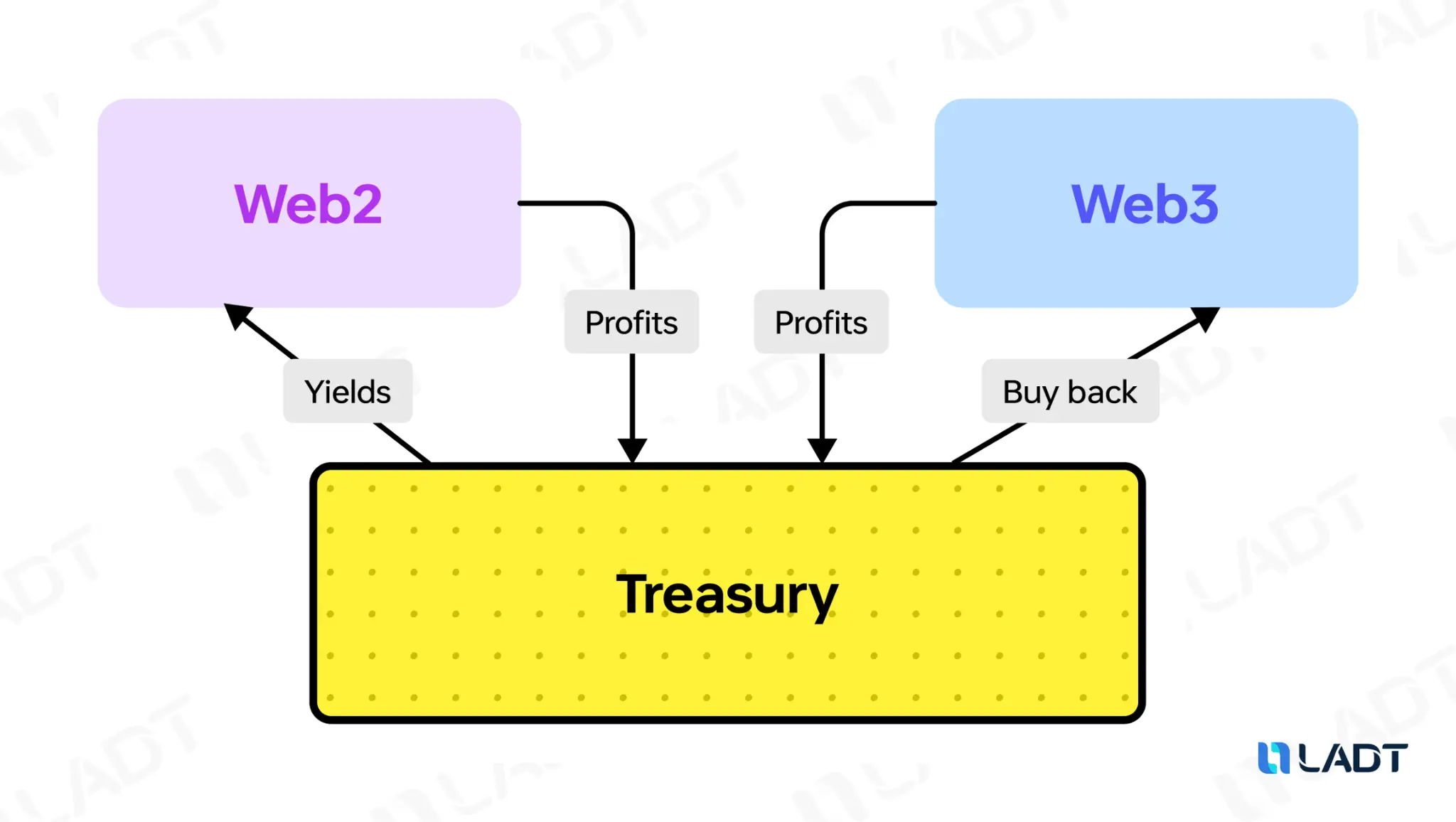
Web2 Economic Circle
ASEAN USD can be minted through US dollars and some ASEAN fiat currencies, including:
Singapore Dollar (SGD)
Thai Baht (THB)
Vietnamese Dong (VND)
Lao Kip (LAK)
Its reserve assets are entirely composed of:
US dollar deposits
US Treasury bonds
Cash equivalents
Achieving full collateralization.
Businesses can open a LADT Account to exchange ASEAN fiat currencies or US dollars for ASEAN USD.
When a business deposits fiat currency or US dollars into the account, LADT will issue an equivalent amount of ASEAN USD, a process known as "Minting," which will also increase the market circulation of ASEAN USD.
Conversely, when a business wishes to exchange ASEAN USD back to US dollars or ASEAN fiat currencies, it can deposit ASEAN USD into the LADT Account and apply for redemption of the corresponding fiat currency, a process known as "Burning," meaning ASEAN USD will exit circulation.
Additionally, some newly minted ASEAN USD will also be introduced into the NewPay ecosystem for offline mobile payments and retail consumption, thereby enhancing the liquidity and usage scale of the stablecoin in real business scenarios.
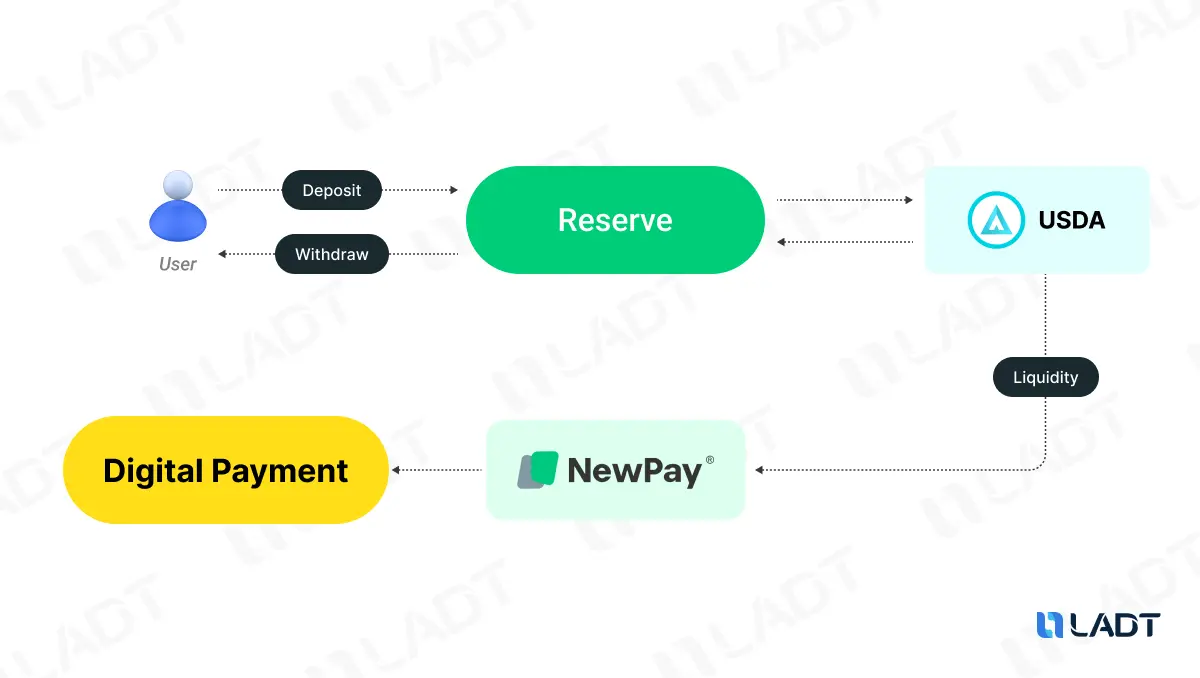
Web3 Economic Circle
LADT's Web3 economic system is built on protocols compatible with EVM (Ethereum Virtual Machine), allowing users to borrow underlying assets by collateralizing crypto assets, while also earning returns by providing liquidity to the protocol. This lending platform is called "Mek Finance."
As previously mentioned, some ASEAN USD will enter the NewPay ecosystem for real payment scenarios, while another portion will flow into Mek Finance to build an on-chain lending and yield system. Meanwhile, the profits generated by Mek Finance will further provide substantial returns for high-net-worth users.
Retail users can use:
BTC
ETH
Certain crypto assets designated by Mek Finance
As collateral to borrow ASEAN USD. Subsequently, users can also stake ASEAN USD and MEK in combination to earn returns settled in MEK.
It is important to note:
While collateralized assets can activate borrowing capabilities, if the account becomes insolvent, the collateralized assets may be partially liquidated.
Mek Finance will also attract users to stake ASEAN USD through higher yields. The initial staking mechanism requires users to:
30% in MEK
70% in ASEAN USD
Users can choose:
To receive all returns after the 90-day lock-up period ends
Or exit early, but will lose part of the returns.
In addition, a portion of the transaction fees generated by NewPay, as well as the RWA earnings corresponding to reserve assets, will continue to flow into the Treasury. Meanwhile, the Treasury will continue to conduct MEK buybacks and deflationary operations to enhance the scarcity and long-term value of MEK.
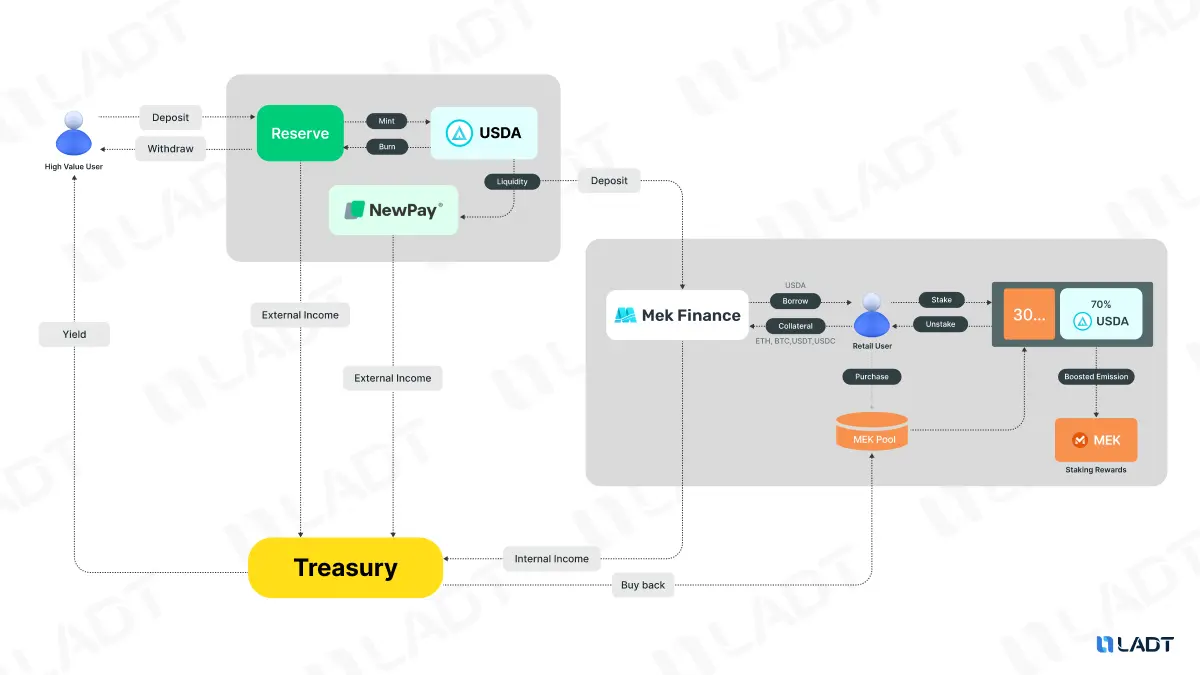
Tron Commentary
The advantage of AWARP lies in its attempt to build "sovereign-level on-chain financial infrastructure" around Laos and the ASEAN market, rather than merely staying within the traditional DeFi or stablecoin narrative. Through NewPay's real payment scenarios, the ASEAN USD stablecoin system, and the Mek Finance lending protocol, it integrates Web2 payment cash flows, RWA earnings, and Web3 on-chain finance, while covering areas such as cross-border payments, RWA tokenization, digital identity, and national-level blockchain infrastructure, demonstrating strong regional implementation and real business support.
However, its disadvantages are also quite evident, including a high dependence on regional regulation, fiat reserve management, and stablecoin compliance systems. Additionally, the overall economic model is relatively complex, requiring a long-term balance of liquidity and earnings between NewPay, Treasury, MEK, and ASEAN USD. Furthermore, its ecological expansion still heavily relies on the adoption of the Southeast Asian market and whether real business scale can continue to grow.
Industry Data Analysis
1. Overall Market Performance
1.1. Spot BTC vs ETH Price Trends
BTC
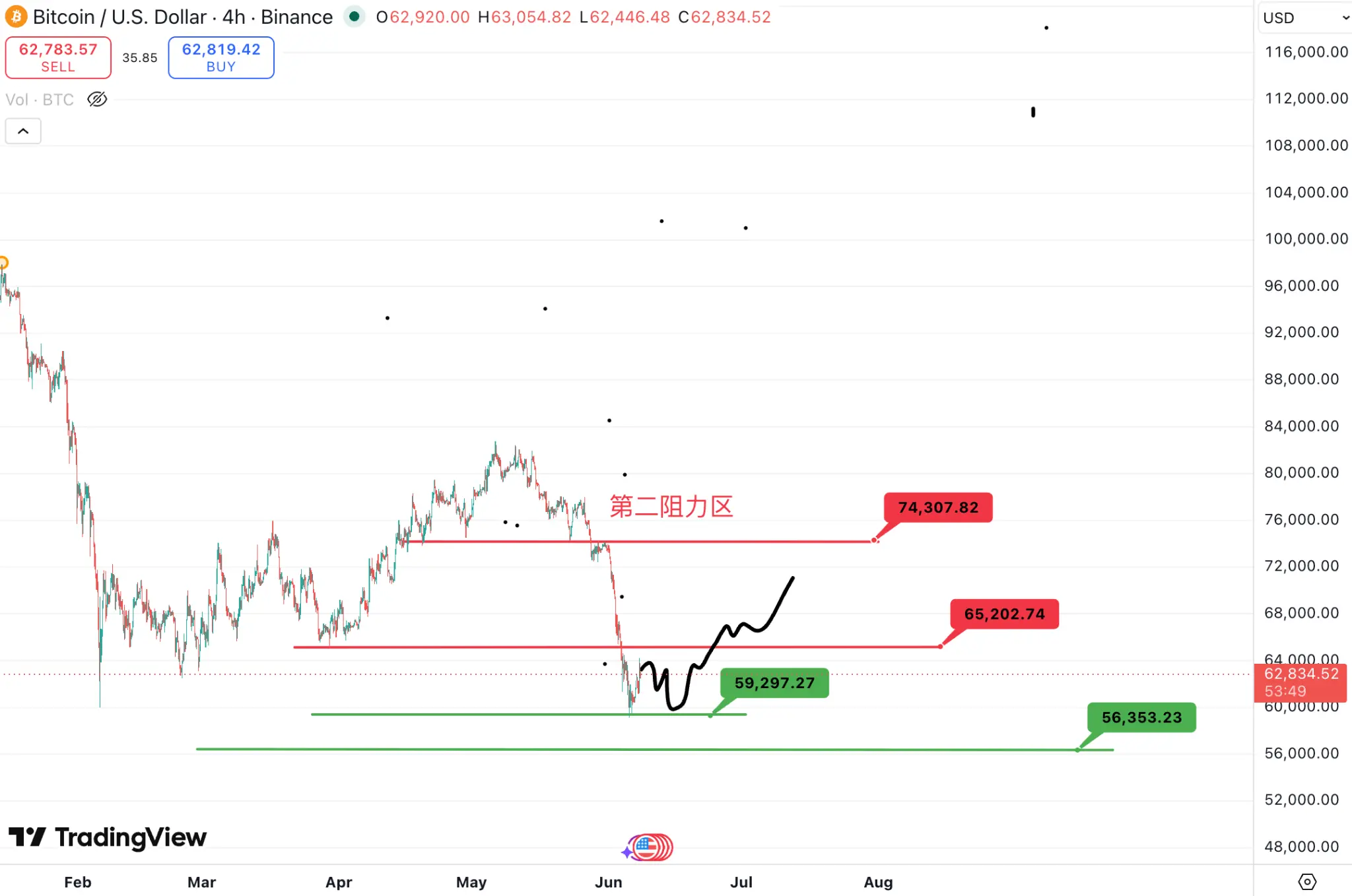
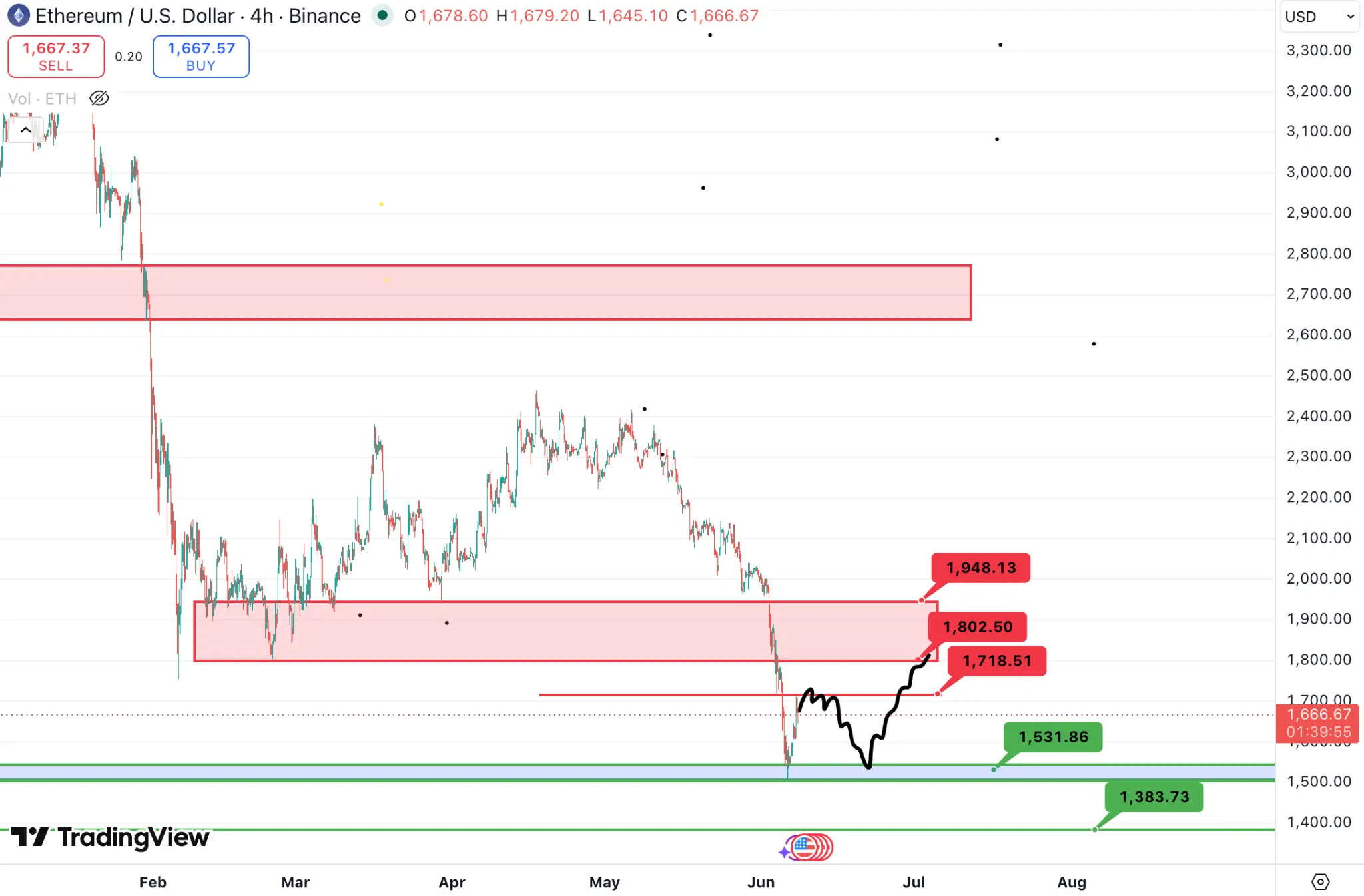
ETH
Macroeconomic Data Review and Key Data Release Points for Next Week
Macroeconomic Review from June 1 to June 7, 2026
United States
Non-Farm Employment (May): An increase of 172,000 jobs, significantly higher than the market expectation of about 85,000, with the unemployment rate remaining at 4.3%, indicating that the labor market remains resilient.
ISM Manufacturing PMI (released on June 1): Continues to reflect weak manufacturing activity, with the market paying attention to signs of slowing economic growth in the United States.
Strong employment data has pushed U.S. Treasury yields higher, further cooling market expectations for a short-term rate cut by the Federal Reserve.
Key Data Points for Next Week (June 8 to June 14)
United States
June 10 (Wednesday)
CPI (May Consumer Price Index) 🔥
Currently the most closely watched data in the global market, which will directly impact expectations for the June FOMC meeting.
June 11 (Thursday)
PPI (May Producer Price Index)
Initial Jobless Claims
June 12 (Friday)
- University of Michigan Consumer Sentiment Index (Preliminary)
Regulatory Policies
United States
The CFTC has approved the first regulated perpetual futures product in the United States, marking a formal further inclusion of crypto derivatives into the U.S. compliance financial system.
U.S. regulators continue to advance the implementation of a coordinated regulatory framework between the SEC and CFTC, with market structure legislation and stablecoin implementation details remaining core topics.
Japan
- Japanese regulatory authorities have proposed a new discussion plan for the crypto ETF regulatory framework while promoting the expansion of the yen stablecoin ecosystem, indicating an acceleration of the integration between traditional finance and the crypto market.
European Union
Only a few weeks remain until the final comprehensive implementation of MiCA (July 1), with member states accelerating the transition of CASP (Crypto Asset Service Provider) licenses and compliance preparations.
The European Parliament entered a critical review phase for the Digital Euro in June, with discussions on digital currency legislation heating up.
 Risk warning Risk warning