Tron Industry Weekly Report: The Federal Reserve releases hawkish signals, BTC rises then falls, a brief analysis of building AI Agent native economic collaboration and value network ARC
 DAO Kraft has completed a $3.4 million financing round, positioning itself as a modular DAO infrastructure platform aimed at decentralized governance and on-chain collaboration, dedicated to enhancing the quality of DAO proposals and decision-making efficiency through intelligent governance tools; meanwhile, ARC has raised a total of $222 million, led by a16z.
I. Outlook
1. Macroeconomic Summary and Future Predictions
From June 15 to June 21, 2026, the global macro market mainly revolved around geopolitical easing and monetary policy repricing. The situation in the Middle East has noticeably cooled compared to before, with a decrease in the risk of energy supply disruptions. International oil prices have retreated from their highs, alleviating market concerns about imported inflation and boosting global risk appetite, leading to strong overall performance in European and American stock markets. Meanwhile, the Federal Reserve maintained interest rates at the June meeting but released hawkish signals, emphasizing that inflation is still not fully under control. Market expectations for interest rate cuts later this year have further contracted, and U.S. Treasury yields remain high and volatile. Against this backdrop, the global market exhibits characteristics of "risk assets supported by geopolitical benefits, but high interest rate environments still suppress valuation expansion," with funds beginning to reassess the possibility of "Higher for Longer."
Looking ahead to June 22 to June 28, 2026, market focus will shift from central bank meetings to verifying economic fundamentals. Major economies such as the U.S. and Europe will successively release PMI, consumer confidence, and manufacturing data, becoming important windows for judging global economic resilience. If U.S. economic data continues to be strong, the market may further delay expectations for interest rate cuts, providing support for U.S. Treasury yields and the dollar; if data weakens, it may alleviate market concerns about ongoing tightening. Meanwhile, oil price trends will still depend on the subsequent developments in the Middle East, and energy prices will continue to influence inflation expectations for the second half of the year. Overall, the global market is likely to maintain a pattern of "stable economic growth expectations, hawkish interest rate expectations, and cautiously improving risk appetite" in the coming week, with a tendency for the stock market to fluctuate strongly and increased volatility in the bond and foreign exchange markets.
2. Market Changes and Warnings in the Crypto Industry
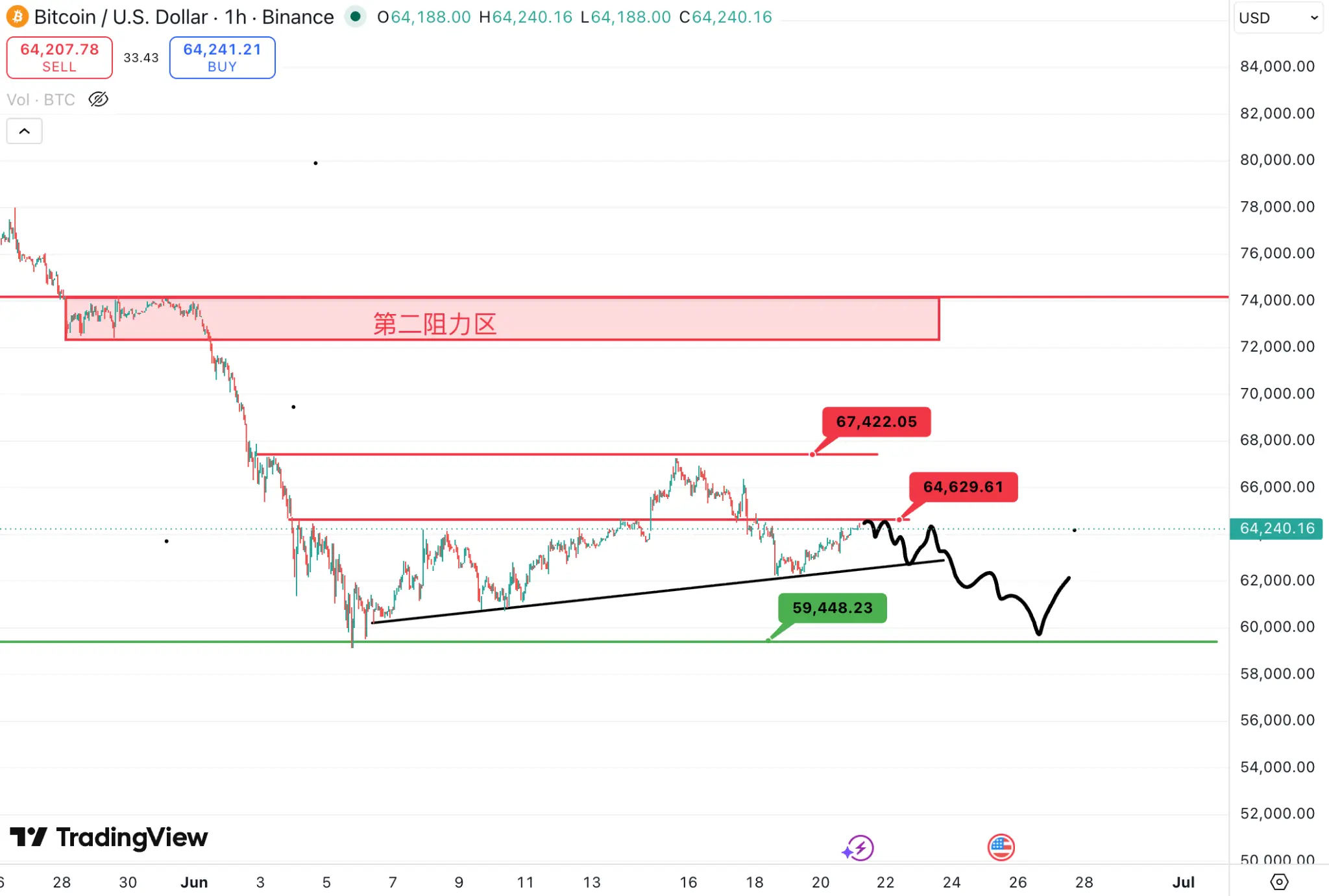
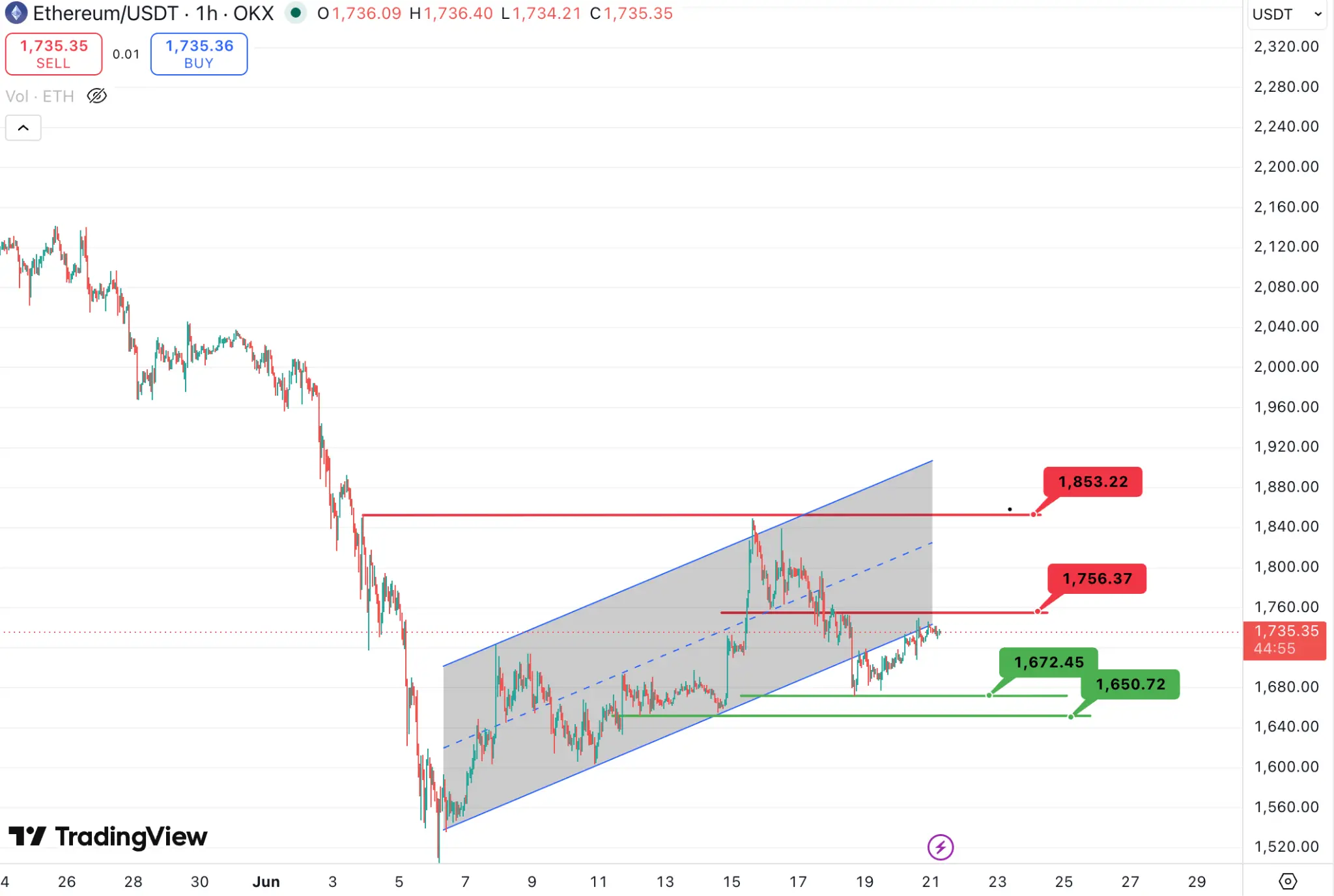
Market changes from June 15 to June 21, 2026: This week, the crypto market rose and then fell. On June 15, driven by a temporary peace agreement between the U.S. and Iran, risk assets rebounded, with BTC rising to about $67,000 at one point, and ETH also showing significant daily gains; however, it later fell back to around $64,000 by June 21 due to ETF fund outflows, hawkish statements from central banks, and weakened institutional demand, overall presenting a fluctuating pattern of "geopolitical risk easing leading to a rebound, but macro and liquidity factors limiting upward movement."
Forecast for the coming week: If the U.S.-Iran situation continues to ease and oil prices maintain their decline, risk appetite may continue to support BTC in the $63,000 to $67,000 range; however, if ETF redemptions continue and the dollar or U.S. Treasury yields rebound, there will still be significant pressure above BTC, making it more likely to experience high volatility and consolidation rather than a one-sided increase. Key attention should be paid to ETF fund flows, macro interest rate expectations, whether geopolitical situations fluctuate, and whether ETH can hold support around $1,700.
3. Industry and Sector Hotspots
DAO Kraft has completed a $3.4 million financing round, positioning itself as a modular DAO infrastructure platform aimed at decentralized governance and on-chain collaboration, dedicated to improving the quality of DAO proposals and decision-making efficiency through governance intelligence tools; meanwhile, ARC has raised a total of $222 million, led by a16z, with support from top institutions such as BlackRock, SBI Holdings, and IDG Capital, positioning itself as a modular smart agent infrastructure for AI Agent collaboration and on-chain autonomous ecosystems, aiming to build an economic collaboration and value network native to AI Agents.
II. Market Hotspots and Potential Projects of the Week
1. Overview of Potential Projects
1.1. Detailed Explanation of Total Financing of $3.4 Million, Co-invested by Animoca and Castrum Capital — DAO Kraft, a Modular DAO Infrastructure Platform for Decentralized Governance and On-Chain Collaboration
Introduction
DAOKraft is an AI-driven Governance Intelligence Layer designed to help DAO contributors transform ideas into high-quality, strategically optimized governance proposals and systematically analyze why proposals succeed or fail.
It enhances governance decision quality, proposal clarity, and long-term governance efficiency in the DAO ecosystem by combining:
- Proposal Intelligence
- Governance Analytics
- Outcome Simulation
- Execution Tracking
- Reputation Systems
Brief Overview of the Protocol Framework
Governance Intelligence Stack
DAOKraft believes that the core of governance is not just "voting," but "Decision Intelligence."
Most DAO governance failures actually occur before voting, such as:
- Proposals being unclear
- Lack of background information
- Absence of impact analysis
- Insufficient execution risk assessment
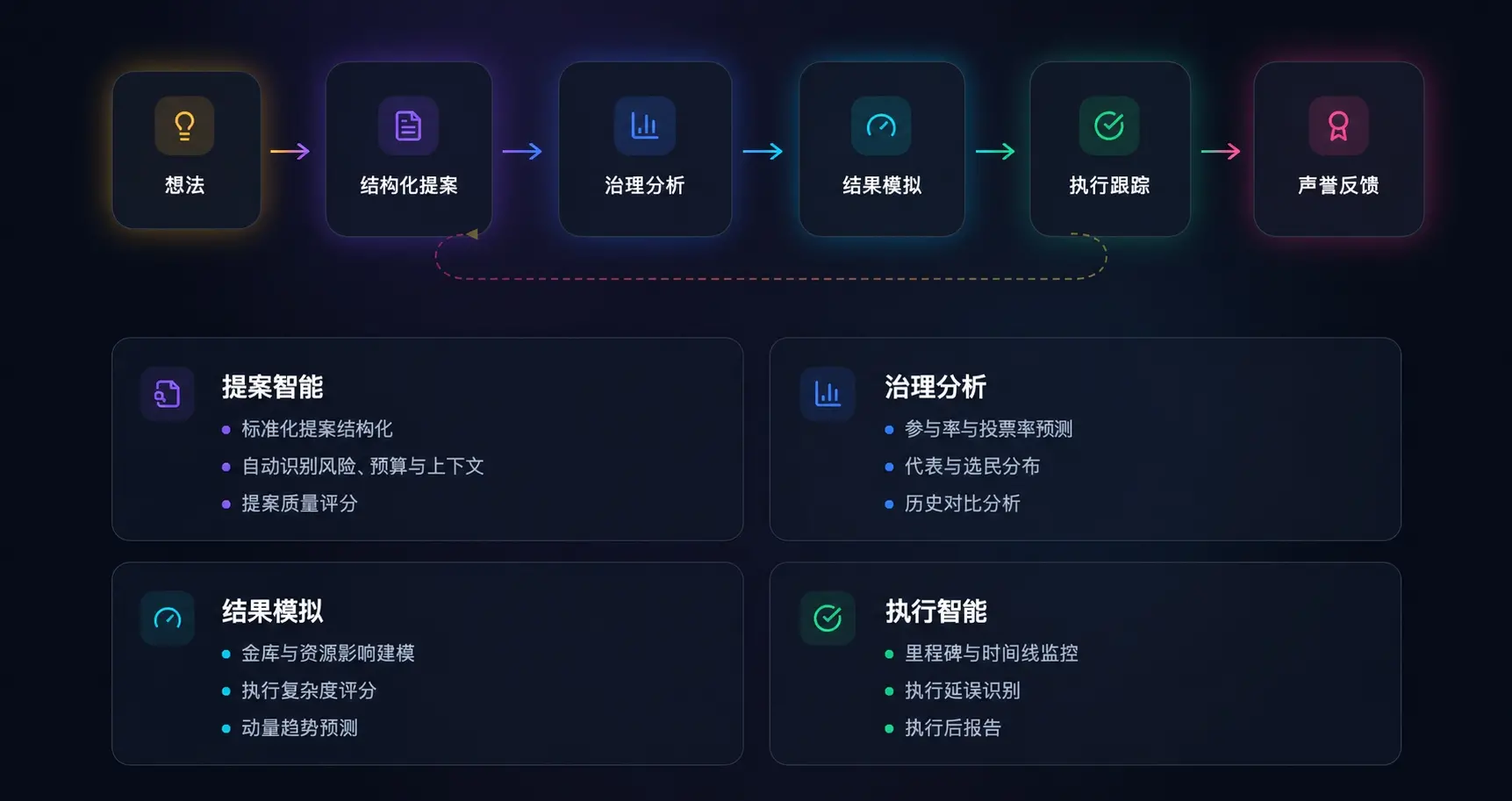
Therefore, DAOKraft redefines DAO governance as a sustainable iterative intelligent governance cycle:
Idea
→ Structured Proposal
→ Governance Analytics
→ Outcome Simulation
→ Execution Tracking
→ Reputation Feedback
Each layer reinforces the next round of governance decisions, forming a continuously optimized DAO governance system.
1.1 Proposal Intelligence
DAOKraft will conduct structured and quality analysis of governance proposals, including:
- Standardized proposal structure
- Automatic identification of risks, budgets, and background information
- Scoring for proposal clarity, completeness, and feasibility
Its goal is to enhance the quality of governance proposals and reduce low-quality governance noise.
1.2 Governance Analytics
The system will further analyze DAO governance behavior, including:
- Participation and voting rate predictions
- Delegate and voter distribution analysis
- Community sentiment recognition
- Comparative analysis with historically similar proposals
This helps DAOs better understand governance trends and community feedback.
1.3 Outcome Simulation
Before a proposal is formally executed, DAOKraft will simulate governance outcomes, including:
- Treasury and resource impact analysis
- Execution complexity and risk scoring
- Community participation and governance momentum predictions
This helps DAOs identify potential risks and execution costs in advance.
1.4 Execution & Accountability Intelligence
After a proposal is approved, the system will continue to track the execution process, including:
- Milestone and timeline monitoring
- Execution delay detection
- Post-execution outcome reporting
It is important to emphasize that DAOKraft does not control DAO assets or execute on-chain transactions.
All analyses are based on DAO native data and publicly verifiable information.
1.5 Reputation & Feedback Loop
DAOKraft will establish a results-based reputation system for governance participants, including:
- Proposal initiators
- Contributors and reviewers
- Advisors and governance bodies
The core logic is that reputation is based on "actual results," not "intentions."
This reputation data will also feedback into future governance recommendations and decision analyses, forming a long-term governance optimization loop.
How DAOKraft Works
- Users log into the system via email or wallet
- Select target DAO and proposal intent
- AI automatically generates a structured governance proposal draft
- The system synchronously analyzes historical governance data and similar proposal records
- Based on governance data, it generates:
- Proposal success probability
- Strategic optimization suggestions
- Governance risk analysis
- Users formally submit proposals through the DAO native governance system
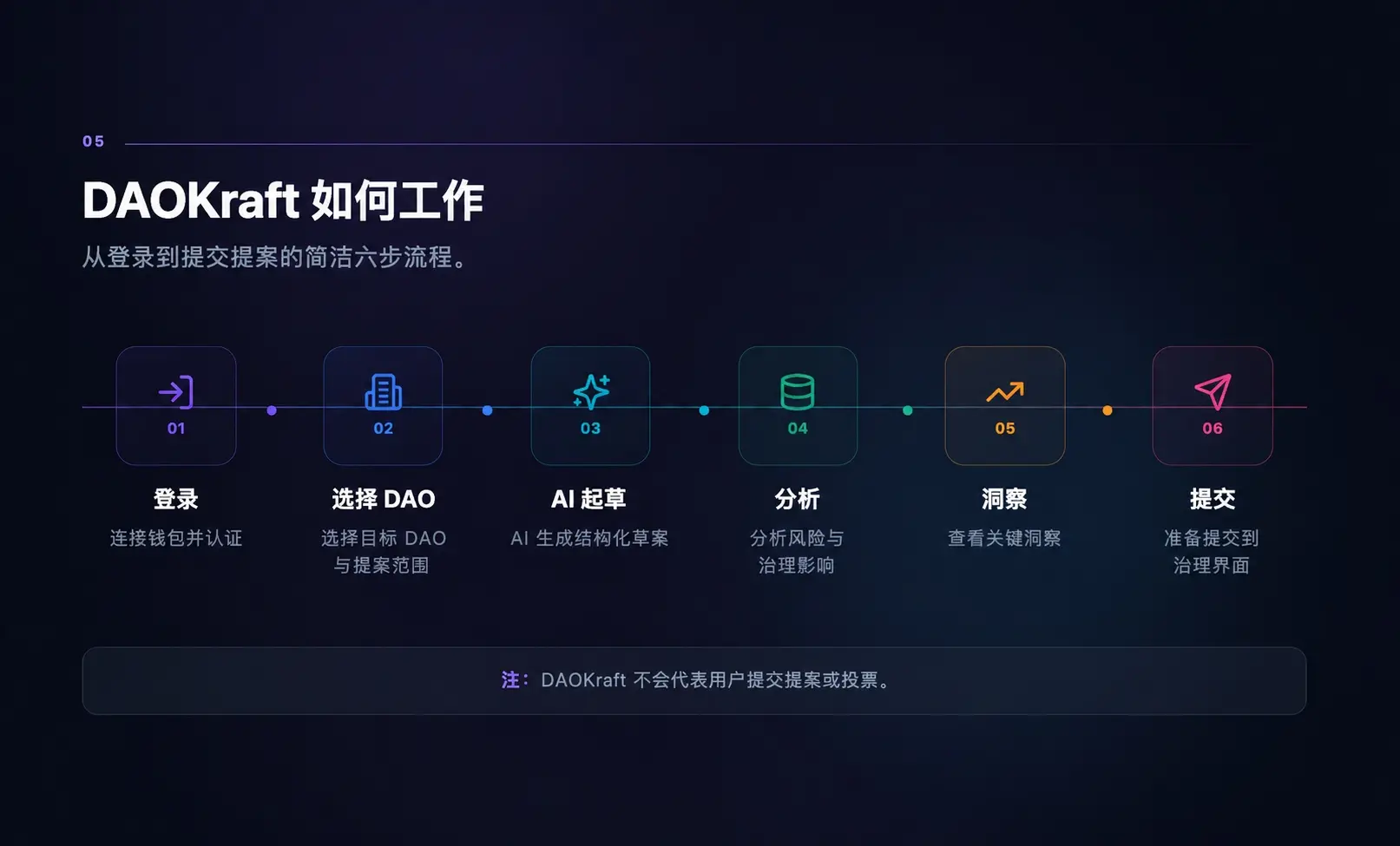
It is important to emphasize that DAOKraft will not submit proposals on behalf of users or vote on their behalf.
Its positioning is more like an AI decision-making and governance analysis assistance layer in DAO governance.
Governance Intelligence & Token Model
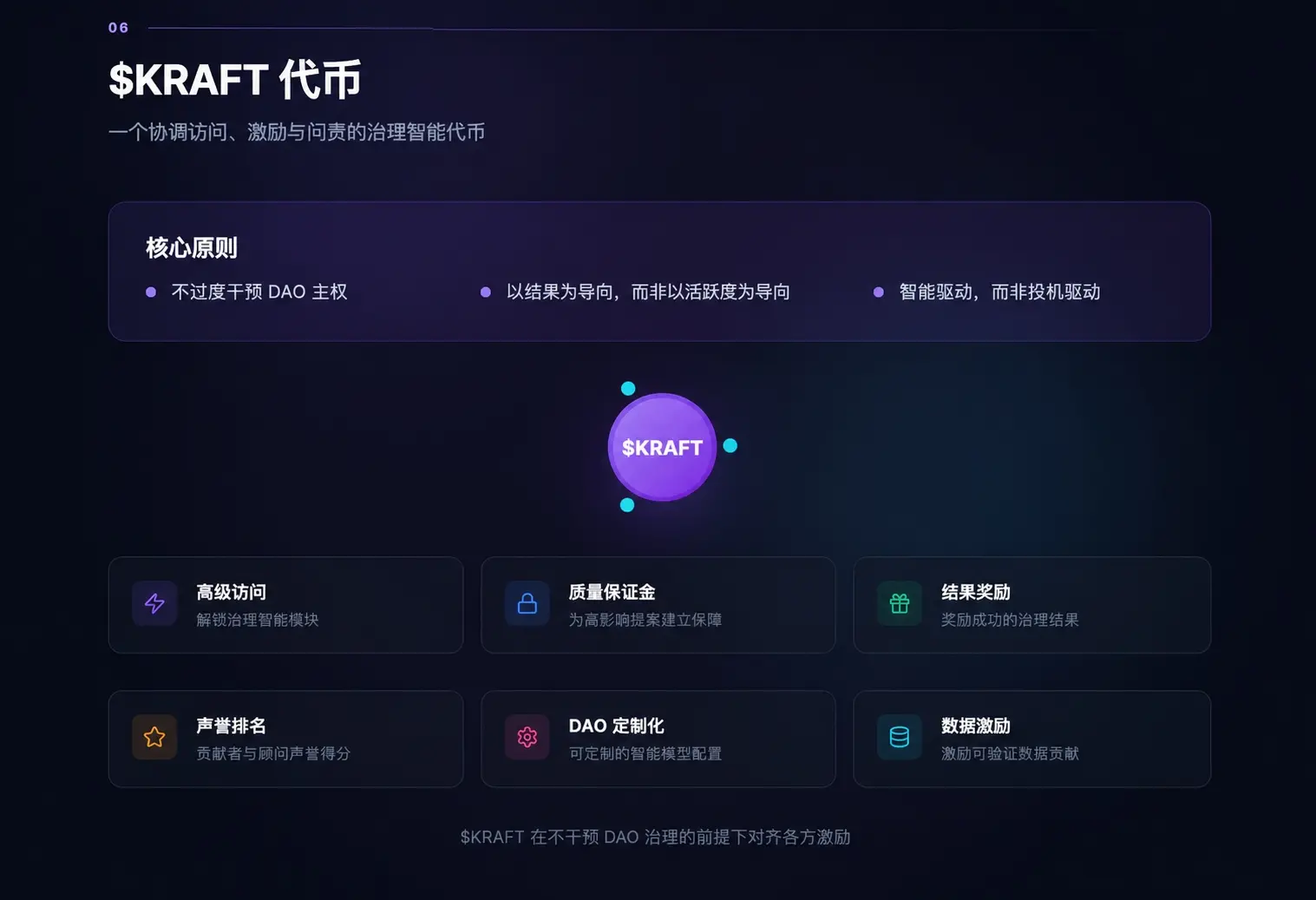
DAOKraft has launched a governance intelligence token — $KRAFT.
It is important to emphasize that $KRAFT does not restrict users from submitting proposals or participating in DAO voting.
Its core role is not to control governance authority but to coordinate the entire Governance Intelligence Layer in terms of:
- Access permissions
- Incentive mechanisms
- Reputation and accountability systems
Thus promoting the long-term optimization of the DAO governance system.
Core Principles
Non-intrusive to DAO Sovereignty
DAOKraft will not take over DAO governance rights or replace native governance mechanisms.
Its positioning is to provide governance analysis and intelligent assistance, rather than control the DAO.
Outcome-oriented, not Activity-based
DAOKraft focuses more on the final governance outcomes, rather than just whether users "participate."
For example:
- Whether the proposal is truly effective
- Whether it is successfully executed
- Whether it creates long-term value
Rather than simply counting votes or activity levels.
Intelligence-driven, not Speculative
The core goal of $KRAFT is to support governance analysis, decision optimization, and governance collaboration, rather than merely focusing on token speculation.
Its overall logic leans more towards AI + DAO Governance Infrastructure.
Governance Data Sources & Integrity
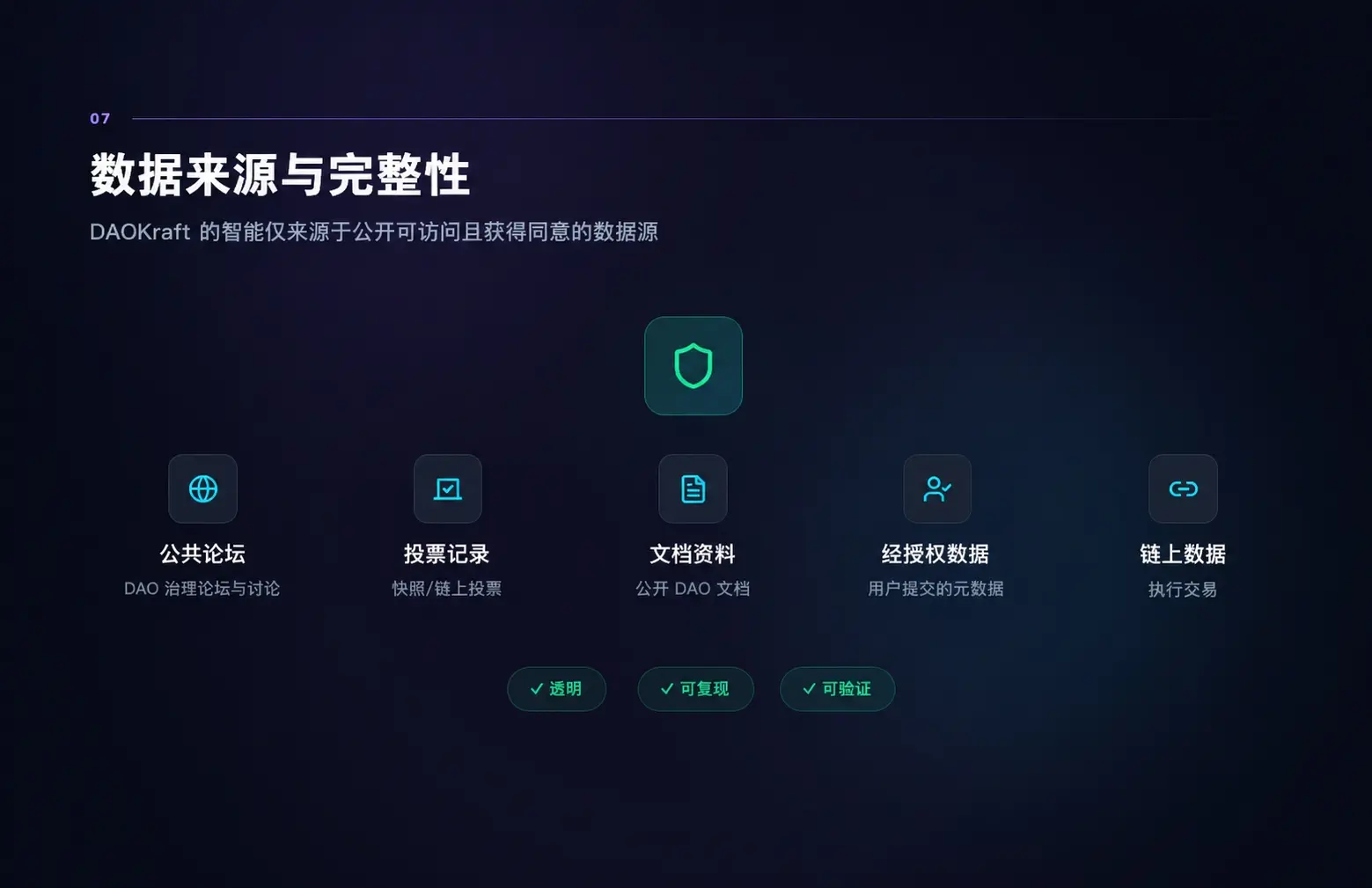
DAOKraft's governance intelligence analysis is based solely on publicly accessible and user-authorized data sources, including:
- DAO public governance forums and proposal archives
- Snapshot, Tally, and on-chain voting records
- DAO public governance documents and governance frameworks
- Governance metadata submitted with explicit user authorization
- Execution data that can be verified through on-chain transactions or public reports
DAOKraft will not use:
- Private communication content
- Proprietary databases
- Unauthorized data scraping
All governance analysis results emphasize:
- Transparency
- Reproducibility
- Public verifiability
Essentially, DAOKraft aims to build an AI DAO Governance Intelligence System based on publicly available governance data.
Tron Comments
DAOKraft's advantage lies in that it is not just a traditional DAO governance tool but attempts to build an AI-driven "Governance Intelligence Layer," upgrading DAO governance from a simple "voting mechanism" to a sustainably optimized "decision intelligence system" through proposal analysis, governance data modeling, outcome simulation, execution tracking, and reputation feedback systems. Its design, which does not take over DAO sovereignty, does not control assets, and analyzes based solely on publicly available governance data, also reduces its intrusiveness to native governance structures.
However, its disadvantage is that DAO governance itself still heavily relies on community culture, governance participation, and human games. While AI can enhance proposal quality and governance efficiency, it is difficult to truly resolve internal conflicts of interest and governance fragmentation within DAOs. Additionally, governance outcomes themselves have strong subjectivity, and the long-term accuracy and actual adoption of "governance intelligence" and "success rate predictions" still need time to verify.
2. Key Project Details of the Week
2.1. Detailed Explanation of Total Financing of $222 Million, Led by A16z, with Participation from Star Institutions such as BlackRock, SBI Holdings, and IDG — ARC, a Modular Smart Agent Infrastructure for AI Agent Collaboration and On-Chain Autonomous Ecosystems
Introduction
Arc is a public Layer-1 blockchain positioned as the "Economic Operating System" of the internet.
It aims to build a full-stack economic infrastructure platform that allows:
- Economic Contracts
- Stablecoins
- Tokenized Assets
- Global Markets
to operate on a unified, composable shared infrastructure.
ARC is the native coordination asset of the network, a utility-driven token used to coordinate the alignment of interests among network participants and the long-term development of Arc through:
- Staking
- Governance
- Fee Capture
- Full platform functionality usage
The utility of ARC is not limited to the chain itself but also covers multiple protocols and products built by Circle and ecosystem partners on this network.
Core Analysis of System Architecture
- Connection with Global Finance and Crypto Ecosystems
Arc connects with traditional finance and crypto ecosystems through various infrastructures, including:
- CCTP cross-chain transfers
- Programmable Wallets
- FX infrastructure
- Circle Mint
- Circle Payments Network
This makes Arc not just a public chain but more like a unified economic network for global payments, stablecoins, and on-chain finance.
- Developer Kits & Frameworks
Arc provides development tools such as Skills and CLI to help developers quickly deploy:
- Lending protocols
- Trading services
- Payment systems
- AI Agent services
Developers do not need to build the underlying infrastructure from scratch.
The core logic is to standardize and modularize complex financial infrastructure.
- ARC Token
ARC is the native coordination asset of the Arc network and the core coordination layer of the entire Arc Economic OS.
Arc itself is positioned as a blockchain network for the global internet economy, and the role of ARC is not just an ordinary gas or payment token; more importantly, it is responsible for coordinating governance, security, economic incentives, and long-term value distribution throughout the network.
ARC holders have governance rights and participate in maintaining:
- Network regulatory compliance
- Network security
- Infrastructure integrity
Thus enabling institutions to build critical financial applications and settlement systems based on Arc.
Arc's Three-Layer Structure
The overall system of Arc consists of three layers:
- Arc Network (Execution Layer)
The Arc network itself provides:
- Deterministic settlement
- Stablecoin-denominated gas
- Configurable privacy
- Institutional-level validation node system
This is the underlying execution environment of the entire Economic OS.
- Stablecoins (Transaction Medium Layer)
Stablecoins serve as the main value medium in the network, providing:
- Predictable value units
- Global liquidity
- More stable payment and settlement capabilities
Essentially serving as the "currency layer" in the on-chain economy.
- ARC (Coordination Layer)
ARC serves as the coordination mechanism of the entire system, responsible for:
- Network security maintenance
- Economic governance
- Incentive distribution
- Network value sharing
It is essentially the core asset connecting network participants with the long-term development of Arc.
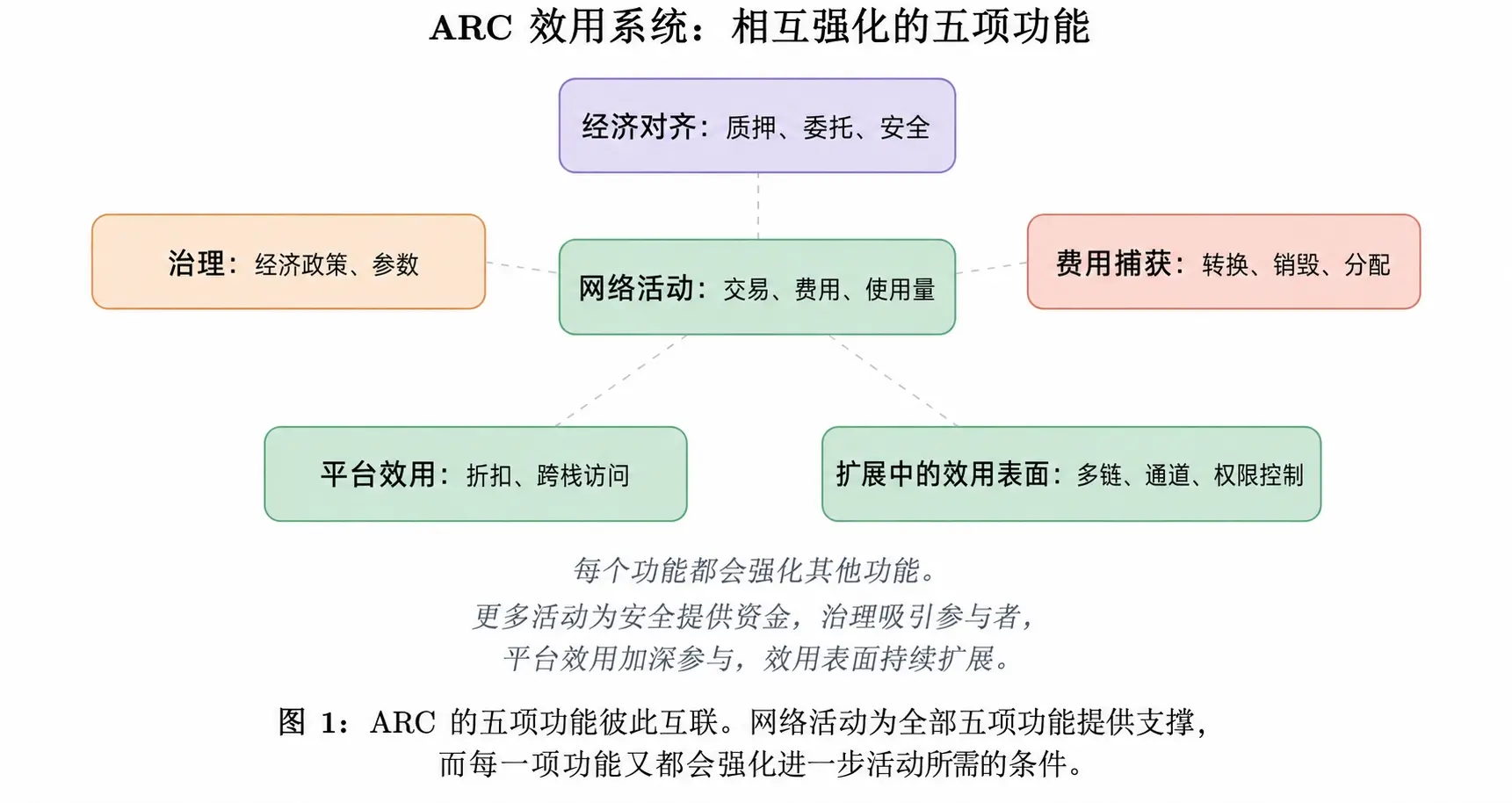
- ARC Utility in Depth
ARC is designed as a "productive asset."
The core logic is that the deeper users participate in the Arc Economic OS, the stronger the actual utility of ARC becomes.
Not just simply holding tokens, users who continuously:
- Trade
- Build applications
- Run services
- Participate in network governance
can gain more platform rights, including:
- Lower gas costs
- Lower platform service fees
- Higher governance weight
- More ecosystem access rights
Essentially, the value of ARC is directly tied to the depth of user participation in the Arc ecosystem.
Staking Mechanism
The Arc network will gradually transition from:
- PoA (Proof-of-Authority)
to:
- PoS (Proof-of-Stake)
Permissioned validators in the network are responsible for block production and network maintenance, while ordinary ARC holders can participate in network security and reward distribution through staking ARC while retaining asset control.
Staking rewards mainly come from two parts:
- Inflation issuance rewards
- Protocol layer fee income (converted to ARC for distribution)
Validators will retain a portion of the commission, while the remaining earnings will be distributed to stakers based on their staking ratio.
Economic Security & Permissioning
The security system of Arc consists of two layers:
- Permissioned Validator Layer
Responsible for identity and compliance layers.
Its characteristics include:
- Validator identities are public
- Meet minimum operational standards
- Subject to legal liability constraints
Mainly ensuring institutional-level credibility.
- ARC Staking Layer
ARC staking is responsible for the economic security layer.
The scale of staking will affect:
- Validator weight
- Block selection
- Reward distribution
- Punishment risks
Thus constraining validator behavior through economic incentives.
Onchain Coordination Evolution
The permission mechanism of Arc will gradually migrate from off-chain to on-chain.
As the network matures, the following functions may gradually be moved on-chain:
- Validator scoring
- Access thresholds
- Permission controls
Coordinated through ARC staking and on-chain data.
The goal is to enhance decentralization while maintaining institutional-level identity and compliance.
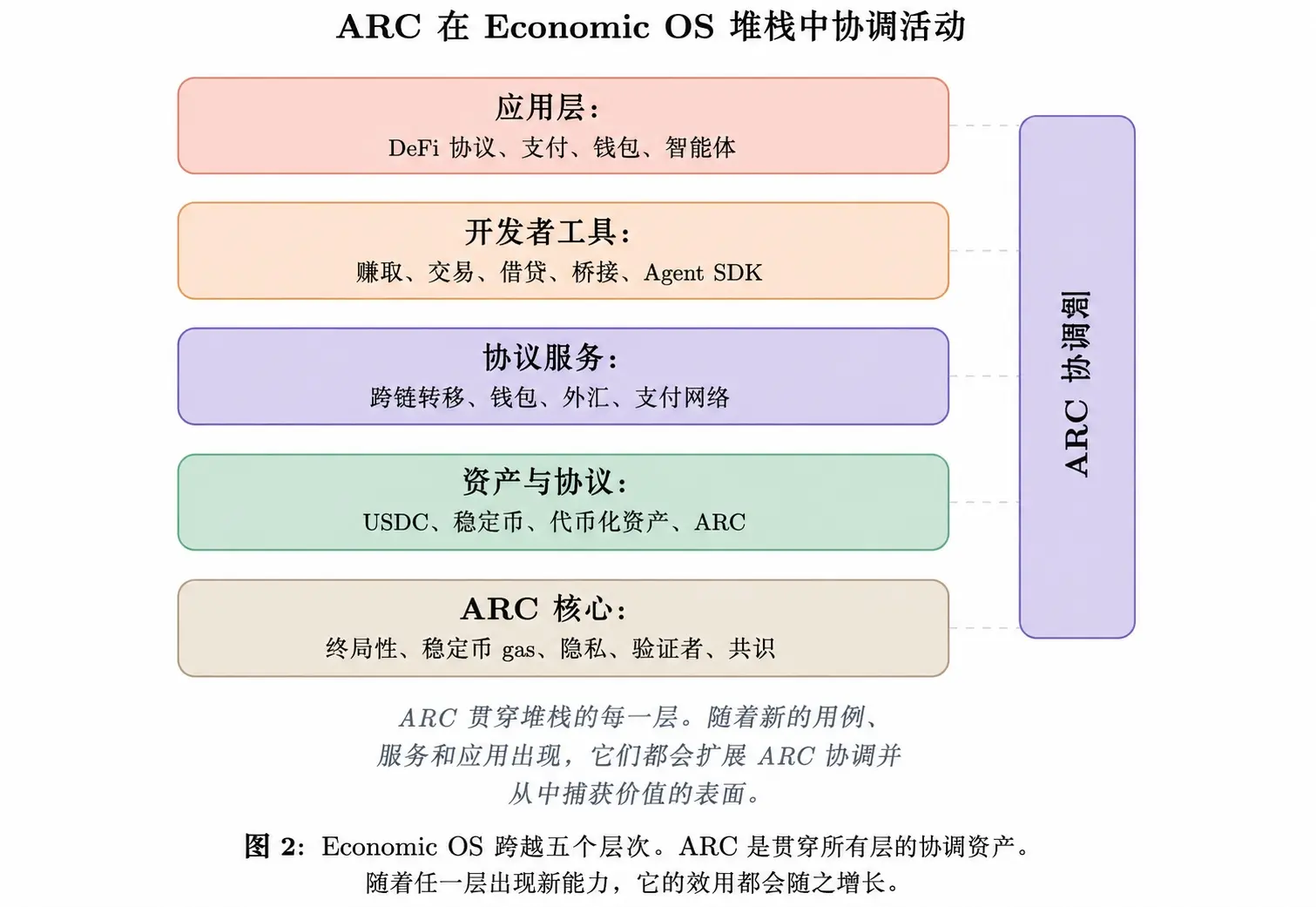
Platform-level Utility
Arc is designed as a continuously expanding complete economic platform covering:
- Core infrastructure
- Stablecoins and assets
- Protocol services
- Development tools
- Application layer ecosystem
The utility of ARC will permeate the entire ecosystem stack.
Overall, the core positioning of ARC is not as a single payment token but more like a "full-platform coordination and value capture asset" within the Arc Economic OS.
- Economic Architecture
Fee Mechanics & Conversion
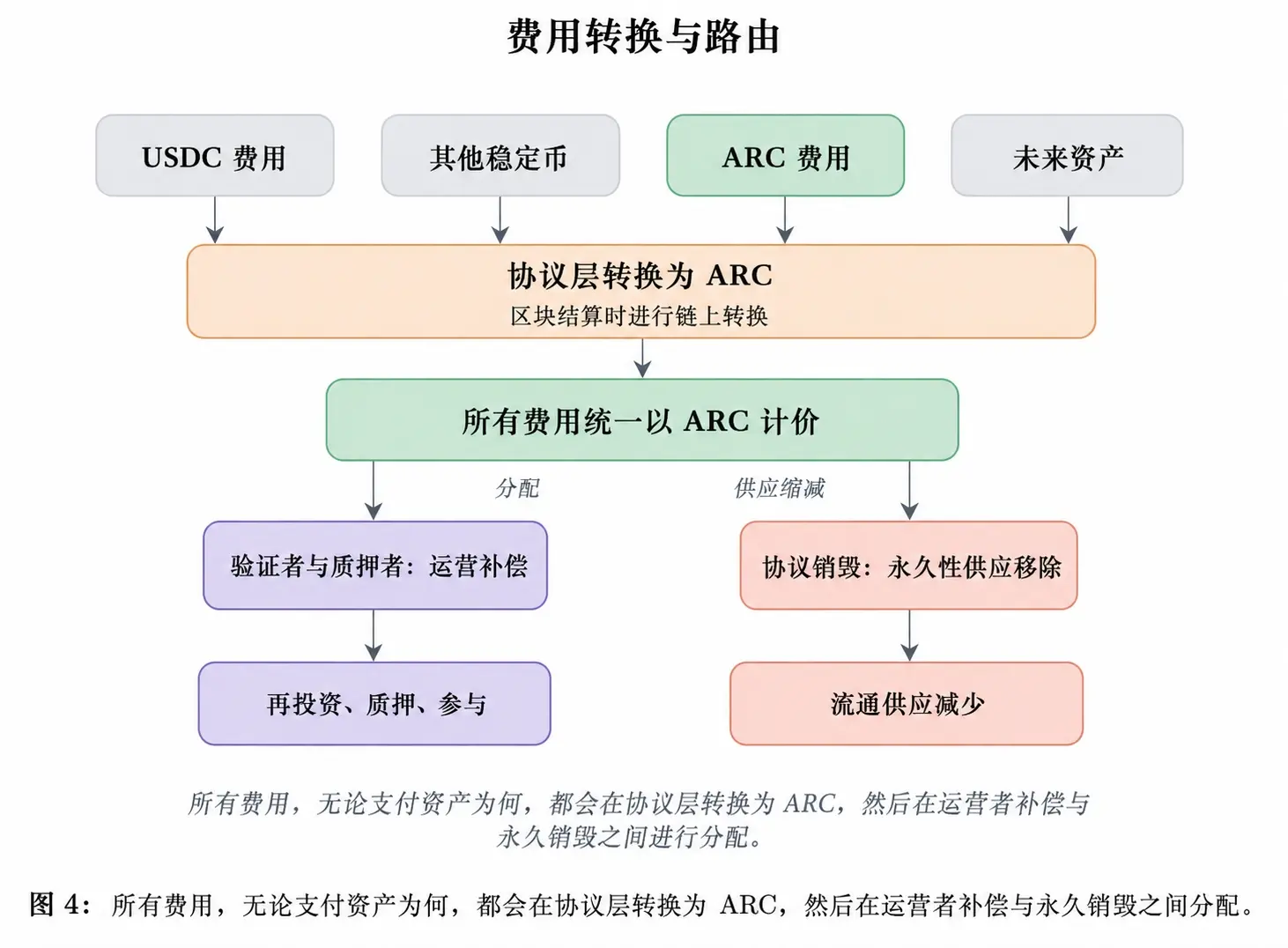
The economic model of Arc is designed so that regardless of what asset users use to pay fees, the final protocol value will flow back to ARC.
Protocol fees in the Arc network will be denominated in stablecoins to ensure predictability and stability of costs.
However, users can complete transactions using different assets. The system will automatically convert these fees into ARC at the protocol layer, which will then enter the reward and burn process.
The converted ARC will be divided into two parts:
- One part is allocated to validators and stakers as network maintenance rewards
- One part is directly burned to offset inflation issuance
Distribution & Burn Balance
The "reward distribution" and "burn ratio" of ARC are not fixed but configurable economic parameters.
These parameters will be dynamically adjusted as the network develops to balance:
- Validator earnings
- Network security
- Token supply management
- Treasury funding needs
In the early stages of the network, Arc will prioritize ensuring:
- Validators have sufficient incentives
- The network has stable operational economics
While also maintaining a certain proportion of the burn mechanism to partially hedge against inflation from the outset.
Governance-driven Economic Adjustment
As the Arc Economic OS matures, relevant economic parameters will be continuously adjusted by the governance system.
Governance participants will optimize the economic structure of ARC around:
- Operating node earnings
- ARC inflation and deflation balance
- Treasury management
- Long-term network growth
Overall, the core logic of Arc is to continuously convert economic activities throughout the network into ARC's value capture and long-term economic coordination mechanisms.
Tron Comments
ARC's advantage lies in that it is not just a traditional Layer 1 public chain but attempts to build an "Economic OS" for the global internet economy, integrating stablecoin native settlement, institutional-level validation nodes, cross-chain payments, Circle financial infrastructure, and a unified economic coordination model into the same underlying network. Meanwhile, the ARC token not only serves gas functions but also deeply participates in network governance, value capture, fee backflow, staking security, and ecosystem coordination, forming a relatively complete economic closed loop.
However, its disadvantage is that its overall positioning leans towards "institutional-level financial infrastructure," and the permissioned validators and compliance orientation may somewhat weaken the complete decentralization emphasized by traditional crypto communities. Additionally, the narrative of the Economic OS itself is very grand and requires long-term cooperation from many real financial institutions, stablecoin liquidity, and developer ecosystems to truly form network effects. Furthermore, its deep binding with the Circle ecosystem also means it will be affected to some extent by stablecoin regulations and changes in centralized financial systems.
III. Industry Data Analysis
1. Overall Market Performance
1.1. Spot BTC vs ETH Price Trends
BTC
ETH
IV. Macroeconomic Data Review and Key Data Release Points for Next Week
Macroeconomic Data Review from June 15 to June 21, 2026
United States (Most Important This Week)
June 17 | Federal Reserve FOMC Interest Rate Decision
- The federal funds rate remains unchanged at 3.50%-3.75%, marking the fourth consecutive pause in adjustments.
- New Chairman Kevin Warsh presided over the meeting for the first time, making a noticeably hawkish statement.
- The dot plot shifted from previous expectations of rate cuts to hinting at a possible rate hike later this year.
- The Federal Reserve raised its 2026 inflation forecast to about 3.6%, citing energy prices and geopolitical issues as major risks.
Market Impact
- U.S. Treasury yields rose.
- U.S. stocks experienced a pullback after the decision.
- The dollar remained strong.
United Kingdom
June 18 | Bank of England (BoE) Interest Rate Decision
- The benchmark rate remains unchanged at 3.75%.
- The voting result was 7:2.
- The Bank of England lowered its future inflation forecast but noted that energy prices still pose uncertainties.
Eurozone
June 18 | Eurozone Current Account Data
- The Eurozone continues to maintain a trade and current account surplus.
- Market focus has shifted to the European Central Bank's subsequent interest rate path.
Key Data and Events for Next Week (June 22 to June 28)
United States
June 24
- Markit Manufacturing PMI Preliminary
- Markit Services PMI Preliminary
Focus on whether the U.S. economy continues to expand.
June 26
- U.S. Q1 GDP Final Value
- Initial Jobless Claims
These will directly impact market expectations for the Federal Reserve's subsequent policies.
June 27
- U.S. May Core PCE Price Index (Key)
- U.S. Personal Income and Personal Spending Data
Core PCE is the inflation indicator most closely watched by the Federal Reserve and may become the main trading line in July.
Eurozone
June 23-24
- Eurozone and Germany PMI Preliminary
Focus on the recovery of the European economy.
Japan
June 27
- Tokyo CPI
This will provide important reference for the Bank of Japan's July policy meeting.
V. Regulatory Policies
United States
- June 16: CFTC clarified that perpetual futures contracts are not automatically excluded from futures regulation due to "no expiration date," and regulated perpetual futures are still subject to leverage limits and funding rate rules.
- June 17: Bipartisan U.S. senators requested the Treasury to clarify state-level stablecoin regulatory authority under the GENIUS Act, focusing on the state regulatory qualifications and certification processes for stablecoin issuers below $1 billion.
- June 19: The Federal Reserve, Treasury, OCC, FDIC, and other agencies proposed bank-level identity verification requirements for stablecoin service providers, including customer identity verification, address confirmation, and terrorism watchlist screening.
European Union / Italy / Malta
- June 16: Binance stated that its MiCA license application has not yet been resolved and plans to update progress by June 30, reflecting the increasing compliance pressure on large exchanges as the EU MiCA transition period approaches.
- June 18: Italian digital asset wallet company Conio received authorization from Consob and the Bank of Italy under MiCAR to provide custody, transfer, and other services in compliance with EU regulations.
- June 18: Malta's MFSA launched a consultation on whether DeFi with partial centralized control should fall under MiCA regulation, focusing on issues such as admin keys, governance centralization, and front-end control.
Singapore
- June 17: Singapore MAS added Bybit to the investor warning list, indicating that it is not authorized to provide regulated services to local users; this list serves as a public risk warning, not a formal ban.
Philippines
- June 15: The Bangko Sentral ng Pilipinas tightened VASP token listing rules, requiring stricter due diligence and prohibiting privacy coins and anonymity-enhanced assets from being listed on licensed platforms.
Oman
- June 19: Oman launched a national Bitcoin mining pool, Omanhash, requiring all licensed miners to connect to this official pool to unify the regulation of mining income, energy consumption, and newly minted BTC.
 Risk warning