Dragonfly partner Haseeb: The fastest-growing companies in the future may all be stuck at 149 people
 Core Viewpoint

 The pricing of large models is actually an "AI tax": it shackles large enterprises with computing power constraints, slows down automation, but turns subscriptions into a subsidy for small teams' innovative dividends. By capping the scale at under 149 people, startups can continuously experiment with almost zero cost.
Author: Haseeb
Compiled by: Jiahua, ChainCatcher
@SemiAnalysis_ recently discovered an incredible phenomenon in the economics of AI programming subscriptions. If you max out usage, the fees you pay are actually 20 to 70 times cheaper than purchasing tokens through the API.
Many people see this and say: Oh my, look at how much these large model companies are subsidizing tokens; the bubble must be about to burst.
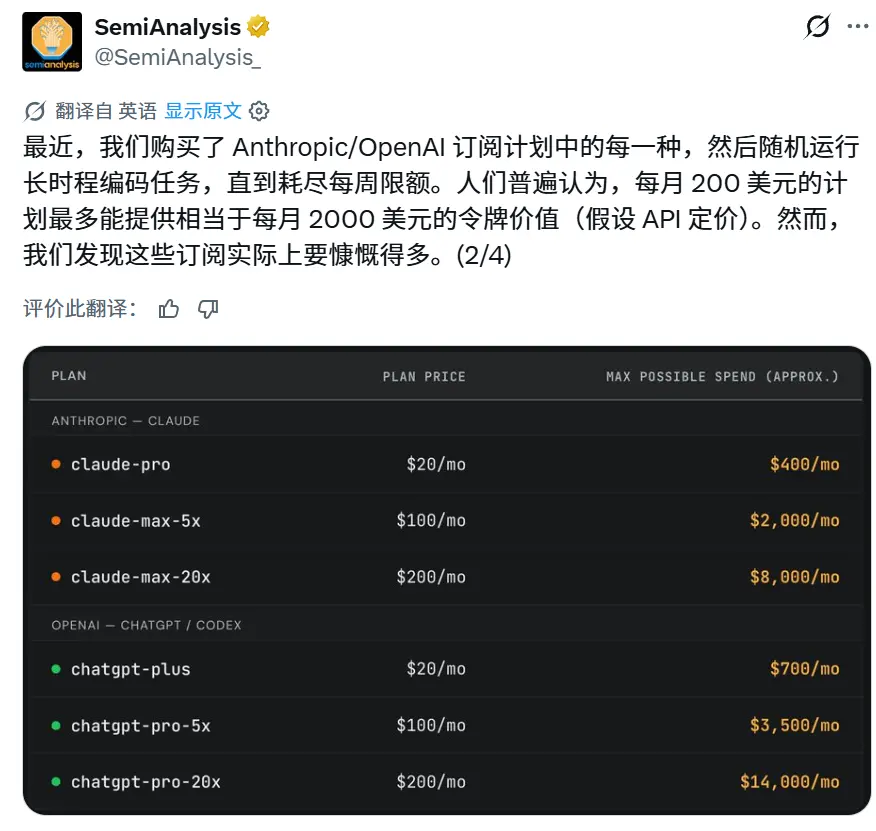
This reaction is incorrect. The reason large model companies are willing to offer such generous packages is that most users rarely hit the limits. This product is like a gym membership: the limits are generous because the vast majority of people hardly use it.
However, I have spent a long time pondering this matter, and there are indeed some strange aspects.
We have no way of knowing their actual comprehensive profit margins on subscriptions, but according to SemiAnalysis, at an average utilization rate of 20%, Anthropic's Max 5x plan barely breaks even. A 20% utilization rate might even be on the high side, especially in organizations where everyone (including non-programmers) has a subscription account but only uses it occasionally. Most institutions I know, including Dragonfly, generously distribute Claude Code subscriptions and encourage non-programmers to give it a try.
But what SemiAnalysis did not delve into is that this phenomenon is entirely characteristic of small businesses. Large enterprises cannot utilize this subscription pricing.

The reason is as follows: when the number of people exceeds 150, you are forced to exit the subscription model known as "Team" and switch to the "Enterprise" version, which is priced at a base of $20 per seat, plus API fees calculated based on actual token usage. Enterprises can only pay linearly based on token costs, and SemiAnalysis estimates that the gross margin on API tokens is about 75%. This is a massive price increase that suddenly takes effect when the number of people reaches 150.
So, if you are a small business or startup (or an individual user), your perception of AI spending is distorted. Your token pricing is actually very favorable, and Anthropic may only be maintaining an extremely low or even negative profit margin on you.
You might be curious why Microsoft and Uber are making such a fuss over token spending and talking about "token-mining." The reason lies here. The structural costs they pay per token are much higher than those of startups and individuals.
But Anthropic doesn't care! For a B2B company, extracting maximum value from small companies or individuals is not very meaningful. Look at companies like Datadog or Cloudflare; 80% to 90% of their revenue comes from large contracts (annual recurring revenue over $100,000). Earning zero profit from long-tail customers is merely a customer acquisition cost.
This is a typical B2B sales mindset.
However, there is another perspective on the same situation: from the standpoint of tax policy.
Because if tokens are replacing labor, then the gross profit that OpenAI and Anthropic collect on tokens is essentially a tax on AI labor.
Viewing token pricing this way leads to two main consequences.
Token Pricing as Tax Policy
Assuming the profit margins mentioned in SemiAnalysis are valid: subscription breakeven, large enterprise API gross margin of 75%. The first reaction is to call it a 75% AI labor tax on large organizations and a 0% tax on startups.
Standard tax analysis would say this hinders large companies from using AI labor internally, marginally prompting enterprises to reduce automation and retain more human labor. (Clearly, this also encourages the use of smaller or open-source models, but the net effect is that both are incentivized. Remember, we are talking about the marginal here.)
However, what drives behavior more strongly is not the average tax rate. It never is in tax policy. What we really care about is the marginal tax rate.
For startups adopting a flat-rate subscription, the marginal price of the next token before hitting the limit is zero. And a zero marginal price is the greatest distortion a policy can create.
For startups, the subscription model is essentially an innovation subsidy. The most overwhelming motivation is to figure out how to efficiently spend the entire token budget. This means running Ralph loops, filling screens with Claude Code sessions, and scheduling groups of agents to work together.
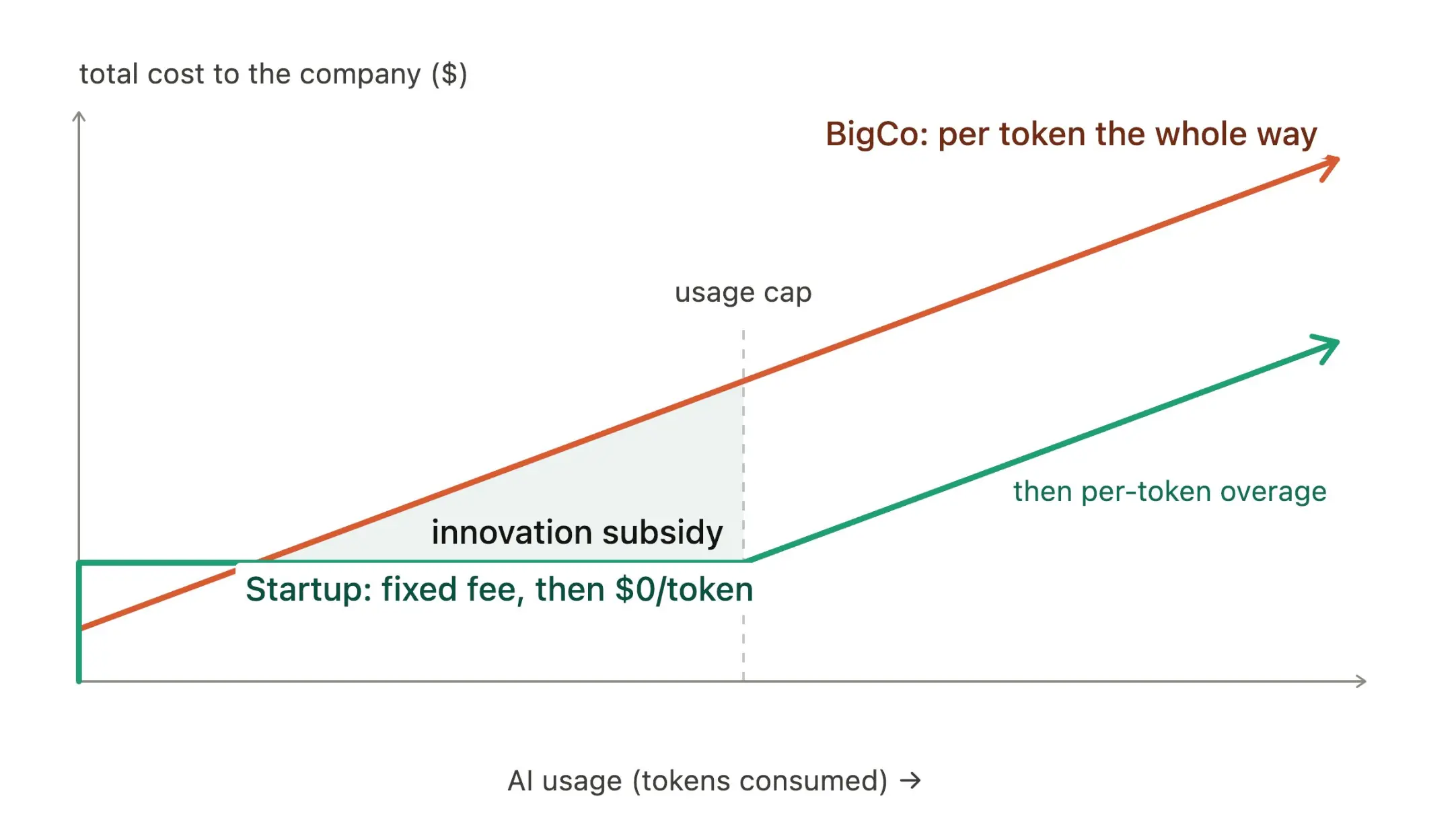
Before hitting the limit, exploration is free. So startups are actually competing to squeeze the last drop of value from subscriptions, relying on output to overwhelm their competitors. Paradoxically, the more they use, the lower the average token price becomes. Every startup wants to be the one that causes Anthropic to lose the most on subscriptions.
The incentives faced by large enterprises are the opposite. If you exceed 150 seats, every token explored is charged at full price (with a 75% surcharge!), so the penalty increases linearly with every step further into exploration.
Large enterprises will still automate those obvious large-scale tasks, but marginal, experimental, and risky automation will never be discovered because the discovery costs are too high. This tax structure ultimately prompts them to retain more human labor and maintain the existing organizational structure.
This is exactly the opposite of Japan. Due to a declining population, Japan faces a massive labor shortage. Historically, this has meant that Japan pursues high levels of automation because high labor costs incentivize automation. This is why there are robots in Japanese restaurants, factories, hotels, and hospitals.
But strangely, large enterprises find themselves in a predicament opposite to Japan: if they have to pay extremely high taxes for using AI, it actually weakens the motivation for automation and strengthens the motivation to retain existing employees (especially if wages remain stagnant during this period).
So where does the labor substitution flow in this model?
Everyone is watching large companies, waiting for the wave of AI layoffs to arrive. But at a 75% tax rate, aggressively replacing their employees with AI may not be cost-effective at all; the token budget could explode directly.
But this does not mean that substitution will not happen; it will just manifest in another form.
When large enterprises lose market share to AI-native startups with extremely low overall labor costs, the decline in revenue and stock prices will trigger layoffs. However, the jobs eliminated will never reappear in the winning startups. The net reduction effect is the same; this unemployment gap simply shifts to another part of the economy with a lower tax rate.
This is also why "AI-washing" (attributing ordinary layoffs to newfound AI efficiency) may not be a temporary phenomenon. AI-washing refers to a company attributing layoffs to AI efficiency while actually just masking ordinary business weakness.
Many people think this is just a fleeting moment in the current AI hype cycle. However, while everyone is ready to witness large companies conducting real AI layoffs and "replacing jobs" with AI, such events may never happen on a large scale.
Labor substitution may unfold in another way: startups defeating large companies, with large companies using AI as a cover for decline until they go out of business, while startups never rebuild those old jobs. Job substitution will still occur; it just won't happen where everyone is watching.
This is the first consequence of this model. But there is a second, even stranger consequence.
The 150-Person Cliff
The so-called regulatory notch refers to a regulatory boundary that induces a significant jump in behavior. For example, the standard of full-time employment at 30 hours per week has led to a large number of jobs that just happen to work 29 hours a week.
It is well known that France has extremely strict labor regulations that come into effect once a company reaches 50 employees (employee committees, mandatory profit sharing, dismissal protection), while small companies are exempt. This gives employers a huge incentive to keep their scale below 50 people.
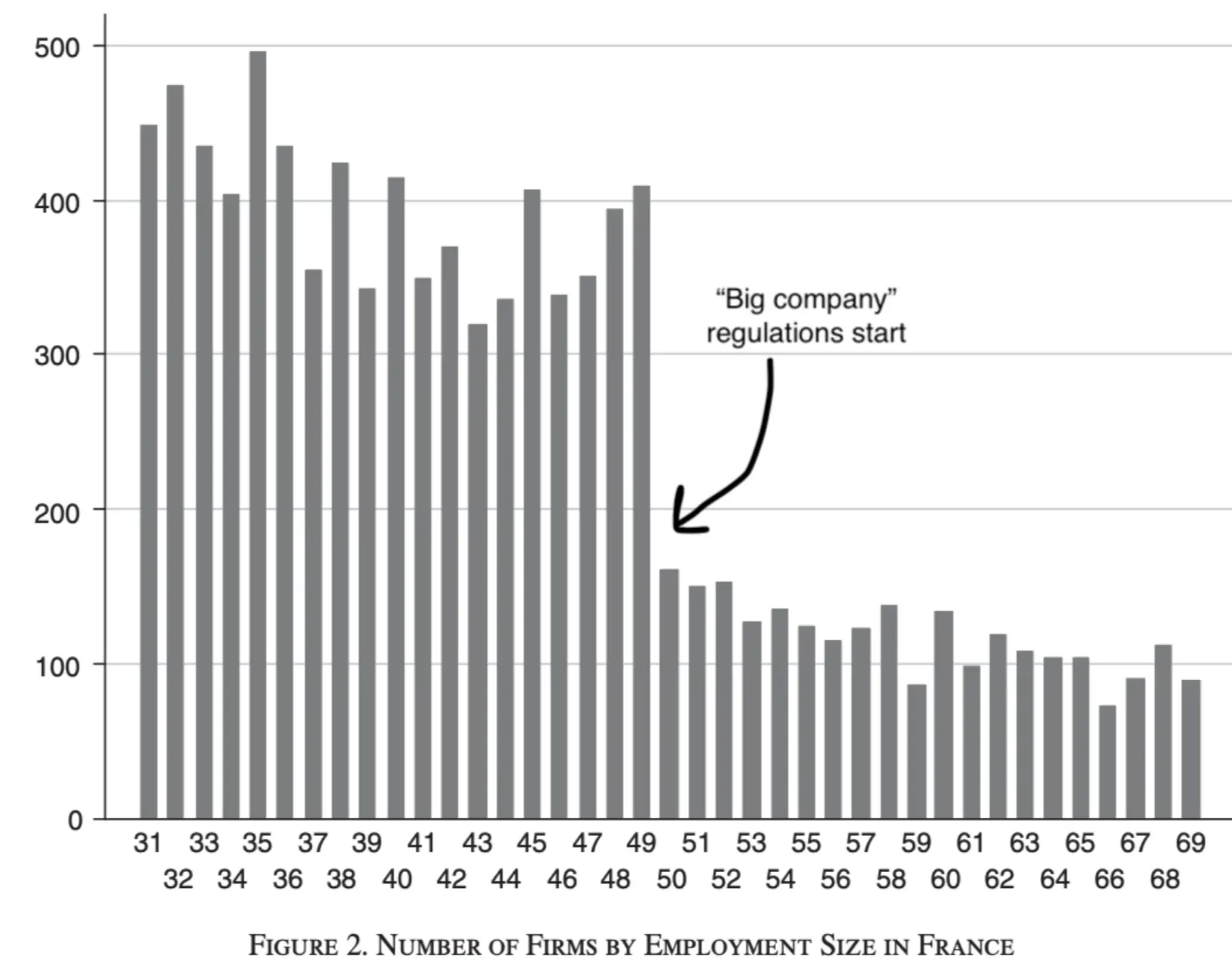
Excerpt from: Garicano, Luis, Claire Lelarge, and John Van Reenen, 2016, "Firm Size Distortions and Productivity Distribution: Evidence from France."
Extending this analogy to AI, large model companies have set a tax threshold that penalizes companies exceeding 150 seats. This means you must remain small to retain that wonderful subsidized subscription price, allowing tokens to be taxed at 0% (or even negative) instead of 75%.
This could foster a brand new corporate management philosophy. Startups will become increasingly obsessed with using agents to solve everything, with smaller teams, more frequent layoffs, more outsourcing, and exhausting all means to minimize the need for human involvement.
This is not because it is the "optimal" level of automation, but because the incentives have pushed them there. If the magical number is 149, then every seat is crucial, and you cannot waste any person outside the core joints of the company.
This fracture might be viewed by people from institutions like Harvard Business School as "the new generation of AI-first management." But as long as the understanding is in place, it is merely a rational response to corporate pricing schemes.
This may sound a bit exaggerated. But you can already see the behavioral differences between different organizations. Go talk to developers at large companies; they are meticulously counting tokens and becoming increasingly tense about budget cuts. Meanwhile, developers at startups are desperately trying to max out usage (tokenmaxxing), launching groups of agents overnight and checking logs in the morning. I expect this trend to accelerate.
No one designed all of this intentionally. No committee decided to subsidize innovation for startups while taxing established companies. All of this directly stems from those tried-and-true traditional corporate pricing strategies.
But tax laws have always been like this: a bunch of accompanying rules ultimately determine which companies can be built and how these companies distort themselves to minimize tax burdens.
You might argue that this is temporary, and large model companies will eventually charge everyone based on usage. Github Copilot has already made this transition. Maybe, or maybe not. But before pricing normalizes, companies with 149 people and this new AI-first management style may have already exploded, capturing significant market share and scripting the next generation of startups.
Tax policy is crucial. The entire concept of the "gig economy" exists because of the legal boundaries between W-2 (formal employees) and 1099 (independent contractors). As more and more labor is consumed by AI, token pricing may become the most influential tax policy of the next decade. However, no one will ever vote on this.
(If the fastest-growing companies in the next cycle are conspicuously stuck at 149 seats, don't be surprised.)
 Risk warning