Tron Industry Weekly Report: June CPI favors inflation cooling, detailed explanation of the synthetic dollar protocol Axis driven by cross-asset arbitrage for returns

 A detailed explanation of creating a seamless anonymous asset transfer cross-chain privacy network Houdini Swap, driven by cross-asset arbitrage for yield in the synthetic dollar protocol Axis.
# I. Outlook
## 1. Macroeconomic Summary and Future Predictions
Macroeconomic Summary for This Week (July 13, 2026 - July 19, 2026)
This week, the global macro market focused on three main lines: the cooling of U.S. inflation, adjustments in major central banks' monetary policy expectations, and geopolitical risks. The U.S. June CPI and core CPI both fell short of market expectations, further strengthening the market's anticipation that the Federal Reserve will maintain interest rates at the end of July. The U.S. dollar index fluctuated at a high level, U.S. Treasury yields fell, and global risk asset sentiment improved. Meanwhile, U.S. retail sales and employment data still indicated economic resilience. China announced its second-quarter GDP and June economic data, continuing the trend of moderate recovery, further solidifying market expectations of a "slowdown but not recession" for the global economy. However, the ongoing tensions in the Middle East pushed international oil prices higher, and the market remained concerned that a rebound in energy prices could re-ignite global inflation pressures, leading to increased risk aversion.
Future Predictions for Next Week (July 20, 2026 - July 26, 2026)
Next week, market focus will shift to the preliminary values of the U.S. July manufacturing and services PMIs, initial jobless claims, leading economic indicators (LEI), and new home sales data. These data points will further influence market judgments regarding the Federal Reserve's interest rate meeting at the end of July and the policy path for the year. If U.S. economic data continues to show resilience, the market may re-trade expectations of "high rates lasting longer," potentially strengthening U.S. Treasury yields and the dollar again; conversely, if economic data continues to slow, it may further improve global liquidity expectations, benefiting risk assets. Additionally, the situation in the Middle East, international oil price trends, and signals from the European Central Bank will remain important variables affecting the global market. It is expected that the macro environment will maintain the main tone of "marginal improvement in inflation, cautious monetary policy, and ongoing geopolitical risks" in the coming week.
## 2. Cryptocurrency Industry Market Changes and Warnings
Cryptocurrency Market Summary for This Week (July 13, 2026 - July 19, 2026)
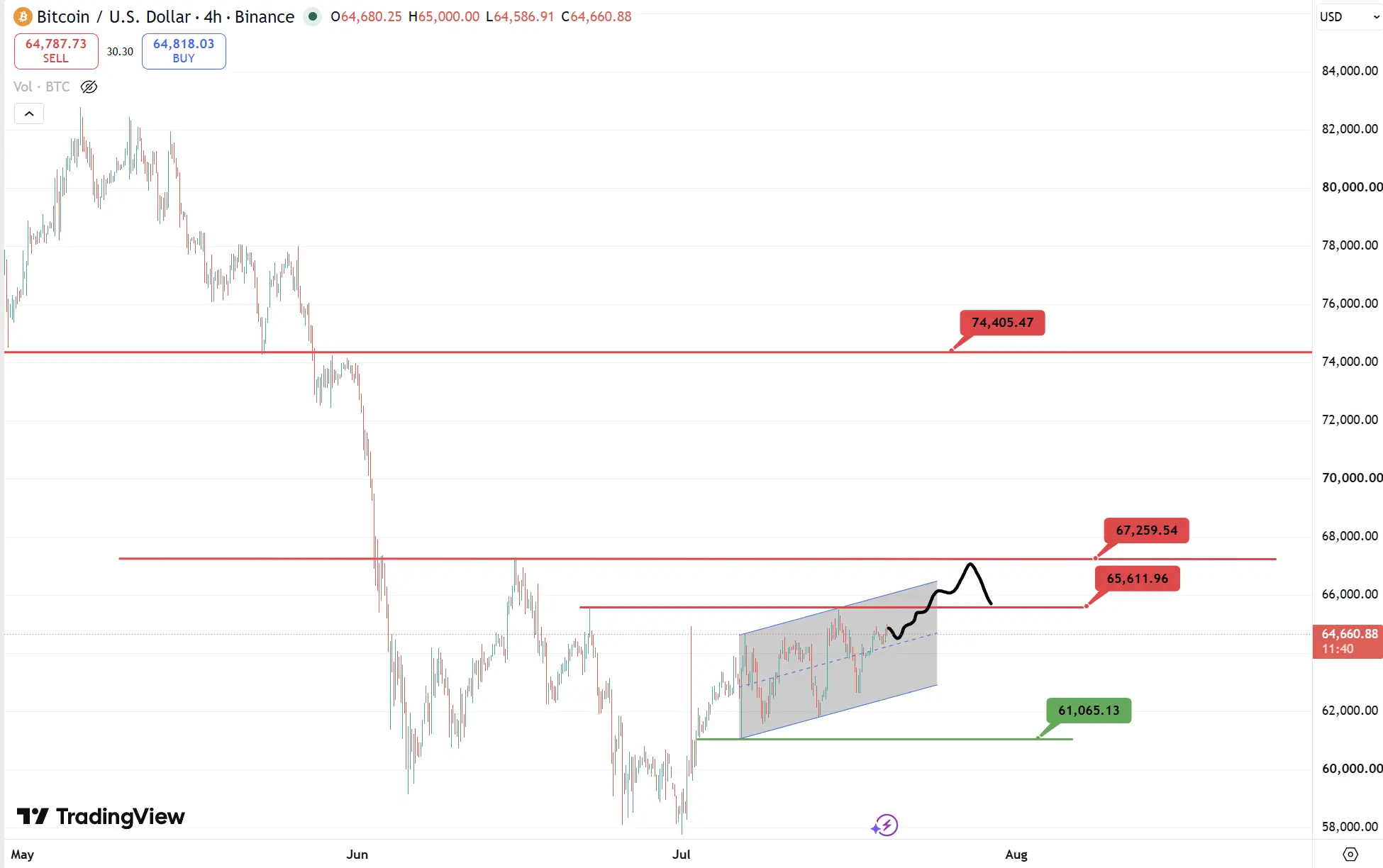
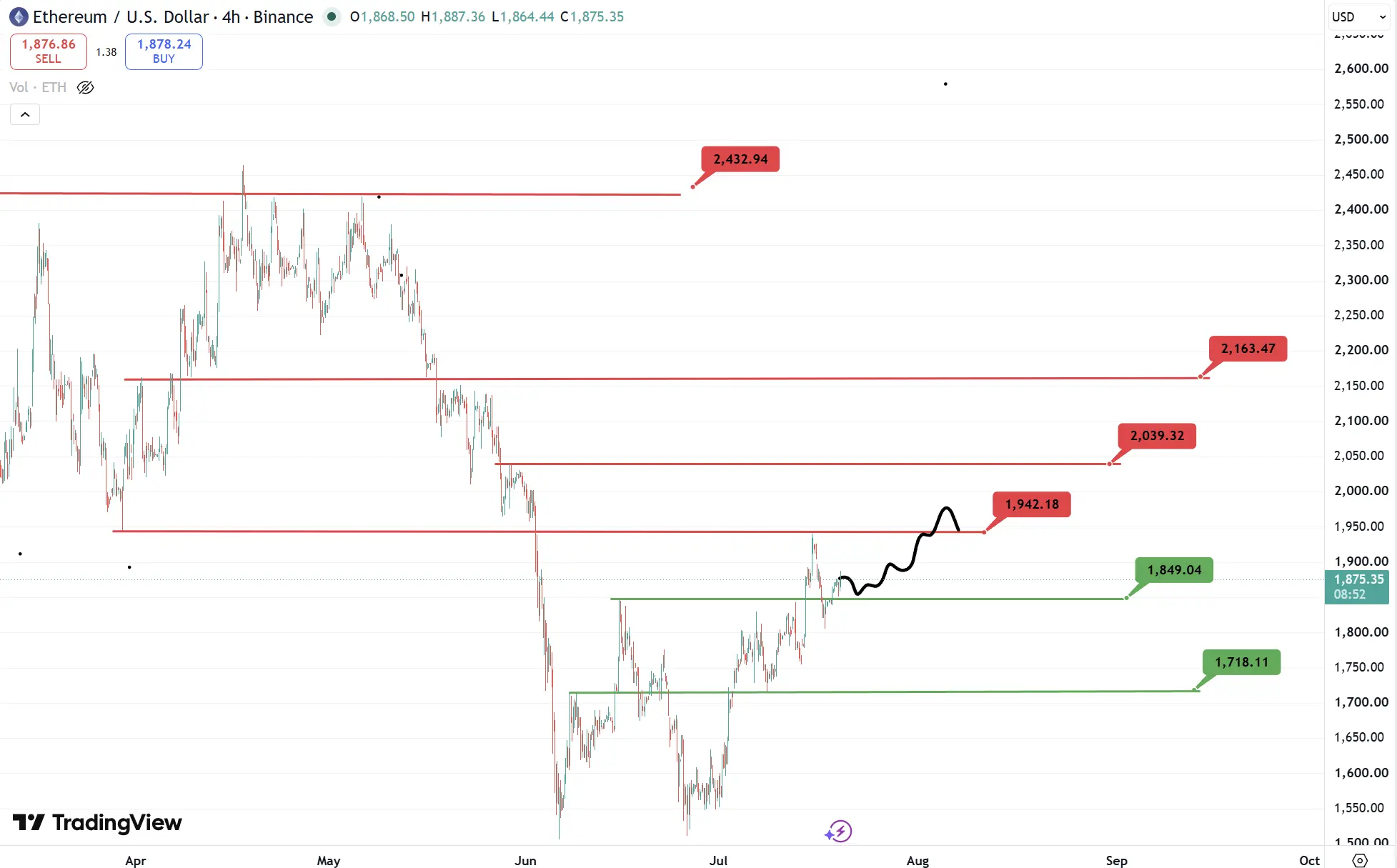
This week, the cryptocurrency market exhibited a trend of initial suppression followed by a rebound, and then high-level fluctuations. On the macro level, the U.S. June CPI being lower than expected improved market expectations for the Federal Reserve's policy, leading to a warming of risk asset sentiment and pushing Bitcoin to rebound rapidly from about $62,500 at the beginning of the week to a mid-week high of about $65,000. However, influenced by the geopolitical tensions in the Middle East, market risk appetite cooled, causing Bitcoin to retreat to the $63,000-$64,000 range, with an overall weekly increase of about 2%. Ethereum followed suit with a rise before a pullback, maintaining a range of $3,500-$3,650. ETF fund flows turned back to net inflows, the market cap of stablecoins continued to grow, and institutional risk appetite improved compared to the previous week; sectors like AI Agent, PayFi, and RWA showed relative resilience, while high Beta Meme and altcoins overall performed weaker than BTC.
Future Market Predictions for Next Week (July 20, 2026 - July 26, 2026)
Next week, the market is expected to continue to revolve around macro data, ETF fund flows, and geopolitical risks. If expectations for cooling U.S. inflation continue to strengthen and spot ETFs maintain net inflows, Bitcoin is likely to challenge the resistance zone of $65,000-$66,000 again; if it successfully breaks through, it may further test around $67,000. Conversely, if risk aversion increases or fund flows weaken again, Bitcoin may retest the support area of $62,000-$63,000. Ethereum is expected to maintain fluctuations in the $3,450-$3,700 range, with funds prioritizing BTC and sectors with fundamental catalysts. RWA, stablecoin infrastructure, PayFi, and AI-related projects are expected to maintain relatively high attention, while smaller market cap altcoins with weaker liquidity still need to be cautious of downside risks.
## 3. Industry and Sector Hotspots
This week, the cryptocurrency market hotspots continued to revolve around RWA (Real World Asset Tokenization), stablecoin payments (PayFi), AI Agent, AI infrastructure, and on-chain derivatives (Perp DEX). Among them, RWA continues to be the long-term sector most focused on by institutions, driven by sustained inflows of institutional funds and the expansion of tokenized securities and on-chain government bonds. The heat around stablecoin payments and PayFi has further increased, with discussions around cross-border payments, AI Agent automatic payments, and on-chain settlement infrastructure continuing to heat up. The AI sector is gradually shifting from a pure AI Agent concept to AI payments, AI infrastructure, and Agent Economy with real application scenarios, with the market paying more attention to its commercialization capabilities. Meanwhile, decentralized perpetual contracts (Perp DEX) maintain high attention due to continuously growing trading volumes and protocol revenues, while market funds continue to shift from short-term narratives lacking fundamentals, like Meme, to sectors with real income, institutional adoption, and infrastructure attributes, indicating a further tilt of fund preferences towards "fundamentally driven" structural opportunities this week.
# II. Market Hotspot Sectors and Potential Projects of the Week
## 1. Overview of Potential Projects
1.1. Detailed Explanation of $18 Million in Total Financing, Led by Solana Strategies ------ Creating a Cross-Chain Privacy Network for Seamless Anonymous Asset Transfers: Houdini Swap
Introduction
Houdini is a non-custodial cross-chain swap aggregator.
It automatically finds and coordinates the optimal execution path for each transaction by integrating multiple liquidity sources, including:
Decentralized Exchanges (DEX)
Cross-chain Solver Networks
Non-custodial exchange service partners
This results in more efficient asset exchanges.
Houdini does not operate an exchange and does not hold user funds.
Specifically:
Does not hold user assets
Does not maintain liquidity pool balances
Does not act as a counterparty
All exchange transactions are executed by the underlying protocols or liquidity providers involved in the routing.
Depending on the routing mode chosen by the user, the system can prioritize optimizing different goals, including:
Lower cost
Faster execution speed
Enhanced on-chain privacy protection
Protocol Mechanism Overview
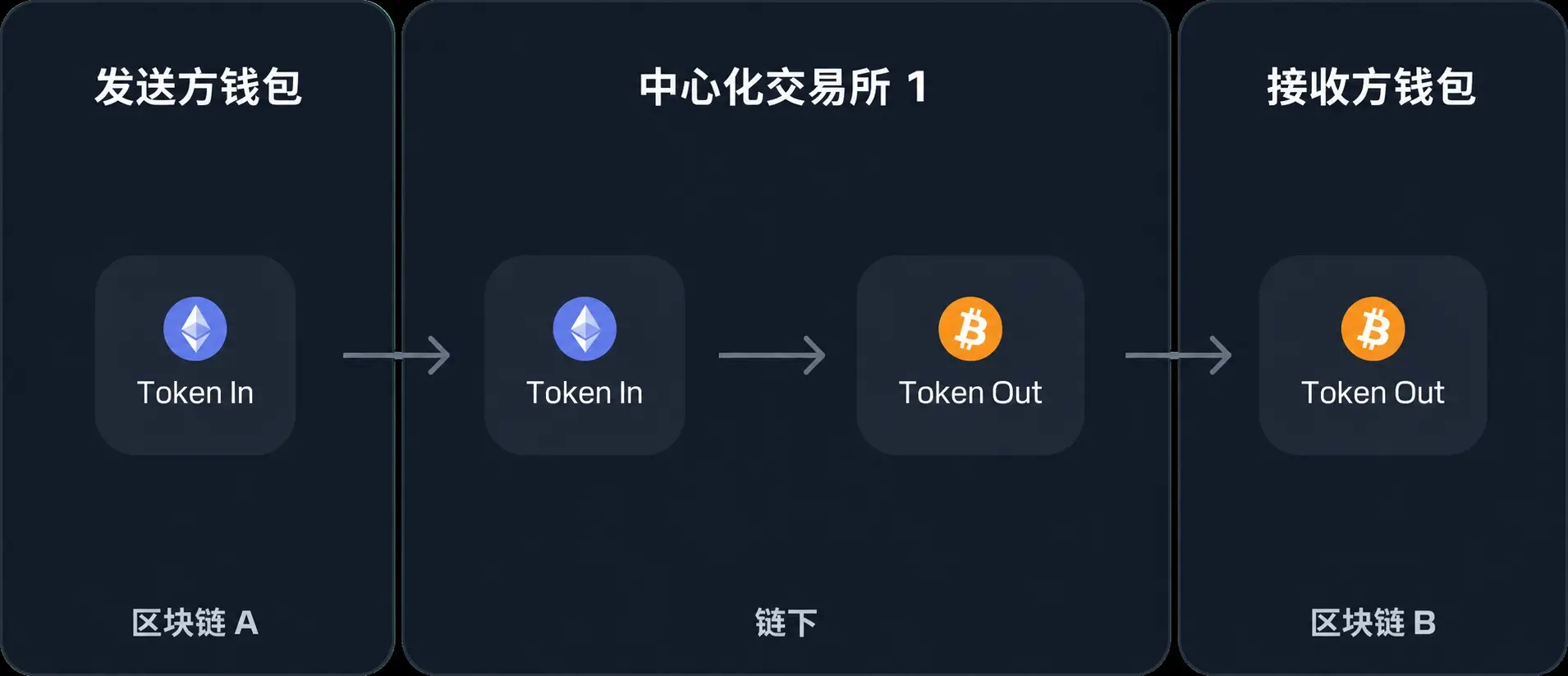
Private Swap
Private Swap is Houdini's flagship routing solution, designed for users with the highest privacy requirements for transactions.
It is a privacy-first, non-custodial cross-chain exchange mechanism aimed at completely severing the traceability of on-chain transactions.
Unlike ordinary cross-chain exchanges, Private Swap breaks the on-chain association between the sender and receiver by using two independent non-custodial exchange services and introducing a temporary Layer 1 intermediate asset as a buffer layer.
As of now, Houdini has processed over $1.5 billion in Private Swap transaction volume, making it one of the most widely used compliant privacy tools in the cryptocurrency industry.
Core Features
Highest Level of Privacy Protection
The sending address and receiving address do not have direct on-chain associations, which is Houdini's core privacy capability.
Non-Custodial
Houdini never touches user assets; all exchanges are executed automatically by the underlying protocols.
Supports Same-Chain Privacy Exchanges
For example:
- USDC (Ethereum) → USDC (Ethereum)
Hides the transaction path while keeping the asset and chain unchanged.
Supports Cross-Chain Privacy Exchanges
For example:
- USDT (TRC20) → BTC
Enables privacy exchanges between any asset and any chain.
Market Validated
Since its launch, Private Swap has processed transaction volumes exceeding $1.5 billion.
How It Works
Private Swap splits a transaction into two independent steps.
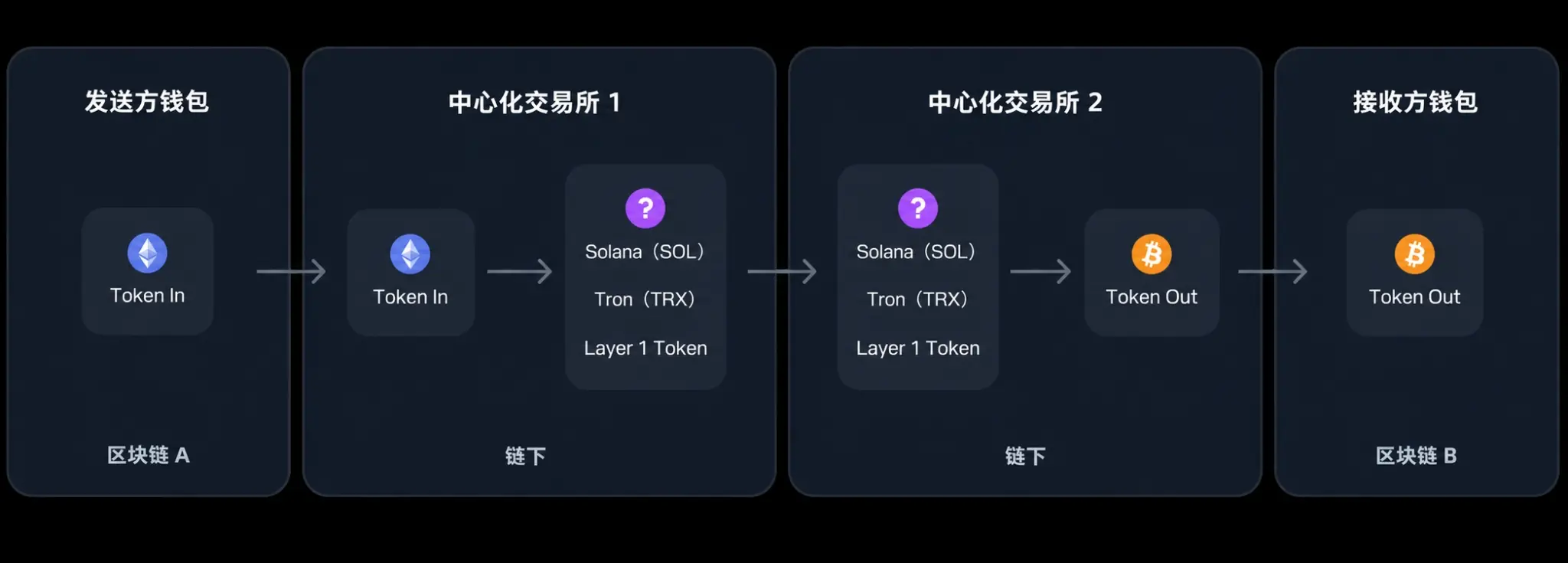
First Phase (Source Chain)
The user sends Token A from their wallet. The asset first enters a non-custodial exchange platform and is exchanged for a temporary privacy-focused Layer 1 intermediate asset.
Intermediate Buffer Layer
This temporary asset acts as a "buffer."
Its role is to:
Sever the original source of funds
Break the on-chain transaction path
Eliminate direct tracking relationships
Second Phase (Target Chain)
The intermediate asset is then sent to another completely independent non-custodial exchange platform.
The system then exchanges it for the target asset Token B and sends it to the receiving address.
The final effect is:
When the funds reach the target wallet,
There is no verifiable on-chain association path between the original sending address and the final receiving address.
How Can Privacy Be Achieved?
- No Direct On-Chain Association
The sender and receiver do not appear simultaneously in the same transaction or transaction path.
Observers cannot directly establish a connection between the two.
- No Identifiable Transaction Markers
On-chain, there will be no appearance of:
"Houdini Swap"
Specific routing labels
Fixed format data
Each transaction phase appears as a normal transaction.
For external observers:
The first phase of the transaction has ended,
The second phase appears to be another completely unrelated transaction.
Thus, it cannot be proven that the two transactions belong to the same exchange.
- Infinite Anonymity Set
Even if observers suspect a transaction comes from Houdini,
They still cannot determine the final flow.
Because:
The second phase can occur on any public chain
It can be exchanged for any token
Covers over 100 blockchains
Supports thousands of assets
Thus, the anonymity set effectively expands to the entire Web3 network.
No Wallet Connect (Wallet-Free Exchange)
No Wallet Connect Swap is a mode provided by Houdini that allows exchanges without connecting a wallet.
Users can complete asset exchanges without going through the traditional Connect Wallet process or signing any on-chain messages or authorizing transactions.
Unlike ordinary DEXs, the system generates a one-time temporary deposit address for users, who only need to transfer from any wallet or exchange to that address, after which the exchange process will be completed automatically.
Core Features
More Secure
No need for:
Wallet Connect
Approve authorization
Signatures
Since wallet authorization and signatures are often considered one of the most common security risks in the cryptocurrency field, this mode significantly reduces the risk of users encountering malicious authorizations or phishing attacks.
Moderate Privacy Protection
Compared to ordinary on-chain swaps:
Does not directly expose the interaction between the wallet and the contract
Provides higher privacy protection
However, since it does not adopt the dual-layer anonymous routing structure of Private Swap, the level of anonymity is still lower than that of Private Swap.
It can be understood as ordinary Swap < No Wallet Connect < Private Swap
Higher Execution Efficiency
Due to the use of a single-path routing mechanism, there is no need to go through the dual exchange process of Private Swap, thus:
Transaction speed is faster
Routing is simpler
Costs are usually lower
### Workflow
1. Initiate Exchange
Users submit exchange requests for:
Any token
Any chain
The system then generates a dedicated one-time deposit address.
2. Deposit
Users transfer assets to that address from any source, including:
Hardware wallets
Exchange accounts
Mobile wallets
Other on-chain addresses
No wallet connection is required.
3. Exchange
Once the system receives the funds, it will complete the asset exchange through partnered liquidity providers or exchange service providers.
For example:
Token A → Token B
4. Send
After the exchange is completed,
The target asset Token B will be directly sent to the user-specified receiving address.
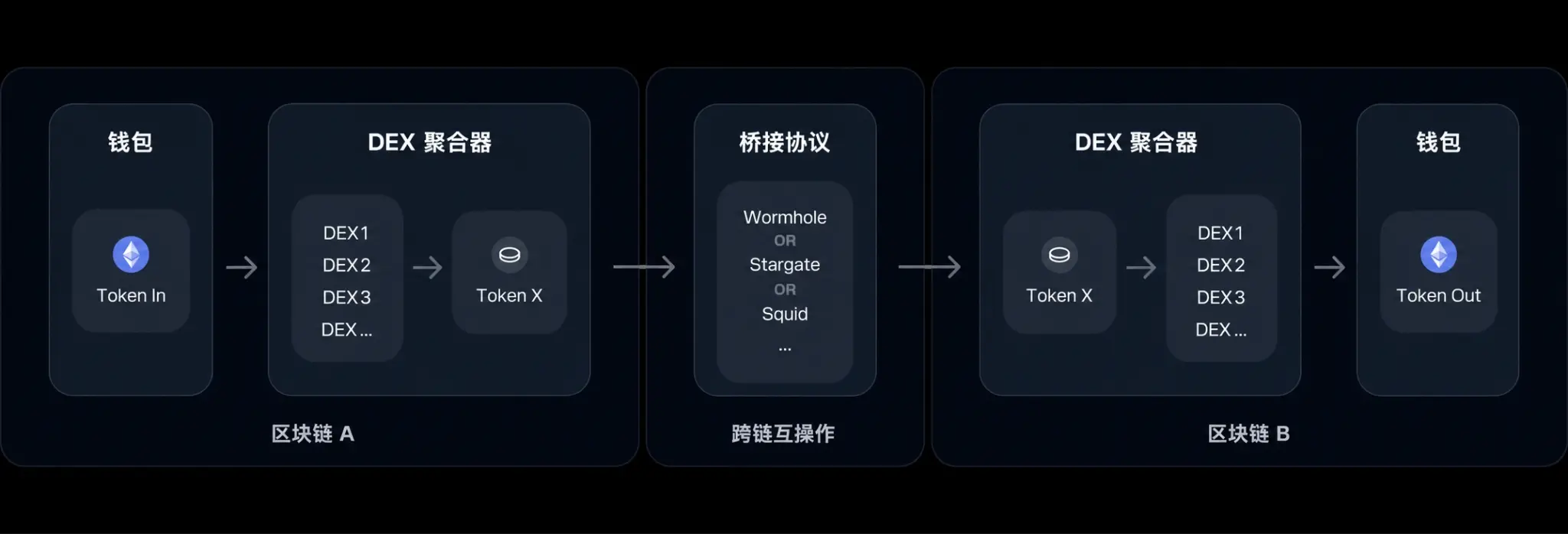
On-chain DEX / Bridge (On-chain DEX and Cross-chain Bridge Exchange)
On-chain Swap is one of the fastest and lowest-cost exchange modes provided by Houdini, focusing on achieving asset exchanges through a fully decentralized approach.
Although Houdini is known for privacy exchanges, this mode emphasizes:
Speed
Best Price
On-chain Transparent Execution
Houdini aggregates multiple liquidity sources, including DEXs, cross-chain bridges, cross-chain swap protocols, and intent routing networks, to automatically find the best trading path for users.
Core Features
Best Market Rates
Houdini can simultaneously query over 20 mainstream protocols and aggregators, including:
Uniswap
Jupiter
SushiSwap
Mayan
ChainFlip
CowSwap, etc.
By comparing different routes, it finds the current best quotes for users.
In many cases, its prices are even better than using a single DEX or aggregator.
Fully Decentralized
All transactions are executed by smart contracts and verified on-chain.
Houdini:
Does not hold user assets
Does not hold funds
Does not act as a counterparty
Assets are always exchanged directly between users and the underlying liquidity protocols.
Fee Transparency
All fees are included in the final quote before transaction confirmation, including:
Protocol fees
Cross-chain bridge fees
Routing fees
Other potential costs
Users can see the final amount before signing, with no hidden charges.
### Workflow
1. Get Quote
Users input:
Asset to exchange
Amount
The system will scan thousands of on-chain routes in real-time and calculate the best exchange plan.
2. Connect Wallet
Users complete:
Approve
Sign
to confirm the transaction through their wallet.
3. Execute Exchange
The system automatically selects the optimal on-chain path.
Token A will be routed through smart contracts and exchanged for Token B.
4. Asset Arrival
After the exchange is completed,
Token B is sent directly to the user's specified wallet address.
Tron Commentary
Houdini Swap's advantage lies in its focus on solving the privacy issues brought by on-chain transaction transparency. Through anonymous exchanges and cross-chain asset transfer mechanisms, it helps users hide the source of funds, transaction paths, and target addresses when transferring assets between different chains, thus enhancing asset privacy and security. At the same time, its operational process is relatively simple, allowing users to achieve good anonymity effects without mastering complex privacy tools, making it highly attractive for protecting personal financial privacy, avoiding on-chain behavior tracking, and enhancing fund fungibility.
On the other hand, its disadvantage lies in the high regulatory pressure that privacy sectors inherently face, as some jurisdictions may impose stricter scrutiny on anonymous trading tools. Additionally, the effectiveness of the protocol's privacy also depends on the overall liquidity scale, user activity, and the depth of the anonymity pool. If the network scale is insufficient and the anonymity set is small, the ability to protect privacy may be affected. Furthermore, privacy protocols generally face challenges such as high transaction costs, cross-chain complexity, and stringent security audit requirements.
## 2. Key Projects of the Week
2.1. Detailed Explanation of $5 Million in Total Financing, Led by Steakhouse Financial, Serotonin, and Galaxy, with Follow-on Investments from OKX, GSR, and FalconX --- A Synthetic Dollar Protocol Driven by Cross-Asset Arbitrage: Axis
Introduction
Axis Protocol is a synthetic dollar protocol that allows users to deposit whitelisted collateral assets to mint a yield-bearing synthetic dollar (USDx).
The protocol's revenue comes from cross-asset arbitrage strategies, which exploit price differences between different assets, markets, or trading venues to generate profits.
The generated revenue will be distributed to users participating in staking through a tokenized vault, allowing holders to earn continuous returns while holding synthetic dollars.
Core System Architecture Analysis
Axis Protocol Architecture Overview (Three-Layer Design)
Axis adopts a three-layer architecture design, isolating the issuance of synthetic dollars, collateral management, and revenue distribution to reduce the impact of risks from a single module on the entire system.
- Token Layer (Token Layer) ------ AxisUSD
Responsible for the issuance and management of AxisUSD (USDx).
Based on ERC-20 standard
Provides minting and burning functions for synthetic dollars
- Minting Layer (Minting Layer) ------ AxisUSDMinting
Responsible for the lifecycle management of synthetic dollars.
Main functions include:
Receiving collateral assets
Minting USDx
Redeeming USDx
Managing the flow of custodial assets
- Staking Layer (Staking Layer)
Responsible for revenue distribution and staking management.
Main components include:
StakedAxisUSDV2
A yield vault based on ERC-4626
Supports configurable cooldown periods
AxisUSDSilo
Custodial contract for cooldown period funds
Holds assets during the withdrawal waiting period
StakingRewardsDistributor
- Automatic revenue distribution module
AxisUSDRateProvider
- Provides exchange rate data to external protocols
The three layers are independent of each other. Even if there is a vulnerability in the staking layer, it will not directly affect the minting system; vice versa. The core asset connecting the minting layer and the staking layer is only USDx itself.
Contract Inheritance Structure
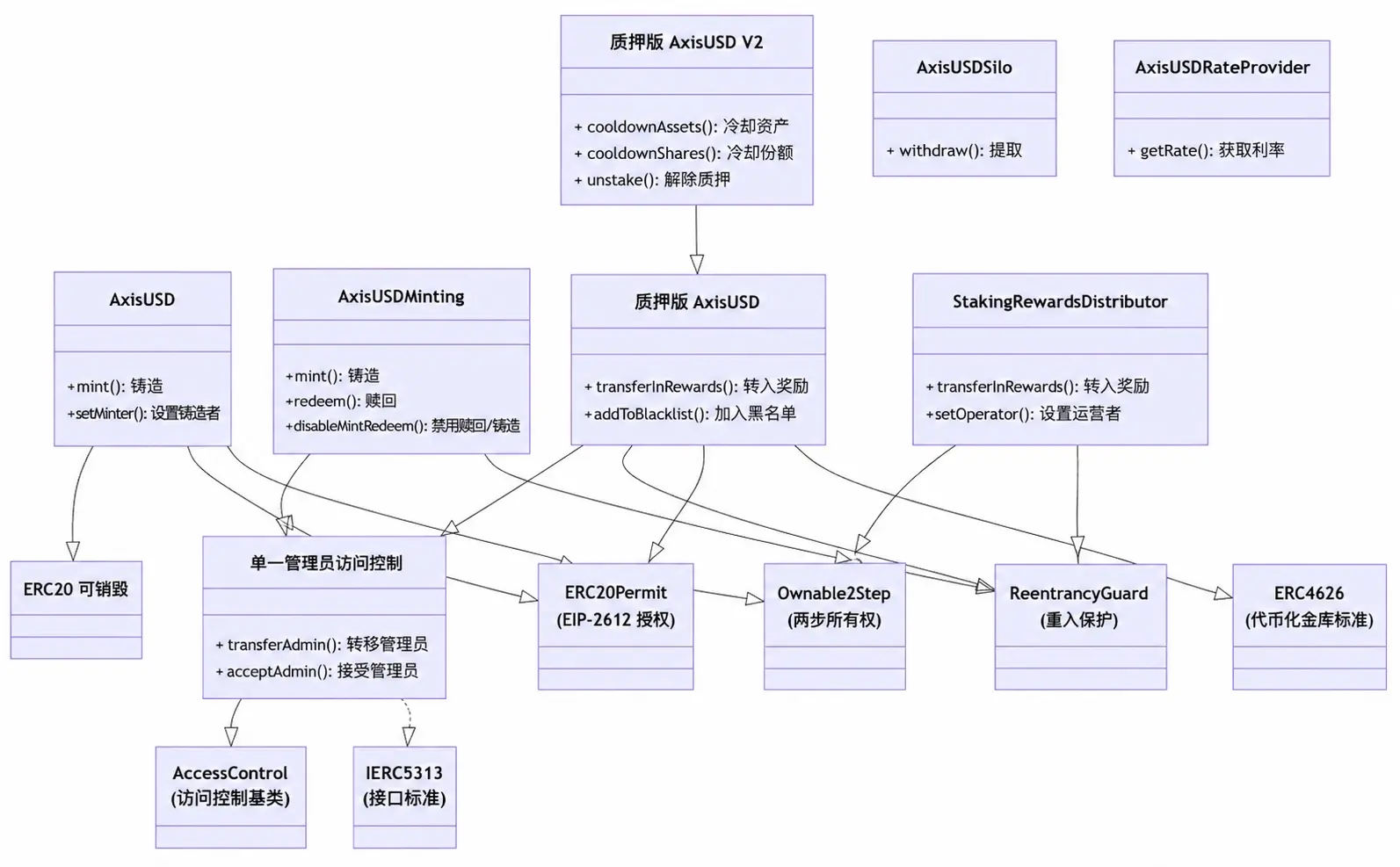
AxisUSD
Inherits:
ERC20Burnable
ERC20Permit
Ownable2Step
Supports:
Burn mechanism
Permit authorization
Two-stage ownership transfer
AxisUSDMinting and StakedAxisUSD
Both inherit:
SingleAdminAccessControl
Features:
Single administrator model
Two-stage administrator transfer
The original administrator retains full authority until the new administrator formally accepts, preventing operational errors that could lead to loss of control.
Fund Flow Mechanism
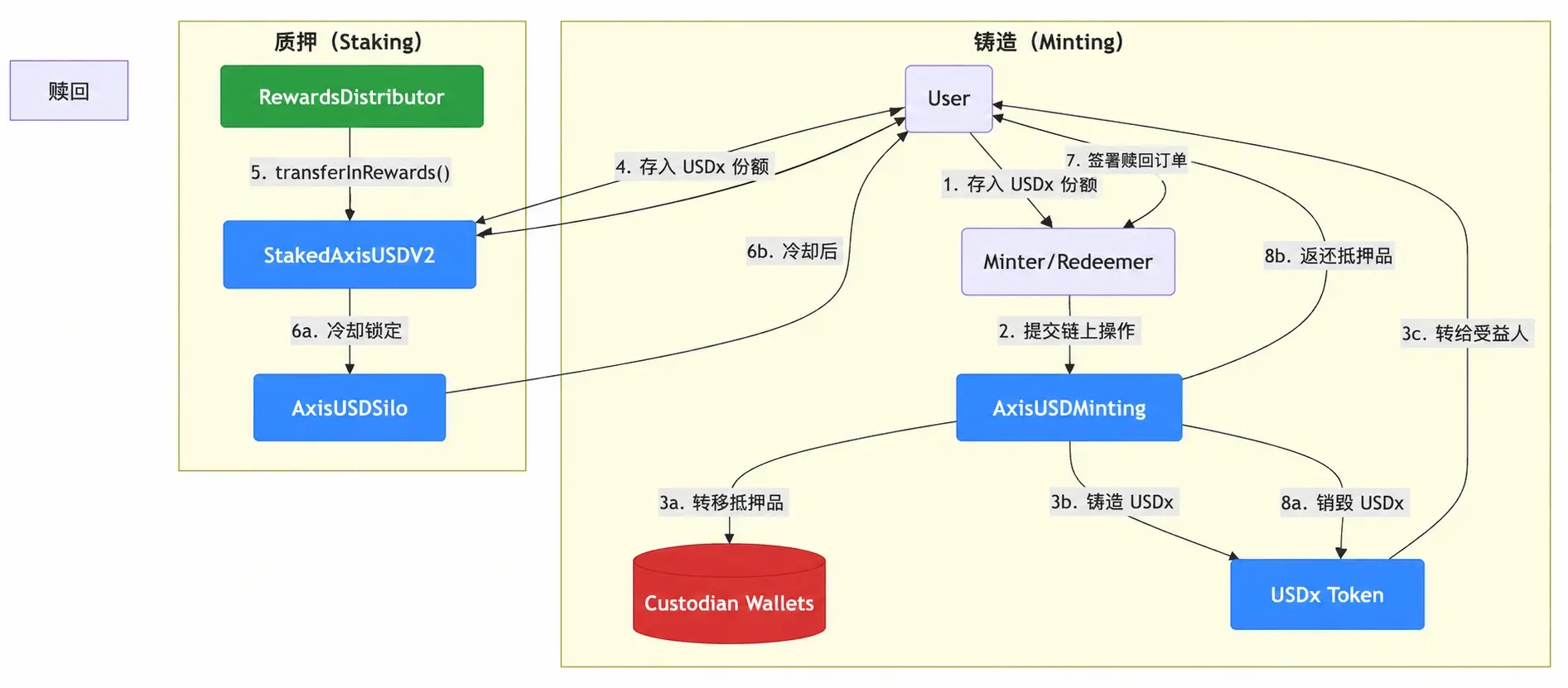
The protocol includes four core fund paths:
- Mint (Minting)
Users sign an EIP-712 minting order.
Process:
Users provide collateral
Collateral enters the custodial account
The system mints USDx for the user
Result: The user receives USDx.
- Stake (Staking)
Users deposit USDx into the yield vault.
Process:
USDx → Vault
Users receive sUSDx share certificates
Revenue is continuously injected by the rewards module.
Result: The value of sUSDx continues to grow.
- Redeem (Redemption)
Users sign a redemption order.
Process:
USDx is burned
Collateral assets are returned to the user
Result: The user retrieves their collateral.
- Cooldown (Cooldown Withdrawal)
When the cooldown mechanism is activated:
Users apply for withdrawal
Funds are transferred to Silo
Wait for the cooldown period to end
Complete the withdrawal
Result: Delayed withdrawal.
Emergency Shutdown
When an account with GATEKEEPER_ROLE executes:
disableMintRedeem():
Minting stops
Redemption stops
However:
Staking continues to operate normally
Unstaking continues to operate normally
Only the administrator can re-enable the system.
Minting Process
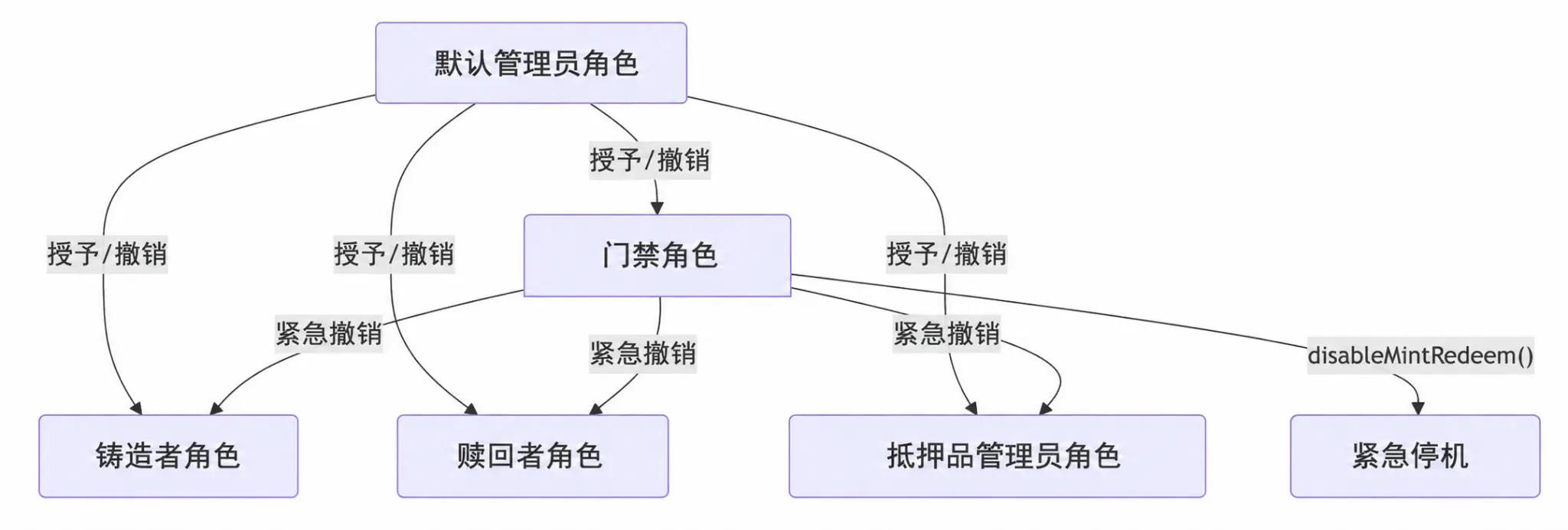
Step One
Users sign an EIP-712 order:
Including:
Type of collateral
Amount of collateral
Target USDx amount
Step Two
An operational node with MINTER_ROLE submits the order while specifying the custodial route.
Step Three
AxisUSDMinting:
Withdraws collateral
Proportionally allocates to multiple custodial accounts
Calls AxisUSD.mint()
Finally mints USDx for the user.
Redemption Process
Step One Users sign a redemption order.
Step Two REDEEMER_ROLE submits an on-chain request.
Step Three
The system:
burnFrom() burns USDx
Returns corresponding collateral to the user
Staking Revenue Mechanism
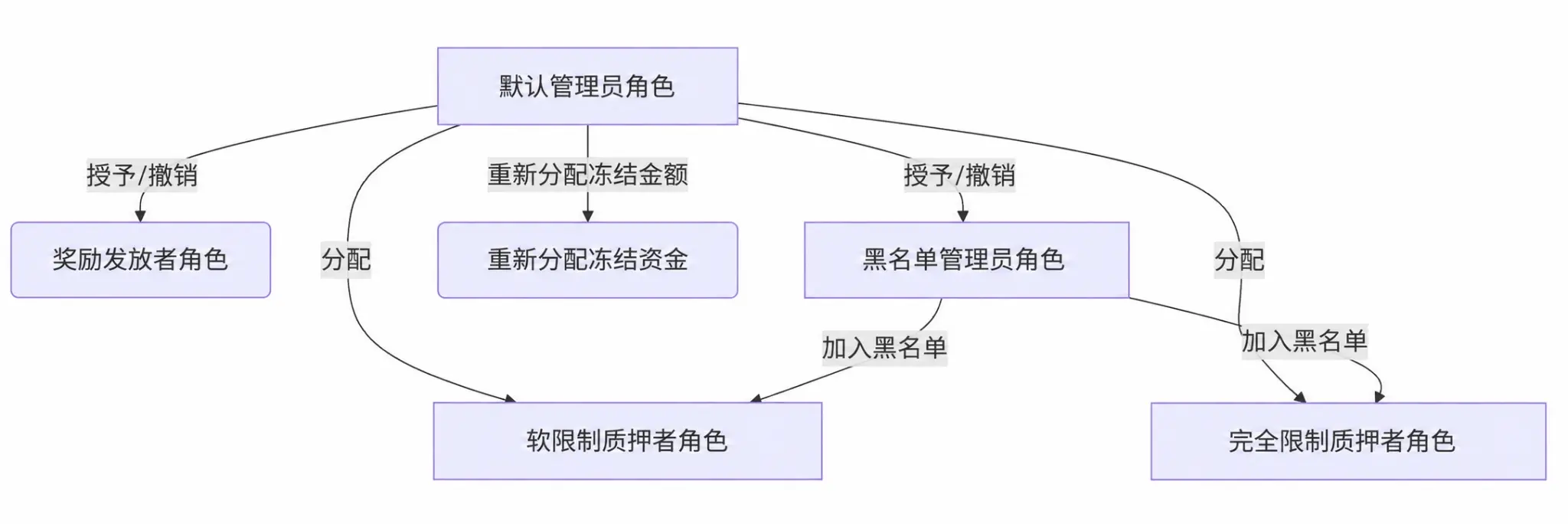
Users deposit USDx into StakedAxisUSDV2
Receive: sUSDx
Revenue is periodically injected by StakingRewardsDistributor:
transferInRewards() injects rewards.
Rewards are released using:
An 8-hour linear release mechanism, with revenue gradually counted into the vault.
Thus improving: sUSDx ↔ USDx exchange ratio.
During withdrawal:
Users call:
cooldownAssets()
or cooldownShares()
After waiting for the cooldown period to end, they call: unstake() to complete redemption.
Access Control Model
The protocol employs two access control systems.
SingleAdminAccessControl
Applies to:
AxisUSDMinting
StakedAxisUSDV2
Features:
Single administrator
Two-stage authority transfer
Core Design Choices
Key designs of the protocol include:
EIP-712 off-chain signed orders
Route-based custodial architecture
8-hour reward release mechanism
Cooldown withdrawal
Dual blacklist mechanism
Minimum shares constraint
Independent reward distributor design
These designs collectively balance:
Security
Liquidity
Revenue stability
Risk control
Contract Dependencies
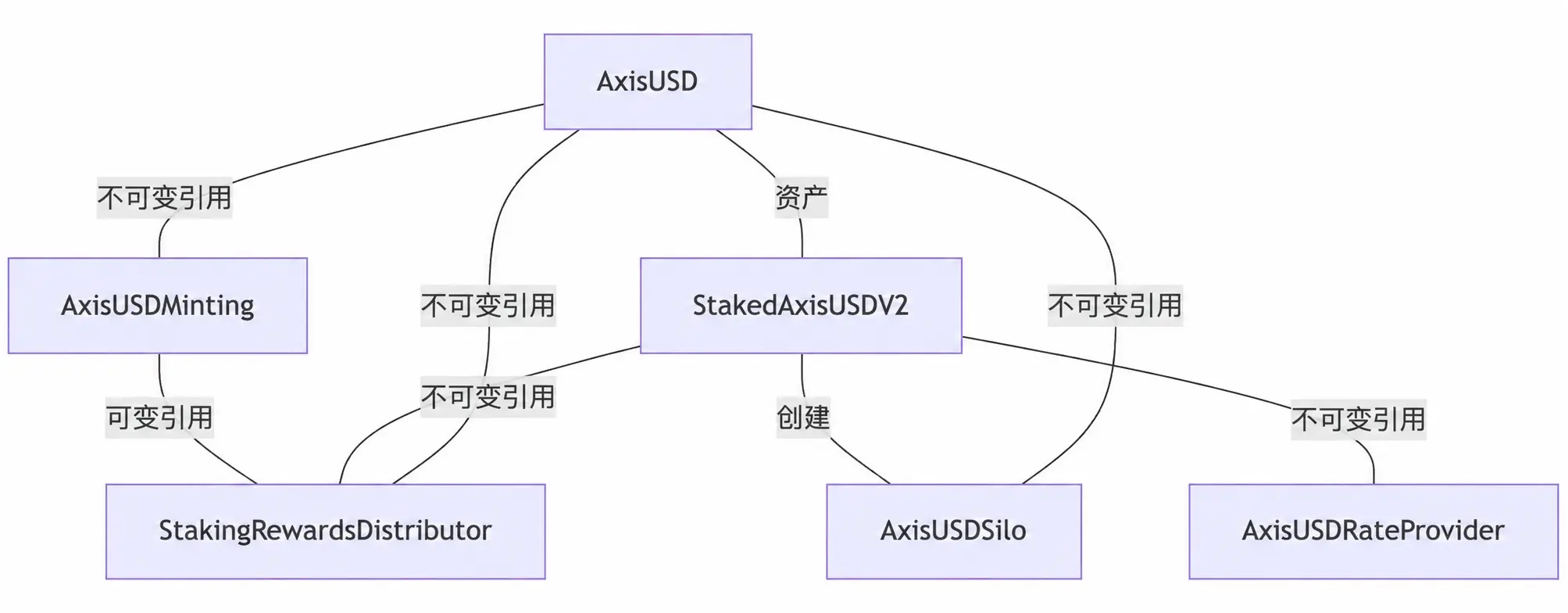
AxisUSD
As the core asset of the system.
Referenced by the following modules:
AxisUSDMinting
StakedAxisUSDV2
AxisUSDSilo
StakingRewardsDistributor
Vault
Automatically created upon deployment:
AxisUSDSilo
Used to manage cooldown period funds.
AxisUSDRateProvider
Responsible for reading vault status and providing exchange rate data to external protocols.
StakingRewardsDistributor
Holds an updatable reference to AxisUSDMinting.
The owner can update the corresponding address as needed.
Tron Commentary
Axis's advantage lies in its introduction of ETF logic from traditional finance onto the blockchain, allowing users to gain overall exposure to a sector or theme through a single transaction without having to buy and sell assets individually, significantly lowering investment thresholds and portfolio management costs. At the same time, the protocol reduces slippage and MEV losses from rebalancing through batch liquidation, Jito auctions, and value internalization mechanisms, improving capital efficiency and allowing the community to freely create and issue thematic indices, demonstrating strong composability and scalability.
Its disadvantage is that the product's value is highly dependent on the quality and market popularity of the tracked assets, and it does not generate underlying returns itself; when the market enters a downturn, index products will still bear overall risks. Additionally, the on-chain ETF sector is currently highly competitive, facing competition from Enzyme, TokenSets, PieDAO, and centralized ETF products, with user scale, liquidity depth, and quality index supply determining whether long-term network effects can form.
# III. Industry Data Analysis
1. Overall Market Performance
1.1. Spot BTC vs ETH Price Trends
BTC
ETH
# IV. Macroeconomic Data Review and Key Data Release Points for Next Week
### 1. Macroeconomic Data Review for This Week (July 13 - July 19)
🔹 U.S. inflation data became the market focus, with limited changes in interest rate cut expectations.
The U.S. released June CPI, PPI, and retail sales data, overall showing that inflation still has some resilience, but consumer demand remains moderately growing, and market expectations for an "economic soft landing" continue to strengthen.
After the data release, the market further solidified expectations that the Federal Open Market Committee (FOMC) will maintain interest rates at the end of July, but there are still differences regarding the number of interest rate cuts for the year, with the Federal Reserve continuing to signal "Higher for Longer."
🔹 The Federal Reserve continues to release cautious signals.
The Federal Reserve's Beige Book and speeches from several officials indicated that U.S. economic growth has slowed, but the job market remains resilient, and inflation is still some distance from policy targets.
The market is beginning to enter an observation window before the July FOMC meeting, and subsequent economic data releases will continue to influence market judgments regarding the monetary policy path.
### 2. Key Focus for Next Week (July 20 - July 26)
|--------------|------------------------------|------------------| | Date | Key Events | Market Focus | | July 20 (Monday) | U.S. June Leading Economic Index (LEI) | Assess whether U.S. economic prosperity continues to slow | | July 23 (Thursday) | U.S. Initial Jobless Claims | Observe whether the job market further cools | | July 23 (Thursday) | European Central Bank (ECB) Interest Rate Decision | Focus on future interest rate cut pace and policy guidance | | July 24 (Friday) | U.S. July Markit Manufacturing and Services PMI Preliminary Values | Assess U.S. economic prosperity and business activity | | July 24 (Friday) | U.S. June New Home Sales Data | Observe the real estate market and consumer resilience |
# V. Regulatory Policies
United States
On July 14, the U.S. Treasury and the U.K. Treasury jointly released recommendations from the "Future Markets Transatlantic Working Group" and simultaneously issued a joint statement on stablecoins. Both parties clearly support the development of cross-border stablecoin businesses, emphasizing the role of the private sector in the monetary and payment systems, and proposing to reduce unnecessary regulatory friction between the U.S. and U.K. digital asset markets, strengthen regulatory cooperation, and improve the clarity of rules for tokenized financial activities. The significance of this progress lies in the shift from domestic regulation to cross-border regulatory coordination between the U.S. and U.K., which may promote mutual recognition of stablecoin issuance, payment, reserve regulation, and institutional access standards in the future.
The U.S. CLARITY Act market structure bill continues to advance, but there has been no substantial legislative breakthrough this week. On July 16, the U.S. President held discussions with several senators regarding this bill and related conflicts of interest. The bill aims to further delineate the regulatory boundaries of the SEC and CFTC over digital assets but still faces the Senate's 60-vote threshold, bipartisan differences, and version coordination issues. Therefore, this week's progress should be defined as "political coordination and legislative promotion," rather than the bill's passage or formal enactment.
United Kingdom
On July 14, the U.K. and U.S. jointly confirmed the promotion of cross-border stablecoin market cooperation. The U.K.'s policy direction has further shifted from simply establishing a domestic stablecoin regulatory framework to exploring market connections and regulatory cooperation between the U.S. and U.K. The joint statement emphasizes support for vibrant cross-border stablecoin activities and retains the important role of private stablecoins in the payment system, sending a clear signal of market openness. For the industry, this is beneficial for future stablecoin issuers, payment institutions, and tokenized asset platforms to conduct business in both the U.S. and U.K., but specific licensing mutual recognition, reserve standards, and consumer protection details still await subsequent regulatory documents to be implemented.
European Union
On July 14, the European Central Bank officially selected 36 payment service providers to participate in the digital euro pilot. Participating institutions include both bank and non-bank payment service providers, with the pilot to be conducted at the European Central Bank and the central banks of 19 Eurozone countries, planned to enter a 12-month practical operation test in the second half of 2027. The testing scope includes online and offline person-to-person payments, payments to physical merchants, and e-commerce payments. This version of the digital euro will closely resemble the technical form proposed in the legislative framework but will not have legal tender status during the pilot.
This progress indicates that the EU's digital currency policy has moved from rule design to the technical and operational verification stage. Although the digital euro is a central bank digital currency rather than a general cryptocurrency, its advancement will directly impact the competitive environment for EU stablecoins, digital payments, and private on-chain payment tools, reflecting that the EU is accelerating the establishment of a European payment infrastructure led by public digital currencies while fully implementing MiCA.
 Risk warning