Bitget UEX Daily Report|Trump imposes tariffs on polysilicon; SpaceX and Tesla launch $16.8 billion Terafab project; Non-farm payroll data coming tonight (August 7, 2026)

 Bitget UEX Daily Report
1. Hot News
Federal Reserve Dynamics
Moussailem: Probability of Inflation Remaining Above Target Increases, Recent Meetings Lean Towards Rate Hikes
- Federal Reserve official Moussailem stated that the likelihood of inflation remaining above target has increased, leaning towards rate hikes in the recent FOMC meeting, and believes that gradual rate hikes are less costly than sudden large adjustments.
- He pointed out that the U.S. economy has shown resilience in recent months, and pursuing higher GDP through loose policies is a mistake.
- He also emphasized that future AI productivity growth is highly uncertain, with risks skewed towards high inflation.
Market Impact: Hawkish statements strengthen expectations for a rate hike in September, putting pressure on high-valuation tech stocks in the short term, while supporting the dollar and precious metals.
International Commodities
Trump States that the Hormuz Agreement Has Not Been Officially Reached, the Strait is "Somewhat Open"
- Trump stated that the agreement to reopen the Strait of Hormuz "cannot yet be said to have been officially reached," but the strait is currently "somewhat open," and the U.S. is participating in negotiations with good progress.
- Iran is advancing a bill regarding the passage rules in Hormuz, proposing to prohibit vessels from hostile countries such as the U.S. and Israel from passing, with fines of up to 20% of the cargo value for violators.
- Saudi officials stated that intelligence shows Iran is planning attacks against Saudi Arabia, with drone and missile movements observed.
Market Impact: The progress of negotiations in the strait remains uncertain, leading to a significant rebound in oil prices on Thursday. Geopolitical risk premiums are rising again, increasing short-term volatility in crude oil.
Macroeconomic Policy
Trump Imposes Tariffs on Polysilicon; Bans Export of Tungsten and Battery Waste
- Trump signed an executive order, under Section 232 of the Trade Expansion Act of 1962, setting a minimum import price and imposing a 15% ad valorem tariff on imported polysilicon and its derivatives, effective December 4, 2026, while launching a "Bring Back to America" incentive program.
- The U.S. Department of Commerce announced a ban on the export of tungsten waste and battery waste, effective August 27, for one year, to enhance the supply capacity of critical minerals.
- SpaceX and Tesla announced the launch of the Terafab AI chip super factory project, with an initial investment of $16.8 billion.
Market Impact: Tariffs and export bans strengthen the localization policy of the supply chain, benefiting related industries in the U.S., but may raise costs for solar energy and semiconductors; the Terafab project highlights the demand for self-controlled AI computing power.
# 2. Market Review
Commodity & Forex Performance
- Spot Gold: Approximately $4,252/ounce, +0.3%
- Spot Silver: Approximately $61.9/ounce, +0.66%
- WTI Crude Oil: Approximately $77.4--77.7/barrel, +2.9% to +3.0%
- Brent Crude Oil: Approximately $82.6--82.8/barrel, +3.9% to +4.2%
- Dollar Index (DXY): Approximately 99.948, +0.01%
Driving Factors Analysis: Trump's statement that the Hormuz agreement has not been officially reached, combined with Saudi warnings of potential attacks, has led to a rebound in oil prices. Gold consolidated around $4,300 after a previous surge, while silver saw a slight pullback. The asset linkage logic is reflected as: rising uncertainty in strait negotiations → oil price rebound → marginal rise in inflation expectations → renewed discussions on Fed rate hikes, while precious metals oscillate at high levels amid a risk-off and real interest rate game. Short-term commodity volatility will heavily depend on non-farm data and actual progress in Hormuz.
Cryptocurrency Performance
- BTC: Approximately $64,374, -0.24%
- ETH: Approximately $1,901, around -0.24%
- Total Cryptocurrency Market Cap: Approximately $2.28 trillion, -0.5%
- Market Liquidation Situation: Total liquidation of $155 million in 24 hours, with long positions liquidated at $87 million.
- Bitget BTC/USDT Liquidation Map: Current price approximately $64,394, with a dense area for short position liquidations at $65,000--66,000; if this area is broken, it may trigger a short squeeze. The pressure for long position liquidations remains significant at $63,000--64,000, with the current price near the watershed for long and short liquidations, and short-term fluctuations may further intensify.
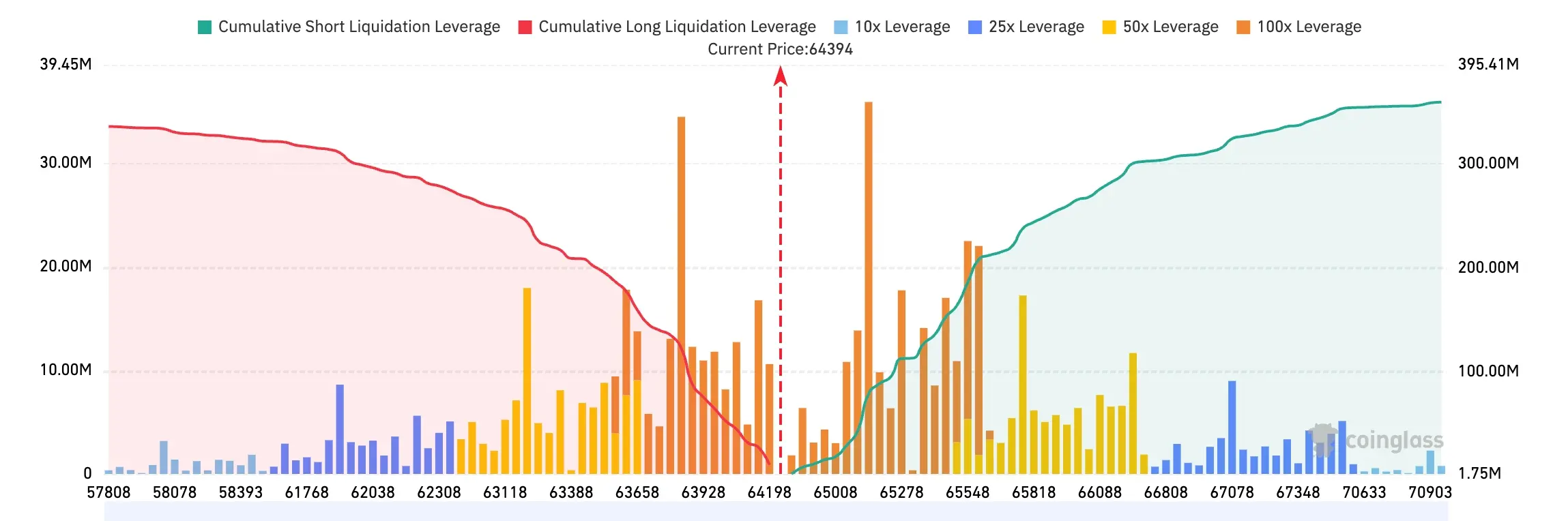
- Spot ETF Net Inflow/Outflow: Net inflow of $244 million yesterday, current dynamic net inflow of $9.3 million.
Driving Factors Analysis: Amid rising geopolitical risks and divergence in U.S. stocks, the cryptocurrency market remains stable overall. BTC holds above $64,000, while ETH shows stronger resilience. ETF fund flows provide support for net inflows, and the scale of leveraged liquidations is controllable. On a macro level, the rebound in oil prices coexists with cautious sentiment ahead of non-farm data, and short-term cryptocurrencies may maintain high-level oscillations, focusing on the impact of non-farm results on risk asset sentiment.
U.S. Stock Index Performance

- Dow Jones: Closed at 53,885.10 points (-0.85%), retreating from record highs
- S&P 500: Closed at 7,709.96 points (-0.18%), slight pullback
- Nasdaq: Closed at 26,348.35 points (-0.06%), basically flat
Tech Giants Dynamics
- NVDA: $219.84 (+0.28%)
- AAPL: $312.42 (+0.46%)
- MSFT: $497.01 (+1.96%)
- GOOGL: $357.75 (-1.29%)
- AMZN: $271.84 (-0.30%)
- META: $590.43 (+0.28%)
- TSLA: $319.32 (-0.70%)
Performance Summary and Driving Analysis: On Thursday, the three major U.S. stock indices collectively closed lower, with the Dow Jones significantly retreating from record highs. Microsoft rose nearly 2%, showing relative strength, while Nvidia, Apple, and Meta saw slight gains. Google continued to face pressure, and Tesla and Amazon saw slight pullbacks. The market is generally cautious ahead of non-farm data, with AI application software stocks generally weakening, and the storage sector continuing to adjust due to previous guidance falling short of expectations. SpaceX rose over 6%, boosted by the Terafab project.
Sector Movement Observation
Storage Concept
- Representative Stocks: Western Digital (-13%), SanDisk (-7%), SK Hynix (-5%)
- Driving Factors: Continued profit-taking after previous guidance fell short of expectations, with the market becoming more sensitive to high-valuation storage targets.
AI Application Software
- Representative Stocks: Datadog, AppLovin, HubSpot (down over 19%), Unity (+15%)
- Driving Factors: Some high-valuation software stocks faced sell-offs, with significant differentiation within the sector.
Space Concept
- Representative Stocks: SpaceX (+6%), Redwire (+10%)
- Driving Factors: The launch of the Terafab project boosted related sentiment.
# 3. In-Depth Analysis of U.S. Stocks
1. SpaceX / Tesla - Launch of Terafab AI Chip Super Factory with Initial Investment of $16.8 Billion
Event Overview: SpaceX and Tesla officially announced the launch of the Terafab advanced AI semiconductor complex project in Grimes County, Texas, with an initial investment of $16.8 billion, aiming to build one of the largest chip manufacturing facilities in the world (planning over 100 million square feet). The factory will achieve vertical integration of logic chips, storage, packaging, and testing, focusing on serving the computing power needs of Tesla's Optimus humanoid robot, Cybercab, and SpaceX's space data center. Musk stated it will be "the largest and most valuable building on Earth," revealing that about 25% of future computing power output will be allocated to Optimus, with 75% for spacecraft AI projects.
Market Interpretation: This project directly reflects the urgent need for Musk's companies for "self-controlled" AI computing power, and indirectly confirms the ongoing global supply tightness of high-end chips (especially advanced processes and HBM). The initial investment of $16.8 billion is already substantial, with greater expansion potential in the future, reinforcing the long-term narrative of "vertical integration + self-built capacity." The market views it as a hedge against reliance on external suppliers like Nvidia, while also potentially reshaping parts of the supply chain.
Investment Insight: Long-term positive for related equipment, materials, and packaging testing supply chains, and reinforces the logic of self-controlled computing power. However, in the short term, attention is needed on the pressure of massive capital expenditures on the free cash flow of both companies, as well as the risks of project implementation progress and yield ramp-up.
2. Western Digital / SanDisk - Continuing Significant Pullback
Event Overview: After previous earnings guidance fell short of market expectations, Western Digital's stock price continued to drop over 13%, and SanDisk fell nearly 7%, putting pressure on the storage sector overall. Although both companies reported strong quarterly results, the midpoint of next quarter's revenue guidance was below the significantly raised consensus expectations due to the AI storage boom.
Market Interpretation: High-valuation storage targets are highly sensitive to "expectation gaps." Previous funds have fully priced in optimistic expectations for AI data center storage demand, and once guidance fails to further strengthen this narrative, profit-taking quickly unfolds. Ahead of non-farm data release, market risk appetite has decreased, with stocks that previously saw large gains becoming the main targets for selling, indicating that the storage sector is still in a "high expectation, high volatility" trading phase.
Investment Insight: The long-term demand logic for AI storage remains unchanged, with resilient demand for enterprise SSDs and HBM. However, short-term stock prices will be more dominated by sentiment and valuation digestion, and it is necessary to observe whether subsequent actual shipment data can gradually validate previous high expectations.
3. Nvidia (NVDA) - Considering Reducing Rubin Ultra Memory Configuration
Event Overview: According to The Information, Nvidia is considering adopting a lower-than-planned memory capacity for the next-generation Rubin Ultra chip to address the ongoing shortage of high-bandwidth memory (HBM). Insiders revealed that the company has tested at least three versions in the past few weeks, with some versions having memory sizes below the initially announced specifications. Reducing memory may affect single-card performance, but Nvidia can compensate through other architectural optimizations; if customers run large models, they may need to call upon more chips.
Market Interpretation: This adjustment directly exposes a key bottleneck in the current expansion of AI computing power—high-end HBM supply cannot fully match chip design needs. While memory reduction may be partially offset through software and system-level optimizations, it may still increase customers' overall ownership costs and deployment complexity. The market interprets this as a real constraint on hardware delivery rhythm due to supply chain constraints, rather than a weakening of demand.
Investment Insight: The long-term demand logic for AI computing power remains solid, but supply chain bottlenecks may impact short-term delivery rhythm and customer experience. Continuous tracking of HBM supply improvement progress and Nvidia's implementation of alternative solutions is necessary.
4. Microsoft (MSFT) - Up Nearly 2%, Relatively Resilient
Event Overview: Microsoft's stock price rose about 2%, performing significantly better than most peers amid overall pressure on the tech sector and heightened cautious sentiment ahead of non-farm data release.
Market Interpretation: Microsoft is viewed as a relatively high-certainty target in the current tech sector due to the continued above-expectation growth of its Azure cloud business and the actual landing of AI commercialization. In a phase where market risk appetite declines and funds tend to favor "defensive growth," cloud and software giants with clear revenue realization paths often receive relative premiums. This contrasts with the pullbacks of some hardware and high-valuation software stocks.
Investment Insight: The ability to realize performance remains the core standard for current market pricing. Attention should be paid to whether the growth rate of cloud business can continue to digest capital expenditures, as well as the visibility of AI-related revenue contributions.
5. Google (GOOGL) - Continuing to Pull Back
Event Overview: Google's stock price fell about 1.3%, continuing the adjustment trend triggered by significant changes in the leadership of its AI department, becoming one of the weaker performers among large tech stocks.
Market Interpretation: Organizational changes in the heated AI competition phase are easily interpreted by the market as signals of strategic execution or internal priority adjustments. Investor concerns about product landing rhythm, cloud business synergy, and gaps with competitors have intensified, leading to short-term fund outflows from some software and search-related targets, shifting towards hardware or cloud service providers with more certain performance.
Investment Insight: Continuous tracking of the new leadership's progress on Gemini, AI product commercialization, and cloud business is necessary. Organizational adjustments do not necessarily weaken long-term competitiveness, but short-term sentiment and fund flows may still require time to repair.
# 4. Market & Project Dynamics
MS NOW reported that two Middle Eastern diplomats familiar with the negotiations stated that Oman has agreed to a framework agreement with Iran to temporarily reopen the Strait of Hormuz. An Iranian government official stated that the agreement will establish a new shipping route by allowing merchant ships to enter the Persian Gulf via Iranian-controlled routes and exit via Omani-controlled routes.
Research firm Bernstein reiterated its "Outperform" rating and maintained a target price of $140 after Circle announced its Q2 2026 financial results, believing that the company's latest performance composition serves as a "reverse validation" of the market's bearish views.
Bernstein analysts stated that the market currently underestimates Circle's long-term growth potential regarding two core concerns—intensifying competition in stablecoins and changes in the interest rate environment that may affect reserve income—while overestimating the impact of these factors. Investors may not have fully accounted for Circle's future revenue opportunities from transaction fees, partner ecosystems, and the Arc blockchain.
The firm specifically pointed out that several infrastructure layouts recently advanced by Circle, including obtaining a national trust bank license, expanding the Circle Payments Network, and the planned launch of the Arc public chain mainnet on September 16, may become future growth drivers.
Additionally, Bernstein stated that Circle has raised its guidance for other revenues and profit margins after deducting distribution costs for 2026, expecting to confirm approximately $180 million in Arc token pre-sale revenue. Analysts believe that future staking income, gas fees, and ecosystem cooperation income from Arc have not been fully reflected in current valuation expectations.
As of the end of Q2, the circulating supply of USDC was $73.3 billion, down 5% from the previous quarter but up 19% year-on-year. Bernstein believes that Circle is transitioning from a purely crypto trading infrastructure to payment, real-world asset (RWA) tokenization, and broader financial infrastructure, which will drive USDC into the next stage of growth.
Circle's stock closed at $63.28 on Wednesday, and Bernstein's target price of $140 implies a potential upside of about 121%.
Nvidia is considering adjusting the design of the next-generation Rubin Ultra GPU by reducing the high-bandwidth memory (HBM) configuration to address the tight supply of advanced HBM chips.
Tesla and SpaceX announced on Thursday that their jointly developed advanced chip factory "Terafab" will be located in Grimes County, Texas, near Houston, with an initial investment scale of $16.8 billion.
Michael Saylor, executive chairman of Bitcoin treasury company Strategy, stated that artificial intelligence is changing the way wealth is created, and businesses and individuals should not try to compete with machines but should leverage AI to amplify their own capabilities.
Saylor stated in an interview that he used ChatGPT to help Strategy design a Bitcoin-based preferred stock financing plan, ultimately helping the company raise about $15 billion through an IPO and related financing. He said, "AI helped me create $15 billion."
Media reports indicate that Alphabet's large-scale bond issuance attracted about $115 billion in subscription demand.
According to BeInCrypto, since November 2025, Bitcoin's 30-day average hash rate has decreased by 19%, from 1,108 EH/s to 898 EH/s. Glassnode data shows that this nine-month decline is the longest in the network's history. This decline coincides with the largest capital migration in mining companies' history, with mining firms holding over $70 billion in AI contracts, and some power capacity originally used for Bitcoin mining has shifted to AI hosting, which may be difficult to return.
# 5. Today's Market Calendar
Data Release Schedule
Time Country/Region Data Name Market Attention
|----------------|----|----------|-------| | Tonight 20:30 (UTC+8) | United States | July Non-Farm Employment Data | ⭐⭐⭐⭐⭐ | | Today | United States | Related Economic Data | ⭐⭐⭐⭐ |
Important Event Forecast
- Non-Farm Data: Expected to increase by 90,000, previous value 57,000; unemployment rate expected at 4.3%. Higher than expected may boost confidence in the labor market and increase rate hike bets.
- Hormuz Progress: Focus on the final landing of the agreement and actual navigation situation.
- Terafab Follow-up: Focus on project details and supply chain impact.
Institutional Views:
Analysts generally believe that Trump's tariffs on polysilicon and the ban on the export of key waste materials further strengthen the localization policy of the supply chain, benefiting related industries in the U.S. in the long term but potentially raising costs. Moussailem's hawkish statements have reignited expectations for a rate hike in September. The Hormuz agreement remains uncertain, with oil prices rebounding significantly. SpaceX and Tesla's Terafab project highlights the demand for self-controlled AI computing power. The storage sector and some AI software stocks continue to adjust, showing high sensitivity of high valuations to expectation gaps. The overall consensus is that tonight's non-farm data will become the core of short-term pricing, with geopolitical and policy uncertainties still present.
Disclaimer: The above content is compiled by AI search, with human verification for publication, and does not constitute any investment advice. The data in the text may inevitably contain deviations; please refer to real-time market data.
 Risk warning



Popular articles