Morning News | DeepSeek's first batch of contracts for the second round of financing is signed today, with a valuation of 500 billion yuan; a South Korean lawmaker proposed to postpone the taxation of virtual asset income for three years until 2030

 August 10 Market Important Events Overview
Compiled by: ChainCatcher
What important events have occurred in the past 24 hours?
Forbes: After Coldcard vulnerability, Bitcoin ETF saw a net inflow of $626 million in a few days, reigniting the self-custody debate
According to ChainCatcher, Forbes reported that the scale of theft from the Coldcard hardware wallet vulnerability has risen to approximately $130 million, involving about 2,000 BTC and over 5,200 addresses, reigniting the industry debate over who should hold private keys. Data from Bitcoin Magazine shows that in the days following the incident, the U.S. spot Bitcoin ETF saw a net inflow of $626 million, with some opinions suggesting that the vulnerability may drive more funds toward ETFs. The report states that supporters of self-custody remain undeterred; Casa co-founder Jameson Lopp stated that confidence in self-custody should not wane due to recent events, as custodial institutions also rely on random number generators. Bitcoin core developer Peter Todd claimed that the historical record of self-custody is far better than that of third parties. Another viewpoint argues that both reflective choices have flaws; Onramp co-founder Michael Tanguma stated that if the only answer is Coinbase or ETFs, it poses a serious problem, as centralizing what should be decentralized assets undermines their foundation, advocating for a multi-institutional custody solution where keys are held by multiple regulated entities.
The crypto industry reignites the debate of "who should hold private keys" due to the $130 million theft from Coldcard wallet
According to ChainCatcher, a wallet security incident involving approximately $130 million in Bitcoin losses is reigniting discussions in the crypto industry regarding asset custody models: should Bitcoin holders rely on personal self-custody or turn to institutional custody? The hardware wallet manufacturer Coldcard had a random number generation vulnerability in part of its firmware in 2021, leading to predictable risks in some generated mnemonic phrases. This vulnerability was discovered years later, and approximately 5,200 addresses and about 2,000 BTC have been stolen, with losses estimated at around $130 million. Following the incident, some investors began turning to Wall Street custody products. Data shows that the U.S. spot Bitcoin ETF saw a net inflow of about $626 million in the days following the incident. Bloomberg ETF analyst Eric Balchunas stated that such security incidents may further drive funds toward ETFs. However, the Bitcoin core community remains committed to the self-custody concept. Casa co-founder Jameson Lopp stated that recent events should not weaken users' confidence in self-custody, pointing out that third-party custody also carries risks. Bitcoin core developer Peter Todd also believes that self-custody has a long-term safety record superior to centralized institutions. Onramp co-founder Michael Tanguma believes that both solutions have flaws. He stated that concentrating large amounts of assets in a single institution creates a "honeypot," while hardware wallets face risks related to supply chains, firmware, and random number generation. Tanguma proposed a "multi-institutional custody" solution, where multiple regulated entities hold keys through a multi-signature mechanism, requiring multiple institutions to jointly sign any transaction to reduce single points of failure. However, this model has also sparked controversy. Critics argue that while multi-institutional custody enhances security, it also introduces permissioned management, conflicting with the decentralized ideals originally pursued by Bitcoin. As Bitcoin gradually enters the realms of pensions, trusts, and institutional asset allocation, the industry is searching for new custody solutions suitable for long-term wealth management. The Coldcard vulnerability incident once again highlights that achieving a balance between security, decentralization, and usability remains a core challenge facing the Bitcoin ecosystem.
Grayscale: The failure of the CLARITY Act may shift new investments in the U.S. crypto industry overseas
According to ChainCatcher, Grayscale's research director Zach Pandl stated that even if the digital asset market structure clarification act (CLARITY Act) is not passed, the main blockchain operations, Bitcoin's value storage demand, and the growth of stablecoin payments will not be immediately affected, as regulators will fill regulatory gaps through rule-making. Zach Pandl pointed out that the lack of comprehensive market structure legislation may suppress new investment activities in the U.S., prompting crypto industry participants and startups to turn to overseas jurisdictions with clearer regulatory frameworks. The U.S. government will continue to support the development of the crypto ecosystem. Strategy co-founder and executive chairman Michael Saylor previously stated that regardless of whether the CLARITY Act is passed, Bitcoin will continue to develop, but the U.S. needs clarity in digital asset regulation. Senator Bernie Moreno stated that Senate Democrats and Republicans have ended related negotiations and will proceed to a vote.
White House economic advisor: Will not replace Fed Governor Cook, supports interest rate cut stance
According to ChainCatcher, White House economic advisor Kevin Hassett stated that he would not replace Federal Reserve Governor Lisa Cook if she were removed from her position due to related allegations. Hassett stated that the allegations against Cook are matters of law enforcement investigation and expressed a "hope that Cook is innocent." Previously, Cook was challenging the Trump administration's attempt to remove her from her position as a Federal Reserve governor. Regarding monetary policy, Hassett indicated that if he were involved in decision-making, he would prefer to maintain current interest rates or implement cuts. He believes that U.S. inflation is easing while supply-side growth momentum remains strong, providing space for a more accommodative policy environment.
AI infrastructure newcomer Nscale prepares for U.S. IPO, possibly in September, with Goldman Sachs and JPMorgan as advisors
According to ChainCatcher, TechFundingNews reported that AI infrastructure company Nscale is preparing for an IPO in the U.S., potentially starting as soon as September this year. The company has disclosed to potential investors that its cumulative contracted revenue has reached approximately $51 billion. Currently, Goldman Sachs and JPMorgan are serving as advisors for Nscale's potential IPO, but discussions are still ongoing, and the listing date may be delayed. Nscale is a company spun off from crypto mining firm Arkon Energy, primarily focusing on AI data centers, GPU computing power, and energy infrastructure. In July, it announced the acquisition of distributed AI software company Anyscale for approximately $1.65 billion, with clients including Coinbase, Runway, and Bedrock Robotics. Previously, AI infrastructure Nscale completed a $2 billion Series C funding round, achieving a valuation of $14.6 billion, led by Aker ASA and 8090 Industries, with participation from Nvidia, Lenovo, and Nokia.
A South Korean lawmaker proposes to delay taxation on virtual asset income for three years until 2030
According to ChainCatcher, MBN reported that South Korean National Power Party lawmaker Jeong Seong-guk plans to propose a bill to delay the implementation date for taxing virtual asset income by three years, from January 1, 2027, to January 1, 2030. The lawmaker pointed out that by postponing the implementation date until a comprehensive review of related systems, including taxation on virtual assets, is completed, a safeguard can be established to enhance taxpayer expectations and prevent system chaos. According to current regulations, starting January 1 next year, income generated from the transfer or lending of virtual assets will be classified as "other income" and subject to income tax. Therefore, the portion of annual profits exceeding 2.5 million won will be taxed at a rate of 22%, which includes 20% other income tax and 2% local income tax. Amid recent stock market turmoil and soaring real estate prices, which have triggered public attacks on the government and ruling party, the National Power Party seems to be attempting to gain public support by actively proposing legislation aimed at protecting the interests of virtual asset market investors. The National Power Party has consistently opposed the government, advocating for the abolition of this tax.
Grayscale: Global alternative asset scale has grown nearly 7 times since 2008, with younger generations favoring crypto allocations
According to ChainCatcher, Grayscale's research director Zach Pandl stated that the global alternative asset market has grown nearly 7 times since the 2008 financial crisis, with private equity, private credit, hedge funds, physical assets, and crypto continuing to rise in global investment portfolios. According to the data cited, within alternative assets, private equity accounts for about 29%, hedge funds about 23%, and crypto about 13%. Zach Pandl stated that generational differences in allocation preferences may further strengthen this trend. According to a Bank of America survey of high-net-worth individuals, investors aged 21 to 43 allocate about 53% of their assets outside traditional stocks and bonds, while the proportion for those aged 44 and above is 26%. With over $100 trillion in wealth expected to transfer to younger generations in the coming years, their stronger preference for alternative assets may provide sustained tailwinds for crypto. He added that the lowering of entry barriers for alternative assets is one of the reasons for this shift, with crypto developing along similar paths, as regulated products like Bitcoin ETPs and institutional-level market infrastructure provide more convenient exposure.
Israeli AI startup Decart negotiating sale at a valuation of about $6-7 billion, with SpaceX and Amazon identified as potential buyers
According to ChainCatcher, CTech (Calcalist) reported exclusively that Israeli AI startup Decart is in deep negotiations with an international tech giant for a sale, with a valuation of about $6 to $7 billion, and the deal may be signed next week. Decart was founded in 2023 and focuses on developing real-time video generation AI models, with about 100 employees and a total funding of approximately $450 million to date. The company just completed a $300 million funding round in May, with a valuation of $4 billion. Negotiations initially involved Nvidia, and as they approached a deal, another giant intervened, prompting the founder to shift to a new buyer. Industry speculation suggests the new buyer may be SpaceX, but Amazon and Nebius are also reportedly interested. Decart's technological advantage lies in its ability to generate videos at a cost far lower than competitors. SpaceX founder Elon Musk has maintained regular contact with co-founder Dean Leitersdorf since experiencing the game Oasis developed based on Decart technology in 2024. Sequoia Capital partner Shaun Maguire (who organized Musk's post-war visit to Israel) has invested in the company since its seed round. If the buyer is SpaceX, it would establish its first R&D center in Israel. Previously, SpaceX had acquired AI programming startup Cursor for $60 billion after its IPO, and acquiring Decart would further strengthen its layout in the AI infrastructure field.
Federal Reserve Chair Waller completes divestment of all financial assets, ethics compliance certification officially signed
According to ChainCatcher, Federal Reserve Chair Waller has sold all financial assets he committed to divest. Waller signed an ethics compliance certification with the government ethics office last Thursday, which was made public on the agency's website on Saturday. Waller had previously submitted a divestment proof to the ethics office, showing that he had sold most of the assets he committed to divest. The latest disclosure document shows that he has sold the remaining holdings involved in the agreement. Waller is one of the wealthiest officials in Federal Reserve history. He had committed to divesting holdings in multiple investments, the underlying assets of which have not been disclosed due to confidentiality agreements—some of which are valued at least $100 million.
Coinbase had offered $2.5 billion to acquire BVNK, ultimately losing to Mastercard's $1.8 billion acquisition
According to ChainCatcher, the insider details of the acquisition of stablecoin infrastructure company BVNK by Mastercard for $1.8 billion have recently been revealed. BVNK's early investment firm Concentric disclosed that during the acquisition bidding process, U.S. crypto exchange Coinbase was once in the lead and reportedly made the highest offer of $2.5 billion but ultimately withdrew from the competition due to insufficient strategic and cultural fit between the two parties. Concentric founding partner Kjartan Rist stated that the BVNK founding team did not focus solely on the offer price when choosing a buyer, but valued long-term partnerships and corporate culture alignment. "Although Coinbase may have offered a higher price, the chemistry between the two parties was not ideal." In contrast, Mastercard, as a traditional financial services company, found it easier to form synergies with BVNK in payment infrastructure and stablecoin applications. It is reported that Mastercard was involved in BVNK's acquisition discussions early on, and after Coinbase failed to advance the deal, Mastercard re-emerged as the main buyer, ultimately completing the acquisition for $1.8 billion. Visa also participated in the competition. Having previously invested in BVNK and holding a board observer seat, Visa had an advantage at one point. However, Visa ultimately chose not to acquire directly but to adopt an open strategy of collaborating with multiple stablecoin companies. BVNK was founded in 2018 and primarily provides stablecoin payment, cross-border settlement, and fund management infrastructure. Its early investor Concentric invested in the company at a valuation of $4 million in 2019, achieving significant returns with this transaction.
Bybit sues North Korea and its Reconnaissance General Bureau, court approves freezing of identified stolen assets
According to ChainCatcher, cryptocurrency exchange Bybit has filed a civil lawsuit in the U.S. District Court for the District of Columbia against North Korea, the North Korean Reconnaissance General Bureau, and the hacking group Lazarus Group, concerning a theft incident of approximately $1.5 billion in February 2025. Bybit stated that the judge has approved a preliminary injunction prohibiting the transfer or disposal of identified stolen assets during the case proceedings and believes that Bybit has a high likelihood of winning on the merits of the case. The lawsuit also lists unknown individuals and entities holding or transferring related funds as John Doe defendants. Bybit disclosed that approximately $48.4 million has been recovered, and about $30.5 million has been frozen across more than 28 exchanges and custodians, together accounting for about 5% of the stolen amount. The attackers transferred approximately 500,000 ETH from Bybit's cold wallet in February 2025, most of the funds were subsequently exchanged for Bitcoin through Thorchain and transferred via mixing services. Bybit stated that the case is proceeding in parallel with a criminal investigation.
Data: Ethereum spot ETF saw a net inflow of $245 million last week, marking five consecutive weeks of inflows
According to ChainCatcher, based on SoSoValue data, the Ethereum spot ETF saw a net inflow of $245 million during the trading days last week (Eastern Time from August 3 to August 7). The Ethereum spot ETF with the highest net inflow last week was Blackrock's ETF ETHA, with a weekly net inflow of $203 million, bringing its historical total net inflow to $11.65 billion; followed by Fidelity's ETF FETH, with a weekly net inflow of $24.15 million, currently totaling $2.12 billion in historical net inflow. The Ethereum spot ETF with the highest net outflow last week was Grayscale's Ethereum Trust ETHE, with a weekly net outflow of $4.7636 million, currently totaling $5.35 billion in historical net inflow. As of the time of publication, the total net asset value of Ethereum spot ETFs is $10.74 billion, with an ETF net asset ratio (market cap relative to total Ethereum market cap) of 4.65%, and historical cumulative net inflows have reached $11.46 billion.
Data: Bitcoin spot ETF saw a net inflow of $854 million last week, with Blackrock's IBIT leading at $694 million
According to ChainCatcher, based on SoSoValue data, the Bitcoin spot ETF saw a net inflow of $854 million during the trading days last week (Eastern Time from August 3 to August 7). The Bitcoin spot ETF with the highest net inflow last week was Blackrock's ETF IBIT, with a weekly net inflow of $694 million, currently totaling $61.17 billion in historical net inflow; followed by Fidelity's ETF FBTC, with a weekly net inflow of $116 million, currently totaling $10.04 billion in historical net inflow. The Bitcoin spot ETF with the highest net outflow last week was VanEck ETF HODL, with a weekly net outflow of $53.4753 million, currently totaling $1.09 billion in historical net inflow. As of the time of publication, the total net asset value of Bitcoin spot ETFs is $79.5 billion, with an ETF net asset ratio (market cap relative to total Bitcoin market cap) of 6.1%, and historical cumulative net inflows have reached $52.18 billion.
ZachXBT: U.S. female scammer impersonates customer service to steal over $5 million in crypto assets
According to ChainCatcher, on-chain detective ZachXBT posted that U.S. threat actor Tiffany Milanovich participated in the theft of approximately $5 million in crypto assets by impersonating customer service for hardware wallets and centralized exchanges. Her methods included disguising as Bitcoin IRA email support, transferring approximately $1.2 million in BTC and ETH from the victim's Trezor wallet in one attack, and stealing about $500,000 in BTC from a Coinbase account in another case. Tiffany was responsible for inducing victims to relinquish access to their funds under the guise of "customer service calls," later boasting about the stolen funds on social media and Telegram groups, recording taunts to victims, and collaborating with other threat actors to use phishing panels and instant exchange services for money laundering, with some stolen funds still dormant on-chain. The threat actor known as "Tiffany" is suspected of being involved in multiple crypto asset thefts, gambling the stolen funds in crypto casinos. The platform Shuffle has frozen related accounts based on evidence submitted by ZachXBT; Tiffany previously shared a Connecticut search seizure warrant, dated before some of the incidents involved. ZachXBT has obtained chat logs, recordings, and on-chain evidence, predicting that this individual may face further legal consequences. This threat actor is also linked to the John Daghita (Lick) case, who is suspected of stealing over $46 million in crypto assets from a U.S. government-seized wallet.
Strategy sold 1,690 Bitcoins last week, cashing out approximately $108.6 million
According to ChainCatcher, U.S. publicly listed company STRATEGY disclosed in its latest filing with the U.S. Securities and Exchange Commission (SEC) that it sold 1,690 Bitcoins at an average price of $64,262, cashing out approximately $108.6 million. Additionally, Michael Saylor posted on the X platform that Strategy increased its dollar reserves by $650 million and repurchased $109 million in STRC. This move increased the dollar duration by 143 days to 2.7 years and narrowed the Bitcoin credit spread of STRC by 10 basis points. As of August 9, 2026, Strategy holds 840,447 Bitcoins, with dollar reserves of $4.65 billion.
Moore Threads reports revenue of 1.736 billion yuan in the first half of the year, a year-on-year increase of 147%, while planning for H-share listing
According to ChainCatcher, domestic GPU manufacturer Moore Threads released its 2026 half-year report, reporting revenue of 1.736 billion yuan, a year-on-year increase of 147.42%, with a net loss attributable to the parent company of 11.56 million yuan, narrowing by about 259 million yuan compared to the same period last year; the net loss attributable to the parent company after excluding non-recurring items was 151 million yuan, narrowing by 52% year-on-year. Revenue for the second quarter was approximately 999 million yuan, a quarter-on-quarter increase of 35.4%. R&D expenses were 769 million yuan, accounting for 44.3% of revenue. The company stated that the improvement in performance is driven by AI computing power demand and accelerated commercialization of its Kua'e smart computing cluster. As of the end of the quarter, the book value of inventory was 3.55 billion yuan, an increase of 166.5% compared to the end of last year, reaching a four-year high, as the company stated it proactively increased stock to meet market demand. Moore Threads announced on the same day that it is planning to issue H-shares and list on the main board of the Hong Kong Stock Exchange, just about 8 months after its listing on the STAR Market in December 2025, which, if successful, will achieve an "A+H" layout. The announcement stated that this issuance still requires approval from the shareholders' meeting and regulatory approval, and there is uncertainty. Another domestic GPU manufacturer, Muxi Co., has already launched its H-share plan in June, with a shorter interval. Moore Threads is accelerating the development of the new generation "Huagang" architecture and the research and development of Huashan and Lushan chips. In the first half of the year, operating cash flow net outflow was 2.169 billion yuan, expanding by about 86% year-on-year.
Yushu Technology angel investor Yin Fangming's early investment of 2 million yuan earned him a 2.76% stake, netting 1.683 billion yuan based on the issuance market value
According to ChainCatcher, Yushu Technology, founded in 2016, received seed round investment from early angel investor Yin Fangming, who invested 2 million yuan for a 15% stake, marking Yushu Technology's first external investment at that time. After subsequent rounds of financing dilution, as of the IPO, Yin Fangming's Junwan Hongyi held 11,174,900 shares, representing about 2.76% of the total, making him the tenth largest shareholder of Yushu Technology. Based on an issuance market value of 61 billion yuan, the value of his shares is approximately 1.685 billion yuan, netting him a profit of 1.683 billion yuan compared to his initial investment of 2 million yuan, achieving a return of 841.5 times.
Avenir Group incubated UMX launched public testing, bridging crypto assets and securities trading
According to ChainCatcher, on August 10, UMX (The Unified Market Exchange), incubated by Avenir Group under Li Lin, announced the launch of invitation-only public testing. UMX is positioned as a crypto-friendly securities platform for global professional investors, supporting spot, leveraged, contract, and options trading of crypto assets, while also supporting real U.S. stocks, ETFs, and U.S. stock options trading, aiming to bridge crypto assets and real securities trading on the same platform to enhance the capital efficiency of cross-asset trading. The public testing focuses on opening the funding link between crypto asset and securities accounts, supporting stablecoin exchange transfers, non-stablecoin collateralized lending, fiat account withdrawals and deposits, and the mutual conversion of securities holdings and stock tokens. To enhance cross-asset capital efficiency, the platform introduces a cross-asset margin mechanism, allowing financial assets to also be used as margin. During the public testing period, BTC and USDT financial products will also be launched, with maximum annualized yields of 2.5% and 5.5%, respectively. This public testing is invitation-only, and users who have not yet obtained a public testing code can reserve the official version and participate in the early bird benefits program.
Initial quantum attacks may manifest as untraceable wallet thefts, with Tether minting keys potentially becoming high-value targets
According to ChainCatcher, Christopher Smith, founder of blockchain startup Quantus, stated that the first quantum attack may manifest as a series of unexplained thefts of crypto wallets, rather than directly stealing the estimated $63 billion in dormant Bitcoin from Satoshi Nakamoto. He pointed out that sufficiently powerful quantum computers could derive private keys from exposed public keys on-chain, allowing attackers to transfer funds without needing to breach wallets, devices, or exchange internal systems. In theft incidents at highly secure institutions, the only forensic evidence may be the absence of intrusion traces. Smith stated that the initial targets of quantum attacks may be military systems and national secrets; in the blockchain field, the minting keys of stablecoin issuer Tether may be of greater value. Attackers could mint tokens out of thin air through managed wallets and sell them before the issuer responds. Google has accelerated its post-quantum migration timeline to 2029; Smith believes the probability of quantum computers breaking modern cryptography is "50-50" around 2028. Relevant blockchains have begun migrating to post-quantum signatures.
DeepSeek's second round of financing signed its first batch today, with a valuation of 500 billion yuan
According to ChainCatcher, DeepSeek's main company, Deep Seek, completed its first batch of signings for a new round of financing on August 10 in Hangzhou. This round of financing is scaled at 50 billion yuan, corresponding to a pre-investment valuation of approximately 500 billion yuan, an increase of over 40% compared to the first round of financing completed in June (valued at about 350 billion yuan). The earliest deadline for the first batch of fund delivery is August 30. This round of financing has a minimum investment threshold of 5 billion yuan, and the funds will primarily be used for computing power investment, model research, human resource expansion, and potential domestic listing preparations. The funding entry path is divided into two: part will go directly into DeepSeek's main company, and part will enter a limited partnership controlled by founder Liang Wenfeng. Previously, DeepSeek briefly paused financing contacts at the end of July but resumed in early August. The new version of the model DeepSeek-V4-Flash was officially launched on July 31, and according to OpenRouter data, the model's invocation volume reached 7.22 trillion tokens in its first week, topping the global charts. The company has recently announced plans to raise API pricing and introduce peak and off-peak pricing mechanisms.
ETH treasury company Sharplink announces Q2 financial report, net loss of $394.3 million
According to ChainCatcher, Nasdaq-listed company Sharplink (stock code: SBET) announced its financial and operational results for the second quarter of 2026. Q2 revenue was $11.5 million, showing significant year-on-year growth; the net loss was $394.3 million, primarily due to an unrealized loss of $321 million in the ETH market and a depreciation of $76.1 million in LsETH and weETH. As of June 30, Sharplink held approximately 886,881 ETH, with crypto assets valued at approximately $1.4 billion according to U.S. GAAP. The company completed a $75 million registered direct offering on June 23, part of which was used to purchase approximately 10,000 ETH at an average price of about $1,611 and to continue repurchasing shares.
Prediction market Trepa announces cessation of operations
According to ChainCatcher, the prediction market Trepa announced that its last playable activity round will take place on August 12, 2026, after which no new rounds will be opened. Recommendations and continuous rewards obtained by users will be sent to Trepa wallets on August 13. The application will remain online until September 30 for withdrawals, after which it will no longer be accessible. If there is a balance, please withdraw it to your own address through the application wallet before this date. Trepa started in November 2024 during the Bybit x DMCC hackathon, initially as a TON-based Telegram mini-program for predicting public opinion poll results, later undergoing multiple hackathons and shifting to macro events and short-term crypto price predictions.
Crypto.com and Trump Media adjust prediction market collaboration, shifting to promoting to Truth Social users instead of direct integration
According to ChainCatcher, Crypto platform Crypto.com and Trump Media & Technology Group Corp (NASDAQ: DJT) announced adjustments to their previously announced prediction market integration plan. The two parties will no longer develop direct prediction market integration on Truth Social but will shift to a marketing cooperation agreement to promote Crypto.com's prediction market products to the Truth Social user base. According to TMTG's interim CEO Kevin McGurn, the company's strategic focus is on enhancing Truth Social's revenue, continuing to expand its global media business, and completing its merger with TAE, and this marketing agreement aligns better with the company's priorities. It is reported that Crypto.com is actively expanding its product line beyond digital assets and recently hired former OKX executive Iskandar Vanblarcum to lead its prediction market department.
Robinhood has begun offering cryptocurrency trading services to UK investors
According to ChainCatcher, in an official announcement, Robinhood announced the launch of cryptocurrency trading services for UK investors, offering trading of over 50 crypto assets including Bitcoin, Ethereum, XRP, and Hyperliquid through Bitstamp UK, with zero trading fees and no account management or custody fees. This service will be integrated into Robinhood's existing app, alongside products such as stock ISAs, options, and futures. Robinhood also launched the AI analysis tool Cortex Digests, which uses generative AI to analyze news, market data, and technical indicators, providing investors with concise interpretations of cryptocurrency price fluctuations. Since the global launch of Robinhood Chain on July 1, DEX trading volume has exceeded $18 billion, with total locked value surpassing $840 million. UK developers can build applications on this Layer 2 chain. Cryptocurrency trading is provided through Bitstamp UK and is not protected by FSCS or FOS, with trading involving the risk of principal loss.
H100 completes acquisition of 2,455.4 BTC, total holdings increase to 3,506 BTC
According to ChainCatcher, in an official announcement, Swedish-listed Bitcoin reserve company H100 announced the completion of a Bitcoin acquisition transaction, purchasing 2,455.4 BTC at approximately $62,900 each, increasing its total holdings to 3,506 BTC. It is reported that this transaction is the largest merger in the European public Bitcoin equity space and also the world's first "Bitcoin-for-Bitcoin" merger transaction. The entire transaction was paid for in H100 shares, with an implied share price of 1.86 Swedish kronor per share (1x mNAV), with no cash consideration. Fully diluted, the number of satoshis per share increased by about 5%, from 288 to 303, with the acquired party holding no financial debt.
New York Times: World Liberty Financial receives $100 million investment from alleged money laundering businessman
According to ChainCatcher, the New York Times reported that the crypto project World Liberty Financial (WLFI), associated with the Trump family, received a $100 million purchase of WLFI governance tokens from businessman Guren "Bobby" Zhou through Aqua 1. It is reported that Zhou was arrested in the UK in 2021 on suspicion of money laundering and is still involved in an active investigation but has not yet been charged. UK court records accuse him of participating in money laundering activities that began in 2019 with five others. Two of his long-term employees were charged last September, one of whom has pleaded guilty. In this transaction, up to $75 million flowed to companies controlled by Trump and his son.
Meme Popularity Rankings
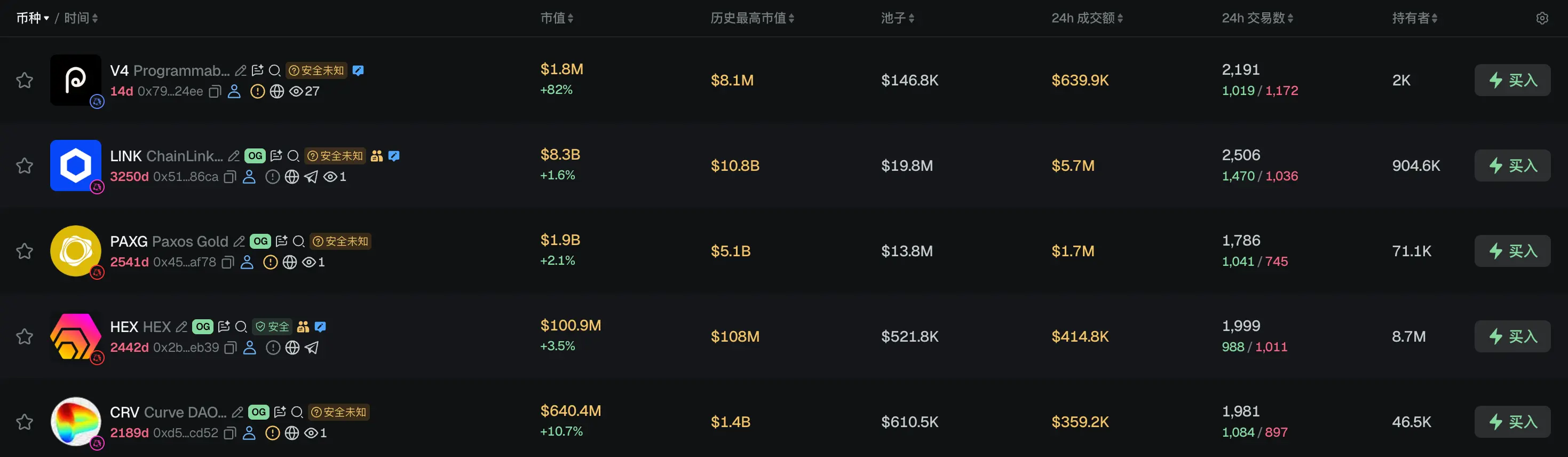
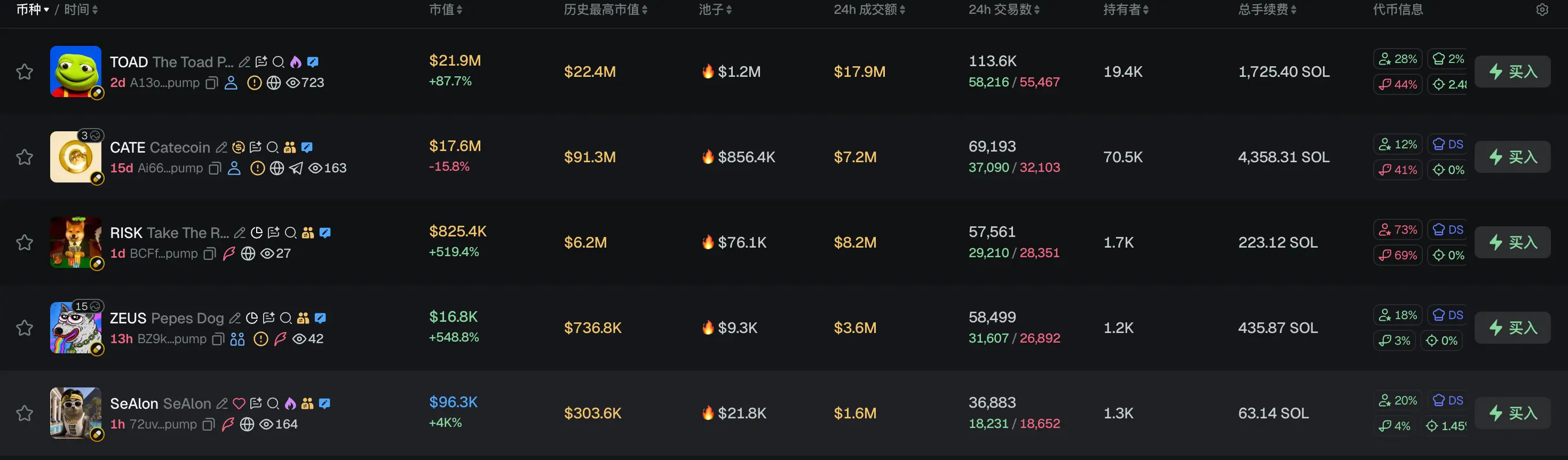
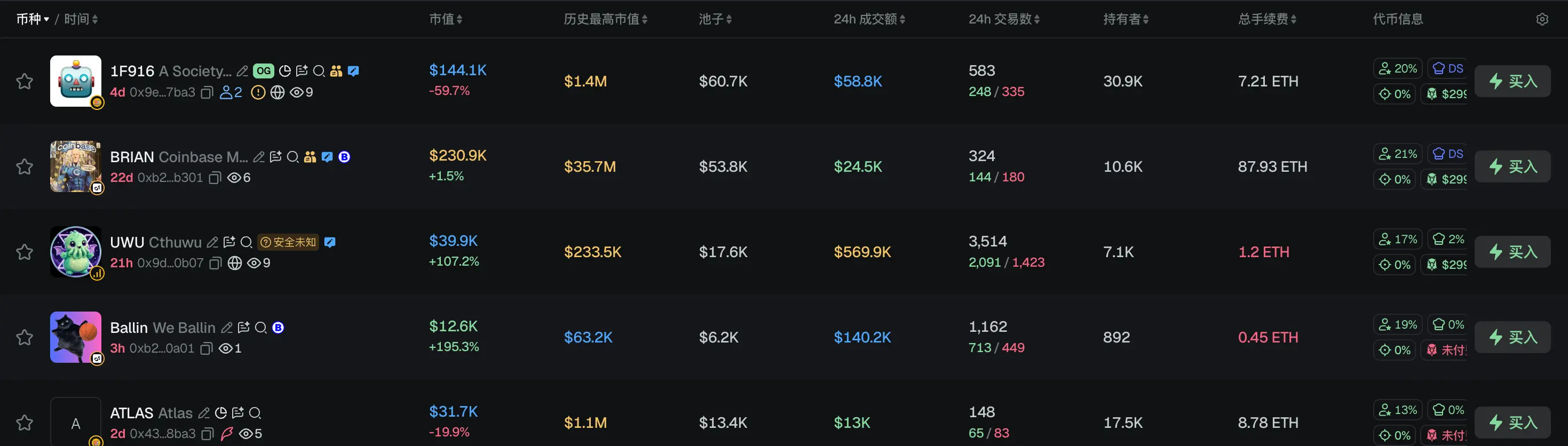
According to the meme token tracking and analysis platform GMGN, as of August 11, 08:45,
The top five popular ETH tokens in the past 24 hours are: V4, LINK, PAXG, HEX, CRV
The top five popular Solana tokens in the past 24 hours are: TOAD, CATE, RISK, ZEUS, Remus
The top five popular Base tokens in the past 24 hours are: 1F916, BRIAN, UWU, Ballin, ATLAS
What are some noteworthy articles to read in the past 24 hours?
The Fat Protocol is Dead: Value Creation Has Left the Token Layer and Shifted to the Equity Layer
The fat protocol theory posits that value aggregates at the protocol layer, and tokens represent your share. This cycle demonstrates that value aggregates in the hands of entities holding legal claims, and those legal claims have never been in tokens—they have always been on the equity table.
In this AI battle in South Korea, Lee Jae-myung cannot afford to lose
Someone in a South Korean anonymous workplace community wrote: "I originally made 600 million won, but now I've accumulated losses of 700 million." Another said: "The money for my wedding is all in there, and I've lost 40%." A 45-year-old office worker, Kim, invested a total of 34 million won after five rounds of averaging down, with a floating loss of over half. A 60-year-old, Song Meijing, made 300 million won in the first half of the year but now has a floating loss of over 60%. She said, "I've never seen such a rapid decline; even the speed of decline during the Asian financial crisis wasn't this fast." "My life is ruined; I can't think of any way out." A retail investor left this statement on a South Korean brokerage forum.
The Major Changes in Exchange Listings
Conclusion: From the mass clearance of crypto-native tokens to the collective expansion of stock-like assets; from the "broad net" quantity expansion to structured exit transmission; from the era of wealth creation through public offerings to the bear market norm of stock competition, the changes in the exchange listing landscape reflect the entire crypto industry's cycle transition. As the supply dividend in the primary market fades, the rough growth model relying solely on the expansion of listing quantity is no longer sustainable; refined asset selection, diversified category layout, and compliant product design will become the core of competition for exchanges in the next stage.
Does Every Great Financial Infrastructure Begin with a Speculative Frenzy?
The attributes of the underlying assets themselves determine the direction and boundaries of speculation. Once valuable underlying targets lose support, the same amount of capital used for speculation is unlikely to yield long-term, valuable results. This rule runs through the history of financial development, and the crypto industry is on the same path. Hyperliquid binds leveraged trading with targets like gold, establishing a new pricing system in just two years; Robinhood builds underlying channels for on-chain securities trading, leveraging unexpected traffic from meme coin speculation. What kind of system speculation can ultimately construct depends on how much value the underlying targets can carry.
Chairman of the Joint Chiefs of Staff Dan Kane recently expressed his position on "seeking an exit" for the Iranian conflict during meetings with senior White House officials such as Vance and Secretary of State Rubio, believing that relying solely on airstrikes is unlikely to achieve all combat objectives. CNN also reported that since the conflict began, the U.S. military has consumed nearly four-fifths of its "THAAD" missile inventory, about half of its "Patriot" interceptors, and nearly half of its "Tomahawk" cruise missiles. According to Bloomberg, any agreement regarding Hormuz would require approval from Iran's Supreme Leader Khamenei. Khamenei has not made a public appearance since the outbreak of the war but stated on social media on the 9th that he had met with President Pezeshkian to discuss war and economic issues.
From $1.6 billion to a 30-story fall: The Final Outcome of the Stablecoin Dealer
In these cases, official conclusions often coexist with community speculation. The Harry Yeh incident is still in the early stages of investigation. The details at the scene (naked, plastic bags, messy apartment) indeed raise doubts about whether it was purely an accident or suicide, but any characterization is premature until the autopsy results and more evidence are released. On-chain wealth can accumulate rapidly, but off-chain security, privacy, and mental health require every crypto player to pay more attention.
 Risk warning