Zuckerberg publishes a lengthy article defining Meta's AI roadmap: aiming to create "personal superintelligence."
 Core Viewpoint

 Zuckerberg's lengthy article sets the tone for Meta AI's new vision: the future belongs to "personal superintelligence," where AI is no longer a tool for a few institutions, but a long-term intelligent assistant for every ordinary person. Open source, security, and the competition for entry points are all woven into the same narrative.
Text by Xiao Jing, Tencent Technology
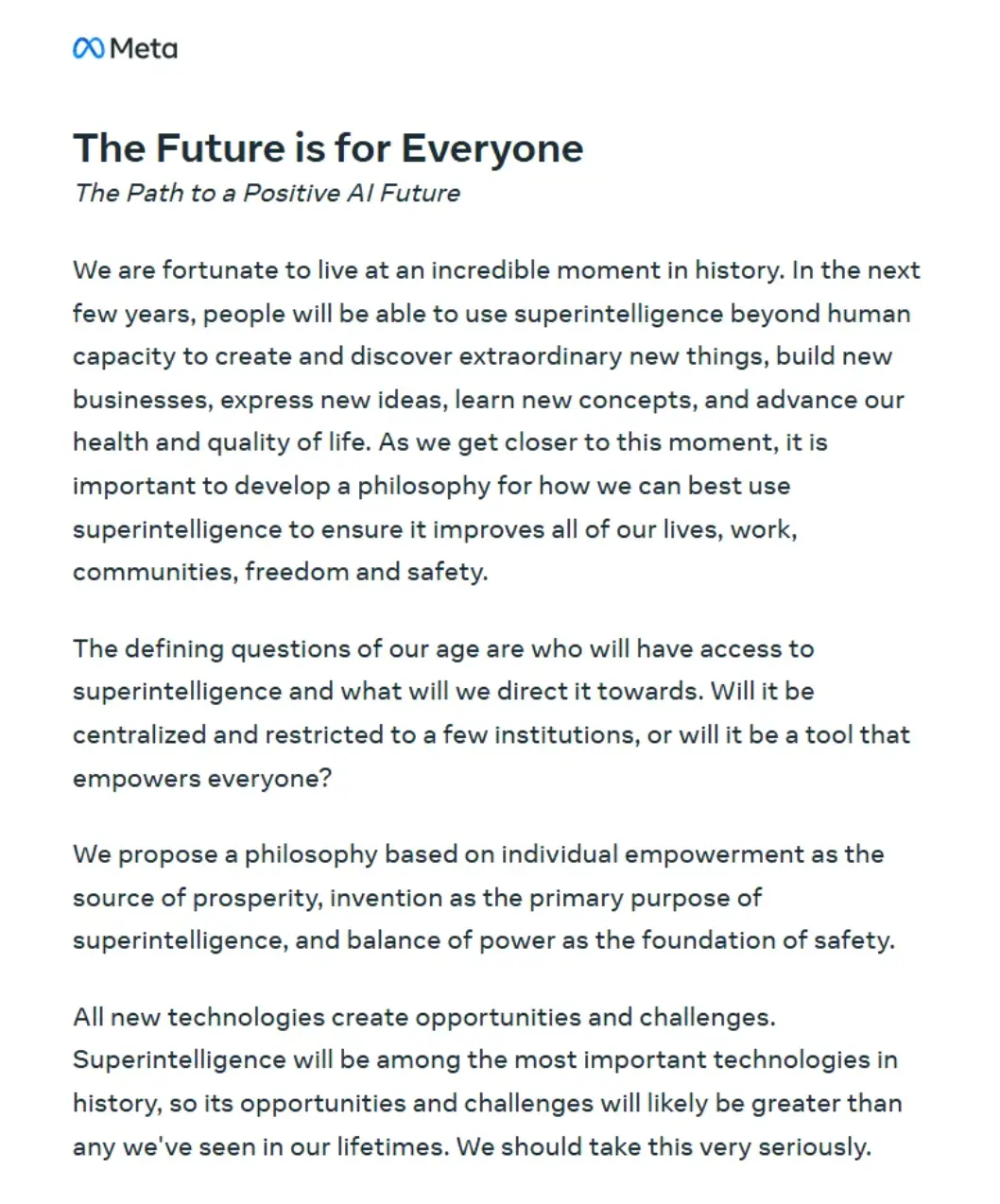
On August 10, local time in the United States, Mark Zuckerberg published a lengthy article titled "The Future Belongs to Everyone: The Path to a Positive AI Future."
On the surface, this is a policy declaration about superintelligence, safety, open source, and infrastructure, but behind this lengthy document lies a more critical main thread: Meta's future goal is to create "personal superintelligence."
Zuckerberg sets a very clear premise for this concept: superintelligence cannot ultimately be controlled by a few companies, governments, or laboratories; it must be distributed to more ordinary people.
In the past two years, discussions in the AI industry about superintelligence have mostly focused on how powerful models can become and how to prevent a system with capabilities far exceeding human abilities from going out of control. Zuckerberg suggests that even if superintelligence is safe, if such power is ultimately held by a very few institutions, it could still create new power imbalances.
Thus, his proposed solution is very "Meta."
He argues that the core principles for the future development of AI should focus on three aspects: viewing personal empowerment as a source of prosperity, seeing innovation as the primary purpose of superintelligence, and ensuring safety through checks and balances.
In his vision, everyone will have a long-term superintelligence by their side. It understands your work style, health status, family arrangements, and long-term goals, and can research, write code, design products, plan tasks for you, and even help a person accomplish tasks that previously required a company.
This also explains why Zuckerberg brings together several seemingly unrelated topics in the same article: open-source models, AI employment, safety governance, data center construction, and even the United States' energy and infrastructure capabilities.
These all point to the same question: If personal superintelligence truly becomes the next generation of computing platforms, who will control it, who will bear the computational costs behind it, and who will decide what it can do?
Zuckerberg's answer clearly reflects Meta's product philosophy over the past twenty years.
Facebook once empowered every user with content production and dissemination capabilities, while Instagram and WhatsApp continued to expand this connection. In the AI era, Meta wants to replicate a similar decentralization—transforming the intelligent capabilities belonging to large institutions into basic tools for ordinary people.
Even on the issue of AI safety, Zuckerberg offers a perspective that is not entirely aligned with mainstream discussions in Silicon Valley.
He believes that one of the real risks to be wary of in the future is the excessive concentration of superintelligent capabilities. Following this logic, open models are no longer just a technical route choice for Meta in competition with OpenAI and Anthropic.
It begins to become part of Zuckerberg's vision of how a superintelligent society should operate. A more practical layer is that Meta is also seeking new business entry points for this narrative.
If AI moves from chat boxes to personal intelligent agents that accompany users long-term, then the truly important entry point may no longer be web pages or just mobile apps, but an AI system that continuously understands users and can take action at any time. Meta has social relationships, content, communication products, and smart glasses; these assets now have the opportunity to be aligned around "personal superintelligence."
Zuckerberg's article aims to construct a larger question than "Can Meta still create the strongest model?"
01 Shifting from "Controlling Superintelligence" to "Distributing Superintelligence"
Zuckerberg raises a fundamental question in the article: Who will own superintelligence in the future? If superintelligence is concentrated in a few companies, governments, or laboratories, will this create new power imbalances in society?
In recent years, one of the important discussions in the field of AI safety has been how to ensure that future superintelligent systems align with human values, known as the "alignment problem." Many researchers worry that if AI capabilities reach levels far exceeding human abilities, and its goals are not aligned with human interests, it could pose uncontrollable risks.
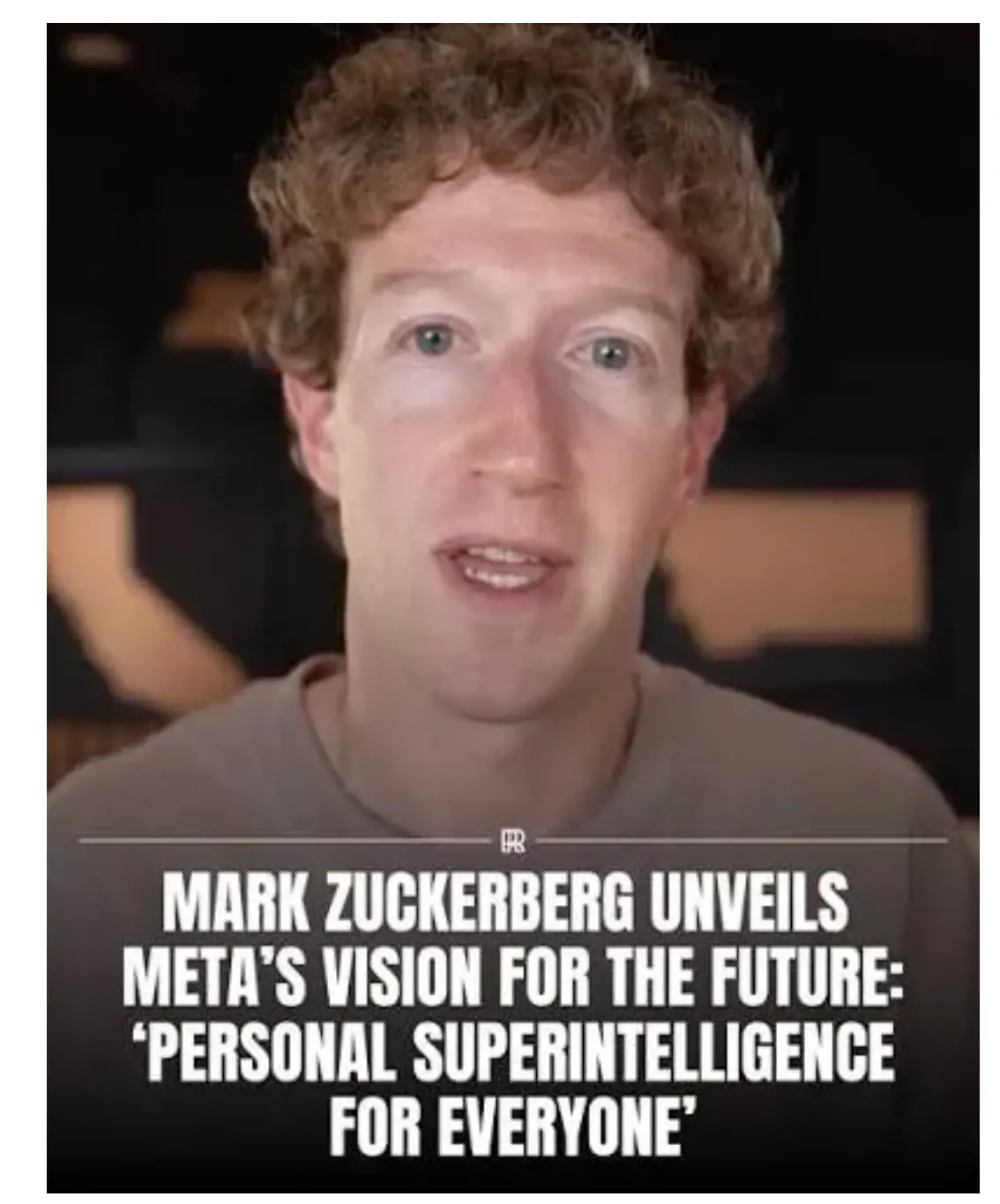
Image: Zuckerberg elaborates on Meta AI's vision
However, Zuckerberg believes that relying solely on technical means to create a "superintelligence that fully aligns with everyone's interests" is logically flawed.
The reason is that there is no unified value system in human society. Different individuals, cultures, and groups have different judgments about what constitutes a better life. A superintelligence designed and controlled by a few institutions will inevitably favor certain groups in its value choices and cannot represent the interests of everyone.
Therefore, he proposes another approach: rather than trying to create a centralized, absolutely correct superintelligence, more people should have their own superintelligence, forming a new power balance through competition among individuals, enterprises, and institutions.
Zuckerberg uses the example of a "superintelligent lawyer" to illustrate this point.
If only one person in the world has a superintelligent lawyer, that person will gain a significant asymmetric advantage in the legal system. But if everyone has similar capabilities, the distribution of legal resources will be fairer, and the information gap between ordinary people and large institutions will narrow.
Similarly, if only one organization possesses superintelligent cybersecurity capabilities, it could become the greatest security risk; but if defenders also have powerful AI tools, the overall security level of the digital system could actually improve.
In Zuckerberg's framework, AI safety cannot rely solely on limiting capabilities; it is more important to prevent superintelligence from forming an uncheckable concentration of power.
02 The Most Important Product Form of Future AI
Based on this concept, Meta is promoting the "personal superintelligence" route.
Zuckerberg believes that the most important product form of future AI will evolve from a question-answering chatbot to a personal intelligent agent that understands users over the long term and helps them achieve their goals.
This intelligent agent will become a smart assistant in users' daily lives, capable of understanding personal preferences, goals, and long-term needs, continuously helping users optimize health, work, family management, financial planning, and learning growth.
Unlike most current AI tools, the core value of future personal intelligent agents will expand from providing information to representing users in taking action. For example, it can help users organize information, generate ideas, plan tasks, and provide lifestyle suggestions based on users' health data, even assisting with family activity arrangements.
Zuckerberg emphasizes the importance of privacy. If personal superintelligence is to truly enter lives, it must obtain users' authorization for a large amount of private information. Meta proposes that future personal intelligent agents will offer a "completely private mode," in which even Meta cannot view user information or authorize others to access it.
This also represents a new type of human-machine relationship that Meta is trying to establish: AI will shift from being a tool owned by enterprises to a capability owned by individuals.
In discussions about employment and automation, Zuckerberg presents a perspective that differs from traditional concerns. He believes that the most important contribution of superintelligence is not simply to replace human jobs, but to help humans create new things that were previously impossible.
Historically, every major technological revolution has sparked concerns about unemployment. From the Industrial Revolution to the Internet era, people have worried that machines would replace a large number of jobs. But ultimately, technology has not only improved productivity but also created new industries and professions. Zuckerberg believes that the AI era will follow a similar pattern.
In the future, the truly important change will not be that machines take on more repetitive tasks, but that ordinary people gain capabilities that only large enterprises and specialized institutions could previously possess.
An individual may use AI to complete product design, software development, market research, or even entrepreneurial operations without needing to assemble a large team. This will change the way companies are organized.
Future companies may be smaller in scale but have greater individual productivity. Many ideas that were previously unfeasible due to high costs or technical barriers will become viable due to the widespread availability of AI tools. Zuckerberg believes that superintelligence should ultimately become an infrastructure for innovation, rather than merely an automation machine.
03 Trading Open Source for Ecosystem: Meta's AI Competition Strategy
In addition to personal superintelligence, open source is also an important theme in Zuckerberg's article.
Meta has long supported the open-source model route, which clearly distinguishes it from some competitors that emphasize closed-weight models. Zuckerberg believes that open source can not only drive innovation but also enhance security.
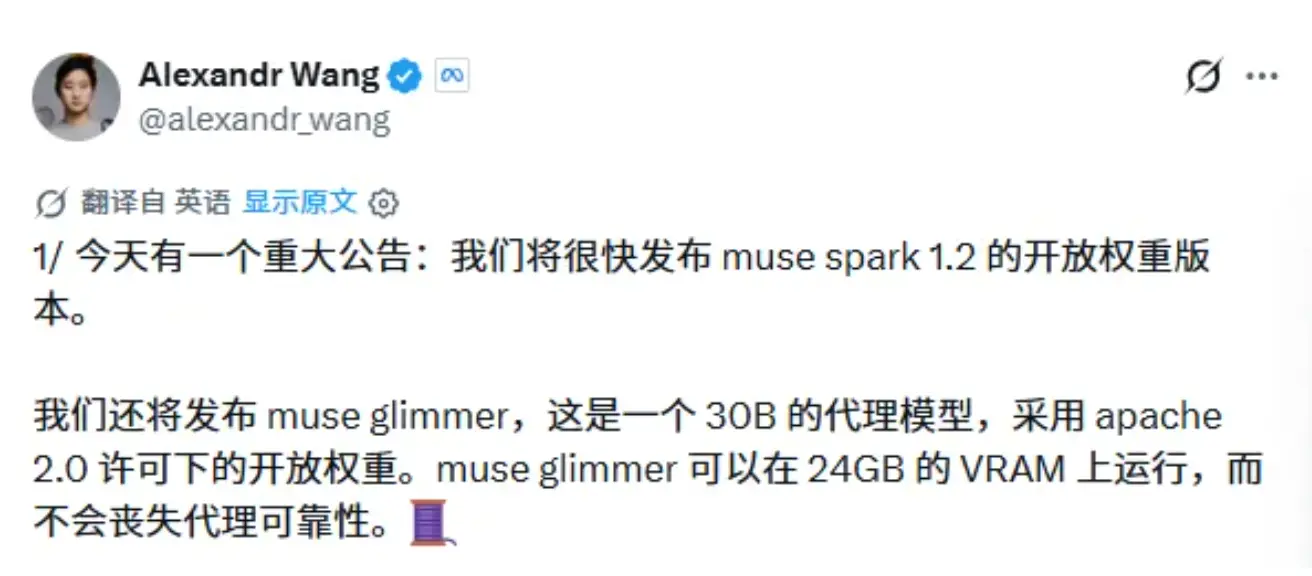
Image: Wang Tao, head of Meta AI, announces that the company will soon release an open-weight version of Muse Spark 1.2
His logic is that more researchers, developers, and enterprises having access to models means more people can discover vulnerabilities, improve systems, and drive rapid technological iteration. Conversely, if superintelligence is long-term controlled by a few institutions, society will lack sufficient checks and balances.
On a global competitive level, Zuckerberg believes that the United States currently has advantages in areas like chip design but faces challenges in the speed of energy, data center, and infrastructure construction. Future AI competition will not only be about algorithms but also about energy and computational power.
He emphasizes that the U.S. needs to improve the speed of infrastructure construction while maintaining its open ecosystem advantages.
Regarding data usage in model training and model distillation issues, Zuckerberg suggests that the U.S. should not weaken its competitiveness due to excessive restrictions. His view is that the development of AI is fundamentally built on the accumulation of human knowledge, and mutual learning between models is an important way for technological advancement. If the U.S. excessively restricts its open-source ecosystem, it may inadvertently leave opportunities for other countries.
On security issues, Zuckerberg does not deny the risks that AI may bring. He focuses on discussing issues such as cybersecurity, biological risks, and government power expansion.
His core argument is that in the face of AI risks, society should enhance its defensive capabilities rather than simply limit technological capabilities.
For example, in the field of cybersecurity, if only attackers have advanced AI tools, the risks will indeed increase. But if enterprises, governments, and individuals can all use AI to enhance their defensive capabilities, the overall security level of the system will also improve.
Regarding biological and chemical risks, Zuckerberg believes that policy focus should be on restricting the production and dissemination of dangerous substances rather than preventing the development of scientific knowledge.
As AI accelerates drug development and life sciences research, regulatory systems also need to be upgraded in tandem; otherwise, traditional approval processes may become bottlenecks for innovation.
04 The "Community Account" of Data Centers
AI competition is entering an infrastructure era.
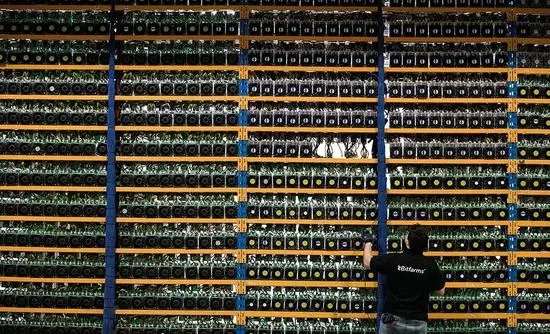
A large number of data centers, energy supplies, and computing resources are becoming the foundation for developing superintelligence. However, at the same time, there is increasing controversy in American society regarding the energy consumption, water resource pressure, and environmental impact of large data center construction.
Zuckerberg specifically emphasizes that AI infrastructure construction must share benefits with the community. Meta proposes the concept of a "community contract," hoping that the locations of data centers can gain more employment opportunities, educational investments, and public service support.
He believes that data centers should not be viewed merely as facilities that consume resources but should become long-term assets that drive regional economic development, similar to past railways, electricity, and internet infrastructure.

Image: Meta's data center project in Richland Parish, Louisiana, USA
This is also an important part of Meta's response to external doubts about its large-scale AI investments.
Future AI competition will require massive capital investment, and whether these investments can gain social recognition will become a problem that technology companies must solve.
In terms of corporate governance, Zuckerberg suggests that the development of superintelligence cannot rely on the judgment of a single leader. He acknowledges that making the CEO the ultimate decision-maker for superintelligence deployment is not the ideal approach. Therefore, Meta is establishing a new governance mechanism that allows an independent board to participate in setting safety standards for model releases and reviewing major model launches.
This arrangement is, in fact, a response to long-standing concerns about the concentration of AI power in large tech companies.
At the same time, Zuckerberg also discusses the extreme risks that may arise if AI gains the ability to autonomously improve itself.
If AI systems can continuously enhance their own capabilities, then computational resources may become a decisive factor. A system with continuous self-optimization capabilities could theoretically rapidly widen the gap between itself and other systems.
Therefore, he believes that even if some computational power must be invested in AI's recursive self-improvement in the future, most intelligent capabilities should still be controlled by humans to achieve human goals.
05 In Conclusion: Competing for the Entry Point of the Next Generation of Computing Platforms
Looking at this lengthy article in the context of Meta's actions over the past year, it seems that Zuckerberg is discussing AI safety, but what he is truly concerned about is clearly Meta's future.
Personal superintelligence, open models, smart glasses, and large-scale computational investments—these previously seemingly scattered layouts are being woven into the same narrative by him: the next phase of AI competition will shift from who has the strongest model to who can master the longest-term and highest-frequency entry point between humans and AI.
This is a war that Meta is truly familiar with.
For the past twenty years, from Facebook to Instagram and WhatsApp, Meta's core asset has always been the entry point for connecting people. However, in the mobile internet era, it has always been constrained by operating systems controlled by Apple and Google. AI has given Zuckerberg an opportunity to redefine the computing platform: if everyone has an intelligent agent that continuously understands them and can invoke various services and act on their behalf, then that intelligent agent itself could become the new operating system.
The significance of smart glasses has also changed. They are no longer just a new hardware category but may become the terminal through which personal AI acquires information about the real world and continuously interacts with users; open models are not just a strategy for the tech community but are aimed at expanding the coverage of Meta's technology stack as much as possible.
However, there exists a contradiction worth further questioning.
Zuckerberg hopes to respond to concerns about the concentration of AI power with "superintelligence belongs to everyone," but the true boundaries of personal AI capabilities are still determined by models, computational power, terminals, distribution channels, and, most importantly, personal data. Superintelligence can be distributed to everyone, but the infrastructure supporting it inherently has strong economies of scale.
In other words, the more personalized AI capabilities become, the more concentrated the underlying platforms may be.
Therefore, whether Meta's route can ultimately succeed depends not only on whether it can create sufficiently strong models. What is more worth observing is whether it can bypass Apple and Google for the first time and establish a computing entry point under its control; and when an AI begins to understand users better than any app, who truly owns this AI, and who truly owns the data and relationships that arise from it.
 Risk warning