Cryptocurrency in the US Stock Market: Ecology, Efficiency, and Compliance, Who Will Break the Deadlock First?

 A financial migration from the old system to the new system is taking place.
Author: TechFlow
In the past two weeks, the U.S. stock market has entered the busiest time of the year.
Apple, Microsoft, Meta, Amazon… major earnings reports have been released almost every morning.
For global traders, this means the most concentrated opportunity window of the year.
For those traders who are not satisfied with "seeing the right direction but not making money," compared to traditional brokers, Crypto U.S. stock trading, which offers more flexible trading hours, higher execution efficiency, and lower entry barriers, is gradually becoming a better choice.
As major crypto platforms continue to launch U.S. stock trading services, all vying for this piece of cake, a more intriguing question arises:
Everyone is doing it, so what is the core capital that wins user choice?
Around this question, we had an in-depth discussion with three experienced trading KOLs: @BroBean88, @xiadadhaida, and @Rocky_Bitcoin.

Trading U.S. stocks on CEX is transitioning from "trying it out" to "everyday"
If you are active in the Crypto U.S. stock trading community, you have likely heard of these three names.
Rocky (X: @Rocky_Bitcoin), a Crypto native who entered the space in 2017, focuses on long-term and multi-asset allocation as a fundamental player, paying attention to on-chain asset forms, composability, and global asset allocation methods in the next generation of financial infrastructure.
Brother Bean (X: @BroBean88), a tech enthusiast who has long focused on AI, has a background in quantitative trading, which leads his trading decisions to start with analyzing earnings reports and scanning indicators; each result he obtains is a further validation of his data analysis model.
In contrast, Xia Die Hai Da (X: @xiadadhaida), who has 20 years of experience in traditional financial markets and is also one of the earliest market makers in Crypto, offers a more cross-disciplinary perspective: often sharing market sentiment and trading opportunities under macro variables and unexpected events.
The three seasoned traders each shared the same observed trend regarding U.S. stocks:
On one hand, the weight of U.S. stocks is increasingly rising. Rocky mentioned that his asset allocation follows the "4321" logic: 40% stocks, 30% crypto assets, 20% fixed income, and 10% cash. Compared to a year ago, while the stock proportion remains stable at around 40%, the amount of money invested in stocks continues to increase with the overall investment volume, and within this 40%, U.S. stocks have become the absolute main character.
On the other hand, trading U.S. stocks on CEX is transitioning from "trying it out" to "everyday." Xia Die Hai Da stated that before May 2026, his U.S. stock trading was mostly conducted on traditional platforms, but he has now fully shifted to crypto platforms, especially Binance, Bitget, and Hyperliquid.
As U.S. stock trading in Crypto becomes more frequent, the core question is which platform's U.S. stock trading service understands traders the best.
As for the answer, the three traders have three different trading logics, each with its own distinct starting points and focuses, but there are also overlapping options.
From old logic to new system: an upgrade in "time, capital, and information" efficiency

As a data logic dissection enthusiast, Brother Bean has extended this methodology to the choice of U.S. stock trading platforms.
In his view, an excellent U.S. stock trading platform must pass the test of three core indicators:
- Execution speed: When a stock experiences a significant rise or fall, faster execution speed directly corresponds to better execution prices;
- Liquidity: The depth of the order book determines the extent to which the actual price received is eroded;
- Trading costs: Both explicit commissions and implicit spreads combined represent the true cost burden.
Using this evaluation system to look at current CEX U.S. stock trading:
On the execution side, leading platforms including Binance, OKX, Bitget, Bybit, and Kraken have matching engines designed for high concurrency trading, with core matching delays ranging from several milliseconds to even lower,
In terms of liquidity, a recent report from DeFiLlama conducted a horizontal evaluation of liquidity performance for mainstream platforms such as Binance, Bitget, Kraken, Bybit, Gate, Hyperliquid, and Ondo Finance. In the liquidity benchmark tests for the five stocks MSTR, SPY, QQQ, CRCL, and NVDA, Bitget achieved the narrowest spreads on rNVDA, rSPY, and rMSTR, and had the deepest order book liquidity across all sample markets. Among the other two assets, Gate's xStock had the smallest spread on QQQ, while Binance's bStock had the smallest spread on the CRCL market.
Beyond the indicators, Brother Bean, who believes that "details determine success or failure," as a "data-sensitive" trader, has also conducted additional observations on the information tools of various platforms. In this regard, Brother Bean explained:
Some AI market movements are often triggered by specific news, such as Gemini launching a powerful model that causes Google's stock price to rise unexpectedly in the short term; this information is very important for investors.
Therefore, many product designs in the U.S. stock trading services provided by Crypto platforms aim to break down information barriers, leading Brother Bean to believe that the product developers are not just following the market but must have genuinely traded U.S. stocks because they truly understand the decision-making logic of AI traders.
Taking Bitget's millisecond-level real-time quotes and vast information as an example, Brother Bean also shared that in addition to using his own constructed information capture and analysis tools, he often utilizes Bitget for information aggregation and strategy formulation.

On July 22, 2026, Tesla released its earnings report after hours, revealing that its second-quarter operating profit fell short of market expectations, causing Tesla's stock price to drop nearly 30% in two days. Well-prepared Xia Die Hai Da completed a short-selling operation on Bitget at the first moment the earnings report was released (Beijing time, July 23 morning), perfectly avoiding losses.
In the past two weeks of earnings season, such cases have occurred almost daily in his account.
In Xia Die Hai Da's view, U.S. stocks are easier to trade than A-shares because the market reacts more sensitively to news; the key is how quickly you can respond when market data sends out signals.
Therefore, Xia Die Hai Da candidly stated that he was initially attracted to trading U.S. stocks on crypto platforms due to convenience, as USDT can be used directly without the friction of complicated registration and fiat currency exchange processes like in traditional finance, but the more flexible trading hours are the core reason for his complete shift to crypto platforms:
With rising tensions in the Middle East, earnings reports being released, and Trump tweeting at midnight… signals occur during off-market hours, and he knows he cannot afford to wait even a second.
Most platforms, including Binance, Bybit, and Bitget, typically support 24/7 trading of tokenized U.S. stocks, while real U.S. stocks cover regular hours + pre-market and after-hours + night trading sessions, which better helps traders respond to unexpected signals without having to wait for the next opening bell.
This sentiment is not unique to Xia Die Hai Da: according to official data from Binance, in July, over 62% of the trading volume of Binance's bStocks occurred outside traditional trading hours, and Bitget's rToken showed a similar trend, with over one-third of trades happening during traditional U.S. stock market off-hours, reflecting strong demand for U.S. stock trading outside regular trading hours.
On this basis, another focus for Xia Die Hai Da is the breadth of asset coverage: everyone is watching popular U.S. stocks, but opportunities do not always occur in these few assets.
This indirectly makes Bitget one of the most frequently used U.S. stock trading platforms for Xia Die Hai Da: In comparison to Binance, which supports over 7,000 real U.S. stocks and ETFs, the tokenized stocks bStocks cover only a few hundred, while Bitget supports over 10,000 real U.S. stocks and ETFs, and its tokenized stocks rToken cover over 600 mainstream U.S. stocks/ETFs, providing a richer selection for traders like Xia Die Hai Da with diverse investment needs.
Beyond functional requirements, Xia Die Hai Da's reliance also stems from emotional factors.
Currently, crypto U.S. stocks, whether in terms of scale or product form, are still in the early stages, and encountering problems during trading is inevitable. The timely responses provided by the Bitget team ensure that traders can receive feedback regardless of the time or issue they encounter, especially from their old friend, Bitget's Greater China head, Xie Jiayin, who has been actively listening to traders' demands and promoting product optimization and iteration for years.
On this point, Xia Die Hai Da expressed: This makes me feel that creating a "warm" trading platform is not just a superficial slogan for Bitget.

As a seasoned trader who has almost experienced the U.S. stock trading services of various CEX platforms, Rocky's expectations for crypto U.S. stocks go beyond the pass mark of "being able to buy and sell," but rather focus more on capital efficiency: how many times the same amount of money can work for him.
Most of the time, traditional financial stocks can only sit quietly in accounts, while once tokenized U.S. stocks truly enter the blockchain, they can function like DeFi Legos, allowing for both staking and lending. When composability is fully unleashed, the multiple efficiencies of a single asset become one of the most appealing narratives of tokenized U.S. stocks in Rocky's eyes.
This more Crypto perspective keeps Rocky closely observing tokenized solutions beyond real stocks.
Among the currently mainstream tokenized U.S. stock solutions, Binance's bStocks is one of the first to attract market attention. Its BEP-20 token design allows bStocks to seamlessly integrate into the BNB Chain DeFi ecosystem, theoretically opening up the imagination for composability. However, how to play it still requires more collaboration between DeFi and traders for prototyping. Currently, bStocks only covers over 50 assets, which still seems thin for most traders.
Recently, Bitget's rToken, which has sparked discussions on social media due to its efficiency, is seen by Rocky as another answer. According to official information, rToken currently covers over 600 mainstream U.S. stocks and ETFs, and unlike bStocks, which has limited support in margin and lending scenarios, rToken can serve as collateral while earning interest, achieving triple efficiency for a single asset.
This "multiple uses for one money" appeal has made Rocky one of the earliest users of rToken, quickly combining it with his trading habits to run a mature efficiency amplification strategy.
For Rocky, who usually engages less in contracts, lending is a more familiar battlefield. He shared:
The current lending rate for rToken is around 2.2%, and you can borrow about 78 U for every 100 U, both of which are very attractive;
Using low-volatility assets as underlying collateral, such as the S&P 500 index, which has an average annualized return of about 11% over the past 15 years, can fully cover the 2.2% lending rate; if you borrow funds and are really afraid of risks, even if you only engage in spot trading, you can seize event-driven trading opportunities for decent returns.
After running through the process, Rocky gave a straightforward conclusion: among all the CEX U.S. stock trading services he has experienced, Binance's advantage lies in its integration with the on-chain ecosystem of BNB Chain, while Bitget excels in capital efficiency within the exchange.
What can we expect next in U.S. stock trading?
As the discussion drew to a close, we did not delve into specific products but instead looked at the broader future of the industry.
Currently, the total scale of tokenized U.S. stocks is about $2.5 billion. Although there has been significant growth compared to the beginning of the year, in the eyes of the three seasoned traders, this number is just the starting point.
Rocky clearly calculated a figure during the discussion:
The total market capitalization of global stock markets is about $125 trillion, and in Rocky's view, the penetration rate of tokenized stocks could reach at least 10% in the next three years, which would be $12.5 trillion; currently, there are about 710,000 addresses holding on-chain tokenized U.S. stocks, and with the development of CEX U.S. stock business, this number is expected to grow to 50 million in the next three years.
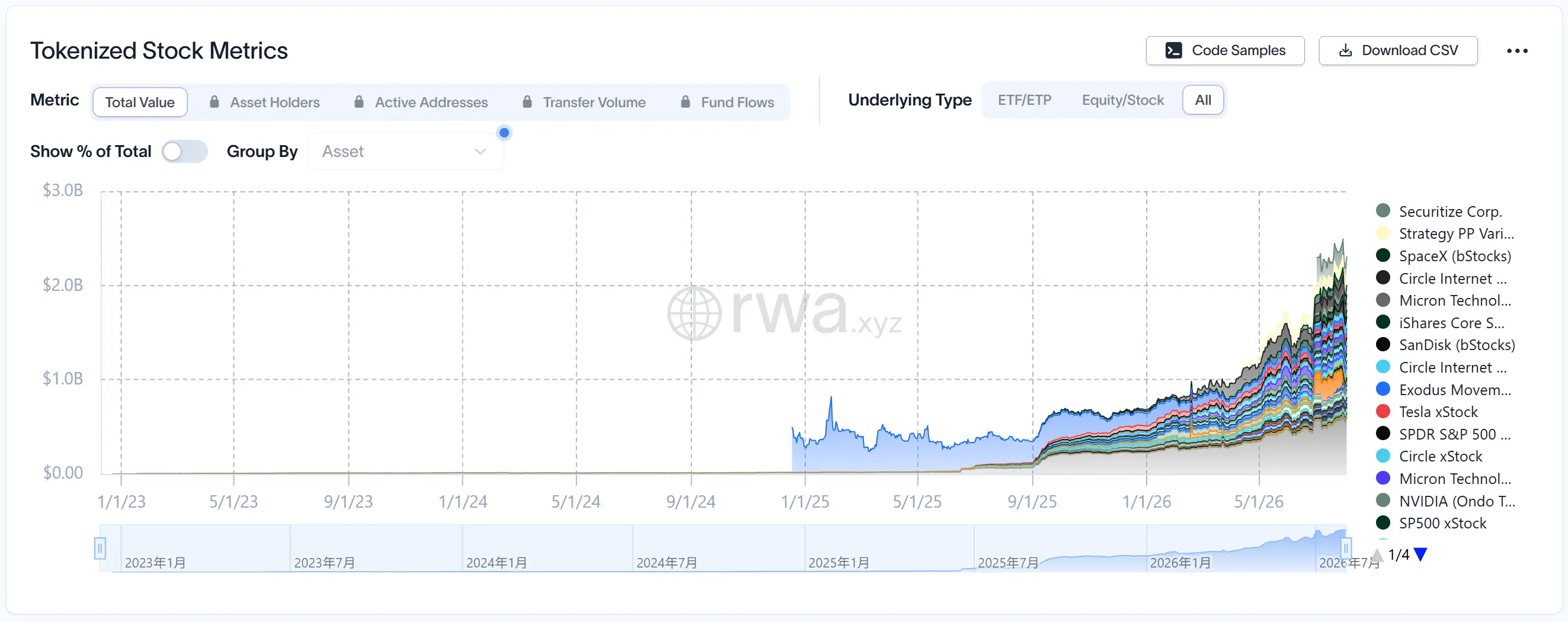
From $2.5 billion to $12.5 trillion represents a significant growth opportunity. So what will be the core driving force to push tokenized U.S. stocks from a "niche window" to a "mainstream option"?
Both Rocky and Brother Bean coincidentally regard compliance as the primary factor:
Brother Bean believes that compliance addresses the most fundamental trust issue; only after gaining compliance recognition can large funds dare to invest, and the time, cost, and efficiency advantages of on-chain U.S. stocks may be further amplified.
Rocky added another dimension: beyond compliance, the explosion of DeFi composability leading to more passive income strategies will attract more participants.
After discussing industry judgments, the three traders also proposed specific expectations for the future evolution of Crypto U.S. stock products based on their own trading needs.
Xia Die Hai Da is concerned about the coverage of trading assets: he hopes that platforms can further expand the range of U.S. stock assets in the future while exploring more IPO Prime-related strategies.
In Brother Bean's eyes, the more transparent the assets, the more confidence traders have, so he is more concerned about asset transparency issues, hoping to have a clearer understanding of the real stock support behind each token.
He believes that currently, many projects' tokenized U.S. stock reserves are verified through a "self-reported" model, lacking external supervision. Although Bitget's rToken provides daily third-party audit reports through cooperation with a U.S. auditing firm, further improvements are still needed, such as refining the transparency disclosures of rToken, for example, each rToken having an independent transparency page showing underlying custodial assets, token issuance volume, recent audit dates, dividend plans, etc.
Rocky's expectations focus on two aspects:
On one hand, Rocky believes that the traditional U.S. stock market has many hedging strategies and plays, but there are still too few on-chain, and it would be worthwhile to bring many ready-made, high-quality strategies that have been validated in traditional markets onto the blockchain. Based on this, Rocky expressed surprise at Bitget's recent launch of U.S. stock options, considering it a significant highlight and potentially a major trend in the future.
On the other hand, Rocky is also very much looking forward to the integration of tokenized U.S. stock assets with AI Agent intelligent trading. He believes that AGI will arrive in the next five years, at which point no one will personally operate U.S. stock accounts; AI will uniformly conduct asset allocation. Whoever connects to these first and fastest, and provides users with quality strategies, will have greater potential to attract users.
Coincidentally, these expectations have almost all appeared in the roadmaps announced by various Crypto platforms:
Under the core strategy of the "super financial app," Binance is primarily focusing on expanding stock assets and promoting deeper integration of bStocks with the ecosystem, while also relying on frameworks like ADGM to improve issuance and custody structures, enhancing collateral transparency and institutional usability;
OKX is emphasizing compliance pathways and has previously announced a joint venture with the parent company of the New York Stock Exchange, ICE, with both parties holding 50% shares, planning to launch tokenized NYSE stocks and ICE futures products in the second half of 2026, allowing OKX users to trade regulated tokenized U.S. stocks directly;
In addition to continuously launching support for more U.S. stock assets, Bitget will also continue to create a better trading experience, including opening API interfaces for U.S. stock spot trading to meet the needs of professional traders and quantitative teams, as well as supporting direct on-chain trading of U.S. stock tokens through Web3 wallets like Bitget Wallet.
At the same time, as AI has become a key direction for Bitget, in the future, around core AI products like GetAgent, GetAgent Playbook, and Agent Hub, Bitget will continue to build a complete AI trading ecosystem, helping users upgrade from "watching the market + manual ordering" to "AI screening + strategy deployment + automatic execution."
Conclusion
When we shift our focus back to Rocky's prediction of a 10% penetration rate for crypto U.S. stocks in the next three years, the leap from $2.5 billion to $12.5 trillion in scale first indicates that the current competition in crypto U.S. stocks is still in the early stages of an undecided landscape.
The first batch of players involved, although they have established early advantages in different dimensions, seem far from forming an unshakeable barrier; the iteration of products, concepts, and experiences is still happening at a rapid pace, and the existing landscape may be pierced by the next innovation: who can execute a millisecond faster, who can add another asset to their coverage, who can provide a smoother one-stop experience, who can get a half-step ahead in compliance frameworks… these small differences will be repeatedly amplified in the next three years, becoming important factors in determining market share.
But the opportunities are equally clear:
While traditional finance still adheres to fixed trading hours, fragmented account systems, and lengthy capital flows from last century's operational rules, crypto platforms have already begun to redefine U.S. stock trading methods using unified accounts, 24/7 availability, and multi-efficiency assets. Whether it's the over 140% increase in the active market capitalization of tokenized stocks since the beginning of the year or Bitget's disclosure that over 52% of its 120 million users hold both crypto assets and U.S. stocks, these data point to a trend: trading is migrating from the old system to the new system, and there seems to be no turning back.
What is even more noteworthy is that from Binance's super financial app to Coinbase's Everything Exchange, and Bitget's UEX panoramic exchange, almost all crypto platforms are blurring the boundaries between Crypto and traditional finance. From this perspective, U.S. stocks appear to be the most representative vanguard in this financial migration.
Because U.S. stocks are the most mature and complex type of asset in traditional finance.
And when a U.S. stock has already achieved real shareholding, on-chain circulation, unified margin, and all-weather trading in crypto, what can be verified by crypto is no longer just "U.S. stocks," but has the capability to open the door for all asset plays.
Through this door, we catch a glimpse of the financial world that is being reconstructed behind it, which is worth every person dissatisfied with the old system to keep an eye on.
 Risk warning