








Arthur Hayes: Waiting for signals from the Federal Reserve, preparing for a crypto bull market
 Core Viewpoint

 Arthur Hayes' latest research report: The yen mechanism forces the Federal Reserve to "print money in disguise," and crypto assets will experience a liquidity explosion.
Original Author: Arthur Hayes, Co-founder of BitMEX
Original Compilation: Golem, Odaily Planet Daily
Editor’s Note: Arthur Hayes believes in his latest article "Yen-quake" that the exchange rate of the yen against the US dollar is about to appreciate, and the most likely path is for the Japanese government to use the FIMA mechanism to pledge its held government bonds to the Federal Reserve for repurchase financing, borrowing US dollars, and then using these dollars to buy yen. Arthur Hayes also states that this will lead to a surge in US dollar liquidity, subsequently driving up the prices of assets such as Bitcoin and physical gold. He believes that apart from Bitcoin and Ethereum being undervalued at this stage, ENA is also expected to rise 5-10 times in the coming months.
Arthur Hayes reveals that his "bullets" are not all fired yet, and what must be awaited now is for Waller to convene the subcommittee and amend the FIMA rules to pave the way for Japan to use the FIMA mechanism to promote the appreciation of the yen. Odaily Planet Daily compiles the core content of the full text as follows, enjoy ~
Over the past decade, the yen has weakened significantly to the point of extreme softness, driving global asset markets higher. But like all good things that favor wealthy financial asset holders, this situation will eventually come to an end. The yen is the most severely undervalued currency globally and is the focal point of debate between the two major powers, the US and China, as well as among ordinary Japanese voters. There are three ways to unravel the yen puzzle, but the US Treasury and Japanese politicians only favor one.
I will explain the operational mechanisms of each method that could lead to the appreciation of the yen and summarize why the last one is the preferred option. Then, I will explore how to politically implement this third option. Finally, I will elaborate on why Bitcoin and cryptocurrencies will experience a surge as US dollar liquidity skyrockets (I know this is also the reason you read my "human nonsense").
The three options are as follows:
The Bank of Japan (BOJ) significantly raises interest rates, thereby eliminating the interest rate differential between the US dollar and the yen (at least in terms of short-term rates);
The government lobbies domestic institutions and public entities (such as the Government Pension Investment Fund, GPIF) to change investment strategies, selling off overseas assets and buying domestic assets;
[Preferred Option] The Ministry of Finance (MOF) of Japan pledges its held US Treasury bonds through repurchase (repo) to the Federal Reserve in exchange for US dollars, and then sells US dollars in the foreign exchange market to buy yen.
Before delving into the details, all "crypto friends" (degens) should ask themselves: why discuss the appreciation of the yen at this time? For decades, countless people have asserted that the yen is about to appreciate and end the global carry trade. Two weeks ago, high-ranking monetary policy officials from both the US and Japan conducted a joint currency manipulation, which of course was officially referred to as "intervention." The same actions, if done by ordinary people, would be called "collusion" and "conspiracy"; but when the manipulators are nations, the terminology changes completely.
US Treasury Secretary Yellen stated that he hopes the Federal Reserve will raise the counterparty limit for FIMA repo tools so that the Japanese Ministry of Finance can use its vast asset reserves to defend the yen's exchange rate. The Japanese Ministry of Finance also announced that it is working with the US side to lower the USD/JPY exchange rate. Authorities have made it clear that they will change the global monetary landscape, so we must take it seriously.
Three Options to Strengthen the Yen
Options one and two are fundamentally unfeasible, as the parties involved cannot bear the political and economic consequences of deviating from the established policies since the 2010s.
Option One: The Bank of Japan Raises Interest Rates
Currency trading often relies on interest rate differentials, and the yield on the US dollar is 2.75% higher than that of the yen. Borrowing yen, converting it to dollars, and purchasing US Treasuries can yield positive interest differential returns. Therefore, according to the no-arbitrage principle, the USD/JPY exchange rate must rise (i.e., the yen depreciates against the dollar) to offset this interest rate differential. The most direct way to appreciate the yen against the dollar is for the Bank of Japan to raise interest rates to align its rate levels with those of other central banks that have raised rates post-COVID.
To understand the challenges facing the Bank of Japan in raising interest rates, it is essential to remember that due to the implementation of yield curve control (YCC) policy over the past decade, which limits the yield on 10-year Japanese government bonds through money printing to purchase bonds, the Bank of Japan has become the largest holder of these "junk" Japanese government bonds.
Once interest rates rise, bond prices will fall; the lower the bond prices drop, the larger the unrealized losses for the Bank of Japan. Unlike ordinary investors, the Bank of Japan, which can print unlimited yen, can bear unlimited yen losses. However, if the Bank of Japan's large-scale money printing leads to a loss of global confidence in the yen, resulting in the yen no longer being accepted for transactions in oil, food, medicine, etc., the situation could become critical.
Although we have not yet reached this point, the Bank of Japan must confront this potential catastrophic scenario. It is precisely because of the fear of seeing losses on its balance sheet that the Bank of Japan has been hesitant, only daring to make slight interest rate increases while watching the market sell off long-term Japanese government bonds. The result is that the yen continues to depreciate, while inflation driven by imported energy severely impacts the foundation of Japanese society.
Politicians do not want the Bank of Japan to raise interest rates because they must issue Japanese government bonds to cover fiscal deficits. If yields rise, debt servicing costs will also increase, which will weaken their ability to "buy off" ordinary citizens through various government subsidies (usually consumption tax reductions).
If the Bank of Japan rapidly raises interest rates, leading to yen appreciation and increased volatility in the USD/JPY exchange rate, all investors who financed global stocks or bonds using yen will be forced to close their positions.
Do you remember July 2024? At that time, the yen exchange rate rose from 160 to 140 in just a few trading days. I wrote two in-depth articles on this, but in short, the newly appointed Governor of the Bank of Japan, Ueda Kazuo, unexpectedly announced an interest rate hike and promised further increases in the future. The market panicked, and those who shorted the yen and went long on other financial assets rushed to close their positions. There were rumors that several hedge fund PMs were forced to resign because of this, just like Kenny G ended the AI stock god Leopold.
When the yen exchange rate hit 140, both the Nasdaq 100 index and the Nikkei index fell by more than 10%. The Bank of Japan panicked and announced on August 12 that it would consider "market conditions" when assessing future interest rate paths, which effectively meant that future interest rate hikes had been shelved. As soon as the news broke, the yen weakened, and the stock market rebounded, regaining its upward momentum.
Compared to other central banks, the Bank of Japan has moved too quickly in the process of interest rate normalization, making it unable to withstand the severe market pressures that arise.
Option Two: "Japan Inc." Sells Overseas Assets to Repatriate Yen
I define "Japan Inc." as the enterprises and public sectors that hold financial assets.
Albert J. Alletzhauser recounts an interesting anecdote in his book "Nomura Empire: Inside Japan's Legendary Financial Dynasty": After the stock market crash in 1987, the Japanese Ministry of Finance instructed Nomura Securities to buy US stocks to support the market. As a private enterprise, Nomura was under no obligation to follow this directive, but Japan is a society that values conformity and collective action, and Nomura ultimately complied.
Often, the highest goal of enterprises is not shareholder returns but achieving full employment and maintaining "national honor" (whatever that definition may be). If the government suggests that private enterprises and individuals sell overseas assets (mainly US stocks and US Treasuries), sell dollars to buy yen, and repatriate funds, "Japan Inc." will have to comply.
The most significant indicator that could signal "Japanese funds repatriation" is the movement of Japan's largest pension fund—the Government Pension Investment Fund (GPIF). The GPIF is managed by a bureaucratic committee whose members are appointed by various government departments.
In 2014, to align with the massive money printing policy under "Abenomics," the then Prime Minister spent years replacing the head of the GPIF, prompting it to vote to increase the allocation of overseas stocks and bonds in its investment portfolio. This was crucial because the GPIF manages a portfolio size of $1 trillion to $2 trillion. When their investment strategy changed in October 2014, it initiated an unstoppable wave, as they began selling yen for dollars and buying US stocks and bonds.
This action created a structural seller of yen, reassuring speculators that they could finance various financial assets with cheap yen without worrying about yen appreciation when extending loans or repaying them.
I mention the GPIF because Mr. Kitayama, the head of the Japanese Ministry of Finance, recently stated that he believes it is time to adjust the GPIF's investment strategy to favor domestic securities over foreign securities. However, the bureaucrats within the GPIF do not buy this and publicly state that they will adhere to the best interests of policyholders. Clearly, given that they are supporters of "Abenomics," they would never support shifting the investment focus to domestic securities.
Just as Abe controlled the situation through personnel arrangements between 2012 and 2014, Prime Minister Kishida must also take similar measures. For us investors, the signal is very clear: the GPIF's investment strategy will eventually change, forcing it to sell off hundreds of billions of dollars worth of foreign securities, and the repatriation of funds will push up the yen exchange rate.
This process may take years to complete, but it is enough to make Yellen anxious, as it means that "Japan Inc.," one of the largest holders of US securities, will shift from a buyer to a seller position. This would destroy the stock and bond markets that "Uncle Sam" relies on to support its extravagant empire. However, because "Uncle Sam" provides guarantees for Japan's national security, "Japan Inc." cannot actually sell its US assets.
What has been said above is not new information. Everyone believes that the yen exchange rate is at a low level, and both the US and Japan hope for the appreciation of the USD/JPY exchange rate. But if the USD/JPY exchange rate falls from 160 to 90 (the fair value calculated by purchasing power parity), neither side can bear the resulting losses.
And when Trump's friend, "Weasel" Waller (who indeed looks like a weasel and acts just as cunning and sinister), took office as the Federal Reserve Chair, the third option was approved to be initiated.
The "Treasury-Fed Agreement" of 2026 remains solid and effective; in addition to using reverse repo tools and policy rates below the nominal growth rate to directly fund short-term Treasury bonds issued by Yellen, Waller also has the authority to implement "Option Three," thereby permanently adjusting the USD/JPY exchange rate to the level needed to rebalance the global economic system.
Option Three: Borrowing from the US
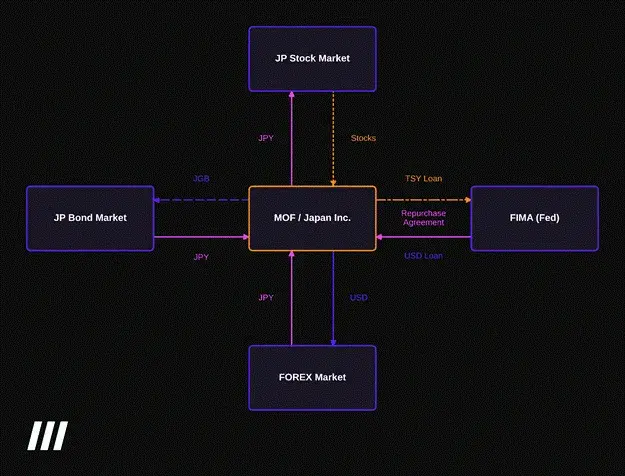
Yellen made it very clear that the Japanese Ministry of Finance and Japanese companies should not raise the funds needed to boost the yen by selling US securities, but should use the FIMA mechanism to pledge their held government bonds to the Federal Reserve for repurchase financing, borrowing US dollars, and then using these dollars to buy yen. There is a small flaw in his plan, which I will discuss later, but the "box and arrow" diagram above illustrates this process. Let's go through this process again:
The Japanese Ministry of Finance purchases government bonds and obtains US dollar loans from the Fed's FIMA mechanism;
The Japanese Ministry of Finance sells US dollars in the global foreign exchange market and buys yen;
The Japanese Ministry of Finance reinvests these yen funds domestically, purchasing Japanese government bonds and stocks.
The main impacts of this policy include:
The Federal Reserve provides US dollar funding through money printing, and its balance sheet will expand in tandem with the increase in the outstanding balance of FIMA repos;
The USD/JPY exchange rate falls, indicating yen appreciation;
Japanese bond yields decline due to yen purchases of Japanese bonds;
The Japanese stock market rises due to yen purchases of stocks.
Who is the "sucker"?
American taxpayers: Japan owes American taxpayers a sum of money that, for political reasons, will never be repaid. Because this is purely a money printing act, it will trigger inflation at the level of financial assets and physical goods. The US cannot use its front-line combat bases in the Asia-Pacific region to confront China and Russia to demand repayment of this loan.
Anyone shorting the yen: Once the trend becomes clear, they must close their positions immediately. This is not a big problem, as the volatility of the USD/JPY exchange rate will decrease, allowing yen carry trades to close in an orderly manner over the years.
Why has Option Three not yet been implemented?
The current situation is that the FIMA mechanism has a cap of $60 billion on outstanding loans for each counterparty. In the recent action to manipulate the USD/JPY exchange rate, the US Treasury and the Japanese Ministry of Finance invested over $100 billion but only pushed the yen to appreciate by 5%, and this appreciation effect lasted only a few trading days. To utilize the FIMA mechanism, this cap must be completely lifted, and the range of eligible counterparties must be expanded to include large Japanese corporations and quasi-public investment institutions (like GPIF).
Who manages the FIMA mechanism? During the COVID-19 pandemic, the Federal Open Market Committee (FOMC) delegated the authority to adjust the operation of the FIMA mechanism to the Foreign Currency Subcommittee. The voting members of this committee include Waller (FOMC Chair), Williams (FOMC Vice Chair and President of the New York Fed), and Jefferson (Vice Chair of the Federal Reserve Board). The committee can convene meetings as needed without issuing meeting minutes or disclosing voting records, and the outside world can only learn about the results of their decisions.
So, will this committee obey Yellen? The answer is absolutely yes.
Trump and Waller communicate frequently, and given that Yellen has clearly articulated how to reshape global economic balance by adjusting the USD/JPY exchange rate, Trump is evidently fully supportive of this. Therefore, Trump and Yellen will convey instructions to Waller. Waller has previously proven himself to be a slippery and blustering "paper tiger." Under Williams' management at the New York Fed, the Federal Reserve's balance sheet continues to expand through RMP.
Waller has claimed that he listens to market opinions when formulating policies, and the market clearly demands interest rate hikes, as the two-year Treasury yield is more than 0.5% higher than the effective federal funds rate, yet Waller refused to raise rates at the July meeting. Waller did not immediately implement a thorough and drastic reform of the Federal Reserve's operations but instead established five special working groups to study how and why the Federal Reserve should change. It is likely that by the time these working groups propose any recommendations, "Godot" will have already appeared
(Odaily Note: The reference comes from "Waiting for Godot," and Arthur Hayes is mocking the efficiency of the five working groups------).
Thus, Waller has quickly proven that he is just another obedient partisan politician who will only act according to his boss's demands. This is akin to his predecessor, the spineless "softie" Powell, and even earlier, the "garden gnome" Yellen (who has turned into a "bad girl" after being promoted to Treasury Secretary).
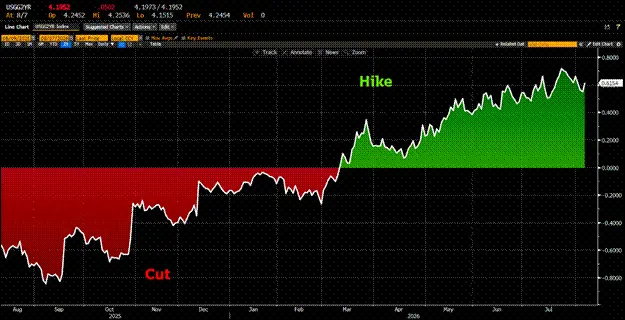
The difference between the two-year Treasury yield and the effective federal funds rate
I do not know when Waller will convene the subcommittee to announce adjustments to the FIMA mechanism, allowing for unrestricted money printing to manipulate the USD/JPY exchange rate lower, but I am sure it will happen. In fact, I bet it will happen, and I am continuously increasing my investment exposure to assets that can reflect the impact of the Federal Reserve's balance sheet expanding massively again. These assets include Bitcoin, physical gold, and stocks of gold mining companies.
The Implementation of the Third Option Will Push Up Bitcoin Prices
The more the Federal Reserve prints money, the higher the price of Bitcoin will be. So, is this FIMA trick enough to become a massive "pump," injecting trillions of dollars into it, thereby pushing up the prices of the assets we hold?
Currently, we are only focusing on the amount of government bonds held because government bonds are the only assets eligible for FIMA collateral. The situation may change in the future, but for now, let's focus on the assets currently allowed for use by this tool. The two entities holding the largest amounts of government bonds are the Japanese government and GPIF. The Japanese government holds $1.143 trillion in US Treasuries, and GPIF holds $230 billion, totaling $1.373 trillion.
This is quite a substantial amount. To put this scale into perspective, we can refer to the situation during the COVID-19 pandemic when the Federal Reserve printed about $4 trillion, as evidenced by the expansion of its balance sheet from the end of 2020 to 2021.
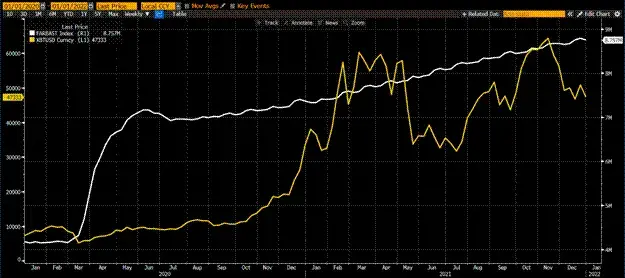
There is a very clear correlation between the growth of the Federal Reserve's balance sheet (white curve) and the surge in Bitcoin prices (gold curve). In previous articles, I speculated that the construction in the AI sector is entering a phase of capital waste. This conclusion is crucial because the Trump administration hopes that this liquidity can be used to drive domestic AI capital expenditures in the US rather than to inflate cryptocurrency prices.
However, I believe that providing credit to those AI companies that cannot achieve positive capital returns (whether they are large-scale cloud service providers that invest heavily but cannot truly profit or US AI labs that cannot achieve profitability at "Chinese market token prices") is essentially wasteful; and the rise in Bitcoin prices reflects this non-productive use of capital.
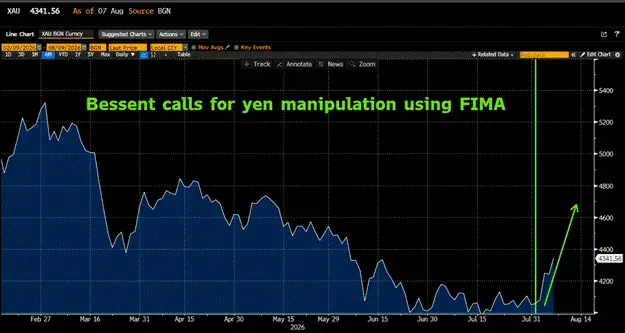
Recently, gold prices have rebounded significantly from a temporary low, sending us a signal: the market prefers to channel the impending flood of US dollar fiat currency into monetary financial assets rather than giving money to that "money-burning machine" OpenAI or Musk's elusive space data centers.
The Altcoin Frenzy is Coming, Expecting 5x Returns from ENA
I know you all want to know what we are specifically doing at Maelstrom, but to build investment conviction, one must first understand the macro context.
As I mentioned earlier, when Yellen speaks, I listen attentively. If there is one skill she possesses, it is currency manipulation. Just Google her impressive resume working with Soros, and you will understand. Implementing this monetary "trick" does not require the approval of elected politicians or the nod of those facing Senate confirmation hearings. It only requires convening that usually sleepy "Foreign Currency Subcommittee" to modify the rules of the game, triggering a surge in dollar printing.
When I saw news about Yellen calling for reforms to the FIMA mechanism, I immediately had a bullish intuition. Every macro analyst I follow believes this indicates a significant turning point in the USD/JPY exchange rate. You must position yourself in advance because this time they are serious.
Money printing is a political decision made to address unsustainable economic realities. Politics is always complex, but in the current situation, the intentions of the Trump administration are clear: they want you to log into your brokerage account and buy financial assets. That is why Yellen has clearly signaled to all who are willing to listen where the printed money will begin to spread. I am listening and will fulfill my "duty"—Buy in.
We already hold a significant amount of Bitcoin, so the next question is who else will perform better?
While this is not an AI stock recommendation article, if you are interested in that stuff, feel free to bottom-fish. The "Leopold low" has already provided you with an excellent entry opportunity for AI-related assets. Speaking of cryptocurrencies, the yet-to-explode potential altcoin is ETH, which is the only mainstream coin that failed to break its historical high in the 2025 market; moreover, Ethereum will become the security layer for RWA assets.
Next, I will introduce an altcoin that is at a low point but is expected to easily achieve a 5 to 10 times increase: Ethena (ENA).
One issue with Ethena is the lack of a repurchase mechanism, but considering it is still the sixth-ranked dollar stablecoin by circulation, this can be overlooked. The problem with ENA is that due to the price drop, the Bitcoin basis yield has disappeared, and the yield for holding staked USDe is only slightly higher than that of US Treasuries. It is simply not worth taking on counterparty risks from centralized trading platforms and smart contract risks to hold staked USDe.
As a result, its circulating supply has decreased by 75% from its peak, and the price of ENA tokens has also dropped by more than 90%. However, even a slight increase in dollar liquidity in the future could drive up Bitcoin prices, thereby increasing basis yields and leading to a significant influx of funds into USDe. ENA does not require many conditions to shake off its slump, so it may be a "speculative" choice worth considering for a quick 5x return in the coming months.
I have not yet fired all my bullets; we must wait for Waller to convene the subcommittee and amend the FIMA rules. Stay tuned, as this could happen suddenly when no one is paying attention. However, gold and the USD/JPY exchange rate should start to fluctuate before the policy announcement, as those closely related to the Trump administration are likely to position themselves ahead of the news release. This situation is not uncommon in other asset classes, and the gold and foreign exchange markets are no exception.
In summary, the days of the "cheap" yen are coming to an end.
 Risk warning

Popular articles





