When "safety" becomes the focus again, how does BIT make trust verifiable?
 "BIT Trust White Paper" V2.0 Released: From 24-hour dynamic risk control to U.S. stock asset links, what else can users verify besides "security"?
Recently, the digital asset industry has experienced a series of security incidents, with multiple attacks and thefts of funds once again bringing platform security to the forefront of market attention. As attack methods continue to evolve, risks are no longer limited to a single wallet or technical vulnerability but may involve multiple aspects such as account permissions, private key management, asset transfers, and third-party infrastructure.
For users, a more realistic question than "Is the platform secure?" is: When anomalies truly occur, can the platform detect and block risks earlier? Are there sufficient authorization and checks in place for key operations? As assets extend further into U.S. stocks, RWA, and other categories, can the security and risk control systems keep up with the new business boundaries?
Against this backdrop, the global digital financial services platform BIT (formerly Matrixport) officially released the "BIT Trust White Paper" V2.0, systematically presenting BIT's current risk governance, security architecture, compliance supervision, and independent verification mechanisms, focusing on security, compliance, transparency, and verifiability, and further covering regulatory, governance, and transparency arrangements in different business scenarios such as U.S. stocks, RWA, and asset management.
As a platform carries more assets and businesses, how can security and trust expand in tandem?
What can the platform do before risks truly occur?
No platform can eliminate all risks with a simple statement of "security." What users should pay more attention to is whether there are defenses in place before risks arise, and whether there are mechanisms to timely identify and limit risks when anomalies occur.
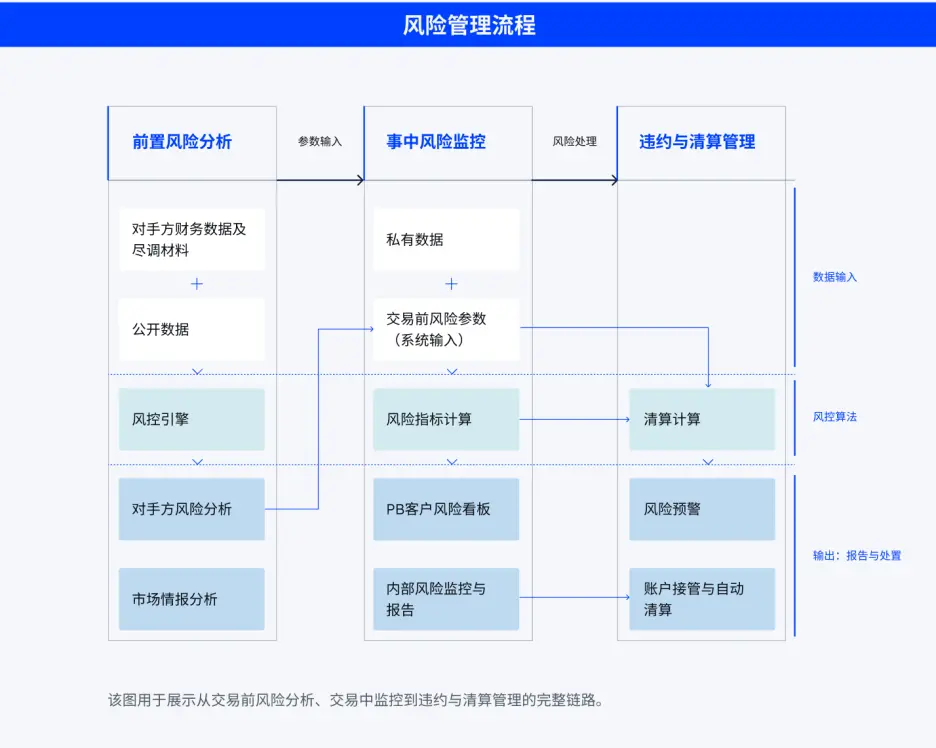
BIT emphasizes in the white paper that risk management is not just about post-event handling but should encompass pre-trade assessment, in-trade monitoring, and post-trade processing. In specific business scenarios such as margin trading and collateral, this mechanism is further implemented through due diligence, risk parameter settings, real-time monitoring, risk warnings, and default and liquidation processes.
These mechanisms ultimately translate into account and asset security that users can more easily perceive. For example, BIT conducts 24-hour dynamic monitoring of high-risk behaviors such as abnormal logins, abnormal devices, and abnormal withdrawals, triggering alerts, delaying processing, or manual reviews based on risk levels. The security system's goal is not just to "find out what happened afterward," but to identify risks as early as possible during the occurrence of anomalies and intervene in a timely manner.
In terms of digital asset protection, most assets are stored in cold wallets; private keys are stored in hardware security modules (HSM) at FIPS 140-3 Level 3, which cannot be accessed or exported in plaintext.
However, a more critical question than technical tools is: When business advancement conflicts with security requirements, who has the authority to say "no"?
The white paper reveals that if there are significant security risks in product plans, system architecture, or changes to the launch, or if they do not meet security baselines and compliance requirements, the BIT security team has "veto power"; for key operations such as asset transfers, permission changes, and transaction instructions, the "four-eye principle" is executed, requiring at least two authorized personnel to participate.
The logic behind this mechanism is not to promise that risks "will not occur," but to do everything possible to ensure safety before risks arise—identifying anomalies earlier, establishing constraints sooner, and minimizing the impact of single-point failures.
How can security keep pace with new business boundaries from digital assets to U.S. stocks?
As business extends from digital assets to U.S. stocks, RWA, and asset management, the meaning of "security" also changes. Users are no longer just concerned about whether their accounts are secure or how digital assets are stored; they also want to know who operates the business, what kind of regulation it is under, and what processes the assets go through.
Taking U.S. stock business as an example, BIT further discloses the regulatory, account, clearing, and asset custody arrangements related to this business in the new version of the white paper. BIT's securities business is operated by Matrix Gelephu Pte Ltd and is regulated by the Greleph Financial Services Office (GFSO); the relevant business is supported by applicable regulatory and licensing arrangements, customer asset protection mechanisms, and participation from licensed third-party financial institutions to provide corresponding compliance and infrastructure support for business operations.
What users see is a "purchase," but what connects it behind the scenes are multiple aspects such as operations, regulation, transaction execution, clearing, and asset custody. For financial platforms, the broader the business boundaries, the more necessary it is to extend the corresponding risk governance and compliance mechanisms, rather than just adding new product entry points.
The same logic extends to BIT's other businesses. The new version of the white paper further supplements the regulatory and governance information of Matrixport Asset Management (MAM) and presents BIT Group's compliance layout across multiple jurisdictions, including Hong Kong, Bhutan, Singapore, Switzerland, the United Kingdom, the United States, and the British Virgin Islands.
From digital assets to traditional financial assets, BIT presents not a single-point security mechanism for a specific product but a risk governance and trust framework that extends as business boundaries expand.
Beyond security, why does trust also need to be "verifiable"?
Risk control addresses how risks are identified and managed, but for a financial platform covering various assets and businesses, simply telling users "we have risk control" is still not enough. If security, compliance, and asset arrangements can only be explained by the platform itself, trust ultimately remains at the level of "believing what the platform says."
Therefore, BIT establishes compliance and regulatory foundations, independent audit and verification mechanisms, and transparency in technology and operations as the three pillars of its overall trust system, allowing "trust" to be further broken down into more specific questions: Who regulates the platform? How are assets protected? How are risks controlled? Can these mechanisms be independently verified?
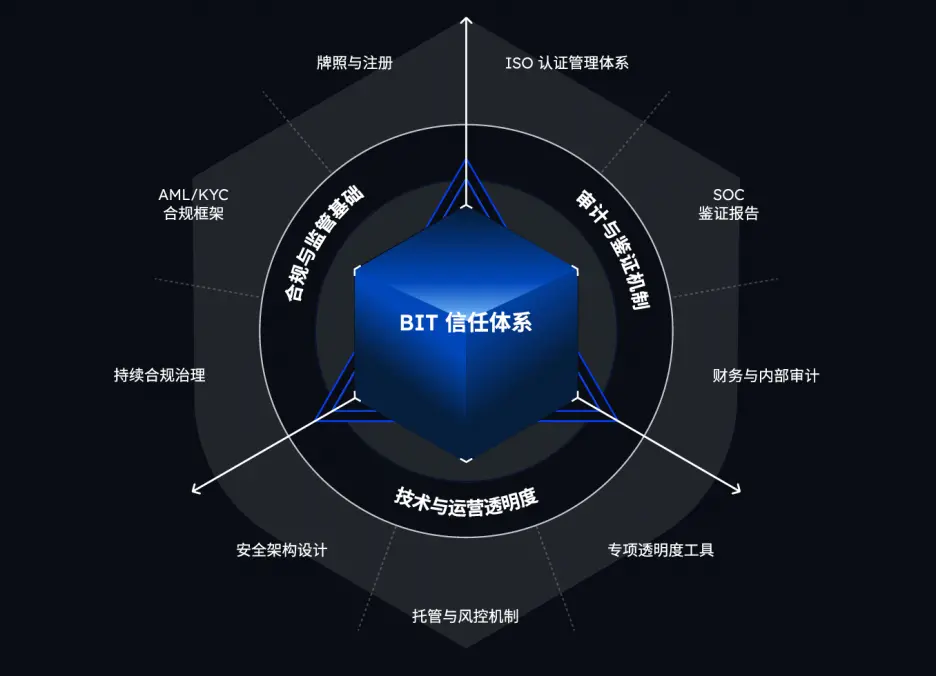
In terms of auditing and verification, BIT forms a multi-level, complementary verification system through mechanisms such as ISO management system audits, SOC independent verification, annual financial audits, and internal audits, based on the applicable scope of different entities and business lines, avoiding excessive reliance on a single audit or verification mechanism.
Transparency addresses whether information can be seen, while verifiability further answers whether this information can be independently verified.
When the industry once again places "security" in front of all platforms, what truly matters may not be repeating the phrase "we are secure," but whether users can see the mechanisms behind that statement.
Trust does not come from a single promise or audit but rather from the long-term, continuous operation of systems and external verification. Security requires ongoing operation, while trust needs to be continuously validated.
Full link to the "BIT Trust White Paper V2.0": ++https://www.bit.com/whitepaper++
 Risk warning Risk warning