BSC Launch Platform Evolution: From Flap to Genius, CZ's Shadow and Binance's Chess
 Core Viewpoint

 Three platforms, three models, three progressive levels of ambition.
Author: Little Cake, Deep Tide TechFlow
Genius Foundation launched genius.fun on September 17, allowing the crypto community to create Meme tokens, pairing them with tokenized stocks like bStocks and xStocks, accumulating real equity through trading fees, and ultimately initiating shareholder proposals or even hostile takeovers against listed companies.
The GENIUS token surged over 40% on the same day.
This narrative sounds crazy, but in the context of the Meme launch platform competition on BSC over the past six weeks, it is the latest link in a clear evolutionary chain. What is happening on BSC is a rapid mutation of Meme launch platforms from "token casinos" to "tokenized stock infrastructure."
Three platforms, three models, three progressive levels of ambition.
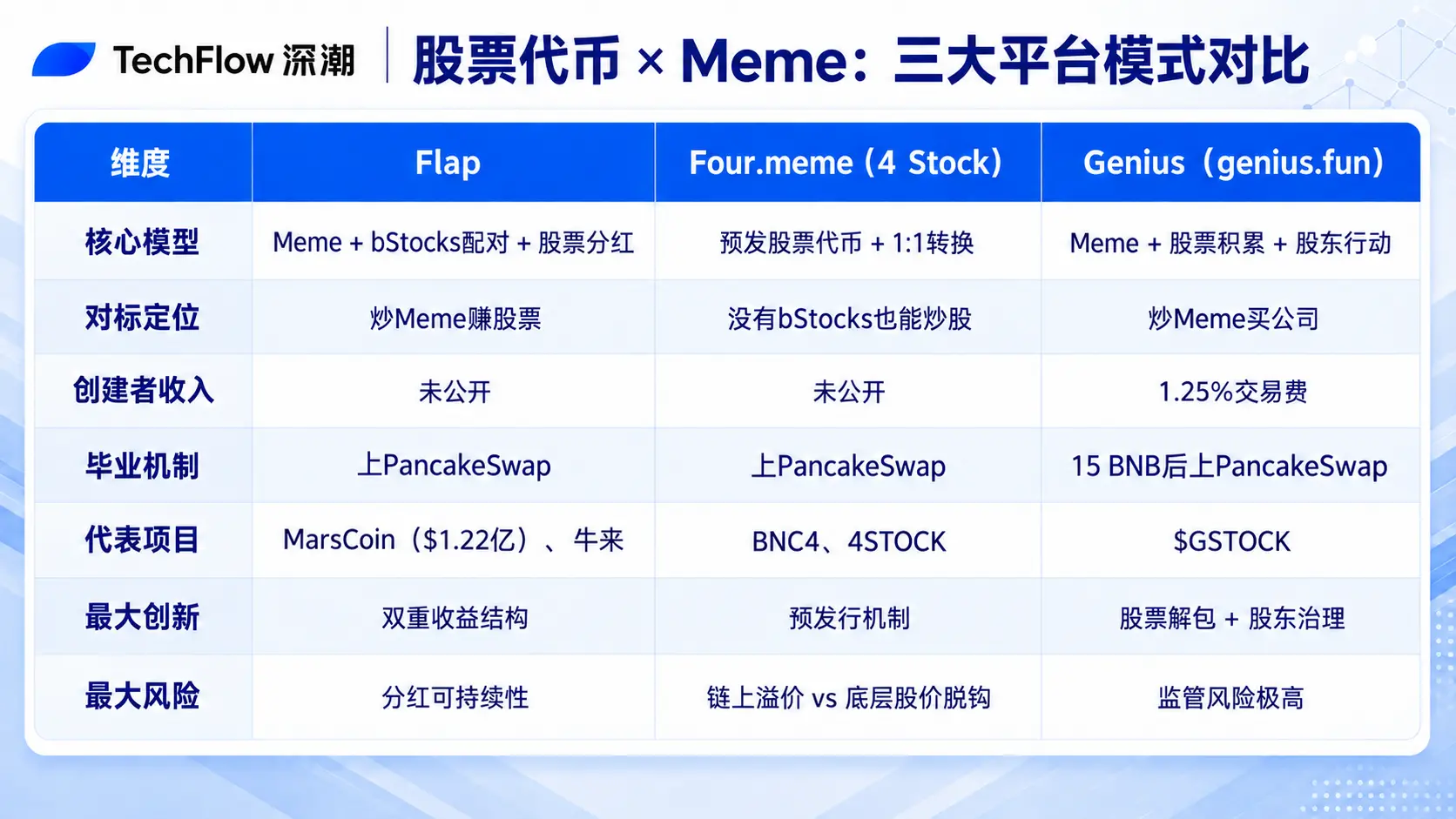
Flap: The Pioneer, "Trade Meme, Share Stocks"
Flap is the igniter of this round of BSC Stock Meme craze.
It made a key modification to the traditional Bonding Curve launch model: allowing Meme tokens to use Binance's bStocks (tokenized US stocks) as a liquidity pool while designating these stock assets as dividend assets. This means that holders of Meme tokens not only hold the Meme itself but will also continuously receive on-chain stock tokens in proportion.
In summary: "Earn stocks while trading Memes."
The wealth effect is astonishing. MarsCoin paired with SpaceX tokenized stock SPCXB, and after being listed for spot trading on Binance, its market cap once surged to $260 million. According to data from early September, MarsCoin distributed approximately $4.47 million of SPCXB to token holders, while another project, Bullish, distributed about $1.46 million of QQQB. With a structure where 3% of trading taxes are fully allocated to token holders, these numbers continue to grow with trading volume.
According to real-time data from DefiLlama, Flap has generated approximately $29.85 million in fees, with about $14.23 million in fees over the past 30 days and approximately $10.77 million in protocol revenue. The platform has expanded to four chains: BSC, Robinhood Chain, X Layer, and Monad, with BSC contributing about 95% of the fees. The cumulative trading volume of bStocks has exceeded $30 billion.
Four.meme: The Follower, "Issue Stocks First, Then Create Memes"
Four.meme was previously the mainstream launch platform on BSC but has clearly lagged behind in this wave of Stock Memes.
On September 8, CZ tweeted, "IPOs will go on-chain." Almost the next minute, Four.meme launched the 4Stock model, issuing the first stock token BNC4, pegged to the US stock CEA Industries (NASDAQ: BNC).
The logic of 4Stock is different from Flap.
Flap is "pairing Meme tokens with existing bStocks"; Four.meme's 4Stock is "creating an on-chain token for stocks that do not yet have bStocks, and then converting 1:1 when Binance lists the corresponding bStock." It is equivalent to a "pre-issue" mechanism. Want to trade SpaceX but bStocks are not yet available for SpaceX? Four.meme will create one for you first.
BNC4's market cap reached $90 million within three hours of launch. Even crazier is the off-chain effect, where the actual US stock of BNC surged over 50% in pre-market trading, with the price jumping from about $3.5 to $5.5. On-chain Meme funds are driving the stock prices of Nasdaq-listed companies in reverse.
However, the issues with 4Stock are also evident. The on-chain price of BNC4 was once 10 times the price of the underlying stock, with a token pegged to a $3.5 stock selling for over $30 on-chain. This premium cannot be called "price discovery," but rather a liquidity illusion in a shallow pool. When the heat dissipates, BNC4's market cap fell from $90 million to below $30 million on the same day.
Genius: The Disruptor, "Trade Meme, Buy Companies"
Genius.fun has pushed the ambition to a new level based on the two previous models.
Its model consists of three steps: the community creates a Meme token, pairs it with tokenized stocks (supporting bStocks, xStocks, 4Stocks, and Ondo products); a portion of the trading fees is used to accumulate underlying stocks, and after reaching a certain scale, the foundation will "unwrap" the tokenized stocks into real stocks, representing the community's exercise of shareholder rights, including voting, proposals, and even initiating hostile takeovers.
Creators receive 1.25% of the trading fees, with 0.25% allocated for token buybacks and supply locking. Tokens "graduate" to PancakeSwap after reaching a threshold of 15 BNB.
In the words of genius.fun: "Capital formation should not only belong to investment banks, private equity funds, and activist investors. A Meme can attract global attention in a few hours, and a token can turn that attention into a liquid market and a decentralized treasury that accumulates real assets."
To translate, use the viral spread of Memes to raise funds, use the redeemability of tokenized stocks to accumulate real equity, and use the coordination ability of on-chain governance to replace Wall Street's activist investors, ultimately initiating on-chain hostile takeovers against listed companies.
Currently, $GSTOCK has become the first wave leader, with Genius officially congratulating it for becoming the first token on the platform to reach a market cap of $10 million, while posing a question: "Will GSTOCK secure a board seat at a BNB treasury company?"
The Shadow of CZ and the Chess of Binance
Throughout the BSC Stock Meme wave, the roles of CZ and Binance are worth pondering.
On September 8, CZ tweeted, "IPOs will go on-chain," and Four.meme almost simultaneously launched 4Stock. Binance's bStocks (tokenized stocks issued by Backed Finance) are the underlying assets of the entire ecosystem. Binance successively listed trading pairs for Niu Lai and MarsCoin, directly igniting the wealth effect of the Flap platform.
These "coincidences" together make it hard not to speculate that Binance is intentionally promoting BSC to become the main battlefield for tokenized stock trading. bStocks provide the underlying asset layer, each launch platform provides the distribution and trading layer, Meme culture provides the viral spread layer, and ultimately, all traffic and trading volume settle on BSC and PancakeSwap.
The emergence of Genius.fun raises the narrative ceiling of this ecosystem. If a community really initiates a hostile takeover of a listed company through on-chain equity accumulation (even for a micro company like CEA Industries), the spread of this story will far exceed the rise of any single Meme token.
Cold Water That Needs to Be Poured
The models of the three platforms sound imaginative, but each has clear risk exposures.
Flap's dividend model relies on trading volume. Dividends come from the trading volume of Meme tokens, and when the heat dissipates and trading volume shrinks, dividends will also drop to zero. MarsCoin distributed $4.47 million of SpaceX stock, but the source of these dividends is the trading fees paid by new buyers, which is a structure that requires continuous new funds to enter.
Four.meme's 4Stock has a serious risk of price decoupling. BNC4 sells for $30 on-chain, while the underlying stock sells for $3.5, a 10x premium. If the bStock is listed and converted 1:1, on-chain premium buyers will face significant losses due to the price difference. 4Stock is not a stock; it is a speculative token with the option of "potentially becoming a bStock in the future."
Genius.fun's "hostile takeover" narrative faces regulatory risks. The SEC's "innovation exemption" has just drawn a compliance line for tokenized stocks, allowing issuers to prevent their stocks from being traded as tokenized. A platform that publicly claims its goal is to "initiate hostile takeovers of listed companies" will almost certainly attract the SEC's attention.
The total scale of the underlying assets (bStocks) in the entire Stock Meme track is about $118.5 million. This pool is too shallow. When dozens of Meme tokens compete for the liquidity of bStocks simultaneously, the depth of the asset side is simply insufficient, which is also the fundamental reason for the on-chain premiums being several times.
The competition of Meme launch platforms on BSC is visibly evolving from "pure Meme casinos" to "tokenized stock infrastructure layers." Flap has proven that there is market demand for Stock Memes with its dividend model, Four.meme has shown that the pre-issue path of "Meme first, then bStock" is feasible with 4Stock, and Genius.fun attempts to connect the attention economy of Memes with real-world corporate governance.
The outcome of this war depends on two variables: to what extent Binance will expand the variety and depth of bStocks (which determines the scale of the underlying asset pool), and whether regulators will tolerate the existence of the play of "accumulating equity in listed companies using Meme tokens."
This battlefield is far from being defined.
 Risk warning



Popular articles