The three-layer game of tokenized stocks: issuance, distribution, and clearing
 Core Viewpoint

 The market for tokenized stocks has nearly tripled in six months, and beneath the excitement lies a competition of mutual substitution.
Author: Zhou, ChainCatcher
In the past few months, the tokenized stock sector has suddenly become crowded. Issuers are spreading assets into more venues, crypto exchanges are building their own issuance brands, and brokerage direct connection channels are gradually going live.
A tokenized stock must go through three stages: issuance, distribution, and clearing and settlement, before it reaches the user. These three stages are functionally separate, but there are no fixed rules about who handles which stage or how many stages a single entity can cover.
On the surface, everyone is competing for the same batch of users who want exposure to on-chain stocks, but the real competition occurs between these three stages.
Competitive Landscape: Do Latecomers Have the Upper Hand?
According to RWA.xyz data, as of August 12, the total market size of tokenized stocks is approximately $2.5 billion. Leading the pack is [Ondo](https://www.rootdata.com/zh/Projects/detail/Ondo Finance?k=MzEyOQ== "Decentralized institutional-grade financial protocol") with about $866 million, holding a 34.6% market share. The second place has changed hands, with Binance's bStocks at approximately $614 million and 24.53%, surpassing xStocks at $560 million and 22.37%. The top three together account for about 80% of the market.
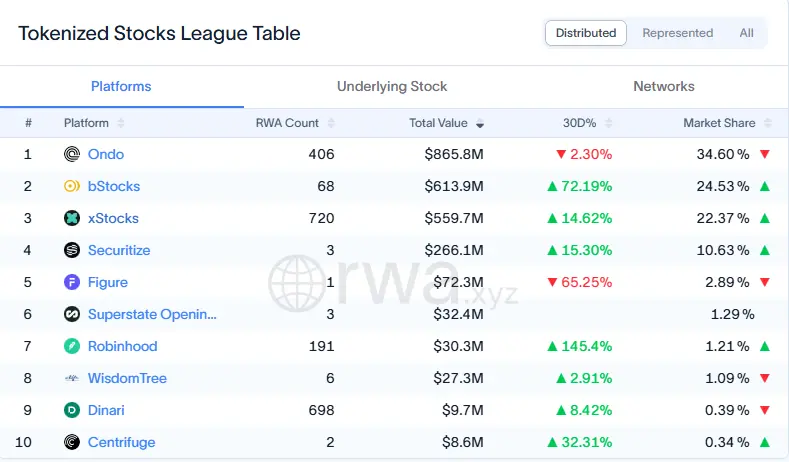
In this ranking, there are actually two generations of players. Ondo and xStocks are independent issuers that entered the market early and secured their positions by launching products ahead of time. bStocks is a self-built issuance brand by Binance, which captured nearly a quarter of the market share in less than two months, surpassing the earlier entrant xStocks.
Further down the list, the differentiation is quite clear. Securitize, which just went public on the NYSE through a SPAC merger in July, ranks fourth with a market share of 10.56%, being the only publicly listed company among these players. Robinhood has seen a 145.4% increase in the past 30 days, making it the fastest-growing platform. Meanwhile, Figure has seen a decline of over 60% in distributed value in the past 30 days, leaving only 2.89%.
Next, let's break down how the players in this sector are competing for this market.
Independent Issuers: Maintaining, Channeling, or Supplementing Rights
The situation of independent issuers can be viewed over a longer timeline.
At the beginning of this year, this market was dominated by three players, with a total size of $682 million: Ondo held 45.51%, xStocks 26.88%, and Securitize 19.48%, together accounting for over 90%.
By early June, the total size had grown to $1.68 billion, with Ondo once monopolizing over 60%.
Now, the landscape has been rewritten. The total size has increased to $2.5 billion, while Ondo's share has dropped from over 60% to 34.36%, and xStocks has also fallen to 21.76%.
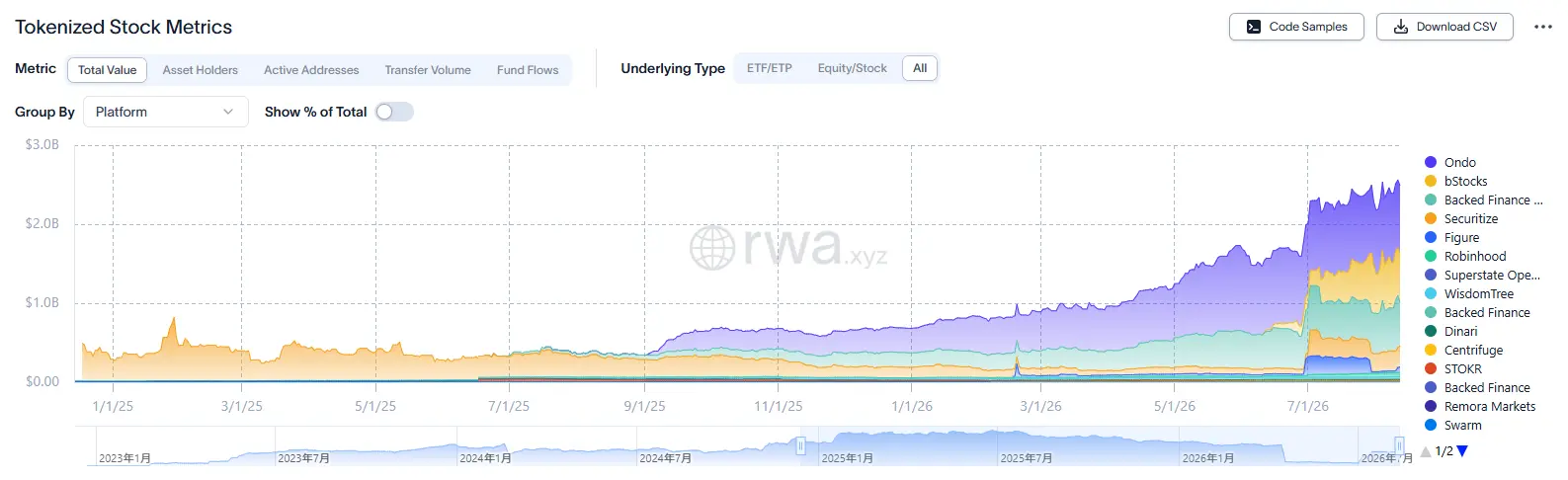
The sector has nearly tripled in size over six months, and while the absolute scale of independent issuers is still increasing, the market share they have relinquished has been taken over by exchanges building their own brands.
The reason is not hard to understand: issuers lack built-in users and liquidity, relying on others' channels for distribution.
Faced with this pressure, several leading institutions have chosen completely different strategies.
Ondo remains the current leader, and its strategy is to position itself as a widely accessible infrastructure. Mechanically, it does not rebuild liquidity itself but synchronously buys corresponding real stocks through partnered U.S. licensed brokers, using minting, redemption, and arbitrage to align on-chain prices with U.S. stock spot prices, effectively inheriting liquidity from the traditional market.
In distribution, Ondo is aggressively multi-chain, deploying on Ethereum, BNB Chain, and Solana, using LayerZero for unified cross-chain operations, aiming to have assets called upon in as many venues as possible rather than being confined to one platform. The extreme form of this approach is Dinari, which has chosen to only provide API channels and not retail brands; currently, the platform is live in 85 jurisdictions and supports over 6,000 tokenized assets, yet has only accumulated $9.7 million.
This strategy initially benefited from scale advantages but also buried potential risks. In the past 30 days, Ondo's scale has not only failed to grow but has decreased, with the following players quickly closing in.
xStocks has taken a middle path, retaining its brand while horizontally expanding venues and vertically supplementing rights. On the horizontal side, it continuously integrates new venues. On August 10, it integrated five tokenized U.S. stock products into Hyperliquid, having previously integrated with Kraken, Bybit, and Gate, adding another layer to its distribution network.
On the vertical side, it is addressing its biggest shortcoming. In early August, Broadridge integrated its unified governance platform with xStocks, allowing token holders to participate in governance votes of the companies they invest in for the first time. Prior to this, xStocks only provided price exposure.
Securitize, on the other hand, does not engage in close combat on this battlefield. It is the only publicly listed company among these players, with a tokenized asset management scale reaching $4.3 billion in the second quarter, but this mainly comes from tokenized funds and government bonds, with only $253 million specifically in tokenized stocks. Retail tokenized stocks are just a small part of its larger portfolio, focusing on institutions is also a viable strategy.
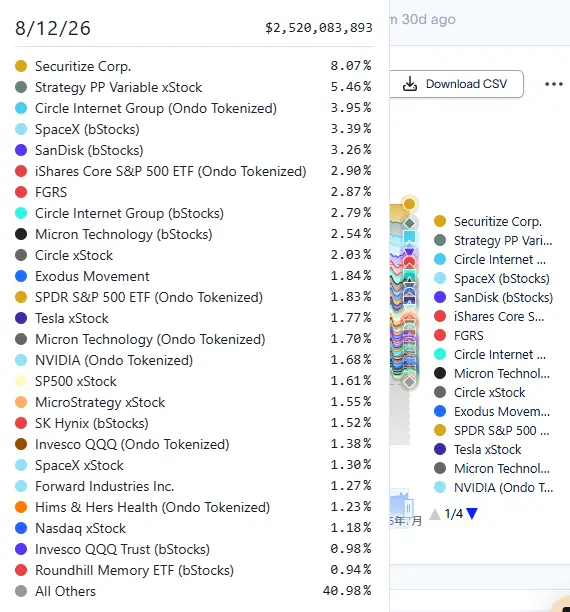
Whether acting as integrated infrastructure, expanding venues to supplement rights, or focusing on institutions, these issuers only handle the issuance stage and lack built-in users and liquidity. To sell their tokens, they must rely on exchanges, wallets, and brokerage apps as external channels.
The biggest problem is that once channel providers decide to issue themselves, issuers become replaceable suppliers rather than collaborators.
Crypto Exchanges: Bringing the Issuance Stage In-House
Exchanges building their own issuance is typified by Binance's bStocks.
First, it's important to distinguish that Binance actually has two lines in tokenized stocks. One is bStocks, Binance's self-built tokenized issuance brand, which issues tokens and uses oracles to push data to anchor stock prices. The other allows users to directly purchase real U.S. stocks using stablecoins, utilizing brokerage channels to acquire actual shares.
Let’s first look at bStocks. Data shows it took only two months to reach the second position, leveraging Binance's existing user base and traffic. Binance co-founder and former CEO Changpeng Zhao stated that bStocks' rapid growth is due to Binance's user foundation.
Bitget's path also illustrates why exchanges have moved to build their own. Its tokenized stock business launched in September 2025, with early trading heavily concentrated on assets issued by Ondo. During that time, Bitget was responsible for distribution while Ondo handled issuance, with Bitget's market share on the Ondo platform reaching as high as 89%.
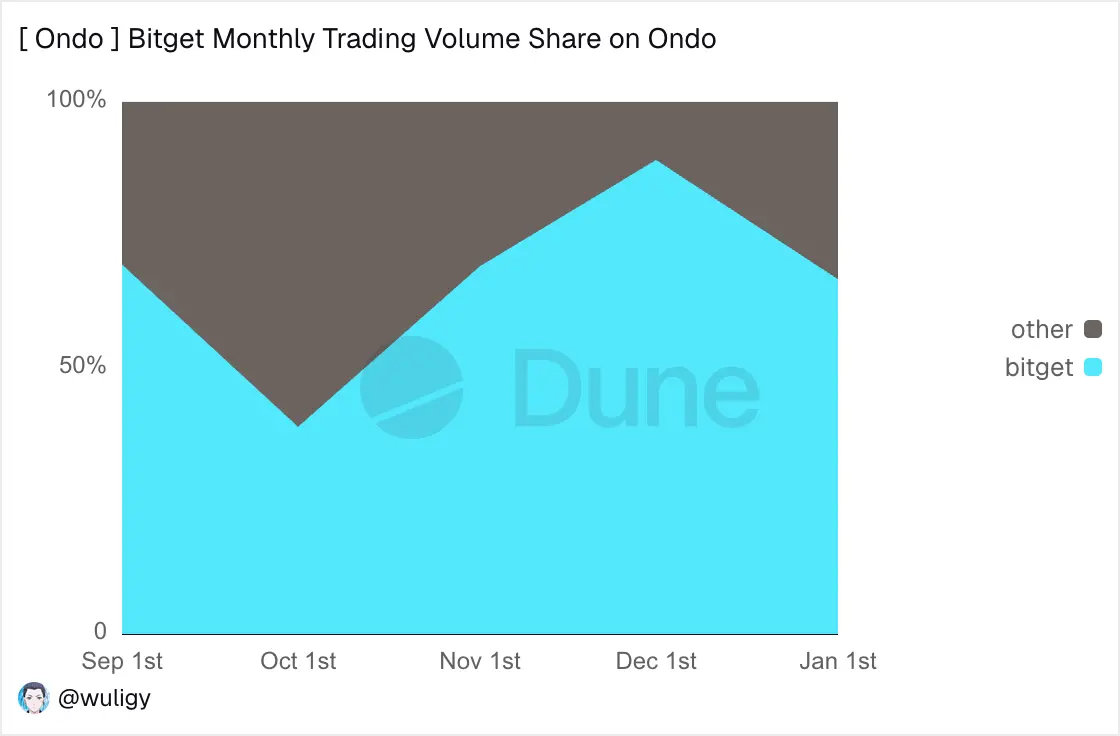
By June 2026, Bitget launched its own licensed issuance platform Reality, issuing its own rTokens, which are 1:1 anchored to the real stocks held by licensed brokers, effectively replacing Ondo's position.
This is not just the action of one or two firms. Gate launched gStocks, and Robinhood built its own underlying public chain to support its tokenized stocks, adding a layer of infrastructure beyond issuance, distribution, and settlement.
Exchanges building their own issuance essentially reclaim the stage that was originally given to issuers.
Brokerage Direct Connection: Users Want Real U.S. Stocks with Genuine Support
Returning to user demand, an ordinary user’s desire is quite simple: to find a familiar place to buy U.S. stocks, preferably with real assets backing the stock rather than just an empty price symbol.
In this regard, the method of directly holding real stocks through brokerage channels has a natural advantage. Users receive actual stocks held by licensed clearing brokers, which come with SIPC protection, allowing for dividends and corporate actions, representing true ownership.
As mentioned earlier, Binance's bStocks issues tokens, and holders do not directly own the underlying shares. However, the U.S. stock spot market launched by Binance in early June is open to non-U.S. users for over 7,000 U.S. stocks and ETFs, arranged by broker Nest Trading, with Alpaca responsible for custody and dividends, giving users direct ownership of real stocks.
Data shows that in the first nine days after the launch of real stock spot trading, the average daily transaction volume was about $143 million, while the peak trading days for the tokenized spot market only reached $35 million to $40 million. The same platform and the same batch of users are willing to pay three to four times more for real stocks than for tokenized spots. What users want is clear.
Not only Binance is doing direct connections for real stocks, but the underlying regulated clearing entities are also highly consolidated. Gate launched Gate Stocks on June 1, using Alpaca for self-clearing, with SIPC protection, covering over 10,000 U.S. stocks and ETFs, and becoming the first crypto exchange to directly support Hong Kong and South Korean stocks. Coinbase launched stock trading in the UK on August 6, authorized by the FCA, using Apex Clearing for U.S. custody. Crypto.com launched a product tracking 1,500 U.S. stocks on August 12, with the underlying also held by Alpaca.
Of course, this is not to say that tokenization has no value. Its value lies in areas where real stocks cannot provide, such as self-custody, 24/7 trading, transferability, and most importantly, composability. For example, after xStocks integrated with Hyperliquid, assets can be used for lending collateral, with spot and perpetual trading closed-loop on the same chain, something traditional brokerage structures struggle to achieve.
The Current Landscape May Not Be the Final Outcome
Currently, these products, whether tokens or spots, mostly serve as tracking certificates or ownership mappings for already listed stocks.
On-chain assets are essentially always shadows of real stocks.
In fact, some have already begun to explore another path, making tokens no longer shadows but the registered shares themselves. For example, Superstate's Opening Bell allows publicly listed companies to put their already registered common shares directly on-chain, while Coinbase obtained a license in Abu Dhabi ADGM to directly register and issue securities within a regulatory framework.
This represents a completely different set of rules from tracking certificates. If this path is successful, the premise of this competition will change. The current landscape of issuers, exchanges, and brokerages competing over "who issues shadows and who distributes shadows" will be reshuffled.
Therefore, the rankings, the ebb and flow of shares, and who has replaced whom on the current list only record the landscape of this moment and may not represent the final outcome of this competition. The true divide may still be on the horizon.

 Risk warning