








$40 billion evaporated overnight, yet the index reached a new high: AI's money is starting to pick and choose segments

 In one night, the index hit a new high, and storage stocks crashed; these two events occurred in the same market and the same trading session. Many interpretations attribute this to Toshiba's expansion, Seagate's acquisition, and risk aversion before earnings reports—these are all correct, but they do not explain why the drop was so severe and why only storage stocks fell.
Introduction: Overnight, the index hit a new high while storage stocks plummeted, with both events occurring in the same market and trading session. Many interpretations attribute this to Toshiba's expansion, Seagate's acquisition efforts, and pre-earnings hedging—while all are true, they do not explain why the drop was so severe or why only storage stocks fell. What is truly noteworthy is the answer to the question of "who is falling and who is rising": AI money is starting to pick its battles.
I. First, the facts: Who is falling, who is rising, and what is the index doing
On October 6, Eastern Time, the S&P 500 rose 0.58% to close at 7,818.93 points, marking its first close above 7,800 points; the Nasdaq rose 0.45% to 27,599.79 points, setting a new closing high for the second consecutive day; Nvidia slightly refreshed its closing record, with a market value of approximately $5.79 trillion, briefly surpassing $5.8 trillion during trading (data verified against market data).
On the same day: Seagate fell 9.18%, Western Digital fell 6.93%, SanDisk fell 2.56%, and Micron fell 1.73%; in Seoul, SK Hynix closed down 3.69%. Based on closing prices and rough calculations of market capitalization, the combined market value of Seagate, Western Digital, Micron, and SanDisk evaporated by about $40 billion. On the rising side: Corning rose 6.03%, Marvell rose 5.81%, Lumentum rose 3.82%, Broadcom rose 3.67%, and AMD rose 2.80%.
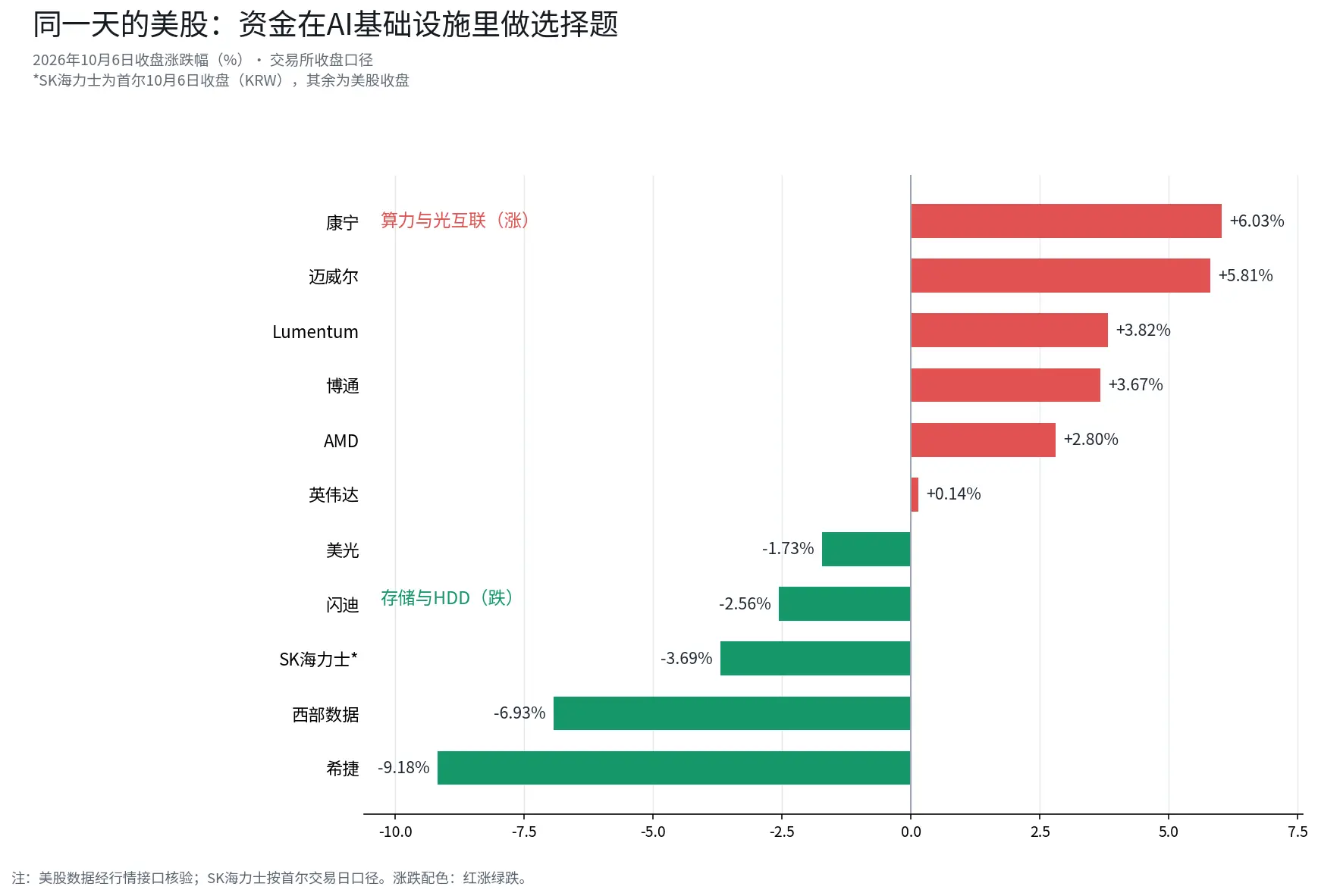
It is necessary to correct a popular saying: this is not a drop in the semiconductor sector. The semiconductor ETF (SOXX) closed flat that day, having risen about 3.9% over the previous five trading days, and was only about 1.2% away from the 60-day point. The index did not fall, computing power is rising, and only storage and HDD are collapsing—this structure itself conveys more information than the drop: funds have not left the semiconductor sector; they have merely shifted seats within it.
II. Two catalysts do not explain this drop
The market has provided two reasons for the decline in storage. First, according to Nikkei News, Toshiba plans to invest about 60 billion yen to expand its factory in the Philippines, aiming to double the HDD capacity for AI data centers before the 2027 fiscal year—this is its first large-scale investment in the HDD business in five years. Second, Bloomberg cited insiders reporting that Seagate and Toshiba are competing to acquire TDK's HDD head business, with the deal potentially reaching several billion dollars; TDK is the only independent supplier of HDD heads globally.
Both reasons are real, but they cannot support a 9% single-day drop. Toshiba's capacity will not double until the 2027 fiscal year, which is too far off to address immediate concerns; the potential expenditure of several billion dollars for acquiring the head business does not constitute a fatal variable for Seagate, a company with a market value of $180 billion. What is more noteworthy is the layered logic that may influence market pricing.
III. Layering of AI capital expenditure: The market is re-pricing "bottlenecks"
First, let's look at the total amount of money. According to public reports, the capital expenditure guidance from Microsoft, Google, Meta, and Amazon for 2026 totals about $730 billion, which is about 77% higher than the approximately $410 billion for 2025; if Oracle is included, Bank of America estimates that the five companies will invest over $860 billion this year, approaching $1.2 trillion next year. However, on the other hand, the annual revenue directly attributed to AI services is estimated to be only about $25 billion—about 4% of capital expenditure. Goldman Sachs' estimates are even harsher: giants need about $300 billion in AI revenue each year to cover their investments.
As money increases, so does the pressure for returns. When capital expenditure shifts from "buying everything" to "focusing on key breakthroughs," cloud vendors' questions change from "how much more do we need to buy" to "which link is choking me."
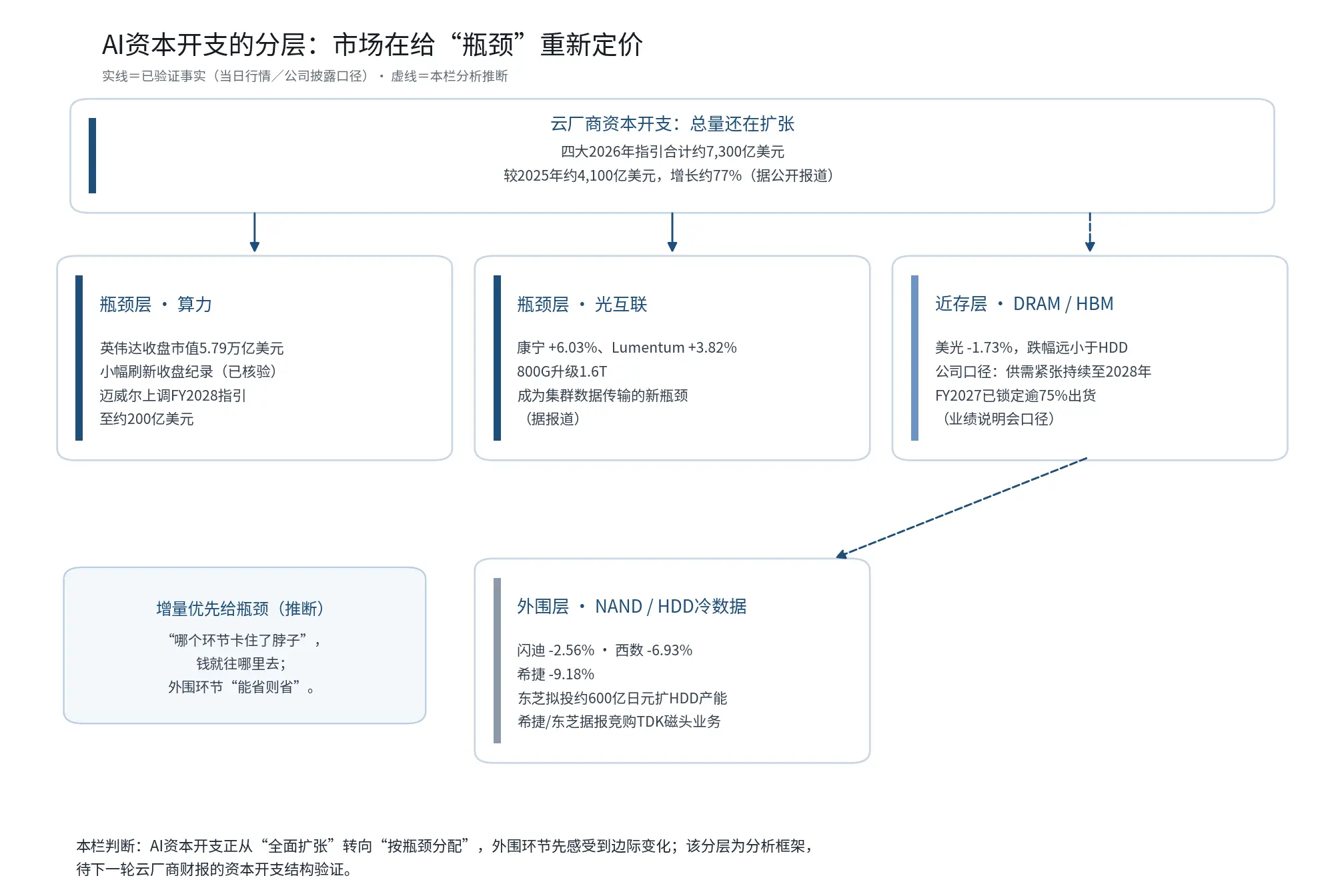
This layered framework can explain every rise and fall that day:
Bottleneck Layer · Computing Power: Nvidia GPUs are still in short supply—according to the Financial Times, SpaceX is seeking $40 billion in financing led by Apollo Global Management specifically for purchasing Nvidia chips; Marvell raised its revenue guidance for the 2028 fiscal year to about $20 billion (Wall Street's expectation is about $18.2 billion) and provided a revenue framework of $70 billion to $90 billion for the 2031 fiscal year, far exceeding the market consensus of about $46.85 billion. AMD rose 2.80%, and Broadcom rose 3.67%, both belonging to this layer.
Bottleneck Layer · Optical Interconnect: Upgrading from 800G to 1.6T, Corning rose 6.03%, and Lumentum rose 3.82%.
Near Storage Layer · DRAM/HBM: Micron only fell 1.73%—note that Micron's own guidance states that supply and demand tightness will continue until 2028, with over 75% of the 2027 fiscal year's shipment volume already locked in. At least based on the disclosures from the aforementioned companies, no clear signs of weakening have been observed; its drop is smaller than that of HDD, possibly related to its closer proximity to computing power demand.
Peripheral Layer · NAND/HDD Cold Data: The HDD duopoly fell 6%-9%. Cold data storage is at the outermost layer of the AI training and inference link and is the first segment to be "bargained" in cloud vendors' budgets. Even in Marvell's own revenue framework for the 2031 fiscal year, "exchange and storage" is also the smallest segment.
Our view is that the sharp drop in storage does not mean the market is saying "storage is no longer important," but rather that the marginal increase in AI capital expenditure is shifting from "buying everything" to "only buying the most scarce." The fact that Toshiba is expanding HDD rather than DRAM also provides an observational angle for the aforementioned framework—its new investment directed towards HDD may reflect the company's judgment on long-term demand and supply conditions in that field.
IV. A larger context: The "prosperity" of the index and the "bear market" of individual stocks
The collapse of storage is not isolated; it occurs in a market with severely deteriorating breadth. According to the latest report from Mike Wilson, Chief Equity Strategist at Morgan Stanley (as reported by the media): 51% of Russell 3000 constituents have retreated over 20% from their June highs, entering a technical bear market, a further deterioration from over 40% two weeks ago; the median stock in the S&P 500 is down 16% from its 52-week high, with market breadth dropping to its lowest since the dot-com bubble burst; there is about a 12% divergence gap between the index and breadth.
Wilson's breaking variable is U.S. Treasury volatility: the current 10-year Treasury yield is around 5.3% (verified against market data), with the MOVE index above 100 and the VIX below 15—if bond market volatility cannot cool down, he expects the S&P 500 to potentially dip to about 6,800 to 7,300 points in the next month to complete a "convergence"; conversely, individual stocks may rally to fill the gap. This judgment represents only Morgan Stanley's viewpoint. Other public statistics show that the weight of semiconductors in the S&P 500 has exceeded 20%, with Nvidia alone accounting for about 13% of the Nasdaq—this explains why the sharp drop in storage can occur on the same day as new highs.
V. What to watch next: Three time points, two switches
The next verification point is tomorrow: On October 8 at 10 AM Beijing time, Samsung Electronics will announce its preliminary results for the third quarter. According to South Korean media reports, Samsung plans to release preliminary results before the market opens on October 8, with expectations that it may achieve its best historical profit level (FnGuide estimates, as reported by the media); the formal financial report and earnings call are expected in late October. This is the first verifiable data point after the recent storage sell-off: if Samsung reports preliminary profits below expectations against the backdrop of rising storage prices, the market may be more inclined to interpret it as a "fundamental reassessment"; if the preliminary data is strong, the day's drop in storage may be interpreted more as an emotional valuation adjustment.
The second time point: two formal earnings calls in late October. According to current media estimates, SK Hynix is tentatively scheduled to release formal results on October 27, and Samsung on October 29 (both companies have not officially confirmed the dates, subject to company announcements). What to focus on in the calls is not just the quarterly numbers but also management's wording on supply and demand beyond 2027—if "tightness" begins to give way to "balance," the market may reassess the valuation framework for the storage sector.
The third time point: cloud vendors' earnings reports from late October to early November. Focus on the allocation structure of capital expenditure: whether the computing budget is maintained and whether the storage and cold data budgets are being compressed. If structural differentiation is confirmed, "allocation by bottleneck" will shift from inference to fact; if all four types of budgets grow synchronously, the day's sell-off is more likely to be proven as a reversible repositioning.
The two switches are in the bond market. One is the extreme divergence between the MOVE index and the VIX (MOVE above 100, VIX below 15, according to Morgan Stanley's report): this is the overall switch for the current index's fragility; the second is the 10-year Treasury yield, currently at a high of around 5.3%, with each additional day spent at this level making breadth recovery more difficult.
Conclusion
We have three judgments. First, what truly happened that day was not a "drop in semiconductors," but a surgical-style repositioning: the semiconductor ETF closed flat, computing power and optical interconnects rose, while storage and HDD collapsed—this marks our positioning of the recent storage sell-off as the marginal increase in AI capital expenditure shifting from "broad expansion" to "allocation by bottleneck." Second, the differentiation where HDD fell 9% while Micron only fell 1.7% may reflect that the market is distinguishing different links within the "storage" label; Toshiba's investment in expanding HDD rather than DRAM also provides an observational angle for this pricing logic. Third, with 51% of Russell 3000 constituents already in a bear market and the index maintained by a few weighted stocks reaching new highs, any "marginal change" in any link could be amplified into index-level volatility—what links may further be affected by this differentiation is worth continuous observation. The above judgments are based on current public information, and conclusions will change as conditions change.
Data Explanation
U.S. Stocks: S&P +0.58% to 7,818.93, Nasdaq +0.45% to 27,599.79; Nvidia +0.14%, Broadcom +3.67%, AMD +2.80%, Marvell +5.81%; storage weakened: Seagate -9.18%, Western Digital -6.93%, Micron -1.73%; SK Hynix -3.69%.
Industry: Toshiba plans to invest 60 billion yen to expand HDD; Seagate and Toshiba are competing to acquire TDK's heads; Marvell's FY2028 guidance is about $20 billion, FY2031 framework $70-90 billion; Micron states supply and demand tightness will last until 2028.
Cloud/AI: The four major cloud vendors' capital expenditure for 2026 is about $730 billion (+77%); SpaceX seeks $40 billion in financing to purchase Nvidia chips, according to FT.
Market: 10Y U.S. Treasury around 5.3%; Morgan Stanley states 51% of Russell 3000 is in a technical bear market, S&P may dip to 6,800-7,300.
Others: Semiconductors account for over 20% of the S&P 500, with Nvidia accounting for about 13% of the Nasdaq; forward P/E: Seagate 18-20x, Micron about 8x, Nvidia about 32x, AMD about 45x. Samsung's preliminary results on 10/8, SK Hynix tentatively estimated for 10/29. Sources: Exchanges, Nikkei, Bloomberg, FT, etc.; some not independently verified.
Disclaimer: The content of this article is for general information and market commentary purposes only, compiled from publicly available information as of the time mentioned in the text. Relevant market data, expectations, and probabilities may change with market conditions. The views and investment strategies cited from third-party institutions, analysts, or other individuals only represent the views of the relevant third parties at a specific time and do not represent the views or recommendations of BIT. This article does not constitute investment advice, investment research, an offer, solicitation, or recommendation for any securities, investment products, or trading strategies, nor should it be the basis for any investment decision. Financial markets carry risks, and securities prices and market performance may fluctuate; past performance and historical market trends do not represent or guarantee future results. Investors should independently assess the relevant risks based on their own circumstances and seek professional advice when necessary.
 Risk warning



Popular articles





