Gold prices fell to $4,066: it's not a failure of safe-haven assets, but the cost of holding U.S. Treasuries has won

 Many reports discuss these two events together: "gold falls, U.S. bonds are snatched up." However, when the timeline is laid out, this statement has a clear flaw: the sale of gold occurred before the auction results were announced. First it fell, then it stabilized—this sequence is more informative than the rise and fall itself.
On October 7, spot gold opened high at $4,163.97. After reaching a peak of $4,170 during the Asian session, it declined throughout the day, dipping to $4,066 in the New York session, marking the lowest point since August 5, and closing at $4,110.68, down 1.28%. On the same day, a $39 billion 10-year U.S. Treasury auction was awarded at a yield of 5.300%, with a bid-to-cover ratio of 2.77, significantly higher than the recent average of 2.54.
Many reports linked these two events: "Gold falls, U.S. Treasuries are in demand." However, when the timeline is laid out, this statement has a clear flaw: the sell-off in gold occurred before the auction results were announced. The sequence of events—first a drop, then stabilization—provides more information than the rise and fall itself.
1. Correcting the Causal Sequence
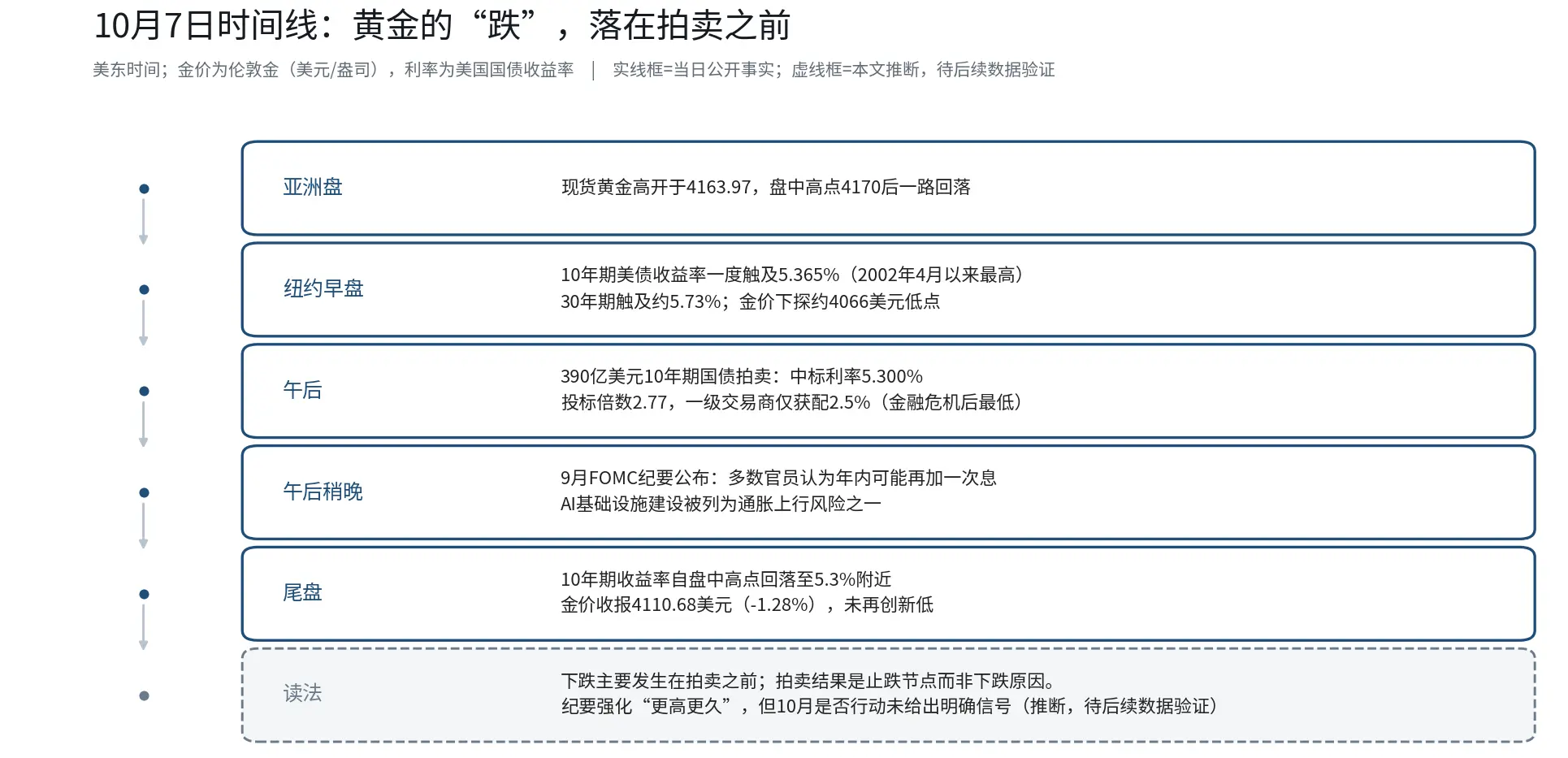
The market on that day followed this sequence: gold surged and then retreated during the Asian session; in the New York morning, the yield on the 10-year U.S. Treasury briefly surpassed 5.34%, reaching a new high since April 2002, while the 30-year yield touched 5.73%, causing gold prices to fall below $4,100 and dip to $4,066; in the afternoon, the auction results were announced, with the awarded rate of 5.300% actually lower than the pre-auction market level (5.317%), leading to a retreat in yields from their highs, and gold prices recovered to close at $4,110; on October 8, during the Asian session, gold further rebounded to around $4,130.
The conclusion is straightforward: the only clear positive event for gold that day was precisely that auction, which was suspected of "crashing gold." Attributing gold's decline to the auction is treating the turning point as the starting point.
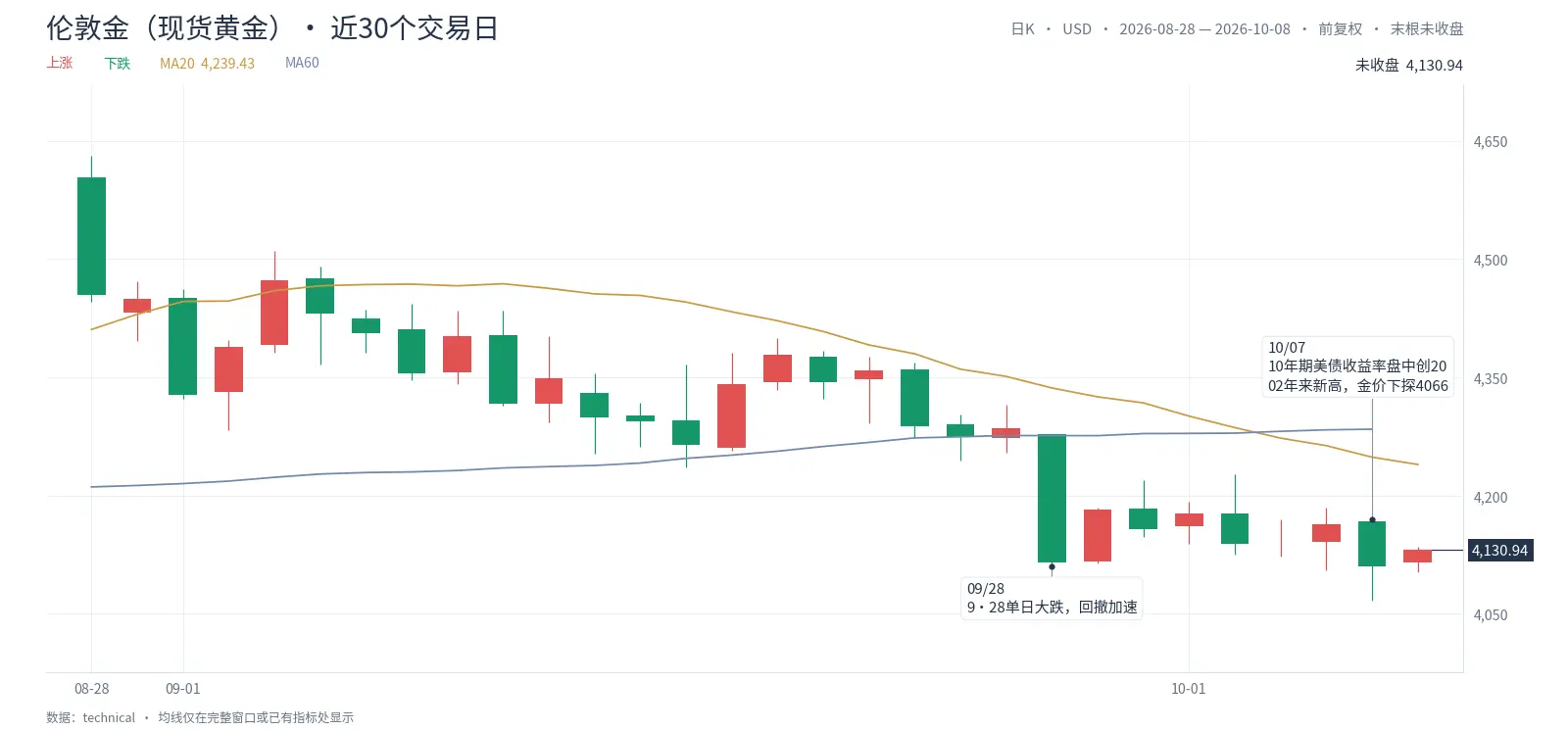 Another often overlooked background: this is not a one-day affair. Gold was still around $4,630 to $4,700 at the end of August, and after a significant drop on September 28, it accelerated its retreat, closing on October 7 about 12% lower than the 60-day high. $4,066 merely broke the low point since August 5. The single-day crash is the result; the two weeks of gradual decline are the process.
2. The Minutes Confirm Old Expectations, Not New Negatives
The FOMC meeting on September 15-16 was held three weeks ago, but the minutes were only released on October 7 in the afternoon Eastern Time, so they represent last night's information—just with very limited incremental value.
The minutes confirmed three things: a unanimous vote for a 25 basis point rate hike; most officials believe there may be one more hike this year; no signals were given regarding action in October. Before the minutes were released, the futures market had priced in only about 19% for October, while December's rate hike was fully priced in. The market had already incorporated the "one more hike this year" into the prices; the minutes merely documented the already priced expectations. Attributing last night's volatility to "hawkish minutes" is treating old expectations as new negatives.
What is truly fresh is another point: some participants listed AI infrastructure construction as one of the upward risks for medium-term inflation. The entry of AI capital expenditure into the central bank's inflation discussion is a change worth tracking separately—but it was not the starting point for the decline in gold prices that day. The new high in yields and the contributions of oil prices and inflation expectations likely preceded the minutes.
3. Gold Lost a Simple Arithmetic Problem
Rather than saying the safe-haven logic failed, it is more accurate to say that gold was defeated by its own holding costs.
The yield on the 10-year U.S. Treasury has exceeded 5.3%, while gold itself does not generate interest. The implicit cost of holding gold for a year is the portion of that 5.3% minus inflation. This is not an emotional issue; it is an arithmetic issue.
The second layer of pressure comes from the dollar: the dollar index rose to around 102.3, breaking the year's high, making gold priced in dollars more expensive for non-U.S. buyers. As for the escalating situation in the Middle East and Brent crude prices surpassing $100—textbook theory suggests this should boost safe-haven buying, but this time it did not, because the direction of oil price increases is toward inflation expectations and long-term rates, which is a net negative for gold. When the textbook fails, it is usually because the weight of interest rate variables has overshadowed everything else.
4. A More Memorable Number than Gold Prices is 2.5%
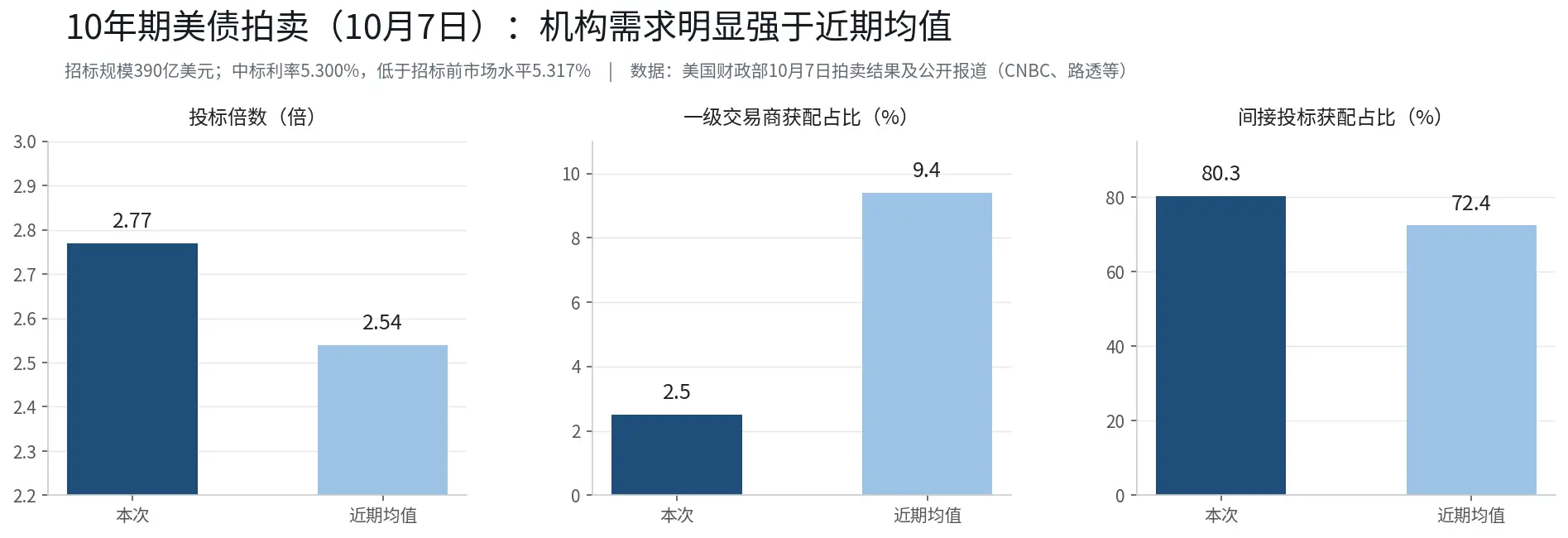
In the auction data, a bid-to-cover ratio of 2.77 indicates "strong demand," but the number 2.5% reveals where the demand came from: primary dealers only took 2.5% of the issuance, the lowest since the financial crisis—this indicates that the take-up was not supported by market makers but rather by real capital allocation; indirect bids (including global central banks and other institutions) received 80.3%, significantly higher than the recent average of 72.4%.
The decision-making logic of this type of capital differs from trading positions: pensions, insurance, and sovereign funds have discipline regarding yields; they allocate when the yield is high enough. For them, 5.3% is a calculable return not seen in years.
The judgment of this article is: if this buying continues, the peak of long-term yields may be closer than currently priced; if it is just a one-time auction anomaly, the pressure on gold and growth stocks has not yet been alleviated. The observation point to distinguish between the two is the $22 billion 30-year auction on October 8—where the issuance yield may reach the highest since 2000.
5. What to Watch Next
First, the results of the 30-year auction. If the 10-year is strong and the 30-year is weak, it indicates that long-term demand is only a repair in individual segments; both need to be strong to discuss "capital allocation returning."
Second, the $4,000 threshold. It is the next integer support; according to public reports, the People's Bank of China has continuously increased its gold holdings to 77.47 million ounces by the end of September, with official buying supporting from below, but it cannot change the upward direction of real interest rates.
Third, the December rate path. The December rate was fully priced in before the minutes were released; as long as there is one inflation data point that exceeds expectations, yields may test previous highs again; conversely, any signals of cooling inflation will simultaneously improve the situation for both gold and long bonds.
Final Thoughts
Reading last night as "gold crashed" or "U.S. Treasuries stabilized" is incomplete. What actually happened yesterday was that yields pressured gold prices to their lowest since August during the day, only to be pushed back by an auction with demand exceeding expectations. Gold prices are a thermometer; the auction is the regulatory mechanism. In the coming days, watching the 30-year auction and CPI will be more useful than observing the daily K-line of gold prices.
Data Explanation
Data as of October 8, 2026, source: public market data, U.S. Treasury, Federal Reserve, CNBC, Reuters, etc.
Gold: London gold closed at $4,110.68 on 10/7 (-1.28%), with an intraday low of $4,066.36; on 10/8, it rebounded to around $4,130 during the Asian session.
U.S. Treasuries: 10Y yield briefly broke 5.34% (the highest since April 2002, range 5.34%--5.37%), 30Y reached 5.728%, and 10Y closed around 5.3%.
10Y auction: $39 billion, awarded at 5.300% (expected 5.317%); bid-to-cover ratio of 2.77 (average 2.54); primary dealers took 2.5% (the lowest since the financial crisis); indirect bids at 80.3%.
FOMC minutes: September 15-16 meeting, released on 10/7; rate hike of 25bp to 3.75%--4.00%; most officials believe there may be one more hike this year; AI infrastructure listed as an inflation risk. Futures pricing for October was about 19%, fully priced for December.
Others: Dollar index around 102.3, breaking the year's high; People's Bank of China gold reserves at 77.47 million ounces by the end of September, continuously increasing.
Disclaimer: The content of this article is for general information and market commentary purposes only, compiled based on publicly available information as of the time mentioned in the text. Relevant market data, expectations, and probabilities may change with market conditions. The views and investment strategies cited from third-party institutions, analysts, or others represent the views of the relevant third parties at a specific time and do not represent the views or recommendations of BIT. This article does not constitute investment advice, investment research, an offer, solicitation, or recommendation for any securities, investment products, or trading strategies, nor should it be the basis for any investment decisions. Financial markets carry risks; securities prices and market performance may fluctuate, and past performance and historical market trends do not represent or guarantee future results. Investors should independently assess relevant risks based on their own circumstances and seek professional advice when necessary.
 Risk warning