Google's Q3 revenue was $127.6 billion, AI is burning cash even faster, cash flow is showing red lights
 Core Viewpoint


 Alphabet's fiscal year 2026 Q3 revenue was $127.6 billion, but revenue, adjusted earnings per share, and free cash flow all fell short of Wall Street expectations, with capital expenditures continuing to increase, leading to a 9.79% drop in stock price after hours.
Sundar Pichai, co-founder of Alphabet and Google. Image generated by AI
Written by|Li Hailun
Editor|Xu Qingyang
On October 28, local time in the United States, Alphabet, Google's parent company, released its financial report for the third quarter of fiscal year 2026, ending September 30.
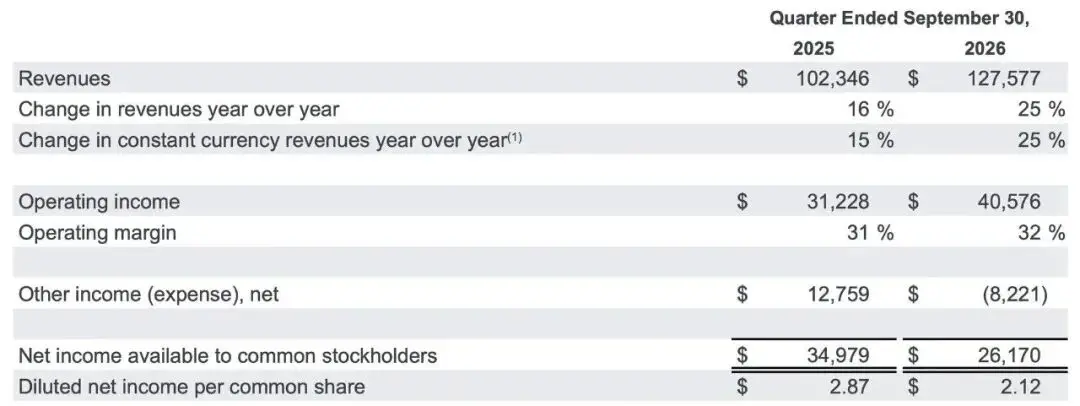
Despite revenue growth, Alphabet's third-quarter revenue, adjusted earnings per share, and free cash flow all fell short of Wall Street expectations. Future capital expenditures are expected to increase further, causing the company's stock price to drop 9.79% in after-hours trading to $293.09.
The financial report shows that Alphabet's third-quarter revenue reached $127.577 billion, a 25% increase from $102.346 billion in the same period last year. Although Alphabet's revenue grew by 25% year-over-year, marking the 13th consecutive quarter of double-digit growth, the actual revenue of $127.577 billion still fell short of Wall Street analysts' expectations of $128.22 billion.
Operating profit reached $40.576 billion, a 30% year-over-year increase; the operating profit margin was 32%, up from 31% in the same period last year.
In terms of net profit, despite a 25% year-over-year increase in revenue, net profit attributable to common shareholders decreased by 25% year-over-year, falling from $34.979 billion in the same period last year to $26.170 billion.
The main reason was the change in the fair value of equity securities, which led to other gains and losses shifting from a gain of $12.759 billion in the same period last year to a loss of $8.221 billion, with a net loss of $8.664 billion due to changes in the fair value of equity securities. Diluted earnings per share were $2.12, down from $2.87 in the same period last year; when excluding the impact of equity securities losses, earnings per share were $2.67, below Wall Street analysts' expectations of $3.02.

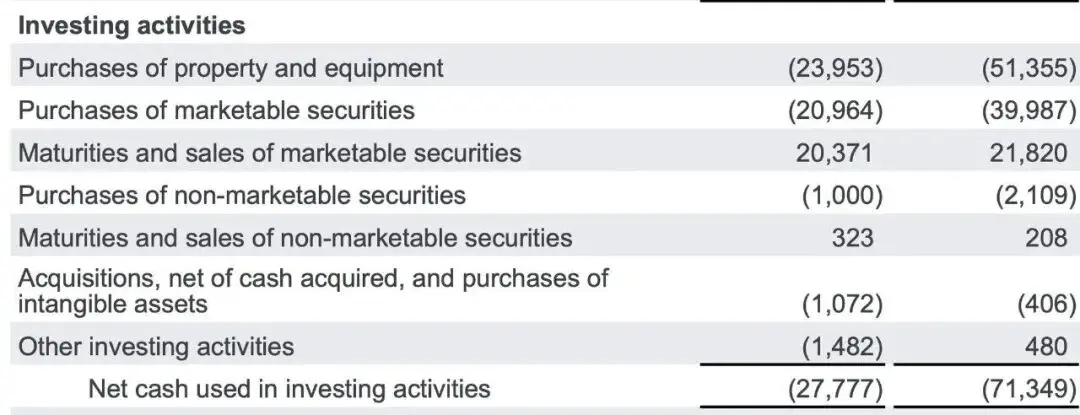
In terms of cash flow, Alphabet's third-quarter free cash flow was negative $9.065 billion, compared to positive $24.461 billion in the same period last year, a decrease of $33.526 billion year-over-year. Capital expenditures during the same period reached $51.355 billion, an increase of about 114% from $23.953 billion at the end of 2025.
The company maintains its full-year capital expenditure guidance of $195 billion to $205 billion for 2026 and expects significant increases in capital expenditures in 2027.
Alphabet CEO Sundar Pichai stated in the financial report that AI investments are driving growth in the search business, with search query volumes, including commercial queries, reaching the highest year-over-year growth rate in the past five years. Google Cloud revenue grew by 103% year-over-year, with the first-party model API processing nearly 32 billion tokens per minute, more than four times that of a year ago. In terms of consumer products, the Gemini App has reached 1 billion users, becoming the fastest-growing product in Google's history; YouTube Music and Premium global subscription users have also surpassed 150 million.
01 Continued Growth in Capital Expenditures
As of September 30, 2026, Alphabet's total assets reached $1,003.312 billion, surpassing $1 trillion, a significant increase from $595.281 billion at the end of 2025. Among them, net fixed assets reached $372.827 billion, higher than $246.597 billion at the end of 2025; marketable securities reached $208.764 billion; cash, cash equivalents, and marketable securities totaled $265.098 billion.
In the third quarter, Alphabet's capital expenditures further expanded to $51.355 billion, an increase of about 114% from $23.953 billion in the same period last year, mainly reflecting the company's continued investment in AI computing power and related infrastructure, as well as inventory building needed for expanding TPU system sales, which also put pressure on cash flow. Meanwhile, despite the company's revenue growth, the significant increase in capital expenditures still exerted pressure on cash flow, pushing free cash flow from positive $24.551 billion in the same period last year to negative $9.065 billion, lower than analysts' expectations of negative $2.7 billion.
In terms of debt, Alphabet's long-term debt rose to $125.102 billion, a significant increase from $46.547 billion at the end of 2025. The company maintains its capital expenditure guidance of $195 billion to $205 billion for the full year of 2026 and expects capital expenditures to further increase significantly in 2027. As investments in AI infrastructure continue to expand, the company's financing needs and debt levels are also rising.
One particularly noteworthy figure in Alphabet's financial report is the allocated costs at the Alphabet level, which reached $7.655 billion (compared to $4.467 billion in the same period last year). This expenditure mainly involves shared AI research and development activities within the group, including personnel salaries and technical infrastructure costs required for the development of general AI models, as well as some group management expenses. As AI research and development continues to advance, related costs at the Alphabet group level are also increasing.
Investments in AI infrastructure and their impact on cash flow have become a common topic in the financial reports of tech giants. On October 21, local time, Meta released its financial report for the third quarter of 2026. The company's advertising business continued to grow, but investments in AI infrastructure continued to expand, leading to further increases in capital expenditures.
In the third quarter, Meta's capital expenditures were $33.942 billion, reaching $34.906 billion when including finance leases; during the same period, operating cash flow was $32.786 billion, and free cash flow turned negative at $2.12 billion. The company also raised its full-year capital expenditure guidance ceiling to $145 billion. After the financial report was released, Meta's stock price fell nearly 7% in the following trading day.
Oracle sent a different signal. On October 28, local time, the company announced its capital expenditure and financing plans for the next few years during its Investor Day, expecting capital expenditures to peak in the coming years and not to exceed $20 billion in external financing before the fiscal year 2030, while also expecting free cash flow to turn positive in the second half of the fiscal year 2028. After the announcement, Oracle's stock price rose by more than 12%.
While Meta and Alphabet continue to ramp up investments in AI infrastructure, Oracle expects capital expenditures to peak in the coming years and plans to control the scale of external financing. The investment strategies of tech giants regarding AI infrastructure are beginning to show differences, and the market's focus is gradually shifting to investment returns: whether the continuously expanding computing power investments can bring corresponding business growth, and whether companies can maintain healthy cash flow during the expansion process.
02 Computing Power Cash Cow Fully Erupts
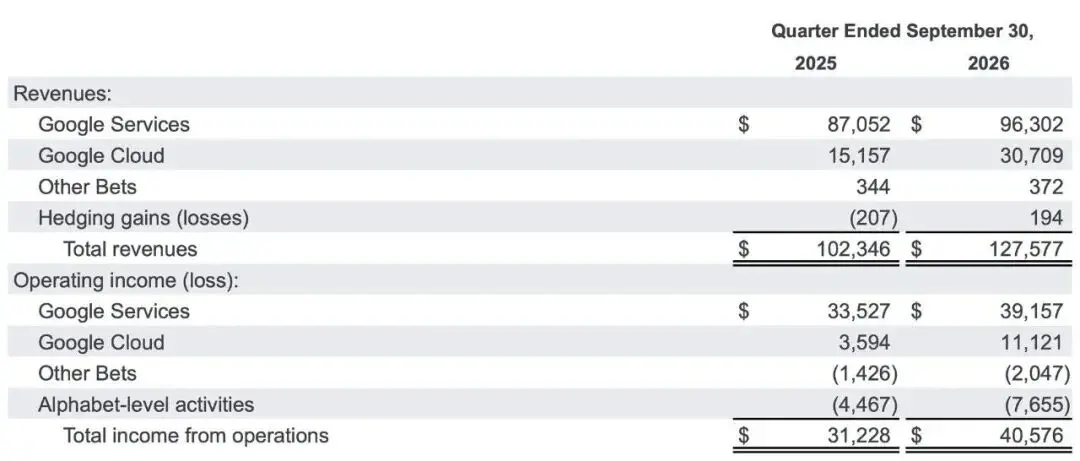
In the third quarter, Google Cloud revenue reached $30.709 billion, compared to $15.157 billion in the same period last year, a substantial year-over-year increase of 103%, significantly exceeding analysts' general expectations of $28.7 billion. Profitability also improved simultaneously, with segment operating profit rising sharply from $3.59 billion in the same period last year to $11.121 billion, and the operating profit margin increasing to around 36.2%.
The demand from enterprises for AI infrastructure and solutions is the core driving force behind the explosive growth of Google Cloud's business.
As more and more enterprises deploy AI models into actual business, the demand for computing power, cloud platforms, and model services continues to increase. Alphabet stated that TPU system sales also made an important contribution to the revenue growth of Google Cloud, reflecting that enterprise customers' demand for AI computing infrastructure is accelerating into actual orders and revenue.
The usage of model services is also growing rapidly. Alphabet disclosed that Google's self-developed flagship series model API processes nearly 32 billion tokens per minute, more than four times the volume from a year ago, and an increase of about 40% from the previous quarter.
The doubling of Google Cloud revenue and significant growth in operating profit indicate that Alphabet's massive investments in AI are beginning to translate into substantial revenue and profits through cloud business. Compared to the cash flow pressure brought about by the continuous rise in capital expenditures, the rapid growth of the cloud business also provides the company with an important window to observe the return on investment (ROI) of AI investments.
However, as subsequent infrastructure investments continue to expand, whether Google Cloud can maintain its current growth rate and whether profit growth can continue to cover higher computing power construction costs remain focal points of market attention.
03 Core Advertising and Search Steady Growth
As Google's traditional core cash cow, the Google Services segment demonstrated strong resilience in the third quarter, achieving revenue of $96.302 billion (compared to $87.052 billion in the same period last year) and operating profit of $39.157 billion (compared to $33.527 billion in the same period last year).
Among them, "Google Search and Others" revenue reached $63.350 billion, a year-over-year increase of 12%, but below analysts' expectations of $64.96 billion. There had been concerns that generative AI would divert traffic from traditional search engines, but as Pichai emphasized, AI investments have not weakened search; instead, they have driven the year-over-year search query volume (including commercial queries) to achieve the highest growth rate in the past five years.
Meanwhile, YouTube ad revenue reached $11.207 billion, a year-over-year increase of 9.2%; Google Network ad revenue was $7.455 billion.
In the consumer AI ecosystem, the flagship AI application Gemini App has officially surpassed 1 billion active users, becoming the fastest-growing consumer product in Google's history. At the same time, YouTube Music and Premium global subscription users have also surpassed 150 million.
Additionally, the Other Bets segment achieved revenue of $372 million, compared to $344 million in the same period last year; operating losses widened to $2.047 billion, compared to a loss of $1.426 billion in the same period last year.
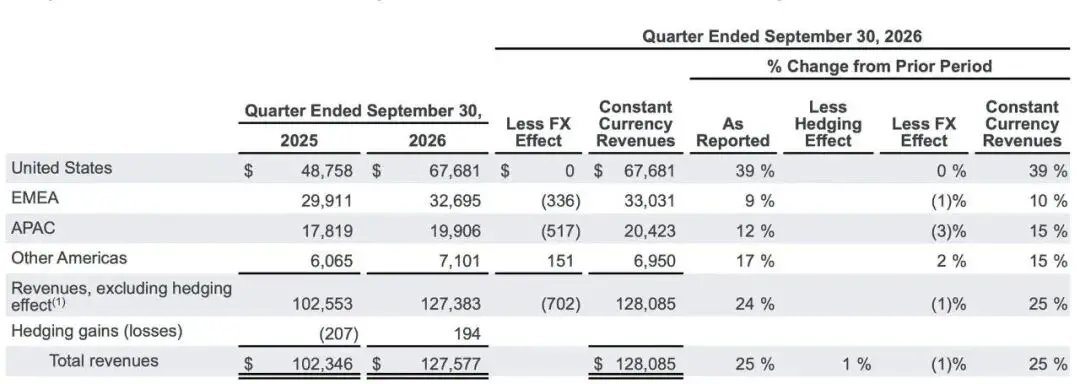
From a global geographical perspective, the U.S. domestic market continues to serve as the core growth engine, with third-quarter revenue reaching $67.681 billion, higher than $60.846 billion in the second quarter of this year.
Overseas markets also performed steadily. Revenue from Europe, the Middle East, and Africa reached $32.695 billion, Asia-Pacific revenue was $19.906 billion, and revenue from other Americas was $7.1 billion, with all major global regions maintaining steady performance.
Examining this report card, on one hand, the 25% revenue surge, the doubling of Google Cloud's business, and the continuously expanding user base of Gemini demonstrate that Alphabet's commercial capabilities in AI infrastructure, model services, and consumer applications are strengthening; on the other hand, the significantly expanded debt scale and the continuously rising capital expenditures have also put the market on edge.
In this "Computing Power Long March" where giants are collectively betting, Alphabet has shown a firm strategic determination. Faced with an empire holding an annual revenue of half a trillion, whether the rapidly advancing AI infrastructure can deliver super dividends that exceed costs in the future will become the core question determining its next phase of valuation direction.
Below is a refined version of the transcript from Alphabet's third-quarter earnings call:
Sundar Pichai's Comments: I will first focus on the cutting-edge models of the Gemini 4 series. Argon was released two weeks ago, and demand and usage are strong; on the developer platform, its usage in the first week climbed to 3.5 times that of Gemini 3, even with capacity constraints.
Argon has performed outstandingly in fields such as finance, law, cybersecurity, and science, with developers and cloud customers using it to clarify legacy codebases, accelerate scientific research, robotics, discover product improvements, and perform domain-specific tasks that require deep reasoning. Internally at Google, the Chrome, advertising, and search teams have used Argon to write and optimize code faster over the past few weeks, increasing code delivery by 35% and reducing errors by 30%.
Argon is just the beginning of the Gemini 4 series. Today we also released Carbon, our strongest cutting-edge model, which has advanced cybersecurity and long-term capabilities, ranking first with a score of 59 in the recently updated Artificial Analysis Intelligence Index. Carbon outperforms Argon in almost all areas, including full-stack web development, multimodal understanding, complex knowledge work, and scientific reasoning. We are initially rolling out Carbon to select trusted cybersecurity defenders before expanding access, and it is currently undergoing testing by the U.S. government.
In addition to the Gemini 4 series, we released Genie 4 on October 27, which is our most advanced world model to date, capable of simulating safe, realistic, interactive worlds in real-time and supporting native audio, serving as an important cornerstone for training robots and agents. This rapid progress highlights our extraordinary model momentum.
We have entered a phase where AI helps enhance training and deployment speed. I expect that in the next 12 months, we will continue to accelerate due to recursive self-improvement (RSI). We have more models coming soon, including more efficient versions to help developers optimize speed and costs, and deploy to our billions of users.
Next, let's talk about search. Search is bringing the benefits of AI to more people than any other product. Just as we transitioned to mobile over a decade ago, we are focused on creating the best search user experience before monetizing it.
We are building a seamless experience from AI overviews and AI modes to traditional search. People are using our AI features more to search in new ways; queries are longer, more personalized, and more multimodal.
The average query length in AI mode is three times that of traditional search, with one-fifth of AI mode searches globally using voice, images, or documents. Our visual searches have exceeded 50 billion per month. One area I am particularly looking forward to is helping people with everyday tasks such as making reservations, filling out forms, scheduling appointments, and shopping.
As AI becomes more personalized and begins to take action for people and businesses, trust and safety are more important than ever. People trust Google to handle everyday tasks, and our leadership in this area remains a significant differentiator.
We are first building these intelligent agent experiences in the enterprise version of the Gemini agent, as security, safety, and governance requirements are extremely high. Next, we will bring these features to search and the billion users of the Gemini app.
Users are already using the Gemini app for more than just asking questions, including complex multi-step intelligent agent queries. The Gemini 4 series has made significant progress in handling these complex tasks well. The agents will serve as a unified layer across our products. You will see us extend these intelligent agent experiences from search and the Gemini app to Chrome, Android, and Workspace products.
Finally, let's discuss long-term positioning. Waymo is making good progress, having completed over 300 million miles of fully autonomous driving. Waymo is now operating in 15 major U.S. cities, recently opening services to the public in San Antonio, San Diego, and Tampa, with plans to expand to Canada, Germany, Singapore, and Spain. Other long-term initiatives are also making strong progress. Isomorphic is supporting drug design research with Argon. We demonstrated magic state distillation in quantum computing for the first time and sent TPUs into space through Project Suncatcher.
04 Analyst Q&A Session
Question: How was the overall performance in the third quarter? What impact did AI progress have on the business?
Pichai: In the third quarter, Alphabet's revenue grew by 25% year-over-year, with an annualized revenue run rate reaching $500 billion. Search business queries grew year-over-year at the highest rate in the past five years, with AI investments significantly boosting usage and commercial queries.
Google Cloud revenue grew by 103%, driven mainly by AI infrastructure and solutions. The first-party model API processes nearly 32 billion tokens per minute, a 40% increase from the previous quarter and more than four times that of the same period last year. The number of users of the Gemini app reached 1 billion, making it the fastest-growing product in Google's history. YouTube Music and Premium subscribers (including trials) exceeded 150 million.
In the Gemini 4 series, after Argon was released two weeks ago, the usage on the developer platform in the first week climbed to 3.5 times that of Gemini 3; Carbon is the strongest cutting-edge model, ranking first in the relevant index and leading in cybersecurity and long-term tasks.
Internally, Argon has increased code delivery by 35% and reduced errors by 30%. We expect to continue accelerating in the next 12 months due to recursive self-improvement and will launch more efficient model versions.
Question: The growth in search business queries is strong, but advertising growth has slowed. What is the reason? How will you promote the monetization of AI features in the future?
Pichai: Query growth is at a five-year high, with user queries being longer, more personalized, and more multimodal, with AI mode queries averaging three times the length of traditional searches, and visual searches exceeding 50 billion per month.
Advertising growth has been impacted by exchange rates, dynamics in certain verticals (such as Asia-Pacific retailers affected by the EU's removal of minimum tax exemptions, and media and entertainment normalizing after the World Cup), as well as the initially low monetization levels of AI modes.
The company has expanded high-quality ads in AI overviews and AI modes to more users and queries, advancing for the first time into international markets and launching multi-round ads in the U.S. User research shows that users have a high acceptance of relevant ads, with click-through rates comparable to organic results.
The intelligent agent experience is seen as an expansion opportunity, unifying across search and the Gemini app, and extending to Chrome, Android, and Workspace products, prioritizing safety and trust.
Ashkenazi: In the third quarter, search and other advertising revenue grew by 12% year-over-year to $63.3 billion. Among the main drivers of the change in growth rate from the second to the third quarter, exchange rates were the largest single factor. Vertical sectors like retail were also affected by the EU's removal of minimum tax exemptions, and media and entertainment normalized advertising spending after the World Cup.
The company has begun to absorb the impact of accelerated search growth in the second half of 2025, which reduced the growth contribution by about 3 percentage points in the third quarter, and we expect to continue absorbing about 2 percentage points in the fourth quarter. Based on current spot exchange rates, the exchange rate drag on consolidated revenue in the fourth quarter is expected to be slightly larger than in the third quarter, mainly affecting search and YouTube advertising.
Question: What are the reasons for the strong growth of Google Cloud? How do TPU system sales affect financial performance and cash cycles?
Pichai: Cloud revenue grew by 103% to $30.7 billion, primarily driven by Google Cloud Platform, with strong performance in AI and core business, and TPU system sales making a meaningful contribution. Over 2,600 customers are using at least 100 billion tokens, with nearly 75 using over 1 trillion tokens; nearly 90% of the Fortune 100 companies are using the enterprise version of Gemini.
The TPU system is not just a chip. It consists of hardware, computing, storage, networking, and optimized software, forming a complete system with significant cost-performance advantages. The company has expanded TPU system supply with several customers and partners, including data center deployments and third-party collaborations.
Ashkenazi: The company does not disclose specific financial data at the individual product level. The confirmation method for TPU system sales is: after signing an agreement, it is first recorded as backlog orders, then begins to accumulate inventory (previously, inventory mainly consisted of hardware products, now unsold portions of TPU systems will be reflected), cash flows out first; once delivered and billed to customers, cash flows in.
Its cash flow cycle differs from traditional capital expenditures. Some system sales have already confirmed revenue, with more to be reflected in 2027. Backlog orders reached $561 billion, most of which are typical Google Cloud Platform contracts, and it is expected that slightly over 55% of revenue from total backlog orders will be confirmed in the next 24 months. Excluding the impact of TPU systems, the cloud revenue growth rate remains extremely strong.
Third-party transitional capacity only came online at the end of the third quarter, having a limited negative impact on this quarter's profit margins; the fourth quarter will see increased usage, which is expected to put short-term pressure on profit margins.
Question: How are capital expenditures, expenses, and free cash flow pressures? How do AI investments affect these metrics? What is the outlook for the year?
Ashkenazi: In the third quarter, capital expenditures were $51.4 billion, the vast majority of which was used to support the technological infrastructure for AI investments. About 65% was for servers and networking equipment (with a typical lifespan of six years), and 35% was for data centers (with a lifespan of seven to forty years).
Total revenue costs were $51.4 billion, a year-over-year increase of 24%; other revenue costs were $35.1 billion, a 32% increase, mainly driven by hardware costs (especially TPU system sales), increased depreciation, content acquisition costs, and operational costs for technological infrastructure.
R&D expenses grew by 36%, mainly driven by AI talent compensation and depreciation; sales and marketing expenses grew by 22%, due to Gemini investments and compensation.
Operating cash flow in the third quarter was $42.3 billion, totaling $179.6 billion over the past 12 months, but impacted by TPU system sales inventory backlog and a $5.2 billion cash payment for the EU fine in 2018. Free cash flow in the third quarter was negative $9.1 billion, mainly due to capital expenditure investments, the aforementioned inventory backlog, and fine payments; free cash flow over the past 12 months was $19.7 billion.
The company’s guidance for full-year capital expenditures in 2026 remains unchanged at $195 billion to $205 billion, with a significant increase in capital expenditures expected in 2027, and more details will be provided in the fourth-quarter earnings call.
The significant increase in technological infrastructure investments will continue to pressure the income statement in the form of higher depreciation expenses and related data center operating costs (such as energy). Throughout the investment cycle, the company expects to generate significantly attractive investment capital returns well above capital costs and anticipates strong cash flow from operations.
AI investments have driven the highest query growth in the past five years in search, and Google Cloud has generated billions of dollars in AI-related revenue so far this year, with Google One becoming the fastest-growing subscription product driven by demand for AI programs.
However, the massive investments in technological infrastructure and TPU system inventory backlog will pressure free cash flow. In the fourth quarter, increased usage of third-party capacity in the cloud business is expected to bring short-term pressure on profit margins, while search will continue to absorb the accelerated base from last year.
Question: What challenges are faced in advancing the intelligent agent experience? How to ensure user trust and safety?
Pichai: The Gemini 4 series has significantly enhanced the ability to handle complex tasks. To advance to a large-scale user base, issues such as model efficiency (distillation version), latency, quality, secure operating environment, skills, and connector ecosystem need to be addressed.
The company prioritizes launching the Gemini agents in the enterprise version (with the highest security and governance thresholds), and then expanding to Gemini applications for 1 billion users, while integrating with other products. Users are highly concerned about security and trust; the company leverages its long-accumulated trust, end-to-end testing, real-time monitoring, and security architecture as its core differentiating advantages. The agent experience expands the existing discovery and selection process without replacing it, bringing new opportunities for advertising and business models.
 Risk warning Risk warning



Popular articles