The rise of tokenized U.S. mortgage loans has led to a weekend price halt becoming the biggest clearing risk
 Core Viewpoint


 The price of the oracle, which has been stagnant due to the traditional stock market's weekend closure, is becoming the sword of Damocles hanging over all lending protocols.
Author: Prathik Desai (The Token Dispatch)
Compiled by: Deep Tide TechFlow
Deep Tide Guide: From Aave introducing Coinbase stock token lending to Morpho launching tokenized U.S. stock collateral pools on the exclusive Robinhood chain, crypto lending protocols are quietly breaking through the high walls of traditional Wall Street brokerages. For the tens of millions of overseas investors who cannot open compliant U.S. stock margin accounts, on-chain collateral loans have for the first time enabled the tokens of Nvidia and Apple in their hands to possess liquidity empowerment indistinguishable from real stocks.
However, the decentralized finance protocols that operate 24/7 face an irreconcilable time gap with the traditional Nasdaq and New York Stock Exchange, which close on a weekly schedule. When on-chain lending interest is a race against time and liquidation moments are online, while price oracles completely freeze on Friday evenings, the "blind lending" caused by sudden negative news over the weekend and the "cliff liquidation" brought about by opening day crashes are becoming the most lethal structural risks in the entire ecosystem.

Robinhood's U.S. stock tokens are achieving true 24/7 uninterrupted trading. Even during weekends when Nasdaq rings the closing bell, global investors can still freely buy and sell Apple or Coinbase stock tokens on the Robinhood chain.
From September 24 to October 23, approximately 60% of U.S. stock token trading on Robinhood occurred outside regular trading hours, with total trading volume reaching $2.2 billion (a total of $3.7 billion for the month). Among this, about $532 million in assets changed hands during weekends and public holidays.
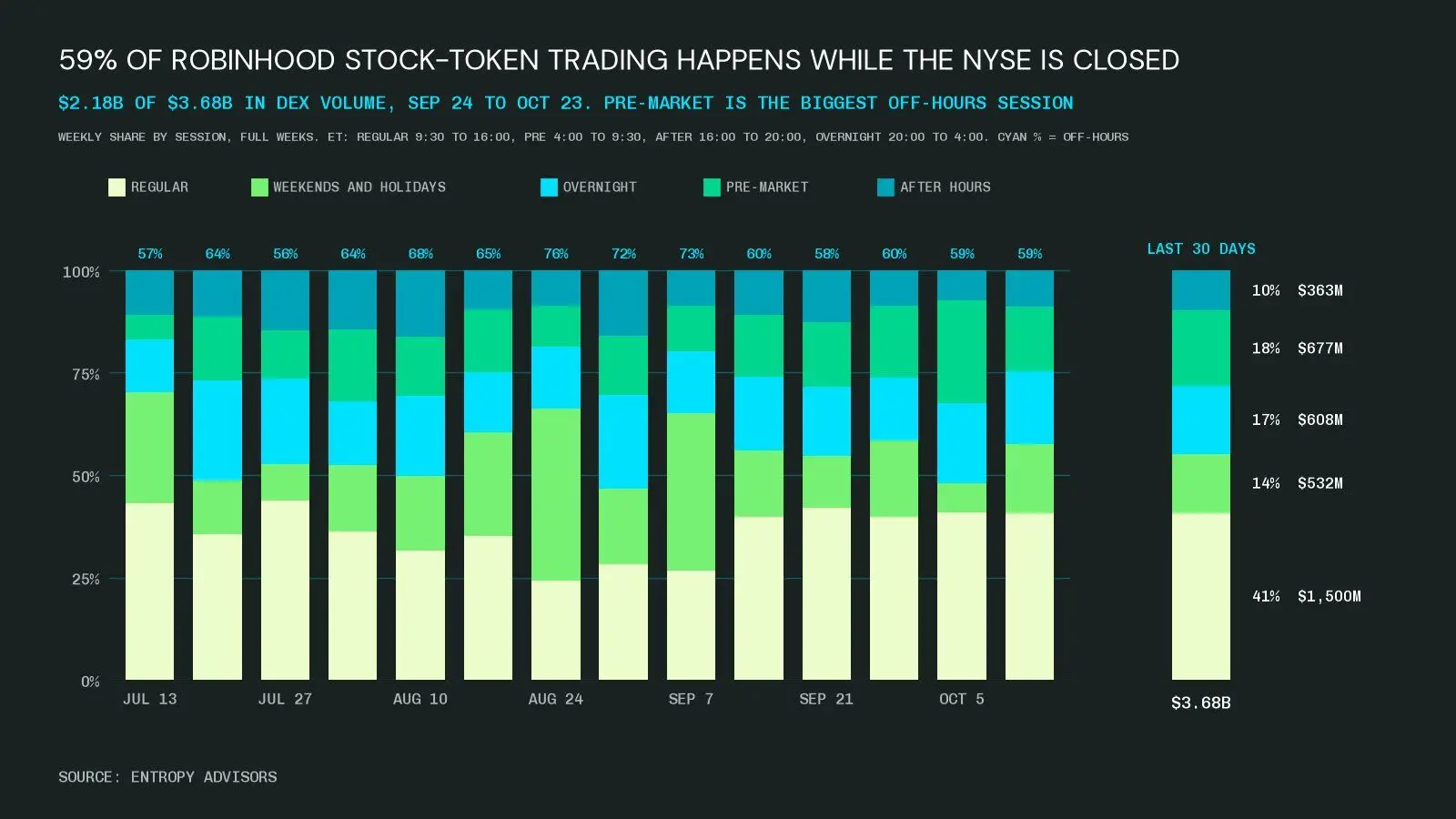
Figure: A large volume of trading in Robinhood stock tokens occurs during traditional U.S. stock market closures (Data Source: @TomWan)
It wasn't until last Thursday that holders of Robinhood's stock tokens truly welcomed a qualitative moment of asset empowerment.
On October 22, Morpho officially launched the lending market on the Robinhood chain, allowing stock token holders to borrow stablecoins using tokenized stocks as collateral. Prior to this, on September 25, Aave had already launched a similar collateral lending service for Coinbase's tokenized stocks.
However, the mere collateral function does not make tokenized stocks a superior way to hold shares. In most cases, tokenized stocks still lack complete shareholder voting rights.
But the real disruption brought by supporting tokenized stock collateral loans is that it allows those who favor on-chain assets to truly activate the stocks in their hands. By using stocks as collateral to borrow stablecoins, tokenized U.S. stocks are transforming from static assets that merely solve "global buying access" into productivity tools with actual financial utility.
However, the fatal risk lies in the fact that these on-chain loans continue to operate and accrue interest throughout the weekend, while the prices of the underlying stocks in traditional financial markets do not update at all. This disconnection can easily trigger malicious arbitrage and market manipulation driven by price mechanisms.
In this article, I will delve into the immense energy released by tokenized U.S. stock lending, who profits from each link in the industry chain, and how on-chain finance should price these silent moments when all of Wall Street falls asleep.
A New Credit System Without Broker Intervention
Borrowing funds using stocks as collateral is fundamentally the most basic feature of high-quality financial assets. Any excellent underlying asset, aside from passive holding, should allow holders to derive a rich space for financial operations.
In the U.S., this collateral lending privilege has long been firmly held by traditional brokerage firms. Opening a conventional Reg T margin account usually requires a starting threshold of $2,000, allowing borrowing of up to half the market value of stocks. Charles Schwab's asset pledge credit limit starts at a staggering $100,000, with an annual borrowing interest rate of about 8.27%.
Regardless of how these traditional product forms evolve, they are all built on an ironclad premise: lenders must hold all your collateral and the broker unilaterally strictly approves whether you qualify for borrowing.
However, looking at the vast markets outside the U.S., these lending prerequisites often cannot be established at all. Many local brokers overseas even directly prohibit investors from pledging their U.S. stock assets.
For example, the "Liberal Remittance Scheme" (LRS) established by the Reserve Bank of India explicitly restricts domestic residents from engaging in speculative trading overseas. The mainstream application Vested Finance used by Indian residents to purchase U.S. stocks only supports cash accounts; Interactive Brokers' Indian branch also explicitly prohibits local residents from using margin leverage products in foreign markets.
This leads to an absurd reality: an Indian investor holding $20,000 worth of Nvidia stock through the aforementioned application can freely trade but absolutely cannot use it for any collateral lending. The same Nvidia stock instantly becomes a "second-class asset" with significantly reduced practicality in the hands of overseas investors.
Of course, these regional restrictions are not absolute. Interactive Brokers has a wide customer base in many countries and regions, and in the third quarter of 2026, it achieved an average stable yield of 4.25% from its margin loan business; Nigeria's retail investment application Trove also began offering double purchasing power leverage for U.S. stock trading in August this year.
Therefore, credit services using stocks as collateral do objectively exist in most regions, but they invariably come with high minimum capital thresholds, cumbersome and lengthy paper material approvals, and centralized brokers with absolute discretion.
Asset tokenization fundamentally reshapes this ancient mechanism. It strips collateral from the broker's closed balance sheet and fully returns it to the user's own on-chain wallet. Once assets are under autonomous control, any decentralized lending protocol that accepts the token can instantly provide liquidity support.
As for how much you can borrow, it fundamentally depends on the collateral haircut rate, and different on-chain markets have vastly different pricing strategies for this. Kraken began accepting 10 types of xStocks as futures and margin collateral on July 3: for the index-tracking SPYx, a 10% haircut, for individual blue-chip stocks like Nvidia, a 20% haircut, and for highly volatile assets like Robinhood's own stocks, a 30% haircut.
On the Aave platform, borrowers can pledge 7 types of Coinbase stock tokens to borrow USDC: the borrowing limit for Microsoft can reach 79% of market value, for Nvidia 70%, and for Tesla and Meta 65%. In Aave's mechanism design, borrowing limits often closely align with liquidation lines, meaning that borrowers at the maximum borrowing level are already on the edge of liquidation from the start.
The emerging protocol Paboxo joined the Robinhood chain on October 19, followed closely by Morpho three days later. Morpho set the liquidation line for Nvidia token loans at 62.5%, while the liquidation line for the S&P 500 ETF (SPY) token was set at 77%, providing a relatively lenient risk control line for large-cap index funds with volatility far lower than individual stocks.
On the Aave platform, the number of active wallets participating in U.S. stock token collateral lending surged from just 8 before October 18 to 144. Notably, three-quarters of these users had never used Aave on the Base chain before.
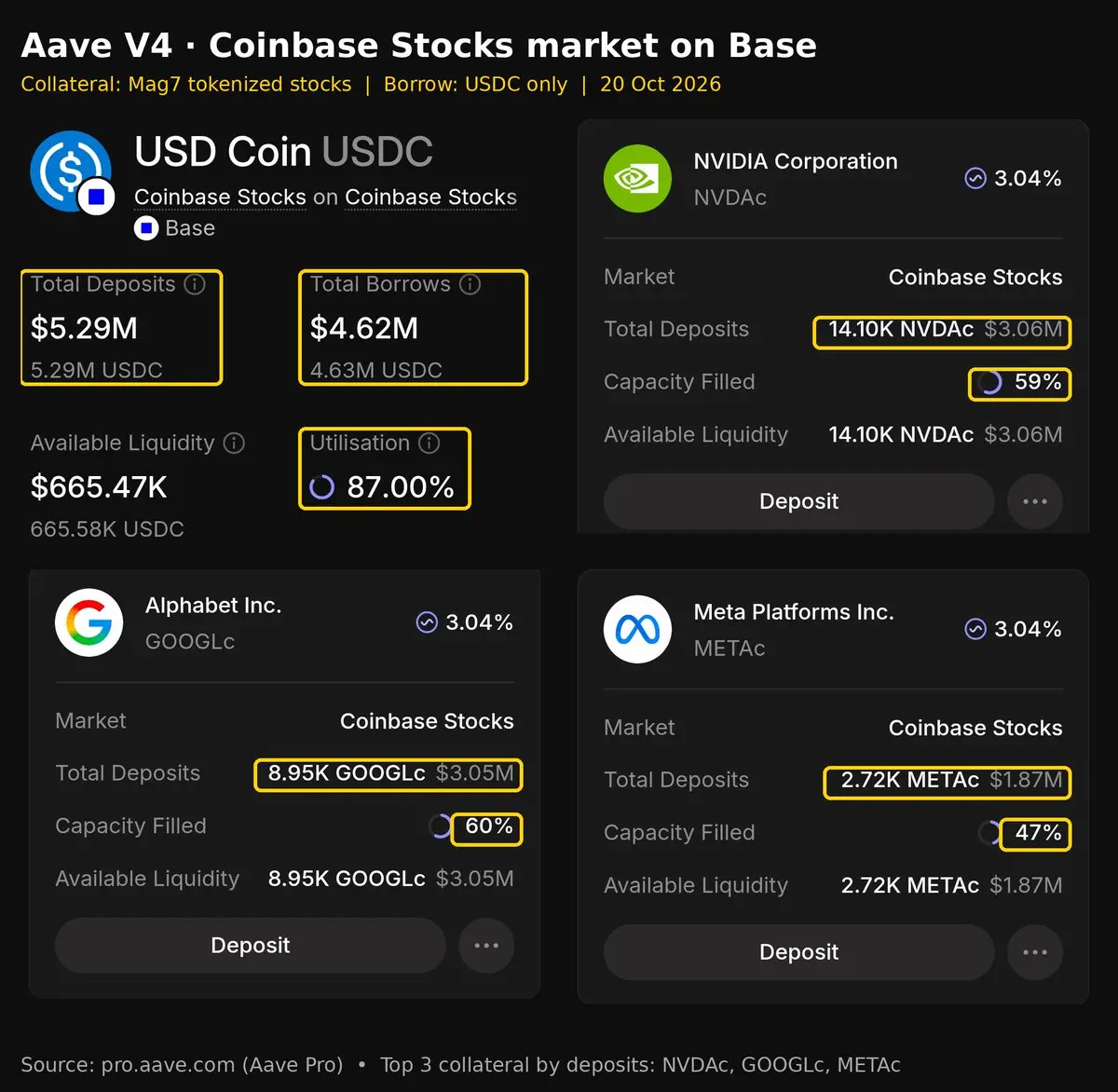
Figure: The number of Aave stock token lending addresses surged, with the vast majority of lending occurring during traditional U.S. stock market closures.
A professional security auditing firm responsible for setting Aave's risk parameters, LlamaRisk, found that the vast majority of tokenized U.S. stock lending activities occurred after the traditional stock market closed. This influx of new users on-chain is calling upon liquidity during non-working hours when traditional brokers would never lend.
However, while tokenization eliminates traditional brokers, it also introduces new centralized issuers, albeit with a broader gatekeeping threshold. Gatekeepers still exist: both Robinhood and Coinbase's stock tokens are currently strictly prohibited from being sold to individuals in the U.S.
Moreover, the rights held by token holders are far thinner than those of real stocks. Robinhood's stock tokens are essentially debt securities issued by Robinhood Assets (Jersey) Limited, registered in Jersey, whose official filing documents clearly state that the tokens do not confer any statutory or beneficial rights to the underlying company; Coinbase's tokens are certificates issued by its special purpose vehicle (SPV), which typically reinvest dividends rather than distribute cash.
Even for mature investors who already have high-level margin accounts at Interactive Brokers, stock tokens can still achieve many advantages that traditional stocks cannot reach: loans do not require cumbersome credit applications, collateral settles on-chain within minutes, and even if you urgently need funds on a Saturday afternoon, cash can arrive in seconds. But aside from these experiential innovations, its true core moat is providing credit services in a market where traditional brokers are completely silent.
There is a timeless fundamental rule regarding the nature of financial assets: any asset that can be accepted as collateral by lending institutions has an inherent value that is always higher than assets that cannot be used as collateral. U.S. Treasury bonds are the most extreme embodiment of this: investors are willing to accept lower yields because they possess extremely high safety and liquidity, almost instantly pledgeable and realizable in any financial corner of the world.
Tokenized stocks currently completely lack this sovereign-level credit background, which is the fundamental reason for their collateral haircut rates reaching as high as 10% to nearly 40%. The high collateral haircut is the risk premium marked by the market for the lack of legal protection and liquidation depth in tokenized U.S. stocks. Compared to real stocks, the collateral premium obtained is inevitably lower, and borrowers must pay for these deficiencies through higher collateral redundancy.
How Value Accumulates at Each Level of the Industry Chain
Basic lending is merely the tip of the iceberg for the entire ecosystem. Once tokens can be leveraged as compliant collateral to unlock credit, various derivative financial products will quickly rise above, with every segment of the industry chain profiting from it.
The first layer is purely the demand for liquidity. Aave founder Stani Kulechov stated that the borrowing interest rate in Aave's U.S. stock collateral lending market is about 5%. Although this cost is slightly higher than top traditional brokers like Interactive Brokers, its core selling point has never been the interest rate but rather the absence of any account asset review and broker approval, allowing funds to be borrowed instantly on a Saturday afternoon.
The second layer is the leveraged loop. Pendle's PendleLoop allows users to collateralize stock tokens on Aave to borrow USDC, buy more stock tokens on the spot, and repeat the staking loop. With this minimalist one-click operation, investors can build leveraged positions of up to 2.6 to 4.2 times in Nvidia or Microsoft, with platform fees waived until December 31. In contrast, retail investors in the U.S. are typically limited to 2x margin leverage with traditional brokers. The Aave risk control team sets parameters as a ceiling limit, while Pendle's front-end interaction directly packages it as the user's leveraged offensive target.
The third layer is the margin for derivatives trading. Kraken allows the use of xStocks as collateral for contract trading, with credit limits for each stock set between $100,000 and $1,000,000. As of September this year, over 300,000 people hold xStocks, and the Apple stocks in their accounts can now directly provide margin support for Bitcoin futures contracts without needing to sell.
The fourth layer extends from the savings end to the lending end, creating a closed-loop of funds. Robinhood's Earn product allows eligible U.S. savers to deposit USDG into the Morpho vault managed by Steakhouse Financial. Steakhouse, as the curator of the vault, acts as the risk control brain that decides the allocation of pooled assets.
As of this week, the vault has accumulated approximately $543.6 million from about 75,000 wallets. Steakhouse has officially approved the vault to provide collateralized loans for Robinhood stock tokens, with a temporary borrowing limit of 1 million USDG for each sub-market.
This creates a highly ironic micro-arbitrage closed loop: U.S. domestic investors in Robinhood Earn, whose deposited dollar savings are providing loan funds for tokenized U.S. stocks that they themselves are legally prohibited from purchasing. Although the overall dollar exposure is still manageable, this underlying structure has taken shape: compliant savings products in the U.S. are quietly transforming into the ultimate major funders behind global tokenized U.S. stock collateralized credit.
On this massive new credit assembly line, different business layers capture their respective commercial value.
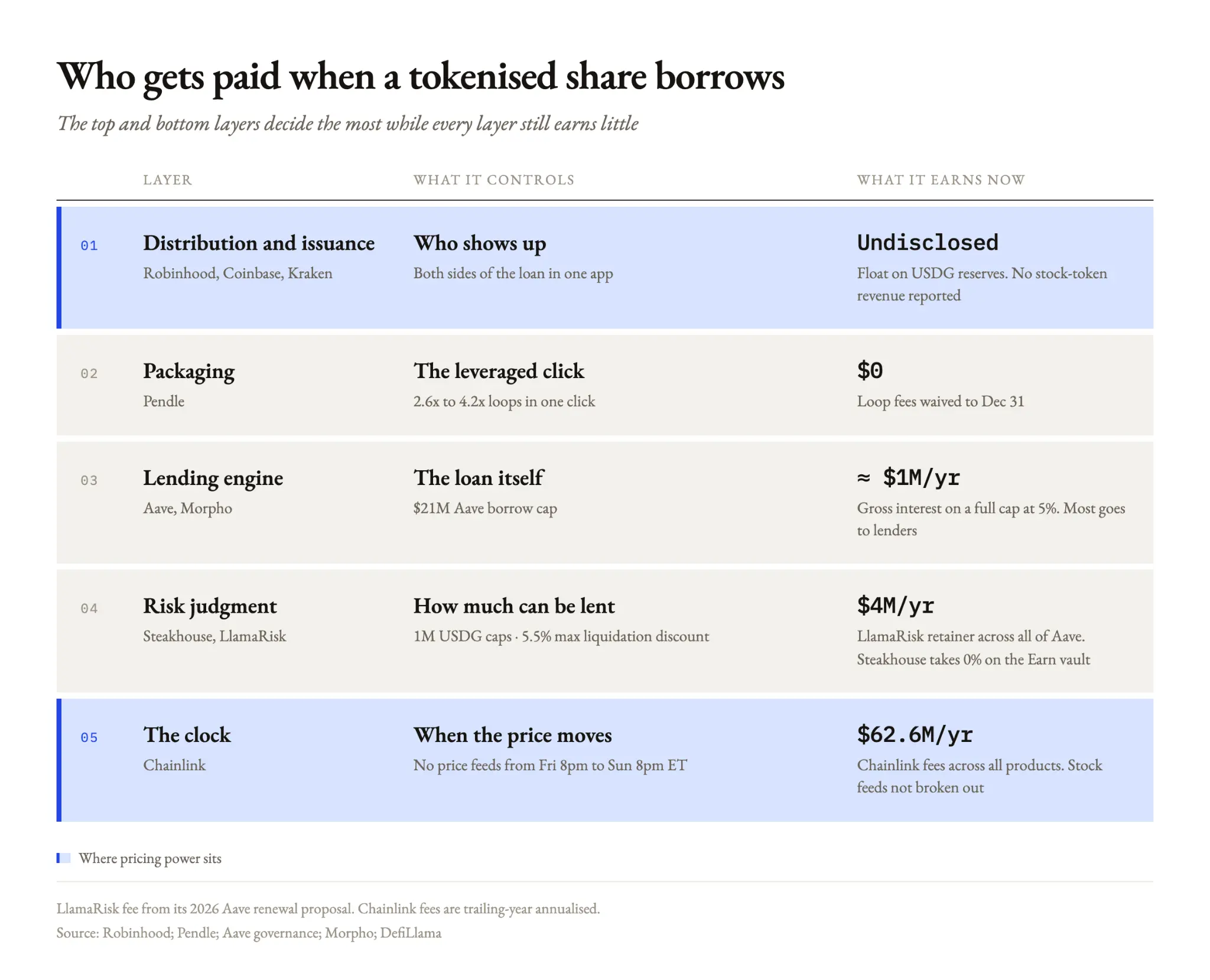
Figure: Tokenized stock lending ecosystem architecture and full industry chain value capture map
Asset issuers sit at the very top of the entire value stack. Take Robinhood as an example; it is not only responsible for issuing stock tokens but also operates a dedicated chain for token circulation and firmly controls the super app entry point for depositors to input underlying loan funds. The collateral of borrowers and the existing funds of lenders are entirely consolidated within the closed-loop application of the same commercial entity.
Moreover, issuers can continuously take a cut from the liquidity reserves, as Paxos shares the underlying U.S. Treasury yields generated from USDG reserves with partners in the Global Dollar Network proportionally. Coinbase has replicated the same script on the Base chain, while Kraken fully owns the issuer Backed behind xStocks.
Following closely is the product packaging layer. Pendle does not lend out any principal; it monopolizes the one-click interactive entry for retail investors seeking high leverage and efficiently routes the generated underlying lending demand to Aave.
The underlying decentralized lending protocol steadily earns the interest spread between what borrowers pay and what savers receive. Given the current business scale, this remains a relatively thin business: Aave strictly limits the total lending scale of its U.S. stock market to $21 million. Even at a 5% lending rate fully lent out, the annual interest income would only be about $1 million, and most of that revenue must be transferred to liquidity providers.
Risk curators and risk control teams extract service fees by selling professional risk judgment. Steakhouse decides how much of the $543 million in its managed savings vault can be involved in U.S. stock collateralized loans; LlamaRisk accurately determines that liquidators on Aave can only enjoy a maximum liquidation discount of 5.5% when seizing collateral from defaulting borrowers.
Meanwhile, Chainlink dominates the most critical time dimension. It provides real-time price feeds for Coinbase and Robinhood stock tokens to all lending protocols, directly controlling when prices fluctuate and when they freeze.
This aligns perfectly with the market structure I have repeatedly discussed: distribution channels determine who can participate, while risk curators decide how much credit leverage borrowers can access.
At this stage, no institution has been able to earn astonishing profits from this. Robinhood has yet to disclose the independent revenue of its stock token business, with its third-quarter official financial report set to be revealed after the U.S. stock market closes tonight.
However, the potential market cake behind this track is astonishing. As of the end of September this year, the margin loan balance held by Interactive Brokers reached $105.2 billion, with net interest income for a single quarter exceeding $1.15 billion; the total margin debt in the U.S. reached a staggering $14.8 trillion in September. In contrast, the total lending amount in Aave's U.S. stock token lending market was only $4.08 million as of October 18, merely 0.004% of Interactive Brokers' scale, indicating vast potential for growth.
How to Price the Liquidation Risk of Market Closure Time Differences
All collateral-based credit systems rely entirely on the accuracy of the immediate market value of collateral. Chainlink's U.S. stock price feed oracle remains active and updates only between 8 PM Eastern Time on Sunday and 8 PM on Friday, while during the entire weekend and U.S. federal holidays, the feed will be completely frozen at the last point from Friday's close.
However, the on-chain decentralized lending market never sleeps. Borrowing channels and liquidation auctions are ready 24/7, and lending interest continuously compounds every second.
This time gap between traditional finance and on-chain mechanisms leaves two fatal arbitrage loopholes for malicious speculators. During the frozen oracle price over the weekend, if a listed company suddenly experiences a significant negative event, savvy borrowers can borrow stablecoins at the inflated price frozen on Friday, knowing full well that the stock will plummet on Monday's opening. Ultimately, the lending protocol and lending vault will have to swallow the massive bad debt from the collateral's market value plummeting far below the loan principal.
So, would introducing on-chain 24/7 decentralized exchange trading prices for weekend pricing solve the problem? The answer is that it would trigger a more severe systemic crisis. The liquidity of tokenized stocks on-chain during the weekend is extremely shallow: Aave's official risk assessment shows that the depth of stock tokens on the Base chain can only withstand sell-offs of $300,000 to $1.1 million; exceeding this scale would cause prices to slip sharply by over 2%. If a whale maliciously dumps and suppresses the weak on-chain price, it would directly trigger a large number of healthy borrowers to face innocent flash liquidations.
This painful lesson has historical precedent: On July 28 of this year, a single SK Hynix stock was traded at an anomalously extreme transaction price 30% lower than the previous closing price in the pre-market trading in South Korea, and the oracle indiscriminately synchronized this transaction price to Hyperliquid, instantly causing 960 leveraged accounts to face ruthless liquidations, involving an amount as high as $57.4 million. However, within just a few minutes, the stock quickly rebounded in the regular market opening.
Even without any malicious manipulation, the natural gap of time can severely injure honest borrowers. The market's accumulated bullish and bearish momentum over the entire weekend often erupts in a concentrated manner in the form of a gap at the first moment the oracle resumes pricing on Sunday night.
In January 2025, Nvidia experienced a market downturn during a weekend when news from DeepSeek fermented, plummeting 17% at the opening before stabilizing and rebounding. However, on Aave, a prudent borrower with a 60% collateralization rate (liquidation line at 70%) would be directly liquidated at the single jump determination when the oracle resumed updates, unable to supplement any collateral, and even deprived of the opportunity to wait for future valuation recovery.
Major lending protocols are striving to resolve this structural ailment. Setting strict limits on loan pool sizes helps control the overall risk exposure of the protocol within manageable limits; Paboxo has chosen to completely freeze the liquidation mechanism during traditional U.S. stock market closures, which temporarily protects borrowers but shifts all potential liquidation risks unreservedly to the critical moment when the market resumes opening; Jupiter's Offerbook is exploring the introduction of fixed-term loans ranging from 1 to 30 days, completely abandoning liquidation determinations based on real-time market value, instead pricing liquidity risk entirely into higher lending rates.
Starting December 6, U.S. traditional exchanges will launch a quasi-around-the-clock trading mechanism lasting 23 hours a day, five days a week. While this significantly compresses the overnight shutdown time window to one hour, the long and unpredictable weekends remain a fog of valuation that cannot be penetrated.
I firmly believe that relying solely on oracle algorithms cannot perfectly cure the time gap problem of weekends. Major lending institutions will ultimately have to choose to fully account for and transfer the unseen potential black swan risks into more stringent haircut rates. This means that the credit leverage that tokenized stocks can leverage will inevitably be slightly inferior to that of real stocks under traditional brokerage systems. However, for those global marginal investors who have been completely shut out by traditional Wall Street brokers, even a discounted liquidity loan can become an epoch-making tool to break the ice of class and regional barriers.
Major lending protocols will continue to charge for the time value of funds on an hourly basis or pre-lock loss limits for potential market shocks. For the global tokenized capital market, this is merely the prologue to a grand reconstruction that has just begun.
 Risk warning Risk warning



Popular articles