Binance to the left, Upbit to the right
 Core Viewpoint


 In the stock market, no exchange would want to miss out on this piece of cake; it's just that Upbit is still blocked by regulations and can only rely on continuously listing new coins to maintain traffic.
Author: Zhou, ChainCatcher
On November 10, South Korea's largest cryptocurrency exchange Upbit opened trading for the Hyperliquid native token HYPE, with Bithumb following suit on the same day.
On the same day, OKX launched the tokenized Oracle stock xORCL. Looking back a week, Huobi HTX launched 20 types of US stock tokens and ETFs, Gate opened trading for stocks like TSMC and MediaTek, and Bitget brought Morgan Stanley and Reliance Industries into the perpetual contract market, also announcing the opening of the IPO subscription channel for Anthropic.
Flipping through the announcement boards of the world's leading exchanges, the newly listed names increasingly resemble a brokerage product catalog, with new coins becoming the minority.
In contrast, Upbit has been launching new tokens more frequently this year, with nearly a hundred new trading markets opened in the first three quarters. Especially in the Korean won market, the launch speed once reached about 16 new tokens per month, more than twice the average of the first half of the year.
It's hard to say that Korean exchanges are more loyal to native cryptocurrencies; they have almost no other choice. Since 2017, Korean regulations have established a wall between the financial industry and the cryptocurrency industry, prohibiting financial institutions from engaging in crypto assets, and making it difficult for crypto exchanges to enter traditional finance. Derivatives have yet to be opened up within the system, and the upcoming tokenized securities will have their circulation channels handed over to the securities system.
Leading Exchanges Shift to Tokenized Stocks
By the end of 2025, Binance established a tiered listing process for Alpha, contracts, and spot trading. According to Binance, as of April this year, out of 200 tokens displayed on Alpha, 99 entered the contract market, while only 35 made it to the spot market. The speculative demand for new tokens remains in the Alpha and contract layers, leading to a significant slowdown in new listings on the spot market.
According to Binance Research, Binance launched a total of 87 new projects in the spot market in 2025, while data from flexe.io shows that as of November 11 this year, only 26 new tokens have been listed on Binance's spot market.
The same statistics show that Binance announced the delisting of 49 tokens this year, with 64 tokens marked for observation, while in 2025, these numbers were 27 and 42, respectively. With fewer new listings and more delistings, Binance's spot market is rapidly contracting.
Of course, this is also influenced by changes in the market environment. According to CoinGecko data, the total market capitalization of the cryptocurrency market fell by 20.4% in the first quarter of this year, and the trading volume of centralized exchanges in the spot market decreased by 39.1%.
Regulation is also a consideration. In June of this year, Binance withdrew its MiCA license application before a formal decision was made by the Greek regulatory authority, and the compliance officer dispatched by the U.S. Financial Crimes Enforcement Network is still in office.
For an exchange that has to deal with regulation at every turn, widely launching high-risk new tokens on the spot market can easily become a scrutinized aspect.
More critically, Binance has shifted more focus to traditional financial assets on-chain. After the Abu Dhabi Global Market Financial Services Regulatory Authority approved the issuer's prospectus, Binance launched tokenized securities bStocks linked to U.S. stocks and ETFs, with almost weekly new listings starting from late September.
Binance is not the only one taking this path. In March of this year, OKX received a strategic investment from the parent company of the New York Stock Exchange, ICE, reaching a valuation of $25 billion, after which tokenized stocks began to be launched in batches, and stock X-contracts are continuously expanding. The number of stock perpetual contract targets supported by Bitget has reached 408, and Gate and Huobi HTX are also expanding their stock-related assets.
Although the current scale of tokenized stocks is still not large, according to RWA.xyz data, as of November 10, the total value of on-chain tokenized stocks is approximately $3.88 billion.
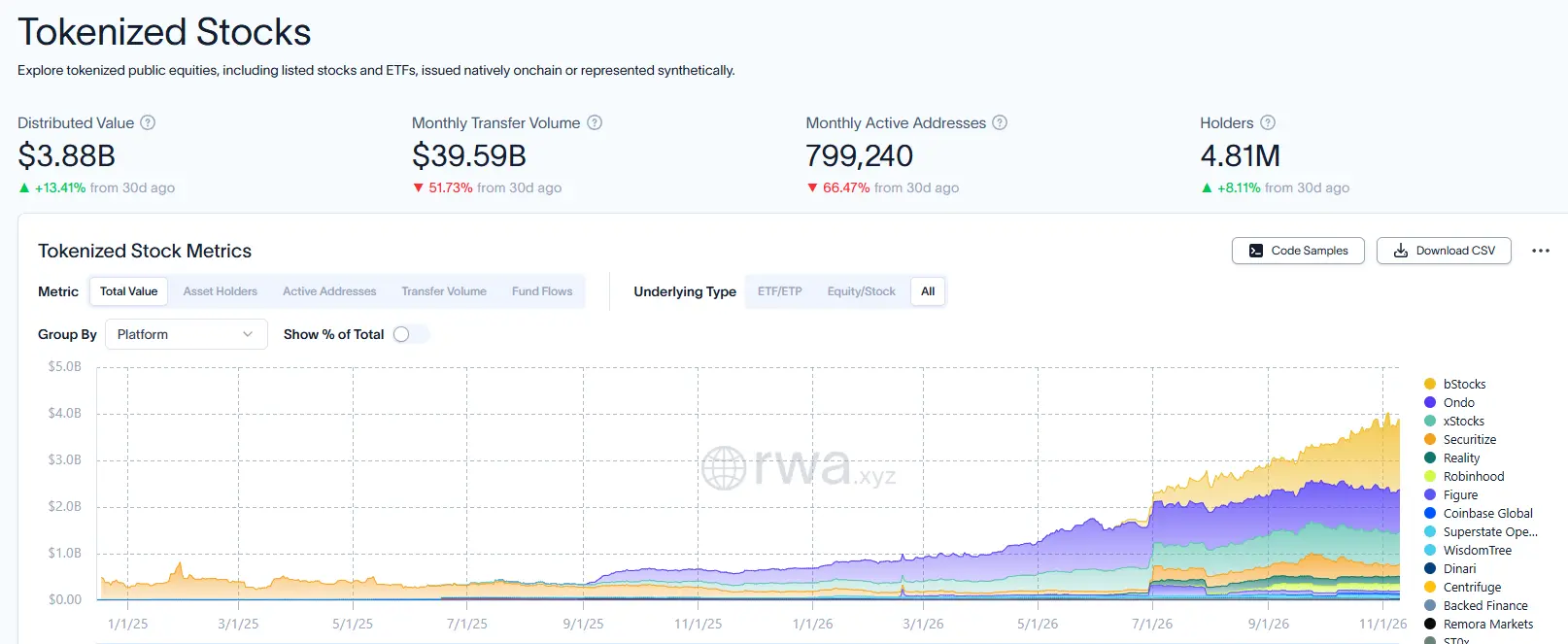
Exchanges are attracted to the market behind it. According to Bloomberg data, the total market capitalization of the global stock market in the third quarter of this year was approximately $165 trillion. Meanwhile, the total market capitalization of the entire cryptocurrency market is about $2.59 trillion, making the global stock market over 60 times larger. The scale of tokenized stocks is still less than one ten-thousandth of the global stock market.
Even moving a small portion of the stock market on-chain represents a much larger cake for exchanges than native crypto assets.
Locked in Spot Trading, Upbit Can Only Defend by Listing New Tokens
Why specifically mention Korean exchanges? They may be the last decent bastion for native assets in centralized exchanges.
Looking at the entire year, the two lines of Binance and Upbit have crossed. Last year, Binance launched 87 new tokens in the spot market, clearly higher than Upbit's 59. This year, the situation has reversed; Binance has only launched 26 new tokens, while according to South Korea's JoongAng Ilbo, Upbit had already opened 59 new Korean won trading pairs by mid-August, matching last year's total in less than eight months.
If we only look at the last three months, the contrast is even more pronounced. According to ChainCatcher's statistics based on official announcements from various exchanges, from early August to now, Binance has announced only 4 new crypto assets: MARSCOIN, Niu Lai, HYPE, and PREDICT, with PREDICT later announcing a delay in its launch. During the same period, Upbit launched 39 new tokens, and Bithumb launched 29.
The Korean exchanges' "commitment" to native crypto assets can be traced back to Korean regulations.
In 2017, the Financial Services Commission of Korea issued administrative guidance restricting financial institutions from holding and operating crypto assets. The principle of separating finance and crypto has continued to this day, making it difficult for crypto exchanges to enter traditional finance.
Korea has yet to establish a regulated market for crypto derivatives, and users with trading needs can only flow to overseas platforms.
The path for tokenized securities is also blocked. In January of this year, the Korean National Assembly passed legislation related to tokenized securities, incorporating them into the Capital Markets Act, with circulation channels handed over to securities companies and over-the-counter trading intermediaries. The relevant laws will take effect on February 4, 2027.
Global peers can engage in contracts and list U.S. stocks, while Korean exchanges are left with only cryptocurrency spot trading, resulting in a particularly singular revenue structure.
According to the electronic public disclosure system of the Financial Supervisory Service of Korea, in the first quarter of this year, the trading platform fee revenue of Upbit operator Dunamu accounted for 97.49% of total revenue, while for Bithumb, this ratio was close to 99.99%.
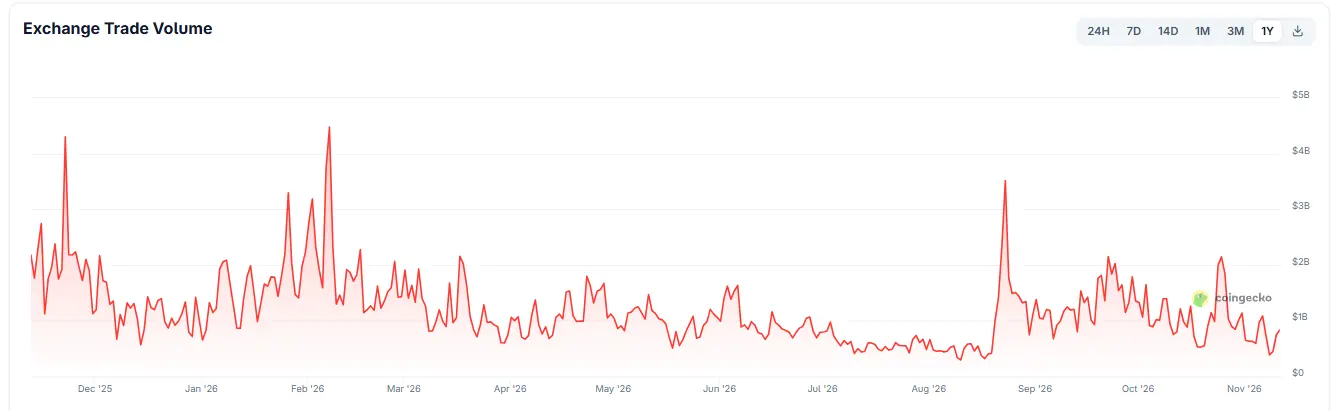
This year, the overall crypto market has remained in a downturn. According to CoinGecko data, the total trading volume of the five major Korean won exchanges in the second quarter decreased by about half year-on-year, with Upbit's decline at 54%.
Transaction fees are almost the only source of income, making new listings the most direct means to drive trading.
At the same time, this is also a battle for market share. The cryptocurrency trading in Korea is almost divided between Upbit and Bithumb. According to CoinGecko data, in September, Upbit accounted for 65.44% of the trading volume among Korean exchanges, while Bithumb accounted for 26.87%.
In such a duopoly market, whoever lists more and faster tokens has a better chance of retaining users.
Korean Exchanges Become the Last Stop in the Token Listing Chain
The new tokens listed on Upbit are rarely making their market debut, which is also a result of regulation.
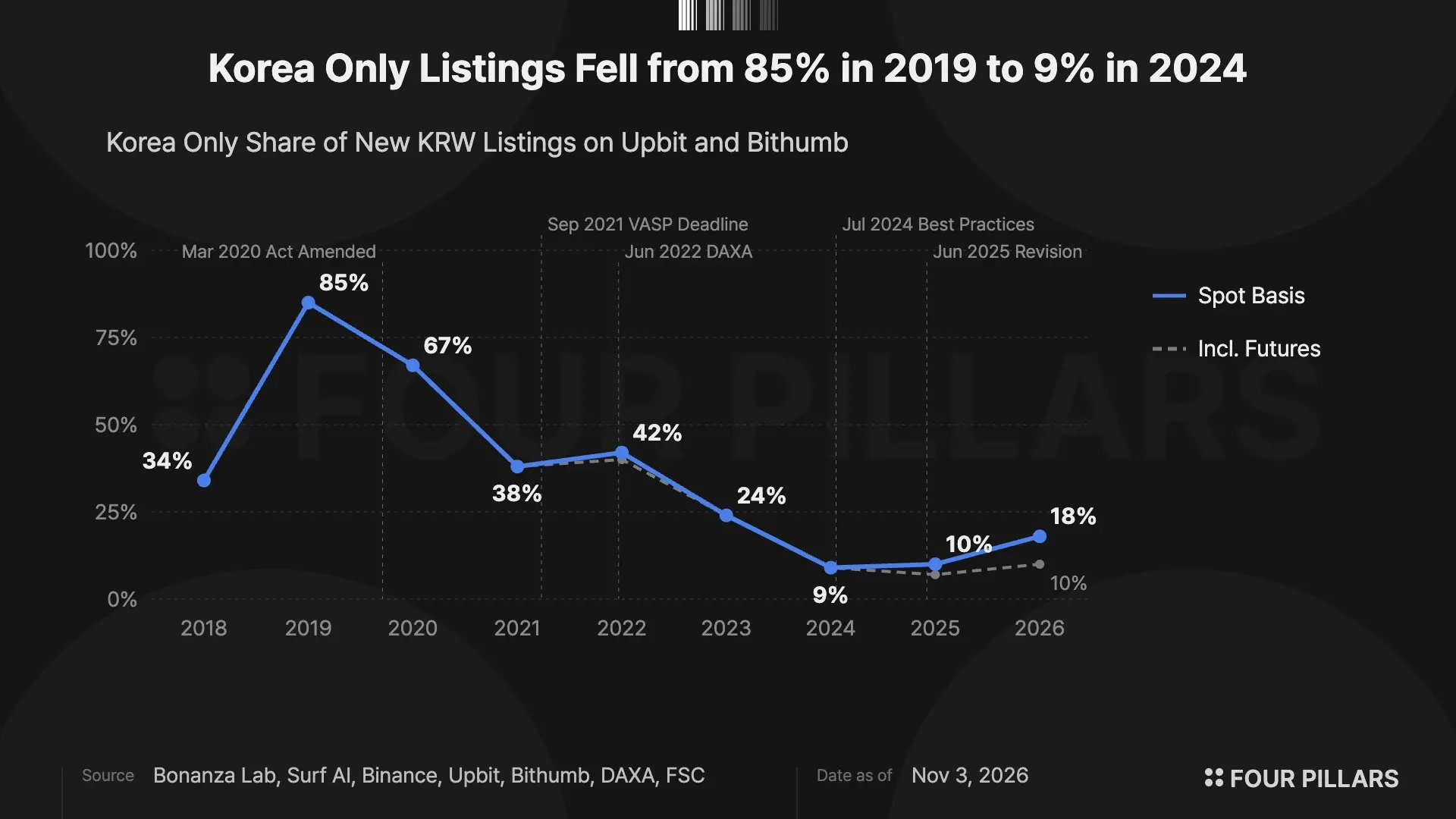
According to researcher tranks from Four Pillars, among the new tokens listed in the Korean won market on Upbit and Bithumb, the proportion of tokens that were first launched in Korea before Binance, OKX, Bybit, and Coinbase has dropped from 85% in 2019 to 9% in 2024.
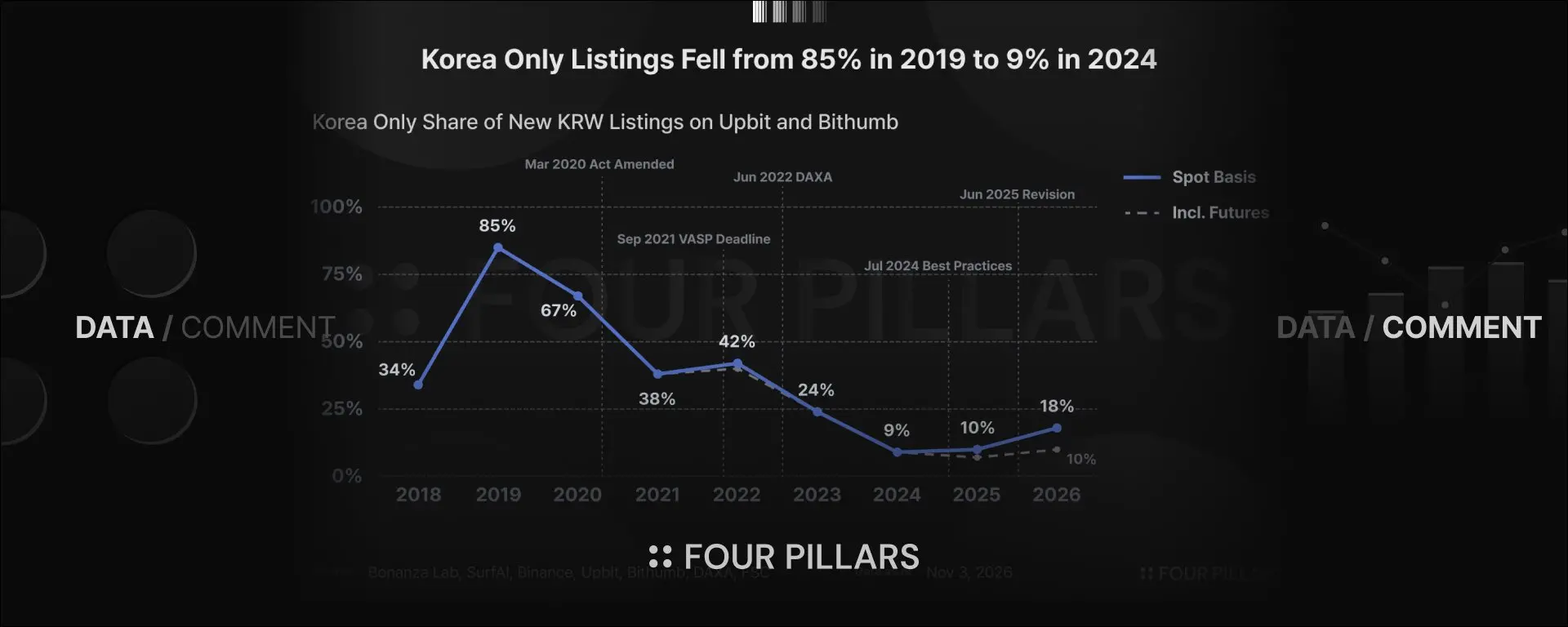
This decline almost coincides with the formation of the Korean regulatory framework. In March 2020, the revised Specific Financial Information Act required exchanges to fulfill registration and anti-money laundering obligations, with a registration deadline of September 2021. The number of tokens launched first in Korea each quarter dropped from 19 to 3, and the annual proportion also fell to 38%.
In 2022, the five Korean won exchanges established DAXA to set common listing review standards; the best practices for listing that will take effect in July 2024 allow assets traded on qualified overseas exchanges for more than two years to be considered as meeting the white paper and information disclosure requirements. By 2024, this proportion has dropped to 9%. Although it rebounded to 18% this year, if we exclude assets that were first traded in overseas contract markets, only 10% remain.
The default path for listing in Korean exchanges has gradually become to first trade overseas and then launch in Korea.
Previously, IOSG Ventures pointed out that in the token listing chain, Coinbase and Bybit undertake early price discovery, Binance contracts subsequently validate liquidity, Binance spot confirms after a pullback, and Korean exchanges are at the end of the chain. Upbit typically lists tokens about 28 days later than the initial exchange. For example, HYPE, which launched on November 10, was already available for spot trading on Binance as early as September 24, with Upbit launching it a month and a half later.
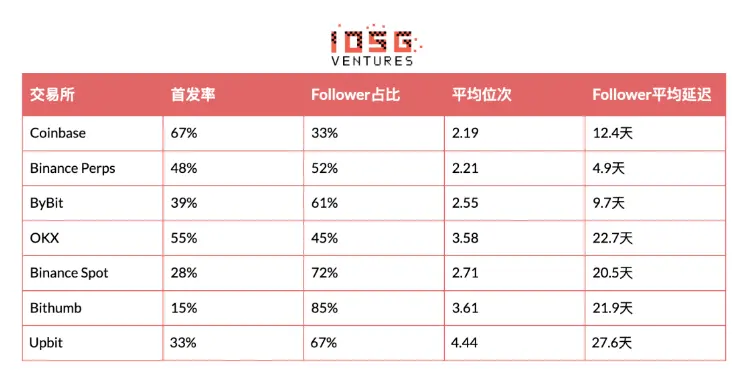
Being at the end of the chain means having to bear the last segment of the market trend. Data from IOSG shows that the entry premium when tokens land on Upbit reaches 27.4%, but the decline after 30 days is also the steepest, at 25.7%.
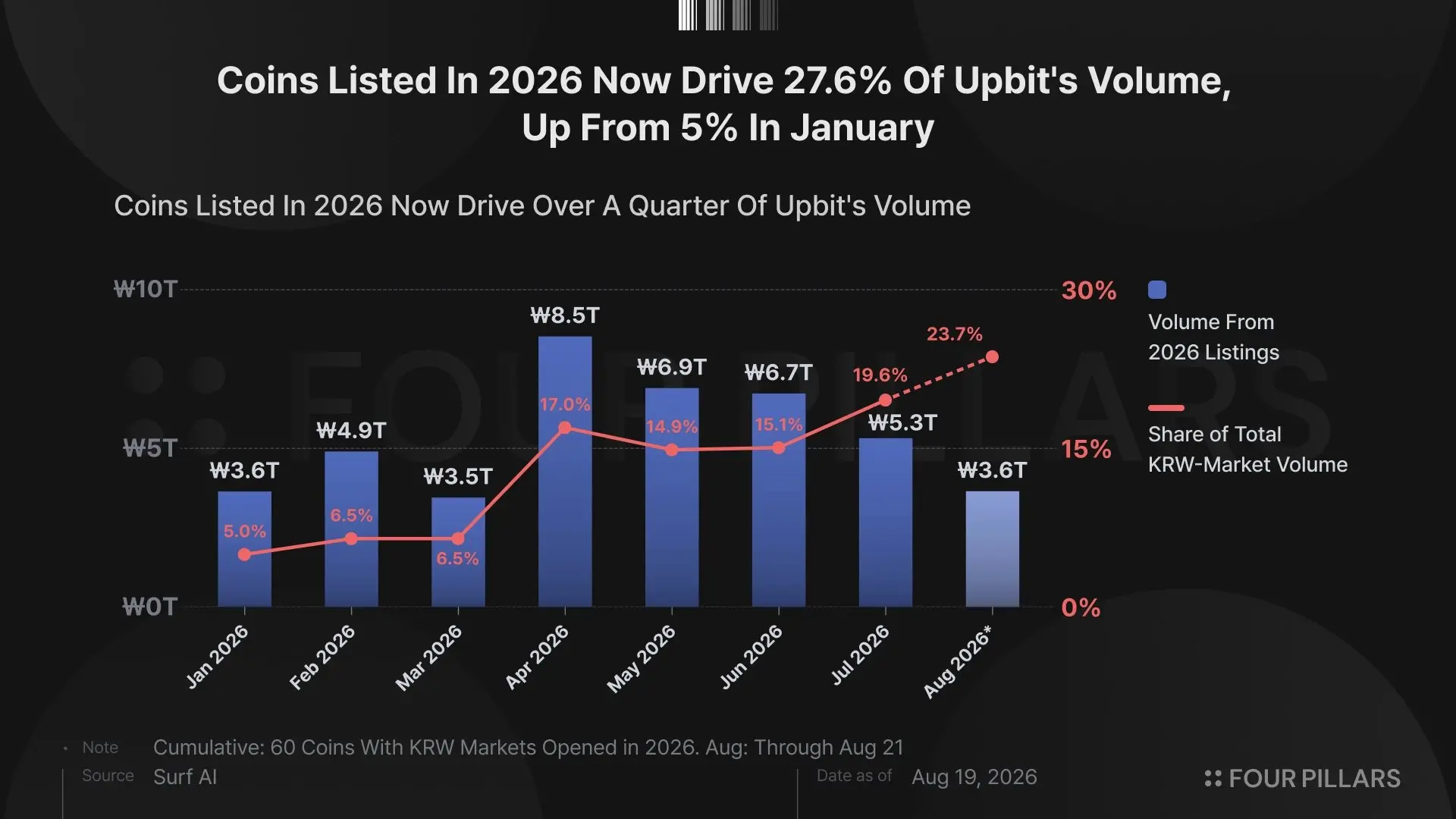
This kind of defense is actually eroding Upbit itself. According to Four Pillars, the proportion of new coins listed this year in Upbit's total trading volume has increased from 5% in January to 27.6% in August. It believes that the scarcity of premium listings on Upbit is being consumed in the defense of trading volume during the bear market.
This year, more and more old coins have been listed on two exchanges in South Korea. In 2025, 47% of new coins were followed up within 30 days of being listed overseas; in 2026, assets that had been traded overseas for more than a year became the largest category, accounting for 31%. Even CRV and RSR, which have been traded overseas for more than six years, made their debut in the Korean won market this year.
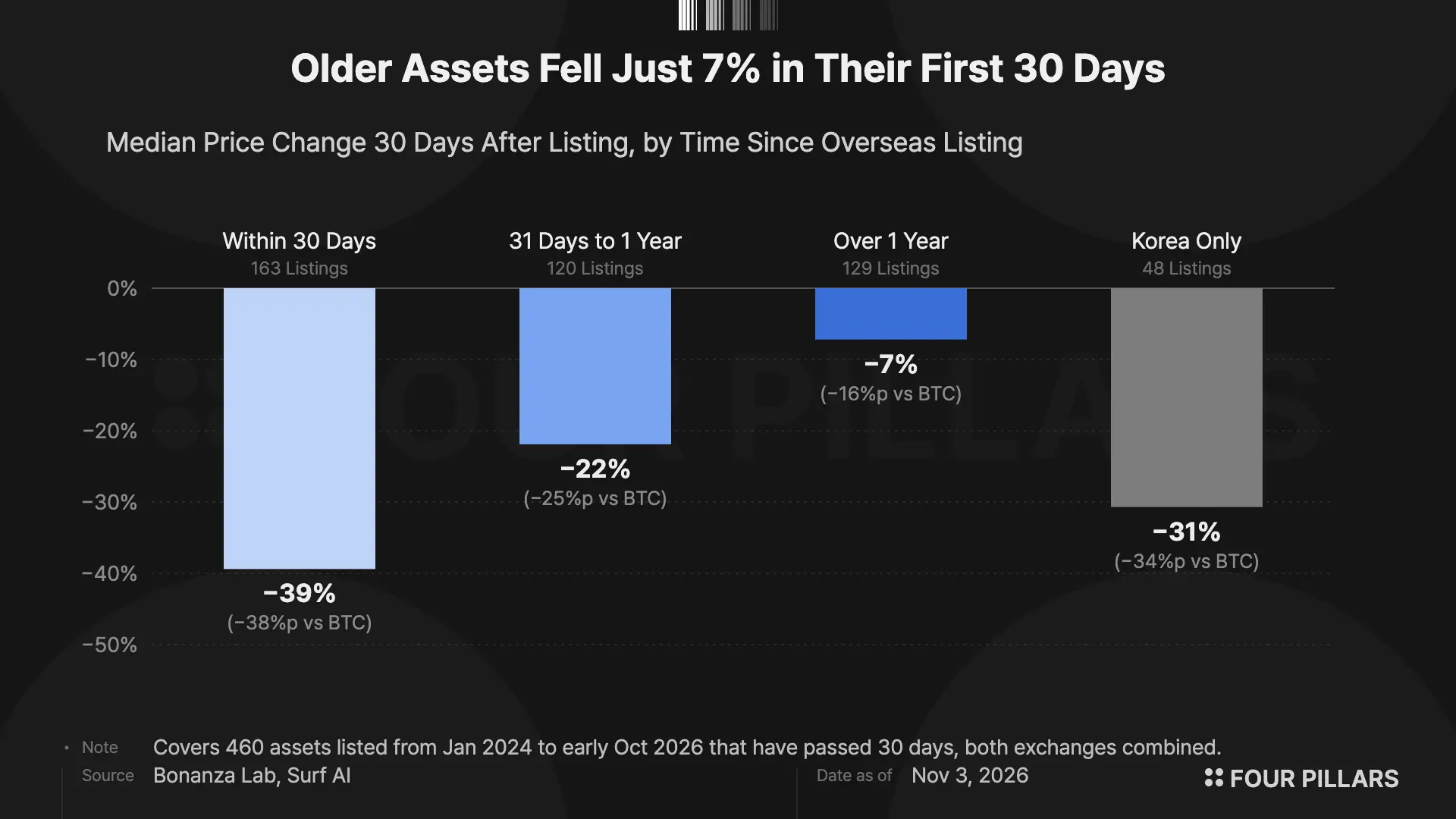
However, old coins have a problem: they do not bring traffic. Statistics from tranks show that for assets traded overseas for more than a year, the median decline within 30 days after listing is only 7%, which is more investor-friendly. However, their median proportion of trading volume on the first day of listing on Upbit is only 5.7%, while new coins that were followed up within 30 days of being listed overseas account for 10.3%.
Final Thoughts
This pattern may not last long.
The challenge facing South Korean exchanges now is to find new trading demands and sources of income beyond listing coins. Clearly, they are aware of this themselves.
On November 10, at the Digital Asset Policy Conference DICON held in Yeouido, Seoul, Dunamu Vice Chairman Kim Hyung-nyeon talked about tokenized stocks. He stated that representative South Korean stocks like Samsung Electronics and SK Hynix can only be traded tokenized on overseas exchanges, which is very painful in itself.
Kim Hyung-nyeon also mentioned that as long as the regulatory framework is designed properly, Dunamu will do its utmost to become a global player representing South Korea.
In fact, the regulatory aspect is slowly shifting. The Chairman of the Financial Services Commission of South Korea has stated that they will study whether to relax and to what extent the restrictions separating finance and cryptocurrency along with the basic law on digital assets.
Min Byung-deok, a member of the ruling Democratic Party, also stated that this law must be passed in the current regular National Assembly, no later than January 18 next year. He also advocated for fully allowing institutions and legal entities to invest in virtual assets.
Once the wall between finance and cryptocurrency is torn down, South Korean exchanges will likely follow the path of their global counterparts, with contracts and tokenized stocks being no exception.
By that time, native crypto assets may not even be able to hold this last stronghold.
 Risk warning
 Risk warning



Popular articles