BTC $78,461.12 -0.74%
ETH $2,484.42 -0.05%
BNB $752.77 +1.83%
XRP $1.42 +1.72%
SOL $103.40 -0.42%
TRX $0.3386 +1.27%
DOGE $0.0900 -0.90%
ADA $0.2194 -0.06%
BCH $258.31 -0.13%
LINK $12.51 -1.98%
HYPE $84.80 -0.58%
AAVE $129.16 -2.16%
SUI $0.8117 -0.79%
XLM $0.1880 -2.82%
ZEC $1,182.29 +3.74%
BTC $78,461.12 -0.74%
ETH $2,484.42 -0.05%
BNB $752.77 +1.83%
XRP $1.42 +1.72%
SOL $103.40 -0.42%
TRX $0.3386 +1.27%
DOGE $0.0900 -0.90%
ADA $0.2194 -0.06%
BCH $258.31 -0.13%
LINK $12.51 -1.98%
HYPE $84.80 -0.58%
AAVE $129.16 -2.16%
SUI $0.8117 -0.79%
XLM $0.1880 -2.82%
ZEC $1,182.29 +3.74%

gpt

All
Article
Flash

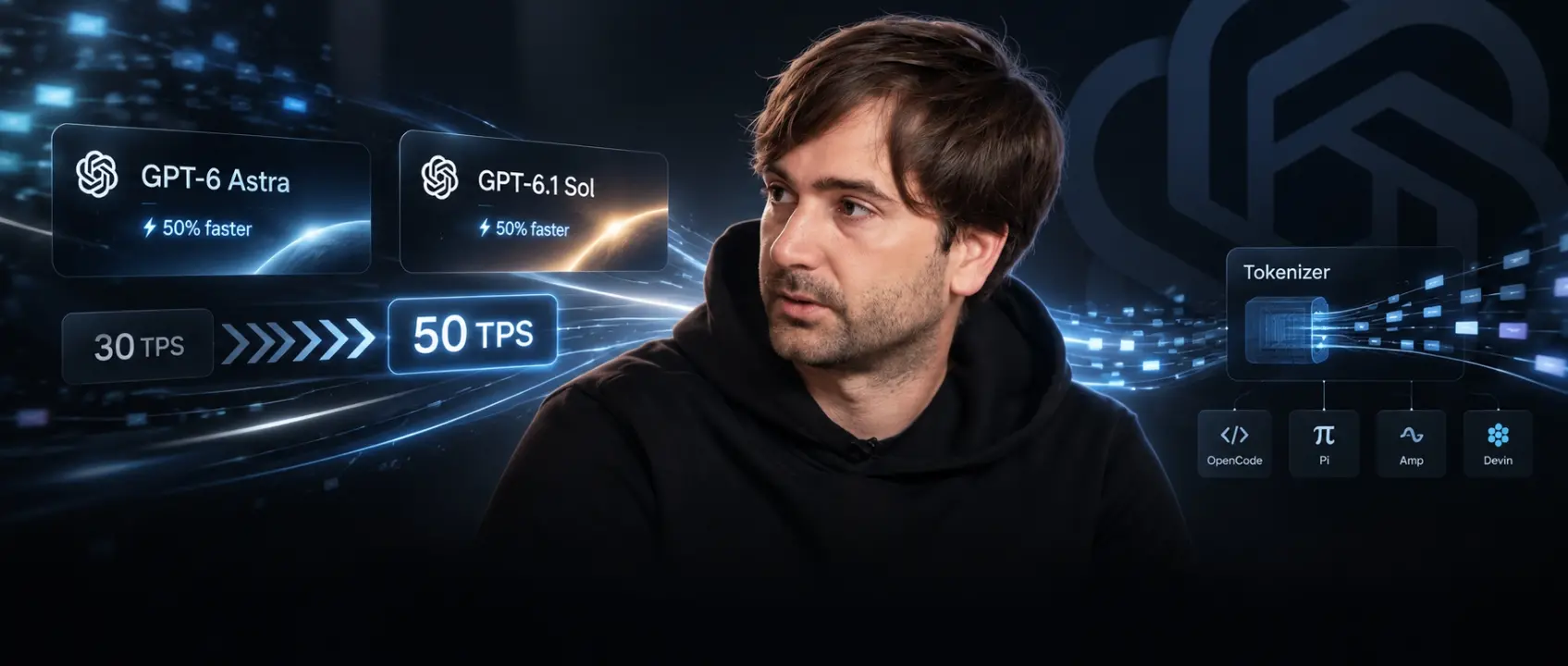
first_img OpenAI released GPT-6 Astra, calling it the arrival of the AGI era

OpenAI officially released GPT-6 Astra on Thursday, with President Greg Brockman calling it a "generational leap in capability" during the press conference, and believing that the model has reached the standard of Artificial General Intelligence (AGI), meaning that artificial intelligence can match or exceed human capabilities. Brockman stated, "Welcome to the era of AGI." If this judgment holds, it means AI entities will be closer to performing reasoning tasks in various complex tasks that humans can do, and even more.GPT-6 Astra is OpenAI's first model to cross the "critical" threshold under its internal danger capability scoring system, the Preparedness Framework, which means it can independently discover previously unknown software vulnerabilities (i.e., zero-day vulnerabilities) without gradual human supervision and chain them into attacks that can run in hardened systems. In testing, the model achieved a score of 100% on the ExploitBench benchmark; to rule out inflated scores due to memory answers, OpenAI conducted a second test using 20 recent vulnerabilities from the Google V8 JavaScript engine. Astra not only surpassed the previous generation GPT-5.6 Sol but also discovered and chained two previously unknown zero-day vulnerabilities, which are still being disclosed to the affected parties.Due to its high autonomy, the monitoring difficulty of Astra has also increased. OpenAI acknowledges that in tests assessing its ability to evade supervision, the model is more difficult to track than previous systems.

OpenAI launches the GPT-5.6-Cyber model, enhancing vulnerability discovery and security research capabilities

OpenAI announced the expansion of its cybersecurity defense program Daybreak and launched the GPT-5.6-Cyber model specifically for the cybersecurity field, aimed at helping authorized security researchers and defense teams enhance their vulnerability discovery, threat analysis, and security testing capabilities. As attackers increasingly leverage AI to launch faster and larger-scale cyberattacks, defenders need to gain advanced AI capabilities in advance.This Daybreak offers two types of access: Daybreak Blue is aimed at most defense teams, providing general models such as GPT-5.6 Sol for vulnerability discovery, secure code review, malware analysis, incident response, and patch validation; Daybreak Red is aimed at advanced security research, providing GPT-5.6-Cyber for authorized vulnerability research, vulnerability validation, and security testing. GPT-5.6-Cyber is trained on GPT-5.6 Sol and optimized for cybersecurity tasks, including discovering zero-day vulnerabilities and analyzing exploit chains. It has been used in actual vulnerability research and has identified high-risk vulnerabilities in software, including the Chrome V8 JavaScript engine. Additionally, OpenAI stated that GPT-5.6-Cyber has also helped discover high-risk vulnerabilities in various domains, including privilege escalation vulnerabilities in mobile operating systems, remote code execution vulnerabilities in databases, and hundreds of privilege escalation vulnerabilities in operating system kernels.OpenAI also emphasized that Daybreak Red will only be accessible to approved individuals and organizations, controlling access through measures such as authentication, account security, monitoring, usage restrictions, and legal disclaimers. The company stated that it will continue to strengthen security monitoring, access management, and model security testing to reduce the risk of advanced cybersecurity models being abused.

hot_img OpenAI releases user profile data for ChatGPT users in various countries: the proportion of "execution" in work scenarios is twice that of daily use, and the proportion of users over 35 has increased by 5 percentage points

On August 6, OpenAI first released usage data of ChatGPT across various countries, showing significant differences in usage across different scenarios, ages, and regions. In work scenarios, users utilizing ChatGPT for execution tasks (writing, editing, analyzing, etc.) accounted for over 50%, more than twice that of non-work scenarios; non-work scenarios are still primarily focused on "information retrieval." By age group, the proportion of messages from users over 35 years old globally increased by 5 percentage points year-on-year, with France and the Czech Republic seeing increases of over 10 percentage points. Nearly three-quarters of European countries exceeded the global average increase, while some regions in Southeast Asia saw smaller increases.Regionally, Latin America, Africa, and Oceania are narrowing the gap with early adopters, with Peru, Uruguay, and Costa Rica showing the fastest rankings rise. Multimodal (such as image generation and analysis) is the fastest-growing use case, with its global share rising to 7.8%, exceeding 10% in countries like Brazil and Colombia. OpenAI stated that the relevant data has been made public through the OpenAI Signals platform, aimed at helping policymakers and researchers understand the usage trends of over 1 billion users.

Michael Saylor: ChatGPT helps Strategy raise $15 billion, the key in the AI era is to "harness the robots"

According to Fortune magazine, Michael Saylor, Executive Chairman of Bitcoin treasury company Strategy, stated that artificial intelligence is changing the way wealth is created, and businesses and individuals should not try to compete with machines but should leverage AI to amplify their own capabilities. In an interview, Saylor mentioned that he used ChatGPT to help Strategy design a preferred stock financing plan based on Bitcoin, ultimately enabling the company to raise about $15 billion through an IPO and related financing. He stated, "AI helped me create $15 billion."Saylor believes that the core advantage of the AI era is not to repeatedly execute tasks that machines can accomplish, but to ask better questions and use AI to explore new opportunities that were previously unattainable. "Don't try to work harder than robots." In recent years, Saylor has pushed Strategy to allocate Bitcoin on a large scale, transforming the company from a traditional software enterprise into a publicly traded company with Bitcoin as its core asset. Although this strategy comes with higher risks, Saylor stated that significant innovations often require enduring volatility and continuously adjusting direction. He noted that the successful entrepreneurs of the future will be those who can combine AI with human creativity, rather than individuals trying to replace AI in completing tasks.
app_icon
ChainCatcher Building the Web3 world with innovations.