BTC $59,676.28 -4.95%
ETH $1,676.09 -5.35%
BNB $546.47 -3.79%
XRP $0.9128 -7.78%
SOL $69.00 -8.70%
TRX $0.3069 -1.08%
DOGE $0.0545 -7.09%
ADA $0.1431 -7.05%
BCH $195.72 -5.53%
LINK $8.76 -5.49%
HYPE $61.10 -8.08%
AAVE $93.59 -8.22%
SUI $0.6404 -10.15%
XLM $0.1237 -8.01%
ZEC $713.82 -16.93%
AAPL $351.08 +0.59%
AMZN $251.88 -2.03%
GOOGL $277.72 -1.35%
MSFT $494.56 -1.04%
META $587.88 -0.86%
NVDA $152.02 -9.17%
TSLA $379.93 -2.51%
SNDK $75.48 -17.73%
INTC $54.28 -5.52%
SPCX $124.69 -8.49%
MU $626.89 -11.17%
AMD $399.84 -12.32%

papertrade

All
Article
Flash

first_img Aster delisted the PAPER perpetual contract before the market opened, adjusting it to a mode of only reducing positions

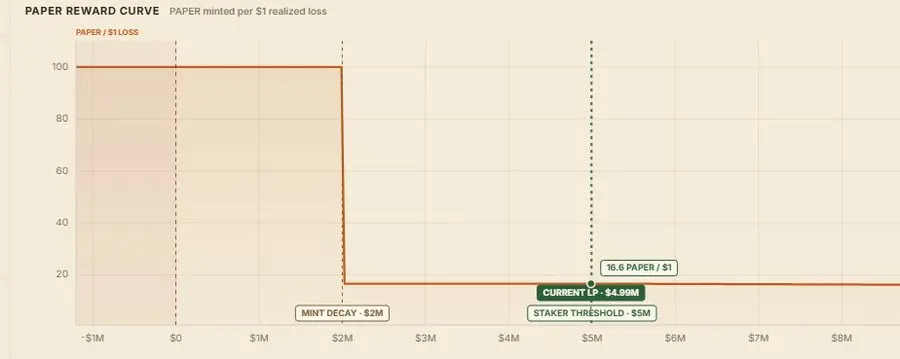
The decentralized perpetual contract trading platform Aster announced that, in light of recent developments related to PAPER and potential market risks, it has adjusted the pre-market perpetual contract for PAPER to a liquidation-only mode and plans to officially delist the contract at 9:45 AM Beijing time on October 20. Aster recommends that users holding open positions proactively close their positions before the delisting, calling this a precautionary measure to manage market risks and maintain trading order.Previously, Papertrade stated that there are currently no plans to allow external transfers of the PAPER token and will adjust short-term trading fees and the token issuance curve. The team believes that the PAPER perpetual contract could make the liquidity pool's solvency a target for short selling, and external short exposure may increase the profit potential for manipulation attacks, as these markets are not controlled by the protocol.Papertrade founder Jez also pointed out that due to the rapid progress of the perpetual contract market, PAPER is currently set to a non-transferable status to avoid potential attack risks and maintain the long-term healthy development of the protocol. Jez emphasized that PAPER represents users' rights to the protocol's earnings, and its long-term value depends on whether Papertrade can continue to attract traders. The team made this risk management choice based on the operational data from the first week after the protocol's launch.

Papertrade responds to concerns about price manipulation and protocol vulnerabilities: the relaxed position limit in the early stages of launch is the cause, and parameters have begun to tighten

Papertrade's official response to the allegations of price manipulation and the existence of obvious loopholes in the protocol states: It has never been possible for small orders to have the same priority as large orders. If this were done, the front end would suffer from congestion due to junk trading, and the consequences would be much worse than the existing queuing mechanism.Under these constraints, we have designed the fair launch to be as inclusive as possible.Last night, the attempts to manipulate BTC/ETH on Hyperliquid BBO were not due to flaws in the mechanism that took six months to design. These situations had already been considered; it was only because the position limits were set very loosely in the early stages to cope with congestion that such occurrences were possible. If position limits were set during peak demand for launching, it would only exacerbate the slow experience, and the queuing mechanism itself, due to the uncertainty of opening/closing confirmation times, naturally provides protection against manipulation.As congestion eases, we have begun to tighten position limits on-chain and at the relay level. In such a system, manipulation attacks are always possible— the key is whether the attempt is economically viable. The official goal is to set parameters to a point where it is almost never profitable; even if successful, the tail risk is extremely high, and the expected value is negative.
app_icon
ChainCatcher Building the Web3 world with innovations.