Scan to download
BTC $76,395.30 +2.10%
ETH $2,399.26 +2.31%
BNB $638.82 +2.49%
XRP $1.47 +3.04%
SOL $89.29 +3.90%
TRX $0.3242 -0.73%
DOGE $0.1006 +3.74%
ADA $0.2628 +3.70%
BCH $454.02 +2.73%
LINK $9.69 +3.13%
HYPE $44.45 -0.88%
AAVE $116.73 +7.88%
SUI $1.02 +3.75%
XLM $0.1721 +5.87%
ZEC $343.80 -0.61%
BTC $76,395.30 +2.10%
ETH $2,399.26 +2.31%
BNB $638.82 +2.49%
XRP $1.47 +3.04%
SOL $89.29 +3.90%
TRX $0.3242 -0.73%
DOGE $0.1006 +3.74%
ADA $0.2628 +3.70%
BCH $454.02 +2.73%
LINK $9.69 +3.13%
HYPE $44.45 -0.88%
AAVE $116.73 +7.88%
SUI $1.02 +3.75%
XLM $0.1721 +5.87%
ZEC $343.80 -0.61%

peer

FATF: Peer-to-peer transfers of stablecoins have become a major money laundering risk, recommending issuers to introduce freezing and blacklisting mechanisms

The global anti-money laundering organization Financial Action Task Force (FATF) pointed out in its latest report that stablecoin peer-to-peer (P2P) transfers have become a key source of money laundering risk in the crypto ecosystem, especially when users trade directly through unmanaged wallets, making it more difficult to track and regulate related activities due to the lack of regulated intermediaries.FATF stated that stablecoins have now become the most commonly used virtual assets in illegal crypto transactions. According to Chainalysis data, approximately 84% of the $154 billion in illegal crypto transactions in 2025 involved stablecoins. The report recommends that jurisdictions require stablecoin issuers to have the technical capability to freeze, destroy, or blacklist assets involving suspicious addresses when necessary, and to embed compliance features such as allow-lists and deny-lists in smart contracts.FATF noted that compared to the highly volatile Bitcoin and Ethereum, stablecoins like Tether (USDT) and USD Coin (USDC) are increasingly being used by criminal networks for fund transfers and money laundering activities due to their price stability, high liquidity, and ease of cross-border transfer. Additionally, the report mentioned that North Korean hacker groups and entities linked to Iran are using stablecoins to launder proceeds from cybercrime and are converting funds into fiat currency through over-the-counter traders or peer-to-peer platforms.FATF calls for strengthened regulation of stablecoin issuers and encourages the broader adoption of blockchain analysis tools and anti-money laundering measures such as the "travel rule" within the crypto industry.

Vitalik: The combination of ZK-EVM and PeerDAS will push Ethereum towards a new form of decentralized network

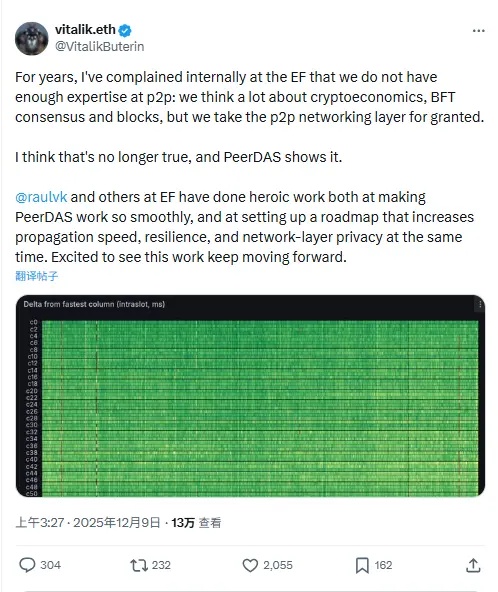
Vitalik Buterin stated that the current ZK-EVM has entered the alpha stage, demonstrating production-level performance, with the remaining major work focused on security; meanwhile, PeerDAS has officially launched on the Ethereum mainnet. Vitalik pointed out that this is not a gradual optimization, but rather a transformation of Ethereum into a new type of P2P network that simultaneously possesses decentralization, consensus mechanisms, and high bandwidth.He recalled that BitTorrent has high bandwidth but lacks consensus, while Bitcoin has consensus but is bandwidth-limited due to full replication; with the introduction of PeerDAS (data availability sampling) and ZK-EVM, Ethereum is expected to achieve decentralization, consensus, and high throughput simultaneously, solving the trilemma through "real code running on the mainnet." Among these, PeerDAS is already running on the mainnet, and ZK-EVM has reached production-level performance.Vitalik expects that starting in 2026, with the advancement of mechanisms like BAL and ePBS, the gas limit will gradually increase, and there will be practical opportunities to run ZK-EVM nodes; from 2026 to 2028, there will be gas repricing, state structure adjustments, and execution load entering blobs; by 2027 to 2030, ZK-EVM is expected to become the primary method for validating blocks on the network, further promoting an increase in the gas limit. Additionally, he mentioned the importance of distributed block construction, with the long-term goal of avoiding the complete construction of blocks in any single location and decentralizing block construction power through on-protocol or off-protocol means to reduce the risk of centralized intervention and enhance regional fairness.
app_icon
ChainCatcher Building the Web3 world with innovations.