Scan to download
BTC $80,186.53 -1.41%
ETH $2,299.96 -1.93%
BNB $643.82 -0.80%
XRP $1.39 -2.14%
SOL $88.78 -0.18%
TRX $0.3495 +0.99%
DOGE $0.1080 -4.17%
ADA $0.2637 -0.86%
BCH $451.21 -3.02%
LINK $9.93 -0.34%
HYPE $42.41 -1.58%
AAVE $92.90 -0.33%
SUI $0.9756 -1.39%
XLM $0.1592 -1.20%
ZEC $567.46 -0.00%
BTC $80,186.53 -1.41%
ETH $2,299.96 -1.93%
BNB $643.82 -0.80%
XRP $1.39 -2.14%
SOL $88.78 -0.18%
TRX $0.3495 +0.99%
DOGE $0.1080 -4.17%
ADA $0.2637 -0.86%
BCH $451.21 -3.02%
LINK $9.93 -0.34%
HYPE $42.41 -1.58%
AAVE $92.90 -0.33%
SUI $0.9756 -1.39%
XLM $0.1592 -1.20%
ZEC $567.46 -0.00%

tree

Wall Street clearing giant DTCC is collaborating with multiple Layer 1s to push corporate actions such as dividends on-chain

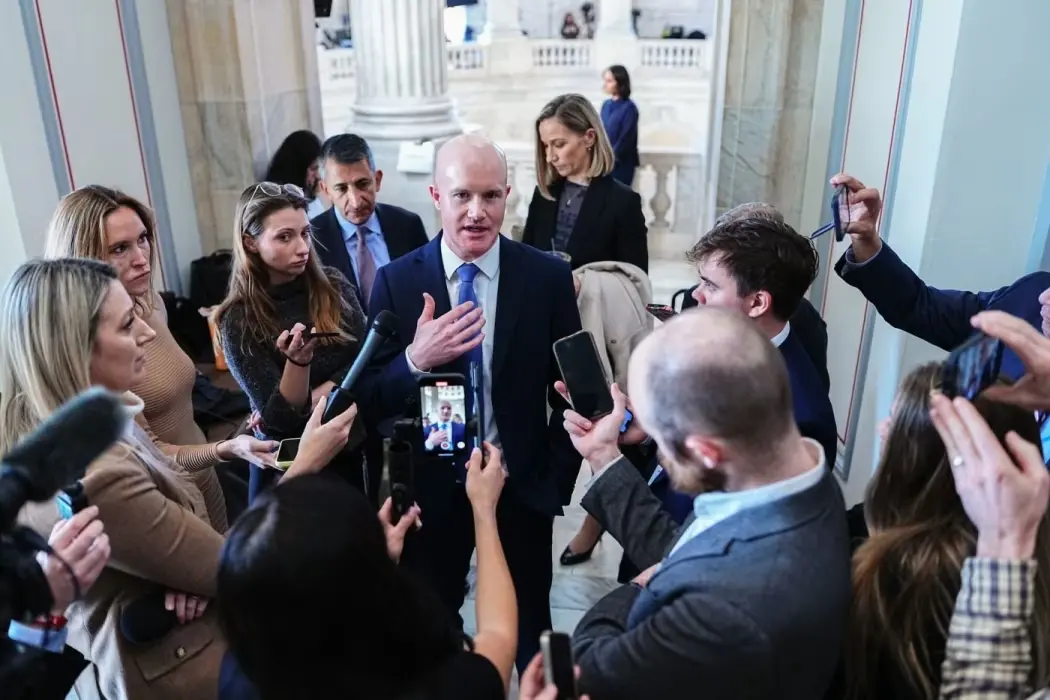
DTCC (Depository Trust & Clearing Corporation) CEO Frank La Salla stated that the company is collaborating with multiple high-performance Layer 1 blockchains to explore migrating complex corporate actions such as dividend payments and tender offers to on-chain processing.La Salla mentioned at the Consensus 2026 conference that most blockchains still lack efficiency in handling corporate actions, while DTCC needs to process millions of dividend payments daily, thus requiring support from Layer 1 networks with high throughput and stability. DTCC is one of the core infrastructures of the U.S. capital markets, handling approximately $20 trillion in U.S. Treasury and securities transactions daily. The organization plans to launch a tokenized securities platform test in July this year, aiming for a broader rollout in October.La Salla believes that "tokenized collateral" could become the first large-scale institutional application scenario for blockchain. In the future, Asian institutions could even access dollar liquidity in real-time through on-chain collateral during New York's Sunday hours. However, he also warned that blockchain still faces issues such as scalability, liquidity fragmentation, and risk management, especially the efficiency of "net settlement" in traditional financial systems, which remains difficult to replicate in a decentralized environment.

Figure CEO: Blockchain will reconstruct Wall Street's "financial pipeline," and traditional intermediaries may be massively replaced

According to CoinDesk, Figure Technology Solutions CEO Mike Cagney stated that the company is trying to leverage blockchain to reconstruct the traditional credit market infrastructure and deeply integrate real-world assets (RWA), securitization, and DeFi.Data shows that Figure's loan issuance in March this year exceeded $1 billion for the first time in a single month, with a total lending volume of $2.9 billion in the first quarter, which annualizes to about $12 billion. Cagney stated that the company's goal is to reduce intermediaries in the securitization, lending, and stock lending markets through on-chain processes, lowering costs and enhancing liquidity.Currently, Figure has launched the yield-bearing stablecoin YLDS and has launched on-chain credit vault products on networks like Solana, allowing users to invest in tokenized credit assets or use them as collateral for borrowing. The company also plans to expand into the Ethereum ecosystem and explore stock tokenization and on-chain securities lending.Cagney believes that the true value of blockchain lies not in "putting everything on-chain," but in reconstructing the financial abstraction layer. "Financial assets such as loans, securities, and equity are naturally suited for on-chain processes, and the entire financial infrastructure may be rewritten as a result."

first_img Buffett on Wall Street's speculative frenzy: The current market is like a church with a casino attached, which could lead to a long-term high in asset prices

According to Gelonghui, Buffett responded in an exclusive interview with CNBC regarding "Berkshire currently holding about $380 billion in cash, and the market is highly concerned about why it has not made large-scale acquisitions or investments": the prices are too high, and there are too few targets.Buffett stated, "Now is not our ideal environment for deploying cash for Berkshire." He emphasized that the company has the right management team to selectively choose opportunities: "Sometimes we do nothing, but sometimes we are very active."When discussing the current macro stock market environment, Buffett used the metaphor of "a church with a casino" to describe the speculative atmosphere on Wall Street. People can move between the church and the casino, with more people in the church than in the casino, but the casino has become very attractive to people.He pointed out, "If you are buying and selling single-day options, that is not investing, nor is it speculation; it is outright gambling." Referring to a recent case where a U.S. soldier used confidential information about military operations in Venezuela to profit $400,000 in the prediction market, he said: unless one knows when we will strike into Venezuela like that person, no one can explain why they would buy a one-day option; the number of such occurrences is astonishing.We have never encountered a crowd with a greater propensity for 'gambling' than now. Buffett further noted that the surge in gambling enthusiasm does not necessarily mean the market will collapse, but it will lead to a long-term high price for many assets.

Jefferies: Kelp DAO security incident may slow down Wall Street's blockchain layout

Jefferies, a Wall Street investment bank, pointed out that the approximately $293 million attack incident on Kelp DAO exposed critical infrastructure risks, which may prompt traditional financial institutions to reassess the pace of blockchain and tokenization advancement.Jefferies believes that the attackers triggered market sell-offs and liquidity strains by minting uncollateralized tokens and engaging in cross-platform lending. This incident is thought to be related to the Lazarus Group and also highlights the single point of failure issues in the verification mechanisms of cross-chain bridges. As institutions accelerate the tokenization of assets (such as funds, bonds, and deposits), the associated risks may cause some banks and asset management institutions to delay deployment and prioritize examining system security. Especially in scenarios that rely on cross-chain infrastructure, security vulnerabilities could lead to market fragmentation, undermining the practical utility of tokenized assets.Despite short-term confidence being shaken, Jefferies still emphasizes that the long-term trend remains unchanged. Under the backdrop of regulatory advancements and continuous improvements in infrastructure, applications such as stablecoins still have growth potential. However, the industry as a whole is still in the early stages of development and requires time to enhance system robustness.

first_img HK Web3 Feastival Roundtable: From Wall Street to Blockchain, the Practical Logic and Future Vision of Global RWA Issuance

ChainCatcher reported live that Li Baiwei, Partner at HashKey Tokenisation, John Cahill, Chief Operating Officer of Galaxy Digital Asia, Abdelhamid Bizid, Managing Director of BlackRock, and Min Lin, Managing Director and Head of Global Business Development at Ondo Finance, attended the HK Web3 Feastival roundtable to share insights on "From Wall Street to Blockchain: The Practical Logic and Future Landscape of Global RWA Issuance."The attendees generally agreed that the core value of RWA and asset tokenization is no longer just an innovative narrative at the conceptual level, but a realistic path for upgrading financial market infrastructure. John Cahill stated that blockchain is essentially a superior "underlying pipeline" for financial markets, and in the long run, the ultimate goal of financial markets will be "tokenization of everything"; what truly needs attention is not whether tokenization will happen, but whether market participants have already begun preparing for this endgame.Abdelhamid Bizid pointed out that from the perspective of traditional asset management institutions, the current tokenized products primarily serve clients who do not wish to move funds out of the on-chain ecosystem but want to achieve stable returns and compliant asset allocation tools. BlackRock has seen a clear demand for on-chain yield products and will continue to launch more new products. However, he also emphasized that the real bottleneck in the industry at this stage is not technology, but rather institutional adoption, demand validation, liquidity depth, regulatory clarity, and non-technical barriers such as costs and taxation.Min Lin, drawing from Ondo's practice, stated that the key to tokenized stocks is not just moving U.S. stocks onto the blockchain, but transforming stocks that are originally static in brokerage accounts into programmable financial instruments that can serve as collateral, margin, and lending assets in DeFi, further unlocking capital efficiency. He mentioned that the main demand currently observed by Ondo still comes from retail and crypto-native funds in regions like Asia, Southeast Asia, and Latin America, which find it difficult to directly access the U.S. stock market. This indicates that tokenized stocks at this stage are more like "global asset access tools" rather than mainstream trading venues for institutional funds.

Illustration of 78 Web3 Business Partners in Anchorage: A Financial Bridge Connecting Wall Street and the On-Chain World

The Web3 asset data platform RootData has outlined 78 business partners of Anchorage, including over 30 DeFi protocols, more than 20 blockchain infrastructure projects, as well as various stablecoins and payment settlement networks, covering the complete path from asset issuance to on-chain operations. Represented by institutions like BlackRock, products such as ETFs bring funds into the crypto market, after which Anchorage assumes custody and compliance responsibilities. These assets are then deployed on-chain, participating in liquidity operations and yield generation through DeFi protocols, stablecoin systems, and infrastructure networks. Ultimately, they flow back into the traditional financial system through OTC, trading, and clearing paths. In this process, Anchorage's role is not just "custody," but a key node throughout the entire lifecycle of funds, with its upstream and downstream including crypto-native institutions such as A16z, Blockchain Capital, Electric Capital, and Defiance, as well as DeFi protocols, L1/L2 networks, stablecoins, and clearing and settlement systems, along with fintech companies like AngelList and Series Financial, as well as payment companies and core banking systems. Anchorage's partner strategy emphasizes "key path coverage," ensuring that funds have corresponding infrastructure at every stage. As compliant entry points like ETFs gradually open up, the crypto market shifts towards asset allocation-driven strategies, and bridge-type institutions like Anchorage are moving from the background to the core. Related compilation: [Anchorage Web3 Partner Network Compilation (continuously updated)](https://cn.rootdata.com/Archives/detail/Anchorage%20Crypto%20Business%20Partner?k=NDc1MTgz) Crypto projects actively showcasing their partner networks have become a key way to enhance transparency and market trust. It is reported that RootData welcomes Web3 project parties to [claim data](https://www.rootdata.com/Projects/submit?ft=claimApply) and continues to track and open more project business relationship disclosure channels. The platform has continuously released multiple editions of crypto project ecological maps, nominating Web3 ecological partners for upstream clients such as Visa, Mastercard, and Coinbase. **If you wish to nominate your project in future ecological maps, please fill out the [RootData 2026 Industry Ecosystem Mapping](https://forms.gle/tWArmXcpSfZJkh1r8) form to supplement your important clients and partners.**
app_icon
ChainCatcher Building the Web3 world with innovations.