Airdrop Reporting Dilemma: Is it about the big picture or the interests? Crypto projects caught in a dilemma

 Airdrops are designed to reward users who invest real time and effort into the project, and the original intention of anti-witchcraft is to ensure a fairer distribution of airdrops.
Author: Wang 1, Deep Tide TechFlow
Editor: David, Deep Tide TechFlow
Whether it's individuals focused on experience projects or studios dedicated to exploiting airdrops, the festive atmosphere on airdrop day is no less than that of the New Year.
However, as project teams gradually impose stricter standards for airdrop distributions, this joy has become increasingly rare.
Checking for witches has almost become a necessary stage before major project airdrops, and users' main expectation before an airdrop has shifted from "How much can I earn this time?" to "I hope I don't get witch-checked this time."
Wool-harvesting parties have gradually formed a classic dichotomy for judging projects: checking means lacking vision, while not checking means having a big vision.
Water can carry a boat, but it can also capsize it; wool-harvesting parties are also an important source of inflated data. Faced with users that cannot be ignored, crypto projects seem to be caught in a dilemma between vision and profit.
In this dilemma, different projects express different attitudes.
zkSync's Gesture
On May 22, zkSync, which plans to launch its TGE this week, stated, "I absolutely cannot check. The system of checks is the killer of freedom."
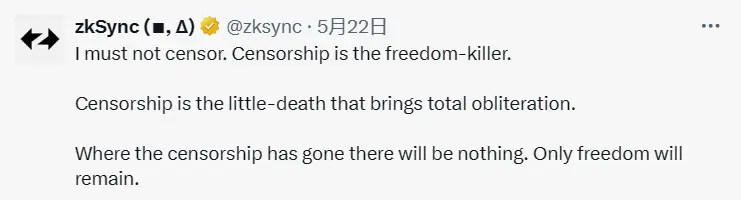
Once this statement was made, the community began to become restless.
Everyone speculated that zkSync was ostensibly discussing the dangers of a checking system, but in reality, it was subtly hinting at a potentially lenient attitude towards witch-checking in the future by criticizing the checking system.
After all, if they publicly criticized the checking system and then proceeded to check for witches, major projects would naturally not want to contradict themselves and give everyone a reason to complain.
How could such a seemingly casual remark, which didn't even explicitly state that they wouldn't check airdrops, lead to a collective cheer in the comments? It seemed like just a straightforward expression of opinion, yet it became news?
Because this month, another project that has caught the attention of wool-harvesting groups, LayerZero, implemented a witch-checking mechanism that was stricter than anyone could have imagined.
L0, Launching an Intensifying "Witch Hunt"
In May 2024, the long-awaited project LayerZero announced that it had completed its first season snapshot and initiated a witch-checking campaign before officially launching its token.
Unlike previous projects that used databases to identify witch addresses, LayerZero introduced "self-reporting" and "third-party reporting" mechanisms this time.
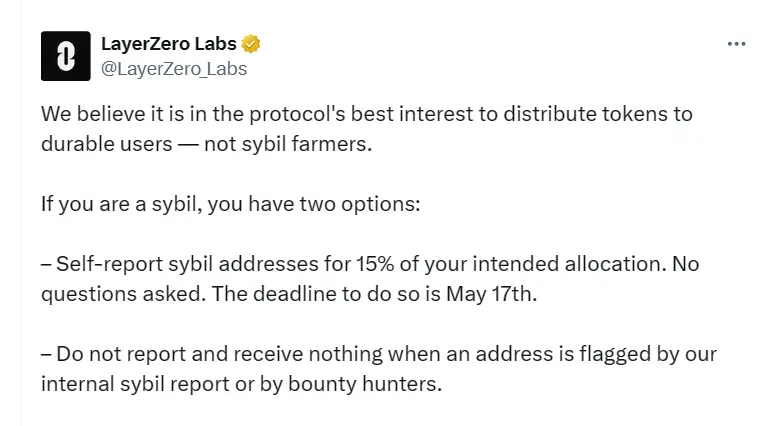
Starting from May 4, users who believed their addresses were suspicious of being witches had 14 days to self-report to LayerZero. After confirmation by LayerZero, they could retain 15% of their airdrop allocation, but addresses that did not self-report would have their airdrop shares nullified once identified.
After the "self-reporting" phase ended, the next 14 days entered the reporting mode, encouraging community users to report witch activities to each other. Successful reporters could receive 10% of the airdrop allocation of the reported address. If the reported witch address was originally entitled to 0 tokens, then the reporter would receive no reward.
Yes, LayerZero introduced a human nature model in the witch-checking process—the reporting mechanism. This unexpected and drastic measure caused an uproar in the community, with many expressing anger at this mechanism, stating, "This is not something that should exist in the crypto community," and "I would rather be executed than self-report." Although there was a chorus of opposition, under this coercive and incentivizing mechanism, many still saw opportunities.
Before the self-reporting phase ended, LayerZero CEO Bryan Pellegrino stated on social media that over 338,000 addresses had acknowledged being witches. On the second day of the reporting mode, LayerZero claimed to have collected 2,312 witch reports, which were gradually being reviewed.
As a result of this move, the originally expected airdrop addresses would likely retain only a small portion. From the results, the project team indeed achieved its goal of "witch hunting."
Is It Vision or Profit That Needs to Be Maintained?
However, the focus of this matter seems to have shifted away from the effectiveness of witch-checking.
Airdrops are meant to reward users who invest real time and effort into the project. The original intention of anti-witch measures is to ensure fairer airdrop distribution, protecting the reward value of genuine users from being diluted by a large number of fake users in the hands of studios, while also ensuring the project's healthy development in the future.
From the perspective of protecting fair distribution and industry development, the project team's actions in "witch hunting" are commendable. However, adopting a reporting system, especially one with rewards, may change the nature of the situation.
The darker side of human nature cannot withstand magnification; under the reporting mechanism, individuals without any vested interests can become adversaries in a zero-sum game.
When personal interests are involved, the reporting mechanism can become a tool for personal gain. Distrust between individuals can be eroded by repeated reports, leading to an infinite amplification of mistrust. This is a profound irony for crypto, which was created to solve trust issues.
To take a step back, if the project team truly wants fairness in airdrop distribution, shouldn't they inform users of the witch-checking mechanism in advance? Instead of waiting until numerous fake addresses have inflated the project's data before "hiding the bow after the birds are gone."
The continuous escalation of anti-witch mechanisms is a foreseeable trend in the industry. Once mechanisms like LayerZero's are initiated, it is highly likely that more project teams will follow suit in the future, increasing the risk of ordinary users being mistakenly harmed. For regular users, trying to abandon "more and faster" in favor of "precision and slowness" and thinking about how to be a genuine user may be a good coping strategy.
Wool-harvesting airdrops were originally a "common prosperity" where you put in money and I put in effort, and in the end, everyone benefits.
But gradually, it seems that everyone has begun to feel out of control: project teams want a better ecological future and will continuously expand their witch-checking methods; wool-harvesting parties want to successfully exploit airdrops and must constantly refine their techniques to successfully evade project teams. Now even wool-harvesting parties must start to be wary of each other.
In this "witch hunt," people frequently enact scenes reminiscent of "Infernal Affairs," and exploiting airdrops has ultimately turned into a relentless torment, where there are no longer free lunches, but rather a tiring competition for interests.
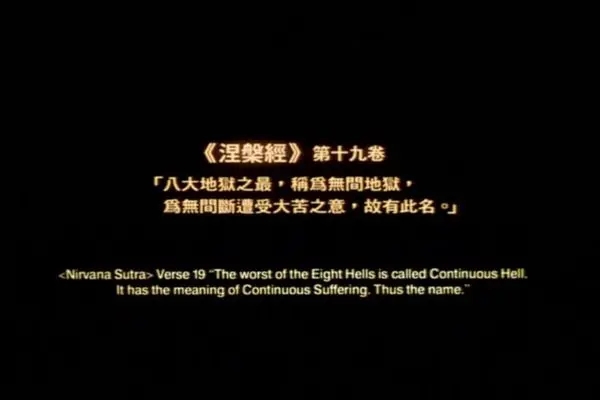
The arena of human nature has never closed; may you find peace amidst the chaos.
 Предупреждение о рисках Предупреждение о рисках