Why did the cryptocurrency market crash today?
 Core Viewpoint

 The threat of Trump's tariffs and the uncertainty surrounding the selection of the Federal Reserve Chair are the triggers, but from both a technical perspective and in terms of leverage and cost structure, the market needs a deep correction to clear out the chips.
Author: zhou, ChainCatcher
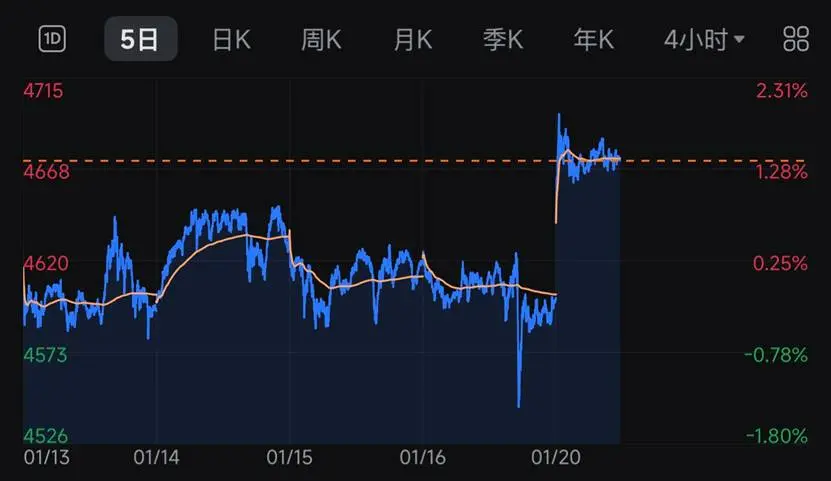
At 7 AM Beijing time on January 19, as the gold spot market opened, its price gapped up, rising about 2% to above $4,690, setting a new historical high.
Meanwhile, the cryptocurrency market faced a severe setback: Bitcoin fell below $92,000, Ethereum dropped below $3,200, and SOL fell over 6% to reach $130, nearly erasing its gains for the year.
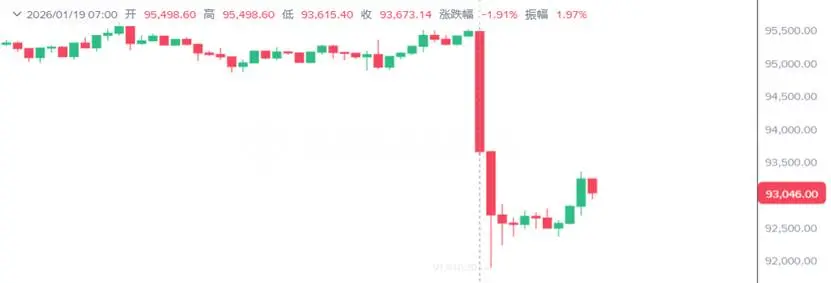
The root cause of this cryptocurrency market crash can be attributed to the dual impact of "macroeconomic policy headwinds" and "market leverage liquidation."
EU Tariff Escalation and Uncertainty Over Fed Chair Nominee
First, on January 17 (Saturday), Trump announced via Truth Social that starting February 1, 2026, a 10% tariff will be imposed on all goods imported from eight European countries/regions, including Denmark, Norway, Sweden, France, Germany, the UK, the Netherlands, and Finland; if no agreement is reached on the "complete purchase of Greenland," the tariff will increase to 25% starting June 1.
This move is seen as a signal of escalating geopolitical tensions and trade wars, prompting multiple EU countries to urgently consider retaliatory tariffs on U.S. goods, involving an estimated scale of about €93 billion.
Data from Polymarket shows that a major player has bet $160,000 that the U.S. will definitely acquire Greenland this year, with the current market probability at 21%.
As a result, the high-risk cryptocurrency market was hit hardest, and European stock markets opened lower across the board. However, institutional views generally believe that while this event may temporarily heighten risk aversion, its long-term impact is limited.
Jane Frey, an analyst at Rabobank, pointed out that while the market is not in a state of panic, strong demand for safe-haven assets may drive gold prices higher. Michael Brown from Pepperstone views this as Trump's old tactic of escalating threats followed by compromise, leading to significant short-term volatility, but with stronger bullish reasons for precious metals and buying opportunities in stocks at lower prices.
Additionally, the uncertainty surrounding the Fed chair nominee has further negative implications. Recently, Kevin Hassett, the White House economic advisor and director of the National Economic Council, publicly stated that Trump is more likely to want him to remain in his current position, which the market interpreted as Hassett essentially withdrawing from the race for the next Fed chair.
The market initially expected the dovish Hassett to take the position, but data from Kalshi and Polymarket shows his probability has dropped to about 15%-16%, while the hawkish Kevin Warsh's probability of taking over has surged to about 60%. Previously, the two were seen as evenly matched.
Analysis suggests that a hawkish leadership could mean a slowdown in interest rate cuts and tighter liquidity, directly pressuring Bitcoin, which relies on a loose environment. Although Warsh has previously invested in a crypto company and served as an advisor to institutional crypto bank Anchorage, analysts believe his monetary policy stance is not as dovish as Hassett's. Aurelie Barthere, chief research analyst at Nansen, pointed out that Hassett originally had a higher level of support for the crypto market.
Long Position Liquidation and Technical Correction
Internal factors within the cryptocurrency market have also amplified its decline. Last week, Bitcoin made several attempts to break above $98,000, accumulating a large number of high-leverage long positions. Once the price fell below the critical support level of $95,000, it triggered a chain reaction of stop-loss orders, accelerating the drop in Bitcoin's price to around $92,000.
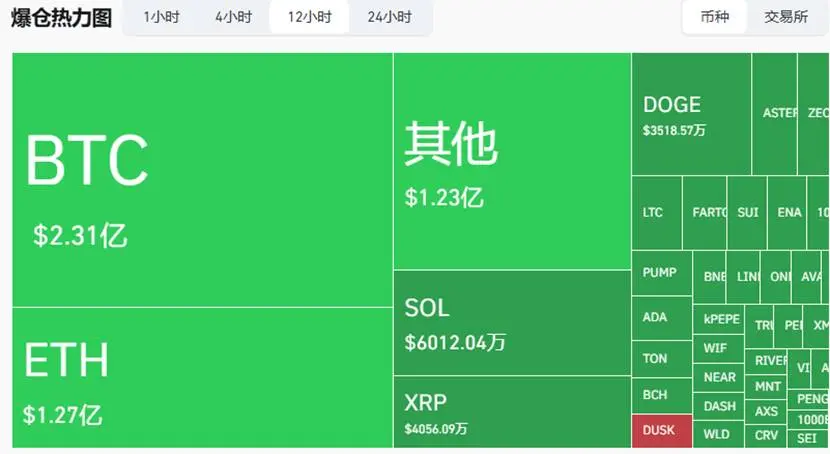
According to Coinglass data, within the first hour of the sharp drop, the total liquidation across the network reached $551 million, with long positions accounting for as much as $533 million. As of the time of writing, $815 million had been liquidated within 12 hours, with long positions making up $770 million.
CryptoQuant analyst Mignolet stated that the market is currently experiencing the strongest selling premium in recent times. Since the U.S. ETF market had not yet opened when Bitcoin plunged this morning, this selling pressure came from U.S. whales operating outside of ETFs.
At the same time, Bitcoin's price is approaching the average purchase cost of short-term holders ($99,460), with the price difference narrowing to just 4%. CryptoQuant analyst Axel noted that historically, areas near cost benchmarks are often accompanied by increased volatility and become reaction zones for the market, which could either continue the trend or trigger a reversal, meaning it could either return to a premium state or face new selling pressure.
Previously, CoinKarma analyzed that when BTC approached $98,000, there was significant selling pressure, with liquidity relatively balanced, suggesting that early-year bulls might consider taking profits and waiting for clearer signals before re-entering.
Ryan Lee, chief analyst at Bitget, stated that rising macro uncertainty, combined with profit-taking after previous significant gains, has led investors to adopt a more cautious strategy across various markets, including stocks, commodities, and digital assets. It is expected that Bitcoin will maintain a range-bound fluctuation in the second half of January, with support potentially forming around $85,000.
From this perspective, whether from technical indicators (such as selling pressure and liquidity) or leverage liquidation and cost pressure, the market needs a deep correction to cleanse floating capital and high leverage.
Min Jung from Presto Research also pointed out that the cryptocurrency market is relatively weak compared to other assets. Although concerns over U.S.-EU trade dominate sentiment, risk assets like the Korean KOSPI are flat or rising. This indicates that there are significant internal weakness factors in the cryptocurrency market, with investors more inclined to allocate to other risk assets. In the context of most markets rising, crypto assets remain the underperformers.
 Risk warning
 Risk warning