Web3 is dead, Web2+3 should rise
 Core Viewpoint

 We are not aiming to hold a self-indulgent party for Web3 practitioners, but rather to build a bridge that rationally connects Web2 and Web3.
Author: Web3 Event
"You may have always had a question: After all these years of Web3 enthusiasts toiling away, aside from speculating on cryptocurrencies, what have they actually accomplished?"
"Before this year, the answer was indeed hard to present. But this year, several signals have made me feel that we can revisit this question."
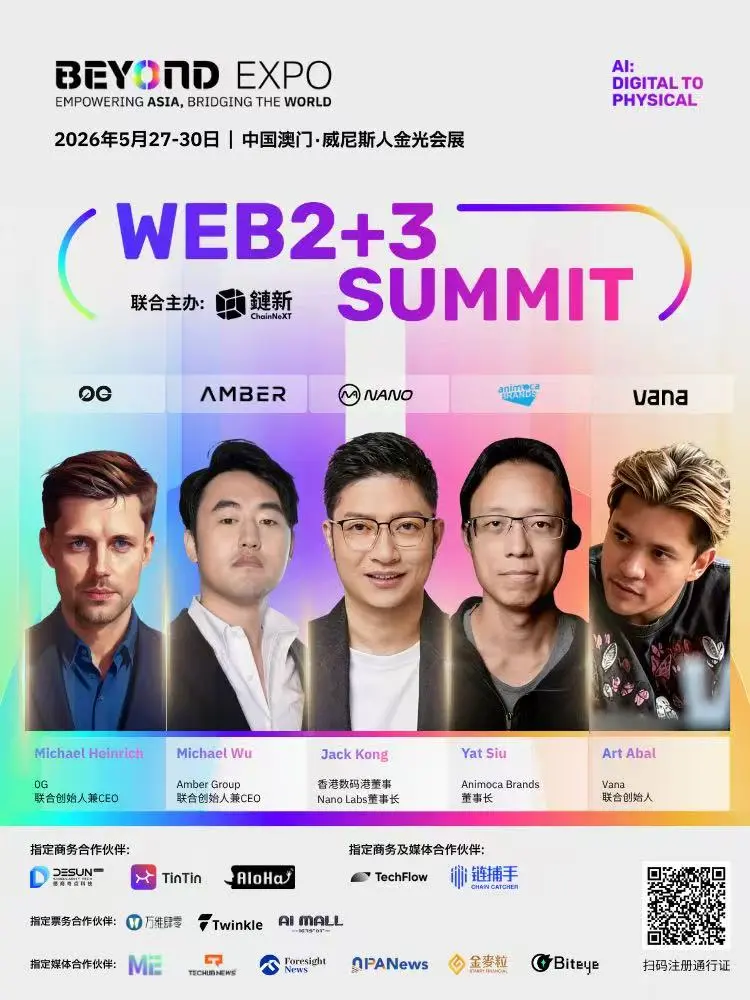
In May this year, I—Trev Ng, founder of ChainNeXT—was busy preparing for the Web2+3 Summit at BEYOND Expo 2026. I mentally listed a long guest list: Yat Siu, Chairman of Animoca Brands; Michael Heinrich, CEO of 0G; Art Abal, co-founder of Vana; and Jack Kong, founder of Nano Labs and director of Hong Kong Cyberport.
This list is quite interesting. If you look closely, you'll find that they represent not the previous round of "get-rich-quick myths," but a whole new wave: the deep integration of Web2 and Web3. My team, ChainNeXT Group, has also officially become the chief partner of the Web3 section at BEYOND Expo 2026, jointly promoting the deep integration of Web3 technology and industrial innovation.
As I was stressed about the summit, past encounters made me more certain: we are standing at a historic turning point.
1. Jack Kong: That half hour changed the trajectory of my life
My acquaintance with Jack Kong dates back many years. Back then, I hadn't graduated from university and attended Consensus in Austin, USA for the first time. At a small dinner on the sidelines of the conference, I recognized him at a glance—he had just become a director at Hong Kong Cyberport.
At that time, I was holding a tattered PPT that had been revised over a dozen pages, desperately looking for investors. Coincidentally, the CEO of an old internet giant was sitting next to me. But Jack didn't rush to chat with that big shot; instead, he turned to me and earnestly listened to my entrepreneurial ideas for a full half hour. Those suggestions and encouragement were an extremely precious enlightenment for me at that naive time.
Later, when OpenClaw exploded, Jack organized a tour in China for OpenClaw. I immediately helped him arrange the event in Macau. Because in my heart, Jack has always been the leader willing to support young people and actively embrace the integration of Web2 and Web3. He is not just focused on coin prices; he looks at the future of every "super individual" in the digital age.
2. Art Abal: The moment I was the only one applauding for him
The first time I met Art was at a peripheral event during last year's Consensus in Hong Kong. It was a roundtable discussion where several Web3 big shots were passionately discussing obscure terms like ZK and decentralized AI infrastructure, while the audience looked confused, with an awkward air of "I don't understand, but I don't dare to ask."
At this moment, Art took the microphone. He didn't continue throwing out jargon but instead asked two extremely simple questions.
He asked, "How many of you have used AI?" The entire audience raised their hands.
He then asked, "How many of you truly own your data?" The audience fell silent, and not a single hand was raised.
He smiled and said, "What we are doing at Vana will allow you to truly own your data in the future."
At that moment, I was the first person in the audience who couldn't help but applaud. He used the simplest language to tear away the glamorous veil of Web3, directly pointing to the biggest pain point of the Web2 era—data exploitation. Later, we learned that Vana was the first DeAI project invested in by CZ (Zhao Changpeng) after his release from prison and received support from top VCs like Paradigm, Coinbase Ventures, and Polychain. When he came to BEYOND Expo last year, he told me, "This is the first time I've spoken about Web3 in front of Nvidia's booth!" This foresight is exactly the voice BEYOND Expo has been seeking.
3. Yat Siu: I asked him, if we can order takeout with fiat currency, why does AI still need crypto?
The first time I met Yat Siu was during this year's Consensus conference. I was honored to be invited to an internal investor gathering that usually only shareholders could attend.
I was very excited to see him because he is the one who has hit all the trends in the metaverse and has deeply laid out plans in the DeAI field. People in the industry jokingly call him the "Jesus of Web3" because he always preaches grand visions of the future.
That day, he talked a lot about the future of the integration of Web3 and AI, mentioning a term—"Crypto is the native currency of AI." I couldn't help but raise my hand and asked a rather "contrarian" question:
"Yat, if we can order takeout with fiat currency, why does AI still need crypto?"
His answer was interesting; he didn't discuss technical details but instead painted a scenario that the Web2 world cannot solve. At that moment, I was convinced that Yat was not just shouting slogans; he was using profound philosophical logic to construct the underlying economic rules after the integration of Web2 and Web3.
4. Michael Heinrich: In this deep bear market, a Silicon Valley big shot actually came to Shenzhen to visit factories
Michael Heinrich is the co-founder and CEO of 0G. The first time I met him was at a dinner in Shenzhen, hosted by JT, the head of 0G's Asia-Pacific region—who happened to be our guest last year.
To be honest, in this bottomless bear market, I rarely see foreign founders willing to travel to mainland China to explore the market. Michael usually stays in the U.S., and his appearance at the dinner table in Shenzhen surprised and moved me.
During the dinner, he didn't talk about coin prices or listings; instead, he discussed what he was doing in China. He mentioned visiting many large companies and even some automotive manufacturing institutions. He was thinking about how to integrate 0G's DeAI infrastructure into the production lines of these physical enterprises.
In this speculative Web3 market, foreign founders like Michael, who are so grounded and value the practical application scenarios of the Chinese market, are truly rare. He doesn't see China as just a simple retail market but as a real world with a vast manufacturing industry and AI application scenarios.
5. What kind of stage will their upcoming BEYOND Expo be?
BEYOND Expo is hosted by the Macao Science and Technology Association and has been held five consecutive times since its establishment in 2021, making it the largest international technology innovation and ecosystem expo in Asia.
The fifth BEYOND Expo in 2025 attracted over 25,000 participants from more than 120 countries and regions, over 800 exhibitors, 300 media outlets, and more than 800 professional investors, with overseas participants accounting for 40% and an average of 55% at the director level and above. This year, from May 27 to 30, BEYOND Expo will hold its sixth event at the Venetian Macao, expecting over 1,200 exhibiting companies and more than 30,000 attendees.
The names that have stood on this stage in previous years are enough to represent an industry: Joe Tsai, Chairman of Alibaba Group; Zeng Yuqun, Founder and Chairman of CATL; Shen Nanpeng, Founding Partner of Sequoia China; Guo Guangchang, Chairman of Fosun International. Top global tech companies like Nvidia, Huawei, Alibaba Cloud, Tencent, Douyin, and Foxconn have also participated deeply.
Why establish the Web2+3 Summit this year? Because the turning point has truly arrived.
6. Four signals sound the horn of integration
Signal One: The Hong Kong dollar stablecoin officially debuts. Just recently, on April 10, the Hong Kong Monetary Authority officially granted the first batch of stablecoin issuer licenses to HSBC and Anchor Financial (a joint venture of Standard Chartered Hong Kong, Hong Kong Telecom, and Animoca Brands) under the "Stablecoin Ordinance." Compliant stablecoins are entering mainstream payment scenarios, marking a significant event in the true integration of Web2 and Web3 financial infrastructure.
Signal Two: Hong Kong's cryptocurrency exchange regulation matures. As of the first quarter of 2026, the Hong Kong Securities and Futures Commission has officially granted licenses to 12 virtual asset trading platforms. The Hong Kong virtual asset ecosystem has completely bid farewell to the "transitional cleanup" phase and entered a new development stage of "normal expansion."
Signal Three: The U.S. passes the GENIUS Act. On July 18, 2025, U.S. President Trump signed the "Guidance and Establishment of a National Stablecoin Innovation Act" (GENIUS Act), marking the formal establishment of a federal stablecoin regulatory framework in the U.S. The world's largest economy has given the green light to compliant stablecoins, providing an unprecedented institutional foundation for the integration of Web2 and Web3.
Signal Four: Under geopolitical circumstances, cryptocurrencies have indeed emerged with real application scenarios. In April 2026, the Iran Oil Exporters Alliance announced that during the temporary ceasefire between the U.S. and Iran, tankers passing through the Strait of Hormuz must pay tolls in Bitcoin. In January of the same year, Iran officially stated that overseas military contracts could accept "digital currency" as a payment method.
In addition to these four major signals, the scale of tokenized real-world assets (RWA) in the financial sector continues to grow, the PayFi (stablecoin finance) in cross-border payments is beginning to bridge crypto payments with traditional supply chains, and the DeAI (decentralized AI) in the artificial intelligence sector is breaking the monopoly of centralized AI on data, computing power, and algorithms—these three tracks are also the core themes of this Web2+3 Summit.
7. Web2+3: A bull market narrative in a bear market
What has Web3 been in the past few years?
It has been a carnival of air coins, a feast of meme coins, a casino of "getting rich overnight and returning to zero overnight." That was a speculative-driven Web3, a zero-sum game where a few people harvested the majority.
In the past few years, I have attended many Web3 conferences and seen too many "seemingly lively" industry consensus. But if you observe closely, you will find that most people in those occasions were already in this industry. Everyone discussed the future in the same context but rarely faced the users and demands outside the industry. This is also why many narratives sound grand but remain within the closed loop of the circle.
The significance of BEYOND Expo lies precisely in changing this.
The Web2+3 Summit is not just about Web3; it is a gathering of over 30,000 builders in the tech industry, representing Asia's top tech ecosystem. Here, we gather Web2 companies, traditional financial institutions, cross-industry decision-makers, and real buyers—these are the users that Web3 has found hardest to reach but are the most critical. When Web3 is placed in such a scenario, it is no longer just talking to insiders but for the first time entering a larger commercial system, tested by real demands.
This is also why this Web2+3 Summit is worth attending. What you see here is not just what the industry is saying, but what things are really starting to be used, and which directions are beginning to have the potential for scaling. The past Web3 relied on emotion-driven consensus, while the future of Web2+3 depends on whether people truly use it. And BEYOND is the place where this "usage" is happening on a large scale for the first time.
The current Web3 market is indeed a bear market, with sluggish trading volumes and many projects going to zero. But at the same time, the Hong Kong dollar stablecoin is entering PayMe, RWA tokenized assets are continuing to grow, and SpaceX's Pre-IPO stocks are entering the DeFi ecosystem through tokenization… these ongoing stories of Web2+3 integration are the real future. The bull market of Web3 relies on FOMO (fear of missing out), while the future of Web2+3 relies on Adoption (real adoption).
This is also why the Web2+3 Summit at BEYOND Expo 2026 will focus on "practical, commercializable, and compliant" as core principles. We are not here to throw a self-indulgent party for Web3 practitioners but to build a bridge for rational connections between Web2 and Web3.
From May 27 to 30, at the Venetian Macao, over 30,000 participants will gather. This summit may not bring about a hundredfold increase in coin prices, but it will announce the end of an era and the beginning of a new one.
By then, we will see Jack, who selflessly supports the younger generation; Art, who brings hope for data sovereignty; Yat, who reveals the philosophical logic of AI and Crypto coexisting; and Michael, who shows respect and awe for China's real industries. They will all be there. Their foresight and execution make Web3 no longer just a concept on a PPT but a real business of Web2+3 that is taking shape.
Now is the bear market for Web3, but it is the starting point for the story of Web2+3. And I am honored to witness the beginning of this integration with you. I am Trev, and I encourage you to share this article and become a part of this Web3 "Yellow Turban Rebellion."
BEYOND Expo 2026 Official Website: www.beyondexpo.com
Customer Service Inquiry: admin@chain-next.com
Conference Registration Link: https://portal.BEYONDexpo.com/reg/BEYOND26/web/#/en/ticket/mall?track=tk19
 Risk warning