Bitget CEO Gracy: AI is forcing Crypto to deflate, and exchanges are entering full asset competition

 Bitget CEO provides an exclusive interpretation of the US stock market 2.0 upgrade, the Reality platform reshapes the RWA track, helping you seamlessly manage cryptocurrencies and global core assets with one account.
Throughout June, major exchanges have been intensively laying out U.S. stock products. As one of the earliest and most aggressive platforms in this field, Bitget has also launched its own RWA platform Reality and made significant upgrades to its U.S. stock products. Today, we invite Bitget CEO Gracy to discuss this trend and more hot topics in the industry.
Bitget has previously integrated stock token solutions like Ondo. Now, U.S. stocks 2.0 has switched to Reality. What is the biggest difference between the two? What problems does this upgrade mainly aim to solve?
Gracy: We started collaborating with Ondo in the third quarter of last year, at one point capturing nearly 90% of their issued stock tokens market share. Not only Ondo, but we have also collaborated with xStocks to launch U.S. stock tokens. However, during this process, the most common feedback we received from users was that liquidity was not good enough, and the mechanisms for dividend and stock split settlements were not clear or transparent.
So, we decided to tackle this issue ourselves. Reality is our compliant RWA protocol, and its biggest difference is that it directly connects with the U.S. licensed broker Alpaca, allowing orders to go directly through Nasdaq and the New York Stock Exchange. Simply put, when trading Reality U.S. stock rTokens, the price of Apple and Tesla in the U.S. stock market is the price users will pay, with liquidity directly comparable to traditional brokers.
Additionally, Reality also addresses the pain points of dividends and stock splits. Cash dividends will be automatically converted into USDT and airdropped to users, and stock splits can also be synchronized 1:1, eliminating the disconnection between token prices and actual stock prices.
Will users in the future be able to use stock tokens like Nvidia and Tesla as margin to continue trading BTC, ETH, or other contracts?
Gracy: This feature was launched on June 4. This is also the core reason we insist on tokenization rather than just "broker direct connection." Users who buy rNVDA, the Nvidia rToken, can directly use it as contract margin on Bitget, and it can also be transferred to DeFi scenarios through public chains like Arbitrum and Morph. What we want to do is truly activate the U.S. stock tokens in users' hands and improve overall capital efficiency.
Recently, many exchanges have been upgrading their U.S. stock-related products. What are the core differences in Bitget's upgrade compared to other platforms' stock products?
Gracy: Indeed, many platforms are laying out U.S. stocks, but from my observation, most competitors are still focused on "broker direct connection." This means users deposit stablecoins and then open trading accounts with traditional brokers. Bitget has recently launched U.S. stocks 2.0, and one important upgrade is that we have chosen a more crypto native path, which is RWA stock tokens.
The core difference is that stocks bought through "broker direct connection" usually just sit in the user's U.S. stock account. But on Bitget, the rTokens issued through Reality are real on-chain assets, and we have already integrated with Arbitrum and Morph public chains. This means users can not only use them as margin within Bitget, but can also withdraw them to their wallets, and in the future, even stake and earn interest in DeFi protocols.
We specifically addressed two long-standing issues in the industry. The first is liquidity: our orders go directly through Nasdaq and the New York Stock Exchange, with prices, order books, and depth synchronized with the real market. The second is dividend distribution and stock splits: cash dividends will be directly converted into USDT and automatically airdropped, and stock splits can also be synchronized 1:1, avoiding disconnection between token prices and actual stock prices.
More importantly, in the environment of UEX, these rTokens can truly achieve higher capital efficiency. For example, if a user holds rNVDA, the Nvidia rToken, it can be directly used as margin to continue trading BTC or ETH contracts, allowing the same asset to function in two markets simultaneously. This is a more native on-chain experience, which traditional broker direct connections cannot achieve.
One long-standing question about stock tokens is: are the tokens users buy a true representation of real stock rights, or just a price tracking tool? How will Reality prove to users that the underlying stocks exist, are auditable, and traceable? Will you provide reserve proofs, disclosures from custodians, audit reports, and broker structure explanations in the future?
Gracy: This is a very good question. Indeed, if it is just a "synthetic asset" that tracks prices, it lacks substance. The rTokens of Reality are backed by real underlying assets. Our underlying stocks are held by the U.S. licensed broker Alpaca and placed in an independent SPV, completely isolated from the platform's own assets. We have achieved 1:1 full reserves.
At the same time, we will have a third-party U.S. licensed auditing firm conduct daily audits. The Reality official website has already launched a real-time audit dashboard, where users can check the reserve ratio at any time. It is expected that after the CPA licensed auditing company completes its work in August, we will also synchronize its audit report to this dashboard. Additionally, Bitget has over $300 million in user protection funds as a safety net, which can be considered a triple guarantee.
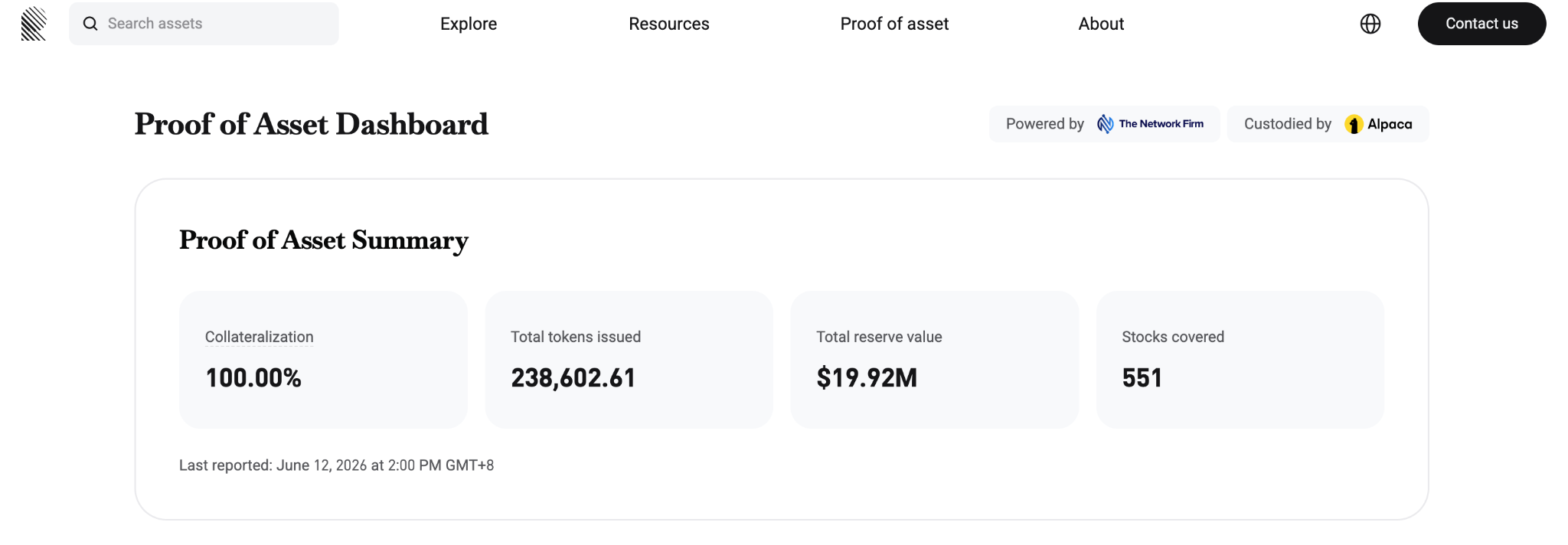
(Source: Screenshot of the PoR dashboard from Reality on June 12, 2026, 2:00 PM GMT+8)
If in the future a stock undergoes a split, merger, special dividend, acquisition, or delisting, how will Reality handle it?
Regarding the handling of corporate actions, this is also where we are stronger compared to many products on the market. For example, in the case of a stock split, like last year's Netflix 1 split into 10, some platforms did not synchronize the token adjustment (rebase), leading to some stock token prices being 10 times different from the actual stock price, which confused users. But in Reality, stock splits will automatically synchronize. A user holding 1 token will increase to 10 tokens, with the unit price aligned with the actual stock price, and the total asset value will remain unaffected.
Cash dividends will also be directly converted into USDT, automatically airdropped to the Bitget account, ensuring clarity and transparency. Whether for individual retail investors or institutions we support later, especially for participants needing to hedge, value, clear, and manage portfolios, the structure of "price is price, dividends are dividends" is closer to the usage habits of the traditional financial system.
In the past few years, the main narrative for crypto users has been BTC, ETH, DeFi, NFT, Meme, L2, and public chain competition. But recently, it is clear that AI, U.S. stocks, Nvidia, OpenAI, SpaceX, and other assets and companies have attracted a lot of capital and attention.
Have you observed this migration in your platform data? What percentage of non-cryptocurrency trading currently accounts for Bitget? What is the growth rate?
Gracy: We have indeed observed this trend. As early as the end of 2024 and the beginning of 2025, we found that altcoins were performing poorly, while user enthusiasm for AI, U.S. stocks, gold, silver, and other commodities began to rise. This is also why I proposed the vision of UEX (Universal Exchange) back in September last year.
In December last year, our cumulative trading volume for U.S. stock perpetual contracts exceeded $10 billion, ranking second globally. At the beginning of this year, our TradFi sector, including gold and foreign exchange, also saw daily trading volume surpass $2 billion for the first time. Currently, 40% of Bitget's trading volume comes from non-crypto assets.
The reason is simple: capital seeks profit. Wherever there is more certain growth and wealth effect, funds will flow there. U.S. stock AI giants have delivered real revenue and profits, while many Crypto projects are still in the storytelling phase.
As for whether this will reverse in the future, I believe this is not a zero-sum game. Crypto assets, such as BTC as digital gold, can completely complement U.S. tech stocks in users' investment portfolios. What we need to do is allow users to smoothly buy different categories of assets with stablecoins like USDT and USDC in one account.
**From a macro perspective, U.S. stocks, especially AI-related assets, have seen significant increases over the past six months, with many assets multiplying by **10. For many crypto users, they may have started paying attention to U.S. stocks only after the profit-making effect in the crypto market declined. Entering the market at this time may actually face the risk of chasing highs.
How do you view the current position of U.S. stocks? What mistakes should users who have just transitioned from crypto to U.S. stock trading avoid the most?
Gracy: The biggest pain point for Crypto users is capital efficiency and asset fragmentation. Funds sitting in exchanges earning interest may miss out on stock market gains; going to open traditional broker accounts makes it difficult for funds to return to the exchange for contract trading. Our rToken product is designed to solve this problem: when users buy U.S. stocks, their positions can still be used as contract margin, keeping the funds active.
Whether U.S. stocks are expensive depends on the time dimension users are looking at. Crypto users participating in U.S. stocks must first realize that, like crypto assets, the U.S. stock market is not a market that only goes up. Especially in hot sectors like AI, semiconductors, and tech stocks, the recent increases have been significant, and short-term volatility and valuation pressure need to be assessed comprehensively.
Setting aside my identity as CEO, as an investor managing my personal account, I recently made some judgments about the bottom price of Bitcoin in this cycle on Twitter, which led to many netizens questioning me: "As the CEO of an exchange, you shouldn't be bearish on your own business." But I want to say that every industry has its cycles. I am merely presenting the data and logic to everyone, pointing out potential cyclical changes. We certainly have a long-term positive outlook on the crypto industry and believe that tokenized assets will bring new opportunities to the industry, but "long-term bullish" does not mean we should "always be bullish," as trading opportunities arise from volatility, and for increasingly mature investors, both rises and falls are opportunities.
From a technical perspective, there is currently a certain degree of extreme deviation in the market. A report from Bank of America (BofA) and related charts show that the semiconductor index (SOX) has now risen to 62% above its 200 day moving average. Historically, when major market bubbles peaked, the average deviation of related market indices from the 200 day moving average was about 35%. The current deviation has already exceeded the 55% deviation level of the Nasdaq index relative to its 200 day moving average before the burst of the 2000 internet bubble.
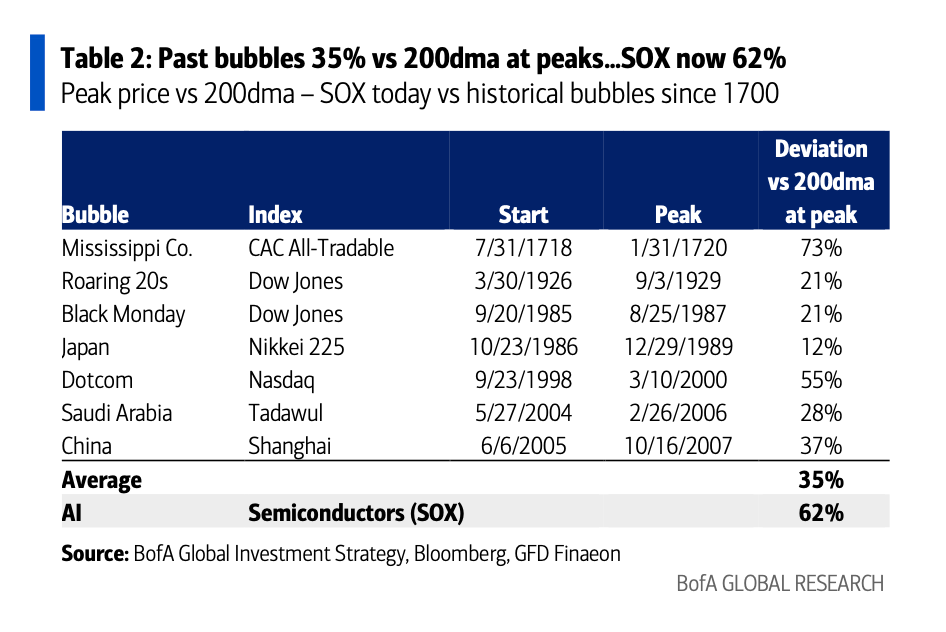
(Source: BofA The Flow Show report on May 14, 2026, 10:45 PM EDT)
At the same time, the current rise in U.S. stocks is extremely dependent on a few tech giants. If SpaceX, Anthropic, and other super IPO projects go public next, it may further divert market liquidity.
Crypto users are accustomed to high volatility, high leverage, and short-term trading, but while U.S. stocks also have volatility, they fundamentally place more emphasis on fundamentals, earnings, valuations, interest rates, and macro cycles. What do you think they need to change the most in their trading habits?
For users who have just transitioned from crypto to U.S. stocks, the most important reminder I want to give is: do not treat U.S. stocks like Meme trading. In the crypto space, users may be used to looking at sentiment, community heat, using high leverage for short-term trades. But the U.S. stock market is a very institutionalized market that values financial reports, EPS (earnings per share), interest rate environments, and macro cycles.
Users accustomed to the crypto market need to learn to closely monitor treasury yields and inflation data. For example, when the 10 year U.S. treasury yield approaches 5%, it may put pressure on high-valuation tech stocks.
Additionally, users transitioning from the crypto space to the U.S. stock market need to change another trading habit: reduce leverage and extend the time horizon. U.S. blue-chip stocks have real earnings, cash flow, and business moats, making them more suitable for asset allocation and long-term investment rather than going all in today and expecting to double tomorrow like trading meme coins. Be patient and be a friend of time. To help crypto users better adapt to the rhythm of U.S. stocks, Bitget will continue to launch educational content related to U.S. stocks, and everyone is welcome to follow along and learn to become "distinguished U.S. stock traders."
In the past, crypto was one of the fields with the highest concentration of young talent, venture capital, technological narratives, and speculative funds. But now, AI has clearly become a stronger main narrative: top talent is going to AI, VCs are investing in AI, secondary market funds are chasing AI, and U.S. tech giants are delivering real revenues and growth.
How significant do you think the impact of AI on crypto is? What is the internal usage of AI at Bitget? Is it mandatory or included in assessments? What AI products are being used?
Gracy: The impact certainly exists, but I prefer to view it as a litmus test for the "de-bubbling" of the crypto industry. In the past, money in Crypto was too easy to make, but now AI is siphoning off funds and talent, which will force the Crypto industry to settle down and seek truly valuable landing scenarios, such as stablecoin payments and RWA.
Internally at Bitget, we require all employees to fully embrace AI. AI-driven innovation is one of our three core strategies for 2026. We do not rigidly include AI usage in mandatory assessments because useful tools will naturally be adopted by everyone. For instance, I often use tools like Manus and NotebookLM to summarize information, which can indeed become addictive.
At the same time, we also provide support at the organizational level for employees to use AI. Bitget has purchased enterprise access to Claude for all employees, covering 2167 staff members, with a monthly cost of $200 per person. This is not due to external requirements, but because we observed that after employees actually used AI tools, we saw a significant increase in productivity, so we want to ensure that team members do not fall behind in the wave of AI applications.
Even the design team, which does not have a technical background, has learned to use tools like Google AI Studio and has developed 6 or 7 AI tools to assist business operations, used for automatically reviewing UI compliance issues in external materials. On the product side, we have also launched AI tools specifically designed for traders, such as GetAgent and GetClaw.
We have AI-related training almost every day. This week, I attended the "Data Team AI Product Special Sharing Session" and the "Digital Employee Program and BG Agent Platform Introduction Sharing Session."
AI is a productivity lever. Those who use it well will be able to run faster in the next cycle. Now and in the future, it is certainly an era where silicon-based life and carbon-based life work together.
More and more crypto exchanges are starting to offer U.S. stocks, gold, foreign exchange, stock tokens, and Pre-IPO products. Optimistically, this is an expansion of crypto infrastructure to global assets; pessimistically, it may indicate that crypto itself lacks quality assets, forcing exchanges to bring in U.S. stocks to maintain growth.
What is your view on this issue? When crypto exchanges are integrating U.S. stocks, are they enhancing the financial infrastructure value of crypto, or are they directing crypto user traffic to traditional finance, ultimately becoming an outsourced market for U.S. stock liquidity?
Gracy: I do not believe this is a black-and-white issue. The integration of U.S. stocks, gold, foreign exchange, and Pre-IPO products by crypto exchanges may superficially seem like "bringing traditional financial assets into Crypto," but on a deeper level, it is actually validating a question: is Crypto merely an asset class, or is it a new financial infrastructure?
My judgment is that the answer depends on how the exchanges operate. If they simply package U.S. stock price exposure as a trading product, it could indeed become a distribution channel for traditional financial liquidity, or even just direct Crypto user traffic to U.S. stocks.
But if they can reorganize asset issuance, trading, clearing, custody, and risk control based on stablecoin accounts, on-chain settlement, global accessibility, fragmented trading, and a 7×24 hour market, then what they enhance is not just a single U.S. stock, but the value of Crypto as the next-generation financial infrastructure.
Moreover, if you have used many traditional financial platforms, you will know that the user barriers in traditional finance are actually very high: difficult account opening, high thresholds, and slow capital flow. Our goal is to connect underlying assets through stablecoin settlement and on-chain RWA protocols, allowing 1.2 million Bitget users to trade global quality assets with just a mobile phone and an email.
I believe this is not outsourcing, but using the high efficiency and low friction of Crypto to improve the experience of traditional brokers. We have not lost users; instead, through tokenization solutions like Reality, we have brought real assets on-chain, making them part of DeFi. This is expanding the territory of Crypto. We believe that as the industry develops, the definition of Crypto is also evolving. Initially, Crypto only represented Bitcoin, later Crypto also included the much-discussed memecoins, and in the future, many Crypto will be RWA. Regardless of what the assets are, underlying technologies like blockchain are the cornerstone driving this new financial system, and our long-term optimism about the industry also comes from our confidence in its technology.
Bitget proposed UEX, essentially allowing users to trade cryptocurrencies, stocks, gold, foreign exchange, ETFs, and other assets in one account. This sounds like an expansion of the exchange's capabilities, but it may also be understood as: relying solely on Crypto can no longer meet user needs, so exchanges must become comprehensive asset platforms.
How do you view this tension? Is UEX a natural evolution of crypto exchanges, or does it mean that "exchanges that only do crypto" have reached their ceiling? How do you hope the outside world defines Bitget?
Gracy: If we view the blockchain behind Crypto as a fundamental value transfer network, the ceiling is still far away.
UEX is a natural evolution of exchanges. For example, Amazon initially only sold books, and later sold everything; the iPhone started as a phone with a touchscreen and later became a digital life hub. Users need more than just "trading coins"; they want to make money and allocate assets. Since stablecoins have become one of the best settlement tools globally, why not let users use them to buy and sell the best assets in the world?
We proposed the vision of UEX in the second half of 2025, and we will steadfastly pursue this transformation path for at least the next three years. Here, I want to elaborate on WHY and HOW.
WHY------Why insist on the UEX transformation?
From the perspective of the financial system's structure, the current financial system is still built on "walls."
Asset fragmentation: Buying stocks requires going to brokers, buying Crypto requires coming to CEX, and buying foreign exchange requires finding banks or IB (Interactive Brokers).
Geographical and temporal fragmentation: U.S. stocks, European stocks, and Asian stocks each have their own closing times, making it impossible for funds to flow 24/7.
Account and technical fragmentation: Traditional finance and Web3 seem like two parallel universes, requiring users to manage countless accounts and margins.
This leads to low capital efficiency, complex user experiences, and difficulty in unifying risk management standards. Therefore, an all-asset trading platform is both a user demand and a trend.
In the past 4 to 5 years, the landscape of exchanges has not fundamentally changed, and under homogeneous competition, the first-mover advantage is strong. But Crypto is becoming the financial foundation, and the industry inflection point has already appeared. At this time, platforms with stronger teams and more decisive actions have the opportunity to overtake. Future competitors are not just peers; traditional finance is also accelerating its layout. Whoever can establish user mindset first will be able to widen the gap.
HOW------How do we achieve a UEX panoramic exchange?
One account, one interface, one-stop trading for all assets. Crypto has always been our main business, but Tokens will become more diverse. Bitcoin is a Token, Tesla, Nvidia, and SpaceX can also be Tokens, and gold and crude oil can likewise be Tokens. RWA is the direction that both Wall Street and Crypto have recognized, and it is also the direction in which we want to establish an advantage.
Around this direction, we have built five core modules.
A unified account achieves cross-asset margin, maximizing capital efficiency. A unified risk engine upgrades single-asset risk management to portfolio-level risk management. A unified liquidity routing integrates CEX, DEX, and external markets, making Bitget a liquidity dispatch center. A unified execution layer evolves from manual trading to API, and then to AI Agent, continuously upgrading user entry points. The asset standardization layer allows crypto, stock ETFs, foreign exchange, commodities, and RWA to all become programmable trading objects.
Three years from now, I hope the outside world no longer defines Bitget merely as a crypto exchange, but sees it as a panoramic exchange where assets can be bought and sold globally with one click, providing a smooth experience that is AI intelligent and secure.
Recently, regulatory actions targeting cross-border brokers like Futu, Tiger, and ChangQiao have sparked considerable market discussion. Although Bitget's U.S. stocks 2.0 path is different from traditional internet brokers, it also involves issues of users trading traditional financial assets across borders.
What is your view on these regulatory changes? Will they affect users' choices for U.S. stock trading entry?
Gracy: Compliance is an irreversible trend, which is why we have made "compliance first" our core strategy for 2026.
The essence of regulation is to protect user asset safety and prevent money laundering and systemic risks. When we were developing Reality and U.S. stocks 2.0, compliance standards were fully met. We did not venture into gray areas but directly partnered with the U.S. licensed broker Alpaca, with the underlying assets also under the U.S. financial regulatory framework.
Regulatory changes will indeed bring short-term pain, but in the long run, they will drive market reshuffling, eliminating non-compliant players. For users, as long as our product experience is good enough, such as supporting 24 hour trading, reducing currency exchange losses, and allowing asset combinations on-chain, while being sufficiently transparent in compliance and asset safety, like the daily audit dashboard of Reality, I believe users will make rational choices.
Many crypto users, when first truly encountering U.S. stocks, may still apply crypto thinking: chasing hot spots, chasing gains, using leverage, looking at sentiment, and trading short-term. But U.S. stocks have different valuation systems, financial report cycles, interest rate environments, regulatory rules, and company fundamentals.
If you could give this type of user one most important piece of advice, what would it be?
Gracy: If I could only say one thing, it would be: find the right timing, invest in quality companies that you truly understand and that have real profit support, and then leave the rest to time. In the crypto space, there are times when our trading feels more like "speculation," but in U.S. stocks, we should try to do more "investing."
 Risk warning




Popular articles