25-year-old "AI Stock God" falls on the eve of the tech stock surge
 Core Viewpoint

 Four times leverage, zeroed out in 10 days, a 25-year-old genius falls on the eve of a surge.
Author|Xie Ruirui, Tencent Technology
On July 30, a nearly dramatic reversal occurred in the U.S. stock market. The technology stocks that had collectively declined the day before suddenly turned around and surged: the Nasdaq index rose by 2.8%, and Microsoft soared by 15.51% in a single day, marking the largest single-day gain since 2008.
Just a day before the surge in tech stocks, Leopold Aschenbrenner, a former OpenAI researcher regarded by Wall Street as the "new stock god," had just been liquidated.
Two months ago, the Situational Awareness fund founded by Aschenbrenner was highly sought after by the market, almost to the point of being "mythical." It was reported that its managed scale once ballooned to $45 billion, heavily concentrated in AI and large tech stocks.
Less than ten days later, the market sentiment shifted dramatically.
First, both Alphabet and Tesla reported negative free cash flow in their earnings reports, followed by a 4.8% drop in the "seven giants" index, with the combined market value of the seven companies evaporating by approximately $797 billion; soon after, Meta's free cash flow plummeted by 91% in the second quarter, leaving only $784 million; Castle Securities publicly stated in a research report that the Federal Reserve might unexpectedly raise interest rates, further deteriorating market sentiment.
Long-term interest rates soared, AI capital expenditures spiraled out of control, cash flow for tech giants worsened, compounded by high leverage and concentrated positions. According to market news, Aschenbrenner had sold most of his publicly traded stock portfolio to Castle Investment Company (a sister company of Castle Securities).
The "AI stock god" of Wall Street could not withstand the pressure and fell before dawn.
01 "Economics Prodigy," Leveraged Fourfold
Castle Investment Company, responsible for taking over the assets of the Situational Awareness fund founded by Aschenbrenner, was established by billionaire Ken Griffin and is one of the largest hedge funds in the world.
Aschenbrenner, 25 years old this year, was born in Germany. He entered Columbia University at the age of 15 and graduated at 19 as an outstanding graduate representative, being referred to as an "economics prodigy" by economist Tyler Cowen.
In 2024, Aschenbrenner was fired by OpenAI for "improperly disclosing internal information." After leaving, he published a 165-page article titled "Situational Awareness: The Decade Ahead" in June of that year, which spread widely in Silicon Valley and became the cornerstone of his future fundraising.
Riding this "tailwind," Aschenbrenner founded Situational Awareness in September 2024 with initial capital of only a few hundred million dollars.
Aschenbrenner's fund strategy was highly concentrated: going long on AI hardware and infrastructure while shorting traditional software.
According to regulatory documents, as of the end of the first quarter of 2026, its largest holdings included Nebius, SanDisk, Micron, and CoreWeave, as well as significant positions in Bloom Energy, SK Hynix, Oracle, and AMD, while shorting software companies like Adobe.
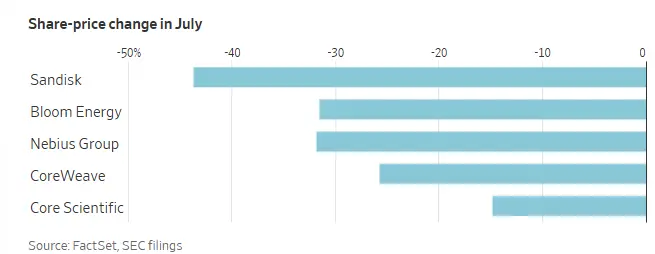
Main publicly traded stock holdings of the Situational Awareness fund as of March 31, 2026. Source: FactSet
Situational Awareness amplified returns through borrowing, with leverage reaching four times at one point. In the private market, it held stakes in Anthropic, chip startup MatX, and data center company Fluidstack.
By the end of 2025, the fund had only about eight employees, with only four investment professionals.
02 The Legend of the Stock God, Ten Days to "Demise"
The turning point came on July 10.
On that day, SK Hynix's American Depositary Shares officially landed on Nasdaq, with an issue price set at $149 per share, raising approximately $26.5 billion, making it the largest IPO by a foreign company in the U.S. Situational Awareness was one of the cornerstone investors in this listing.
On the first day of trading, SK Hynix's ADS opened at $170, rising about 14%. However, the good times did not last long, as AI hardware stocks began to correct overall.
Between July 10 and 20, both the long and short sides of Situational Awareness faced pressure.
On the long side, core holdings like SK Hynix, SanDisk, Bloom Energy, and Nebius continued to decline, with these stocks generally plummeting over 30% within a month; on the short side, stocks like Adobe that were shorted rebounded, causing damage to both ends of the "long hardware, short software" strategy.
On July 24, Aschenbrenner wrote to investors, admitting that his fund "could not escape" the market turmoil, especially in the Asian market, but referred to this sell-off as one of the most attractive buying opportunities since early 2025, inviting clients to invest new funds starting August 1. However, according to Bloomberg, this call did not bring the funding commitments he had hoped for.
Just three days later, Castle Securities publicly stated that the Federal Reserve might unexpectedly raise interest rates, further deteriorating market sentiment. On July 29, major brokers like Bank of America, Goldman Sachs, and JPMorgan Chase began to call for margin.
By July 30, Situational Awareness officially faced liquidation.
According to insiders, Castle Investment Company acquired the portion of the publicly traded stock portfolio financed by borrowed funds, while the remaining part funded by client capital was retained. After the transaction, the total assets of the Situational Awareness fund plummeted from a peak of about $45 billion in early July to about $10 billion.
Dramatically, this liquidation coincided with Aschenbrenner's wedding taking place that weekend, with his fiancée Avital Balwit serving as chief of staff to Dario Amodei, CEO of Anthropic.
03 Cash Flow Gaps and Capital Expenditure Dilemmas of Giants
The liquidation of Situational Awareness stemmed from a larger narrative shift behind AI trading: tech giants, once known for their "fortress-like" cash flows, are collectively burning cash into data centers and computing infrastructure.
In recent years, the market has been willing to give tech giants high valuations, with one important premise being that they can both grow and continuously generate substantial free cash flow. However, the latest round of earnings reports shows that this premise is weakening:
Alphabet's second-quarter revenue was $119.8 billion, a year-on-year increase of 24%; Google Cloud revenue was $24.8 billion, with a staggering year-on-year growth of 82%, and the operating profit margin of the cloud business rose from 20.7% to 35.6%. However, capital expenditures during the same period reached $44.9 billion, directly leading to a negative free cash flow of $5.9 billion for the quarter.
Alphabet's CFO Anat Ashkenazi stated on the earnings call that as AI investments deepen, free cash flow "will continue to be under pressure."
Meta faced similar issues. In the second quarter, the company's revenue was $60.8 billion, a year-on-year increase of 28%, with advertising revenue still growing, but costs and expenses surged by 55% year-on-year, with capital expenditures reaching $31.08 billion and free cash flow dropping to only $784 million, a year-on-year decline of 91%. The company's management clearly stated that expanding computing power remains a priority for 2026 to 2027.
Amazon's second-quarter AWS revenue was $42.2 billion, a year-on-year increase of 37%, marking the fastest growth in 18 quarters; however, the company also raised its full-year capital expenditure forecast to $220 billion, with free cash flow shifting from a net inflow of $18.2 billion in the same period last year to a net outflow of $7.6 billion.
When combining the annual guidance of several "super capital spenders": Alphabet $205 billion, Amazon $220 billion, Microsoft $190 billion, Meta $145 billion, totaling approximately $760 billion.
When will the investments start to yield returns? As Ken Mahoney, CEO of Mahoney Asset Management, said, "The real question is the current scale of spending; no one knows what the return on investment actually is."
04 The Largest Seller Exits, but AI Trading Is Not Cleared
The rebound in tech stocks on July 30 was a release of market sentiment after the "largest seller exited."
Oroluk pointed out that when investors know a potential seller has left the market, buyers will rush in to buy on dips. CNBC commentator Jim Cramer referred to the liquidation of Situational Awareness as a "clearing event," believing it helps stabilize AI trading.
However, opinions on the nature of this liquidation are not uniform within the industry.
Michael Dempsey, managing partner of investment firm Compound, posted that Situational Awareness's "foresight is incredibly impressive," but anyone with public market experience can see that this was a "single bet," with failures in risk management.
Former Bloomberg columnist Tim Culpan stated that this "shows the difference between wisdom and cleverness," meaning that even if the investment thesis is correct in the long term, leveraged positions eliminate the buffer for maneuvering during sharp market declines.
Investor Martin Shkreli more bluntly stated that the level of leverage was evident, and there was no other outcome.
Situational Awareness is not an isolated case. Data from Goldman Sachs' prime brokerage shows that Asian fundamental long-short funds had an average drawdown of 18.6% in July; Morgan Stanley's prime brokerage report indicated that equity hedge funds are simultaneously unwinding long and short positions at relatively equal scales, and deleveraging has not yet ended.
What the market urgently needs to answer is: how long can a portfolio with continuously negative free cash flow be sustained while cloud revenue continues to materialize, and how many institutions have established similar high-leverage concentrated positions on the same stocks?
 Risk warning
Popular articles