








Who's business is being snatched in the 23-hour trading of Nasdaq?
 Core Viewpoint

 23-hour trading is primarily about competing for trading orders rather than competing for listed companies. Nasdaq first competes for orders, then for prices. Only after mastering the prices can it attract more companies. The purpose of 23-hour trading is to turn the daytime in Asia into the night session of U.S. stocks, competing for the global asset initial pricing power.
Author: Wall Street Insights
The most active in the Asian session is not tech stocks, but U.S. market ETFs.
On December 6, 2026, Nasdaq plans to launch stock trading for 23 hours a day, five days a week. The SEC has approved the Nasdaq 23/5 trading rule change, but the official launch still depends on the readiness of market infrastructure like SIP and the implementation of supporting rules.
The new night trading session starts at 9 PM Eastern Time and ends at 4 AM the next day. In December, it corresponds to 10 AM to 5 PM Beijing Time. Asian investors can trade U.S. stocks directly during the day.
This reform seems to merely extend trading hours. Behind it is a battle for orders. Nasdaq wants to reclaim transactions from night trading platforms, broker internal trading systems, and other exchanges. It also wants global investors to complete transactions in the U.S. market first after significant events occur in any time zone.
In the short term, Nasdaq is competing for orders from ATS night trading platforms, broker internal transaction systems, and other exchanges; in the medium term, it is competing for nighttime price discovery of ETFs and large tech stocks; in the long term, it is competing for the global asset pricing gateway during Asian daytime.
Nasdaq's extension of trading hours is not to keep U.S. investors awake trading stocks. It aims to turn the daytime of Asian investors into trading hours for U.S. stocks.
Asian Daytime Becomes U.S. Stock Night Trading
The core trading time for U.S. stocks is only 6.5 hours. Pre-market and after-hours trading already exist. Nasdaq's new arrangement fills the gap from 9 PM to 4 AM Eastern Time. Only 1 hour is left for maintenance. 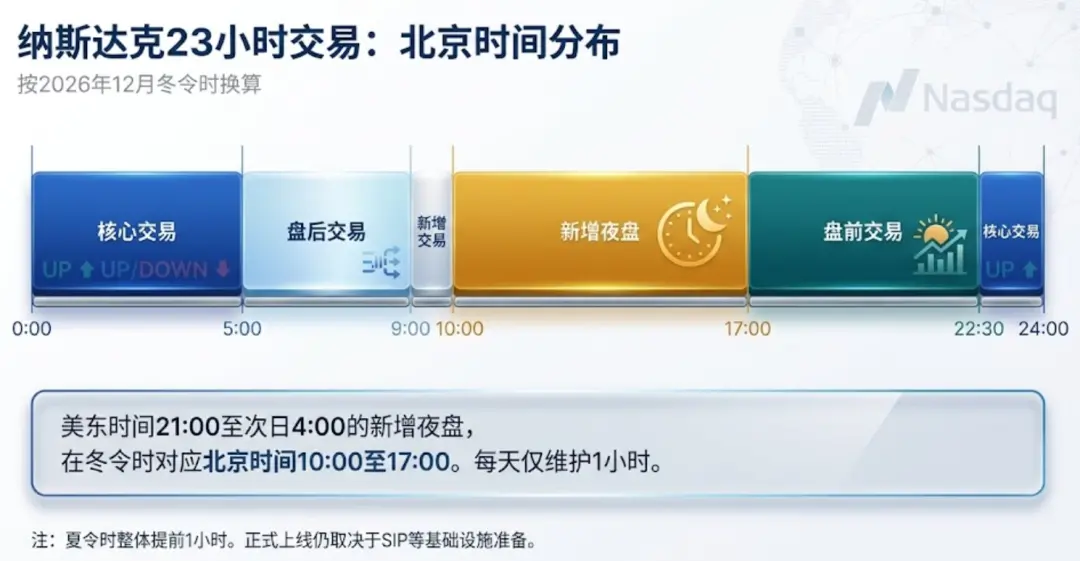
Note: Nasdaq's 23-hour trading time distribution in Beijing time crosses days.
This newly added time perfectly covers the daytime of major Asian markets. Investors from China, Japan, and South Korea no longer have to wait until late at night. After the Federal Reserve's policies, geopolitical conflicts, or corporate news occur, Asian funds also do not have to wait for the New York market to open.
What Are Investors Buying During the Asian Session?
Nasdaq has released a set of overnight trading data for the U.S. The statistical period is from January to June 2025. These trades mainly occur during the Asian session, and the data cannot identify the nationality of investors, nor can it label all transactions as Asian funds. It is more suitable for observing trading preferences and tool choices during the Asian session.
There are about 11,300 trading codes in the U.S. market. Only 1,403 had transactions overnight. Only 644 had a daily transaction volume exceeding $10,000. The top 15 varieties account for about 53% of the total overnight transaction volume, which Nasdaq summarizes as close to 55%. Among them, 12 are ETFs, and only 3 are individual stocks. This indicates that night trading is not a migration of liquidity across the entire market, but rather concentrated trading of a few macro risk tools and mega-cap assets.
SPY, IVV, and VOO are all S&P 500 ETFs, collectively accounting for 25.6% of overnight transactions. QQQ accounts for 4.5%. The triple-leveraged QQQ TQQQ and the triple-inverse QQQ SQQQ together account for 2.9%.
The three most active individual stocks are Tesla, Nvidia, and Alibaba, collectively accounting for 12.7%. Other active varieties include gold, Indian stocks, international stocks, and corporate bond ETFs. 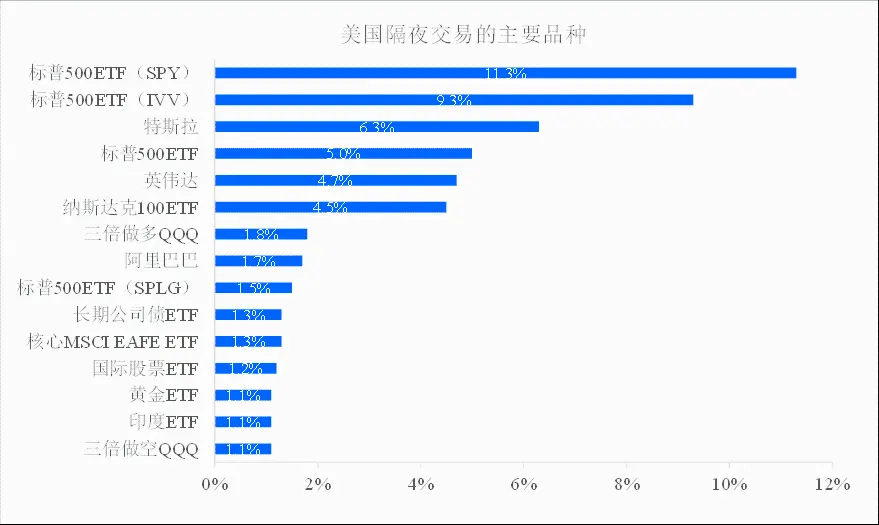 Note: Data for January to June 2026.
Investors during the Asian session primarily trade in the U.S. market, and only then do they trade U.S. companies. The main focus of night trading is not company research, but risk management.
Nasdaq Is First Competing for Orders
SPY, IVV, VOO, and Alibaba are not listed on Nasdaq. They can still be traded on Nasdaq. This fact indicates that 23-hour trading is primarily about competing for trading orders rather than listed companies.
After U.S. exchanges close, orders do not disappear. They flow to overnight platforms like Blue Ocean, broker internal systems, and other trading venues. The New York Stock Exchange and Cboe are also promoting longer trading hours. The London Stock Exchange is preparing to build a new delayed trading platform starting with ETFs. Supporters argue that bringing these orders back to regulated exchanges can improve transaction transparency, quote visibility, and market monitoring capabilities.
Exchange revenue does not come solely from transaction fees. Orders bring market revenue, attract market makers, and form market reference prices. Whoever gets the orders first can write information into prices earlier.
Longer trading hours will also enhance the attractiveness of the U.S. market to overseas companies. This effect ranks after order competition. Companies choosing where to list still need to compare valuation, liquidity, investor structure, and regulatory costs.
Nasdaq first competes for orders, then for prices. Only after mastering prices can it attract more companies.
Who Pays for 23-Hour Trading
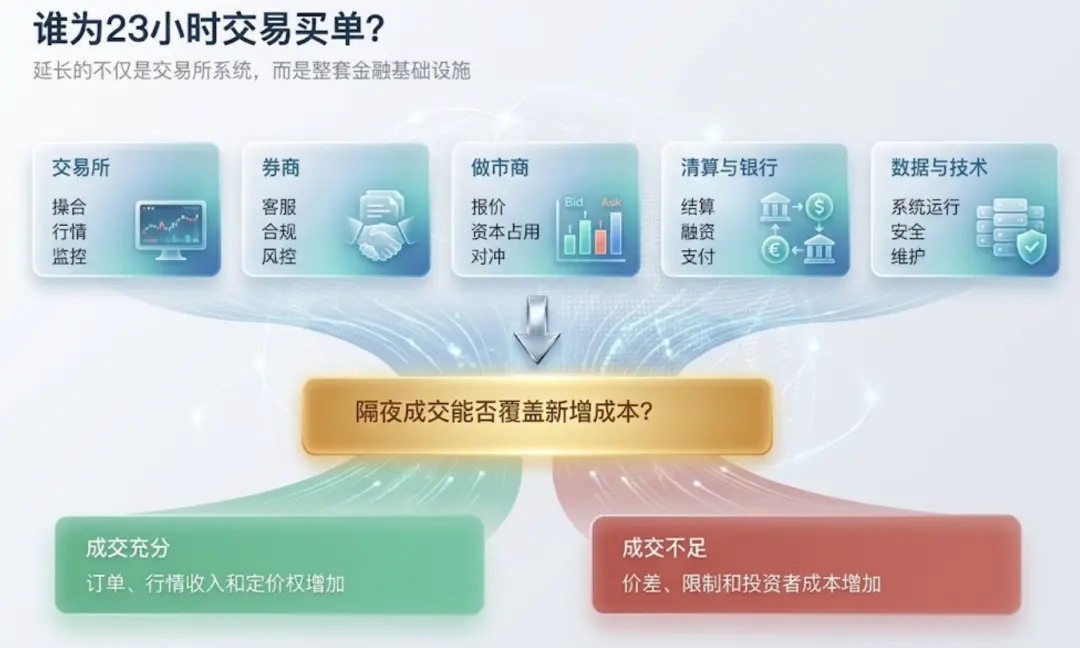
The exchange is extending not just the matching system. The entire financial infrastructure needs to extend its operation.
Exchanges need to continuously provide market data and monitor trading. Brokers need to arrange customer service, compliance, and risk control. Market makers need to extend quotes and occupy more capital. Clearing agencies, banks, data providers, and technology service providers also need to work in sync. System maintenance time is compressed, and cybersecurity risks increase accordingly.
Existing pre-market and after-hours trading already bear some costs. The new night trading will still increase personnel, system, capital, and compliance expenditures. The problem is that overnight transactions for most stocks are very light. Many institutions must maintain a full set of services for a few ETFs and large tech stocks.
Costs will ultimately fall back on investors. This may not manifest as a night trading commission. The bid-ask spread may widen. Financing costs may increase. Brokers may restrict market orders and trading varieties. Market makers may also factor in capital occupation and hedging risks into their quotes.
The exchange extends time, while investors bear the spread. Trading time is not a free public service; it is a financial product that requires transaction volume to pay costs.
Faster Price Discovery Does Not Mean More Accurate Prices
23-hour trading increases market response speed. It does not automatically create liquidity.
There are fewer participants overnight, leading to insufficient market depth. The trading times for stocks, futures, and options are also not fully synchronized. After market makers sell stocks, they may not be able to immediately use other tools to complete hedging. Quotes will be more conservative, and spreads will be wider.
After significant news occurs, night trading will quickly form prices. These prices may reflect new information or may just be the result of a small number of orders driving them. Once the main trading session opens, more institutions enter, and night trading prices often need to be re-evaluated.
Investors gain the freedom to trade at any time, but they also gain the freedom to make mistakes at any time. Night trading is more suitable for reducing sudden risks, not for chasing short-term prices. Limit orders are more important than market orders. Waiting for liquidity to recover can sometimes be cheaper than acting immediately.
23-hour trading solves the question of "can I sell," but does not solve the question of "at what price should I sell."
The U.S. Exports Not Just Capital, But Also Prices
ETFs dominate overnight transactions, revealing deeper changes. Global investors can trade U.S. stocks in the U.S. market, but they can also trade gold, Indian stocks, global bonds, and market risks from other countries. These assets may not belong to the U.S. However, trading and pricing are increasingly concentrated in the U.S. After significant events occur, global funds first adjust their positions through U.S. ETFs. Before local markets open, the U.S. market has already formed reference prices.
This leaves a question for Asian markets. When Indian stocks are traded through U.S. ETFs, who is determining the international price of Indian assets? When Chinese tech stocks are traded simultaneously in Hong Kong and the U.S., which market reflects global expectations first? After the Asian market opens, is it independent pricing, or is it correcting the answers already given by the U.S. market?
The U.S. exports not just capital, but also prices.
Does the Hong Kong Stock Exchange Need to Copy Nasdaq?
The Hong Kong Stock Exchange has already studied extending trading hours. The spot market has discussed opening at 9 AM and canceling the lunch break. The current focus is still on extending the night trading for derivatives. The Hong Kong stock market is more suitable for limited delays and pilot varieties in the short term, rather than directly copying 23-hour spot trading.
The Stock Connect is the biggest constraint. Southbound funds account for a significant proportion of Hong Kong stock transactions. If the Hong Kong Stock Exchange opens night trading independently, mainland funds cannot participate simultaneously. Transactions may be split into two markets. The operational costs for financial institutions will certainly increase, but new orders are not guaranteed. A more realistic path is to first focus on night trading for derivatives, ETFs, a few large dual-listed stocks, and the convenience of RMB trading and settlement.
Hong Kong's real advantage is not its operating hours. Hong Kong has a batch of Chinese internet, consumer, pharmaceutical, and artificial intelligence companies that global investors cannot access directly in other markets. The more important work for the Hong Kong Stock Exchange is to increase the supply of quality assets, expand connectivity, and improve RMB trading and settlement.
Nasdaq brings global orders to the U.S. market. The Hong Kong Stock Exchange brings Chinese assets to global investors. The two are competing for pricing power, but their paths are not the same.
Conclusion: It's Not About Who Keeps the Door Open Longer
23-hour trading is superficially a change in trading systems. Behind it is the competition for global orders among trading platforms, financial intermediaries, and major capital markets.
Trading time is merely an amplifier. With global demand, extending time can increase transactions and expand pricing power. Without sufficient demand, extending time will only increase costs and disperse liquidity.
If there are no assets worth continuous trading by global investors, extending operating hours will only prolong the dullness. What exchanges are truly competing for is not who keeps the door open longer, but who defines the next global price.
 Risk warning


Popular articles





