








Morning Report | Morgan Stanley Bitcoin ETF listed with a paper loss of $66.8 million after 85 days, yet still received $371.1 million in subscriptions; SpaceX institutional holdings overview: Alphabet holds $94.18 billion at the top, Nvidia holds $20.98 billion

 Overview of Important Market Events on August 16
Compiled by: ChainCatcher
What important events have occurred in the past 24 hours?
Morgan Stanley Bitcoin ETF records a paper loss of $66.8 million after 85 days of listing, still receives $371.1 million in subscriptions
According to ChainCatcher, regulatory documents reveal that the Morgan Stanley Bitcoin Trust (MSBT) recorded approximately $371.1 million in total subscription contributions within 85 days of listing, including about $200.3 million in cash and approximately $170.8 million in Bitcoin. During the same period, the fund's net assets decreased by about $66.8 million due to operations, almost entirely from unrealized depreciation in Bitcoin (approximately $66.17 million), along with realized losses of about $618,600 and sponsor fees of about $72,300, not caused by large redemptions from investors. The documents show that redemptions during this period accounted for only about 1.42% of total subscription contributions. The fund issued approximately 17.9 million shares and redeemed 250,000 shares (corresponding to 1,790 creation baskets and 25 redemption baskets). The share circulation increased from about 17.65 million on June 30 to about 21.74 million on July 31, an increase of about 23.17%. Creation and redemption are conducted by authorized participants at a net asset value of 10,000 shares per basket.
VanEck Research Director: Passage of the CLARITY Act will trigger a huge rebound in L1 tokens
According to ChainCatcher, Matthew Sigel, the head of digital asset research at VanEck, stated that if the U.S. CLARITY Act is passed, it will trigger "an enormous relief rally" in L1 tokens. Sigel's comments focus on the potential impact of regulatory progress on native assets of public chains. The CLARITY Act aims to provide a clearer regulatory framework for digital assets, which the market generally views as one of the important legislative variables affecting the risk appetite for crypto assets.
SEC reviews Cboe's application for six 3x leveraged commodity ETFs, covering Bitcoin and Ethereum
According to ChainCatcher, the U.S. Securities and Exchange Commission (SEC) is reviewing a rule change application submitted by the Cboe BZX Exchange, involving six leveraged commodity ETFs that track a benchmark daily performance of 3x. The SEC's initial review period is 45 days after publication in the Federal Register. Volatility Shares LLC is the sponsor of the relevant funds, which include 3x ETFs for gold, silver, Bitcoin, Ethereum, crude oil, and natural gas, all intended to operate as commodity pools and not as investment companies. The Bitcoin and Ethereum ETFs will primarily invest in near-month and next-month futures contracts on the Chicago Mercantile Exchange (CME), rather than directly holding Bitcoin or Ethereum, and will allocate cash and cash equivalents as collateral or margin. Before the products can be listed, the SEC must approve the exchange's rule changes, and the trust's Form S-1 registration statement must also become effective. Each fund must have at least 100,000 shares at the time of listing, and authorized participants can subscribe or redeem in cash at increments of 10,000 shares.
Cboe applies to list 3x leveraged ETFs for Bitcoin, Ethereum, gold, and natural gas
According to ChainCatcher, Cointelegraph reports that the Chicago Board Options Exchange (Cboe) has submitted an application to list 3x leveraged ETFs for Bitcoin, Ethereum, gold, silver, crude oil, and natural gas. These products cover both crypto assets and traditional commodities, and if approved, will provide investors with higher-leverage trading tools, further enriching the ETF product line in the relevant markets.
Overview of SpaceX institutional holdings: Alphabet holds $94.18 billion, Nvidia holds $20.98 billion
According to ChainCatcher, as SpaceX went public on June 12 on Nasdaq, the Q2 13F report first revealed its institutional holdings post-listing. Third-party 13F platform Giantsight reports that as of June 30, approximately 1,697 reporting entities disclosed their positions in SpaceX, covering various types of funds including pre-listing investors, venture capital, asset management institutions, and pensions. SEC documents show that Google's parent company Alphabet reported holding 551 million shares of SpaceX (worth $94.18 billion), making it the largest 13F reported position currently; Valor Management holds 503 million shares ($86.01 billion), FMR LLC holds 303 million shares ($51.66 billion), Gigafund Management holds 172 million shares ($29.36 billion), the Saudi Public Investment Fund holds 154 million shares ($26.34 billion), and Baron’s BAMCO holds 146 million shares ($24.91 billion). Other key reporting entities include Nvidia holding 123 million shares ($20.98 billion), Baillie Gifford holding 51.4 million shares ($8.78 billion), BlackRock holding 51.04 million shares ($8.72 billion), Ontario Teachers' Pension Plan holding 50.68 million shares ($8.66 billion), and Harvard University's endowment holding 12.935 million shares ($2.21 billion). In terms of holdings sources, Alphabet and Gigafund are pre-listing investors in SpaceX; Nvidia's position in SpaceX stems from a prior investment in xAI. FMR, BAMCO, BlackRock, and Baillie Gifford mainly represent asset management funds. These positions first appeared in the 13F and do not imply that the relevant institutions all bought from the secondary market after SpaceX went public. The amounts are all as of June 30. On that day, SpaceX closed at $170.86, and as of August 14, it closed at $140, down about 18.1% from the end of the quarter. If the number of shares held has not changed, the current market value of the relevant common stock positions will correspondingly decrease. The 13F primarily reflects long positions in reportable securities at the end of the quarter and some held options, without disclosing short positions, option selling positions, specific purchase times, transaction costs, or trades after the end of the quarter.
Harvard Fund discloses holding $2.21 billion in SpaceX shares, Bitcoin ETF holdings remain unchanged
According to ChainCatcher, Harvard University's endowment fund's latest 13F filing shows that as of June 30, its holdings in BlackRock's spot Bitcoin ETF IBIT remain at 3.0446 million shares, valued at approximately $101.4 million, with the number of shares unchanged from the end of the first quarter, ending a previous two-quarter reduction. Harvard reduced its IBIT holdings by 21% in Q4 2025 and again by 43% in Q1 2026. Currently, IBIT accounts for about 2.4% of Harvard's disclosed $4.26 billion U.S. stock portfolio. Its gold-related product holdings are even more valuable, with the iShares Gold Trust (IAU) and SPDR Gold Trust (GLD) combined valued at approximately $171.2 million as of the end of Q2. Harvard previously completely liquidated its $86.8 million position in BlackRock's spot Ethereum ETF and did not add any Ethereum-related positions in Q2. Harvard University's largest holding is SpaceX, reaching 12,935,100 shares, valued at $2.21 billion, making it the largest single stock position disclosed in the filing. The total U.S. stock assets disclosed by Harvard this time amount to approximately $4.3 billion, meaning SpaceX holdings account for 52%. Among other institutions, the Abu Dhabi sovereign wealth fund Mubadala and the Abu Dhabi Investment Authority maintained their IBIT holdings at 14.7219 million shares and 8.2187 million shares, respectively, with a combined value of approximately $764 million. JPMorgan increased its IBIT holdings from about 8.3 million shares to 10.4 million shares; Morgan Stanley reduced its holdings from 17.3 million shares to about 16.5 million shares, a decrease of 4.5%.
Paul Tudor Jones' Tudor Investment Corp increases its holdings in BlackRock's Bitcoin ETF to $22.9 million
According to ChainCatcher, Tudor Investment Corp, a macro hedge fund founded by Paul Tudor Jones, disclosed in its latest 13F filing with the SEC that as of June 30, 2026, it holds 688,529 shares of BlackRock's iShares Bitcoin Trust (IBIT), valued at $22.9 million. The institution's holdings increased by 18.9% compared to the 578,083 shares disclosed in the previous quarter. Tudor Investment Corp manages approximately $106 billion in assets, and its spot Bitcoin ETF holdings gain exposure to Bitcoin through a fund structure. Paul Tudor Jones first disclosed his Bitcoin exposure in May 2020, when he allocated a low single-digit percentage of assets through Bitcoin futures. In October 2024, he stated that he holds gold and Bitcoin but does not hold fixed-income assets.
Analysis: The era of Bitcoin fighting against banks is ending, trillion-dollar financial institutions are accelerating their embrace of crypto assets
According to ChainCatcher, as reported by CoinDesk, with Wall Street and global financial institutions accelerating their entry into the digital asset space, the boundaries between traditional finance (TradFi) and decentralized finance (DeFi) are gradually blurring. Bitwise CEO Hunter Horsley stated that the era of "going long on Bitcoin and shorting bankers" is over, as financial institutions are turning to the other side of the crypto industry, driving the adoption of digital assets. Hunter Horsley noted that this summer, two financial institutions managing over $1 trillion in assets approved the launch of crypto products in a bear market environment, indicating that large institutions are expanding channels for clients to access digital assets. "This year, everyone is wearing the crypto industry's jersey. Now, everyone is working for the crypto industry," Horsley stated. He pointed out that these financial institutions managing over $1 trillion in client assets did not open related services during the downturn of the crypto market in 2022, but are now actively embracing this field. Sygnum's Chief Investment Officer Fabian Dori also believes that the relationship between banks and the crypto industry has undergone a structural change. "The past trades of 'going long on Bitcoin and shorting bankers' are over; banks have shifted from resisting digital assets to building, supporting, and distributing digital assets through custody, tokenization, and compliant trading," a change driven mainly by growing customer demand and gradually clarified regulatory rules, rather than short-term market cycle changes. Anchorage Digital CEO Nathan McCauley stated that over the past two years, its client base increasingly reflects the trend of integration between traditional finance and crypto finance. Large financial institutions typically choose to collaborate with specialized crypto infrastructure companies rather than building their own technology systems. In recent years, more and more financial institutions have entered the crypto space, including Swissquote, DBS, BBVA, BNY Mellon, Credit Suisse-related institutions, as well as Morgan Stanley and Charles Schwab.
Crypto company Bits of Gold suffers data breach, affecting 200,000 customers
According to ChainCatcher, as reported by Crypto Briefing, Israel's largest compliant crypto broker Bits of Gold has suffered a data breach, with approximately 200,000 customers' personal information stolen by hackers, putting all platform users at risk. The company obtained Israel's first virtual asset service provider (VASP) license in September 2022 and was approved in April 2026 to issue the BILS stablecoin, pegged 1:1 to the shekel. The types of stolen data have not been disclosed, but crypto brokers typically collect sensitive information such as identification documents, proof of address, and financial information based on KYC regulations. While cold wallets can protect digital assets, they cannot protect customer identity documents on servers. Historical cases show that similar data breaches are often used for phishing, SIM swapping, and targeted social engineering attacks, with security risks extending beyond the platform itself.
Ondo Stocks tokenized stocks TVL surpasses $1 billion
According to ChainCatcher, as reported by Chainwire, Ondo Finance's tokenized stock platform Ondo Stocks has reached a total locked value (TVL) of $1.01 billion, less than a year since its launch in September 2025. The platform became the world's highest TVL tokenized stock service provider within 48 hours of launch and continues to lead, offering over 440 assets. Each token is fully backed by the corresponding stock or ETF and is held by a licensed U.S. custodian broker. Additionally, Ondo Finance has disclosed that its perpetual contract platform Ondo Perps, launched in July, has accumulated a trading volume exceeding $8 billion, with over $5 billion traded in the nearly 30 days since its public launch.
UBS significantly increases holdings in Bitcoin ETF options, IBIT call positions surge 24 times in the quarter
According to ChainCatcher, as reported by CoinDesk, Swiss banking giant UBS significantly increased its exposure to BlackRock's iShares Bitcoin Trust (IBIT) in Q2, with its nominal holdings of IBIT call options rising from 80,000 shares to approximately 1.95 million shares, a quarterly increase of over 24 times; during the same period, its directly held IBIT shares increased from 364,371 shares to 407,890 shares, an increase of about 12%. In contrast, UBS's nominal exposure to IBIT put options decreased from 303,300 shares to 143,300 shares, a decrease of about 53%. Regulatory documents did not disclose the option strike prices and expiration dates, nor did they specify whether the changes were driven by client trading demand, market-making hedges, active management, or proprietary trading.
Korean crypto operator sentenced to 15 years for $50 million fraud
According to ChainCatcher, as reported by CoinDesk, a South Korean court sentenced a crypto platform operator to 15 years in prison this week for a fraud case involving approximately $50 million. This ruling is considered one of the longest sentences handed down in South Korea for cryptocurrency fraud to date. Reports indicate that this case occurred against the backdrop of South Korea strengthening its scrutiny of outbound capital transfers and platforms like Binance implementing restrictions, reflecting local regulators' ongoing tightening of efforts to combat crypto fraud and capital outflows.
A user loses $750,000 in BTC from CEX account due to Google verification cloud sync issue
According to ChainCatcher, monitoring by GoPlus revealed that a Bitcoin holder had just securely transferred assets from a Coldcard MK4 hardware wallet to a centralized exchange, avoiding the risk of the hardware wallet itself being stolen. However, within 12 hours of the transfer's completion, their Google account was hacked, due to enabling Google verification cloud sync, leading to the exchange account being logged into and approximately $750,000 worth of Bitcoin being emptied. GoPlus pointed out that such attacks typically do not rely on brute force cracking but are achieved through social engineering phishing and weak password cracking, with common paths including: phishing pages inducing input of Google passwords, malicious browser plugins or cracking software stealing cookies and passwords, weak password reuse being cracked, and recovery email or phone numbers being taken over to reset passwords.
COLDCARD hacked, Mk3 user Prince Filip's entire Bitcoin at risk of theft
According to ChainCatcher, Bitcoin News posted on X platform stating that Prince Filip learned during his vacation that COLDCARD had been hacked. As a Mk3 user, he faced the risk of all his Bitcoin being stolen at any moment.
Long-term Bitcoin holder loses approximately $750,000 in BTC after Google account hacked
According to ChainCatcher, Bitcoin News posted on X platform stating that a long-term Bitcoin holder had all assets withdrawn from their account less than 12 hours after transferring BTC to a major exchange in Australia. According to a friend, the hacker had infiltrated their Google account for about three months and obtained credentials for Google Authenticator backed up in their email and cloud, then waited for them to deposit BTC into the exchange. The exchange identified the hacker as the account holder and approved the withdrawal, with the holder receiving a notification of the approved withdrawal at 3 a.m. The post suggested disabling Google Authenticator cloud backup and using hardware security keys like YubiKey; setting up two keys can serve as a backup if one is lost.
Analyst: Binance sees record high UNI whale withdrawals, large investors are positioning at lows
According to ChainCatcher, CryptoQuant analyst Darkfost stated that despite Uniswap's native token UNI dropping over 93% from its 2021 high of $43 to about $3, whale accumulation has reached its strongest level in five years. Data shows that the top 10 largest UNI outflows on Binance averaged 7,300 UNI per transaction, setting a five-year high; the current average remains high, with this trading group still accumulating 5,600 UNI daily. Darkfost pointed out that although the overall environment for altcoins is challenging, some tokens are still attracting attention, especially those actively accumulated by whales. The accumulation intensity of UNI has reached historical peaks during the current downturn, indicating that large investors are positioning at lows.
Vitalik: The Bitcoin community deserves recognition for UTXO innovations, Ethereum scaling will integrate various state model advantages
According to ChainCatcher, Ethereum co-founder Vitalik Buterin posted on X platform stating that the Bitcoin community deserves recognition for promoting the development of relevant technological concepts, including Utreexo and other UTXO (Unspent Transaction Output) state optimization solutions. The scaling route currently being explored by Ethereum is integrating the advantages of different blockchain state models in practice. Vitalik Buterin pointed out that Ethereum aims to simultaneously have the advantages of UTXO model state, dynamic state, and solutions between the two, allowing the vast majority of network activities to achieve "hyperscale" without sacrificing decentralization, ease of node operation, and censorship resistance. Vitalik Buterin stated that future Ethereum scaling is not simply about replicating a certain architecture but aims to combine different design concepts to enhance throughput while maintaining network openness and security. Among them, Utreexo is a state compression solution proposed by the Bitcoin ecosystem that reduces the storage burden on nodes by introducing accumulator technology, making full node operation more lightweight, and is considered beneficial for enhancing Bitcoin's long-term scalability.
Apple urgently fixes macOS screen sharing vulnerability, exposing Macs used for cryptocurrency mining
According to ChainCatcher, as reported by The Hacker News, the Dutch National Cyber Security Centre (NCSC) warned that a recently patched severe authentication vulnerability (CVE-2026-65400, CVSS score 9.8) in Apple's macOS screen sharing component has been exploited in the wild, allowing attackers to access exposed Macs on the internet (port 5900) and implant Monero mining programs without valid credentials. Apple has urgently updated macOS Tahoe 26.6.1, Sequoia 15.7.9, and Sonoma 14.8.9 on August 6 to fix this vulnerability by enhancing credential verification through improved state management. The NCSC confirmed that in multiple attacks, attackers obtained root privileges and deployed mining software. Security researcher @osxreverser disclosed another pre-authentication vulnerability in the same component (also fixed in 26.6), which can bypass password authentication with just the target IP, allowing exploitation without a username. According to Calif company, researchers developed usable attack programs for both vulnerabilities using AI in just four hours, showing that AI is significantly shortening the time from vulnerability discovery to attack code development. Users are advised to update their systems immediately; if unable to update, they should disable screen sharing.
Data: BSC chain meme coin "Behemoth" market cap briefly exceeds $2.7 million, 24H increase of 8251%
According to ChainCatcher, GMGN data shows that the market cap of the BSC chain meme coin "Behemoth" briefly exceeded $2.7 million, currently reported at $1.04 million, with a 24H increase of 8251%. Meme coin prices are highly volatile, and investors are advised to participate cautiously. Previously, a developer announced the completion of the first real on-chain 4-bit processor (CPU) on the BNB Chain, consisting of 2,251 logic gates, including NAND gates and flip-flops, and verified cycle by cycle, with performance specifications comparable to Intel's 4004 processor from 1971. This on-chain CPU is named "Behemoth" and has successfully run Fibonacci sequence calculations: 1, 1, 2, 3, 5, 8, 13. As the processor's operating rhythm synchronizes with BNB Chain's block generation, it executes a cycle every 0.45 seconds, currently running at a frequency of about 2.22Hz, referred to by developers as "possibly the slowest CPU in the universe." Developers stated that they will publicly release the complete protocol in the future, allowing anyone to create their own on-chain processors based on the protocol and support inter-calls between processors, building more complex on-chain computing systems in a "building block" manner. Regarding this project, Binance co-founder CZ responded to inquiries about its practical application scenarios: "What is the use case?" sparking community discussions.
Data: The number of tokenized stock holders has doubled in the past month to 1.31 million, with transfer volume soaring 179% to $23.13 billion
According to ChainCatcher, as reported by Cointelegraph, data from RWA.xyz shows that the number of tokenized stock holders has more than doubled in the past month, reaching 1.31 million. During the same period, monthly transfer volume surged nearly 180% to $23.13 billion, while the number of monthly active addresses grew by 34.62% to nearly 572,000. The total value of tokenized stocks also increased by 5.9%, reaching $2.38 billion. Ondo leads the market with a value of approximately $872 million, followed by Kraken's xStocks ($557.8 million) and Binance's bStocks ($521.8 million). The largest single tokenized assets include Securitize ($145.2 million), Strategy PP Variable xStock ($135.6 million), and Ondo's tokenized Circle shares ($99.7 million).
Cardano announces Dijkstra upgrade roadmap: Leios to launch this year, Peras to activate in 2027
According to ChainCatcher, as reported by Crypto.news, Cardano's governance company Intersect has updated its roadmap, dividing the Dijkstra upgrade into two phases: the first phase will launch in Q4 2026, including the Linear Leios scaling solution, nested transactions, new serialization structures, and PlutusV4 changes; the second phase will activate the Ouroboros Peras consensus protocol through a separate hard fork, targeting Q2 2027. Linear Leios introduces an endorsement block mechanism, certified by the stake committee for additional transactions to enhance throughput while retaining the existing Praos security model. Additionally, Cardano plans to submit amendments to add Dijkstra-related parameters by September 11. The Rust node client Amaru has achieved relay and chain synchronization capabilities, with a mainnet block generation target set for November 2026. Intersect emphasizes that the above timelines are estimates and not commitments, and governance and community testing may lead to activation delays.
Data: Coinbase Bitcoin negative premium has lasted 90 days, setting a new historical record
According to ChainCatcher, CoinGlass data shows that the Coinbase Bitcoin premium index has been in negative premium territory for 90 consecutive days from May 19 to August 16, with the latest report at -0.1066%, setting the longest continuous negative premium record since the index was launched. The previous longest record was 40 consecutive days from January 16 to February 24 this year, also exceeding the approximately 30 days of continuous negative premium duration during last year's "1011 crash." The Coinbase Bitcoin premium index is used to measure the price difference between Coinbase Pro and Binance for Bitcoin. A continuous negative index typically indicates that Coinbase's quotes are relatively low, reflecting weak buying pressure or significant selling pressure in the U.S. market, but this indicator should not be solely relied upon to determine that institutional funds are flowing out.
Galaxy Research Director: Attacks on Coldcard are ongoing, users need to confirm device settings
According to ChainCatcher, Galaxy's research director has monitored that attacks on Coldcard are still ongoing, and users still using Coldcard should remain vigilant and confirm their device settings. They continue to assist victims and gather intelligence about the attackers, hoping to receive help tracking stolen funds; victims can contact them via private message.
Meme Popularity Rankings
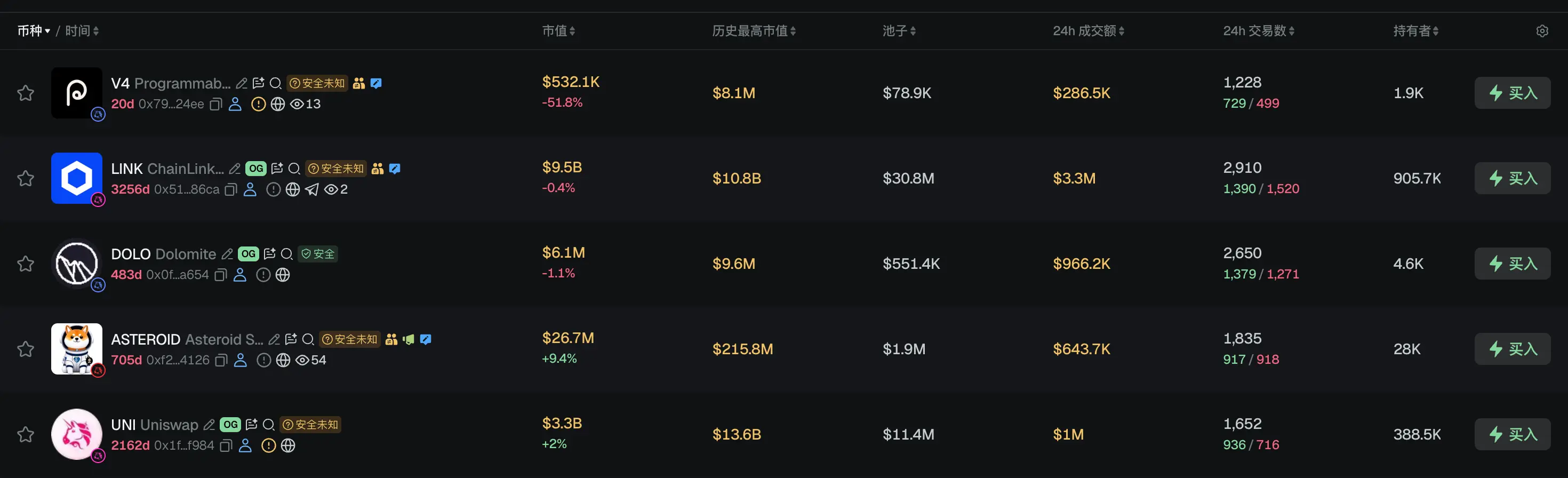
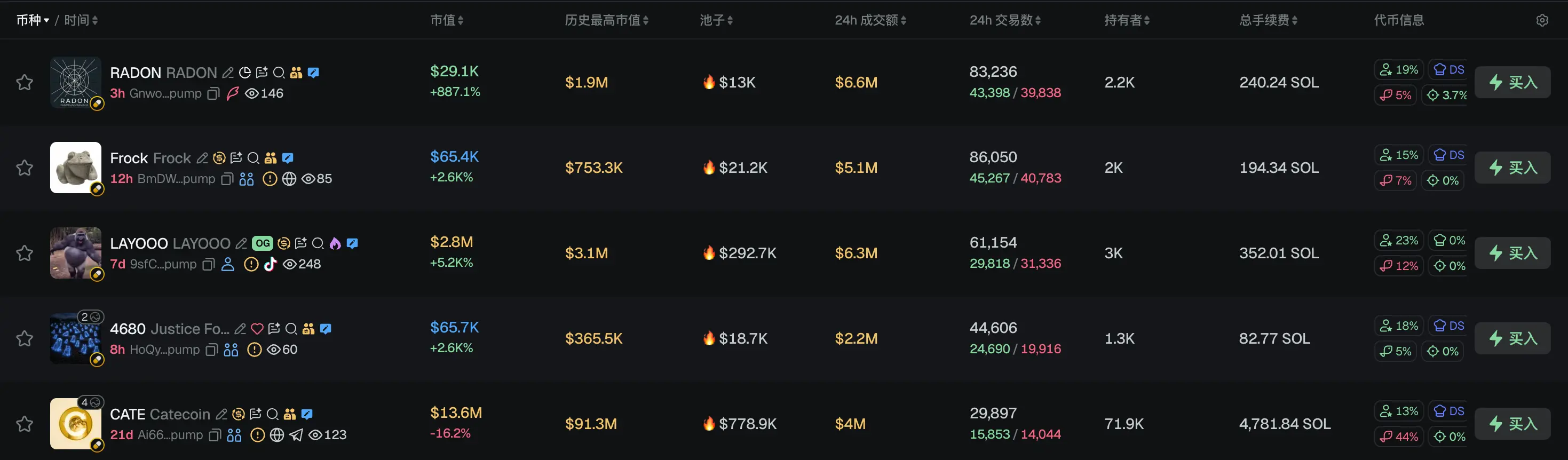
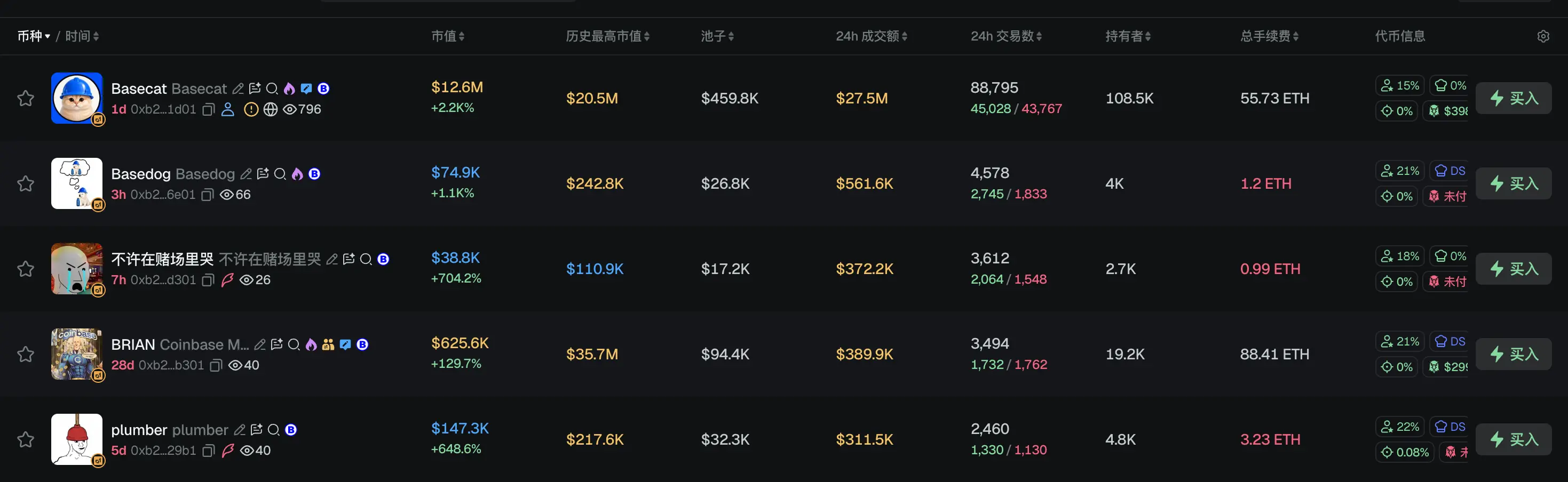
According to meme token tracking and analysis platform GMGN market data, as of August 17, 08:45,
The top five popular ETH tokens in the past 24 hours are: V4, LINK, DOLO, COW, ASTEROID
The top five popular Solana tokens in the past 24 hours are: RADON, Frock, LAYOOO, BLUEBALLS, 4680
The top five popular Base tokens in the past 24 hours are: Basecat, QUID, Don't Cry in the Casino, Basedog, VELVET
What are the exciting articles worth reading in the past 24 hours?
Nasdaq trades for 23 hours a day, whose business is it stealing?
Nasdaq brings global orders to the U.S. market. The Hong Kong Stock Exchange brings Chinese assets to global investors. The two compete for pricing power, but the paths are different. Conclusion: It's not about who keeps the door open longer. The 23-hour trading is superficially a change in trading systems. Behind it is the competition for global orders among trading platforms, financial intermediaries, and major capital markets. Trading time is just an amplifier. With global demand, extending time can increase transactions and expand pricing power. Without sufficient demand, extending time will only increase costs and disperse liquidity. Without assets worth continuous trading by global investors, extending business hours will only prolong the dullness. What exchanges are truly competing for is not who keeps the door open longer, but who defines the next global price.
Upbit is in a hurry, a hasty counterattack aimed at regaining stablecoin market share
Thirdly, the contradiction lies in: regulatory regulations may make it difficult for Dunamu to fully enjoy the dividends of the Korean won stablecoin. The current "Specific Financial Transaction Information Act" and "Virtual Asset User Protection Act" stipulate that virtual asset service providers cannot trade assets issued by related parties. After Dunamu falls under the Naver Group, if Naver leads a consortium to issue a Korean won stablecoin, there is a regulatory interpretation that Upbit may be restricted from listing that currency. Whether it can launch a local Korean won stablecoin in the future is still uncertain, but the opportunity that can be firmly grasped now is to become the distribution hub for U.S. dollar stablecoins in Korea.
The only new stock that Berkshire built in Q2 was Horton Homes, with a small addition of 3,564 shares, worth about $580,000. In terms of reductions, in addition to Bank of America, Berkshire also reduced its holdings in Ally Financial, Capital One, kidney dialysis service provider DaVita, grocer Kroger, and steel manufacturer Nucor. The alcoholic beverage producer Constellation Brands was significantly reduced in Q1 and completely liquidated by Berkshire in Q2.
In fact, the biggest scenario for stablecoin payments is not cross-border
These data indicate that a considerable scale of capital exchanges has formed between the Asian market and markets outside Asia with high stablecoin usage rates. Net inflow data also shows similar characteristics. The Asia-Pacific region received $167 million more than it sent, showing an overall net inflow; meanwhile, the U.S. recorded the largest net outflow in the sample. Indonesia (+$111 million), Singapore (+$57.9 million), and South Korea (+$31.7 million) are among the markets with the largest net inflows in the sample. Therefore, for institutions currently assessing the demand for stablecoin payments, the Asia-Pacific region has the largest identifiable transaction scale, the highest domestic transaction volume, and positive net inflows of stablecoins.
 Risk warning




Popular articles





