AI computing power stocks collectively rebound: Anthropic's projected $807 billion long-term contract and Broadcom's $63 billion financing, what is the market repricing?

 These four companies are positioned differently within the industry chain, so we cannot only look at revenue growth rates, nor can we simply judge the long-term value of all companies based on a single quarter's free cash flow. However, they collectively illustrate one issue: computing power orders can bring growth expectations, and only with controllable costs and continuous customer payments can growth potentially translate into shareholder returns.
1. Why Did AI Computing Stocks Suddenly Rise Collectively?
On October 27, U.S. stocks in the AI computing chain experienced a strong rebound. The Philadelphia Semiconductor Index rose by 3.6%, with all 30 constituent stocks closing higher. Broadcom increased by 4.00%, Oracle rose by 3.55%, Cerebras surged by 10.10%, and CoreWeave climbed by 7.94%. The Nasdaq Index rose by 1.18%, and the S&P 500 Index increased by 0.60%.
The rebound was not limited to chip stocks. The computing cloud company Nebius rose by 11.22%, IREN increased by 7.90%, and hardware supply chain company Celestica rose by 11.93%. In contrast, NVIDIA only rose by 0.90% that day, NXP closed up by 3.12%, but after the earnings report was released, it briefly fell by about 7%.
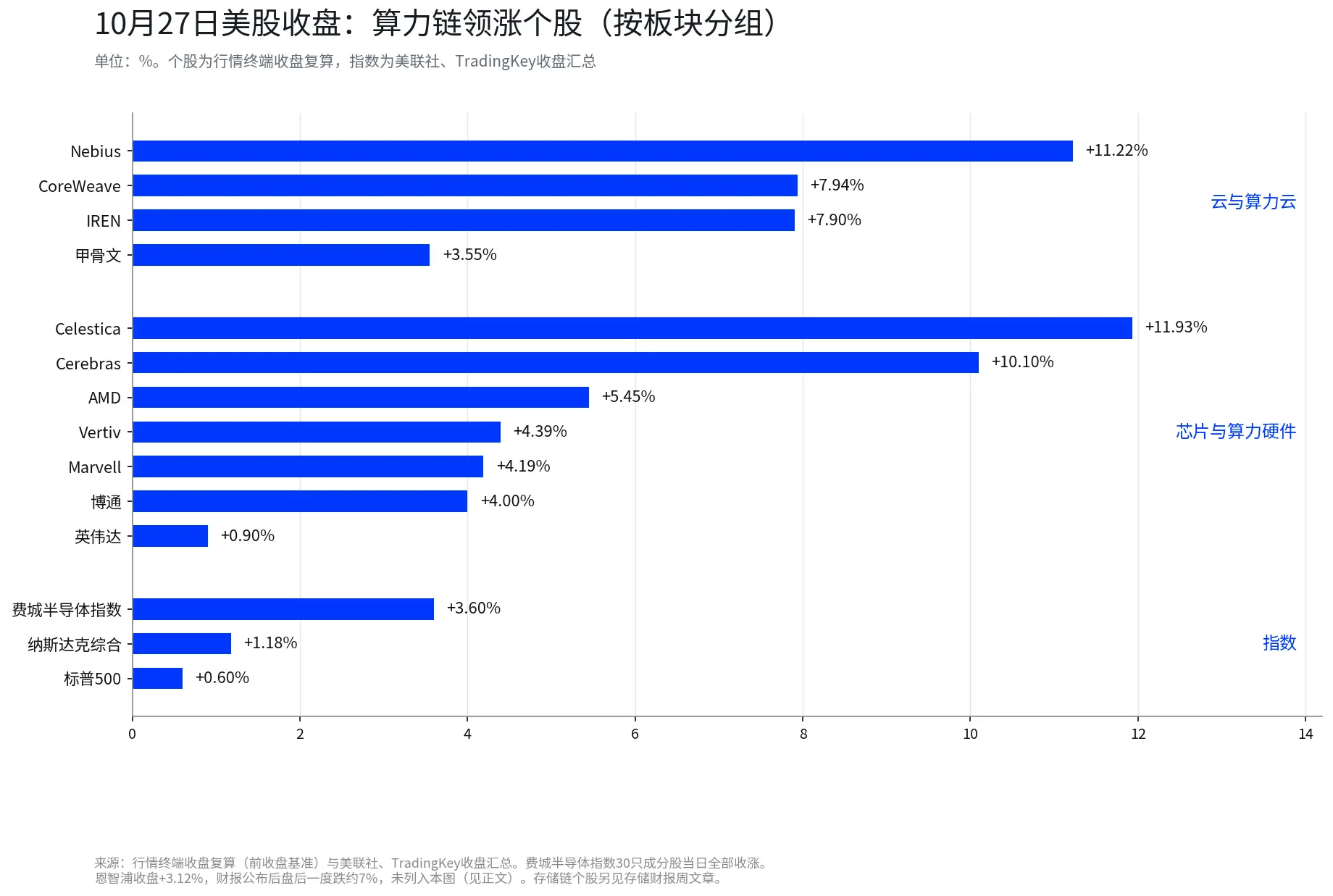
This indicates that funds are not simply buying all AI-related stocks. Companies with significant gains are more related to the expansion of computing infrastructure, equipment procurement, and computing leasing. The market's focus has shifted from whether the AI boom can be sustained to who can secure orders, obtain funding, and ultimately realize profits from this round of investment.
There are two direct catalysts. The first is that Anthropic submitted its listing documents, with related disclosures and media summaries presenting a massive long-term computing expenditure plan, allowing investors to see the demand for cloud services, accelerators, and data center resources from model companies in the coming years. The second is that Broadcom announced a $63 billion financing arrangement, with Bank of America, Blackstone, Citigroup, and Morgan Stanley participating to finance the procurement of Broadcom AI accelerators and networking equipment for Anthropic, with related equipment expected to be delivered starting in 2027.
When these two pieces of news are combined, the significance goes beyond "AI demand remains strong." Long-term contracts increase the visibility of demand, while financing arrangements provide funding support for some of that demand. Previously, the market was concerned about whether the increasing capital expenditures of tech companies could ultimately be recouped. Now, the market is beginning to see how computing demand can be transformed into actual deployment through contracts and financing structures. However, this is not yet the answer to investment returns. There remains a gap between contract amounts, financing scales, and final profits, which still depend on delivery, equipment utilization rates, customer payment capabilities, and ongoing cash flow.
2. $807 Billion Computing Commitment: Understanding Demand Does Not Equal Seeing Revenue
According to media summaries of Anthropic's prospectus and related agreements, the company's computing and infrastructure expenditure arrangements amount to approximately $807 billion. This figure covers long-term cloud services, equipment leasing, procurement agreements, and some future computing arrangements, with suppliers including Broadcom, Google, Amazon, Microsoft, and NVIDIA-related procurement channels.
Media reports also mentioned that the payment obligations corresponding to signed agreements are about $417 billion. Additionally, there are some additional computing arrangements for delivery between 2028 and 2031, with prices yet to be determined, which are expected to increase payment obligations by $125 billion to $150 billion.
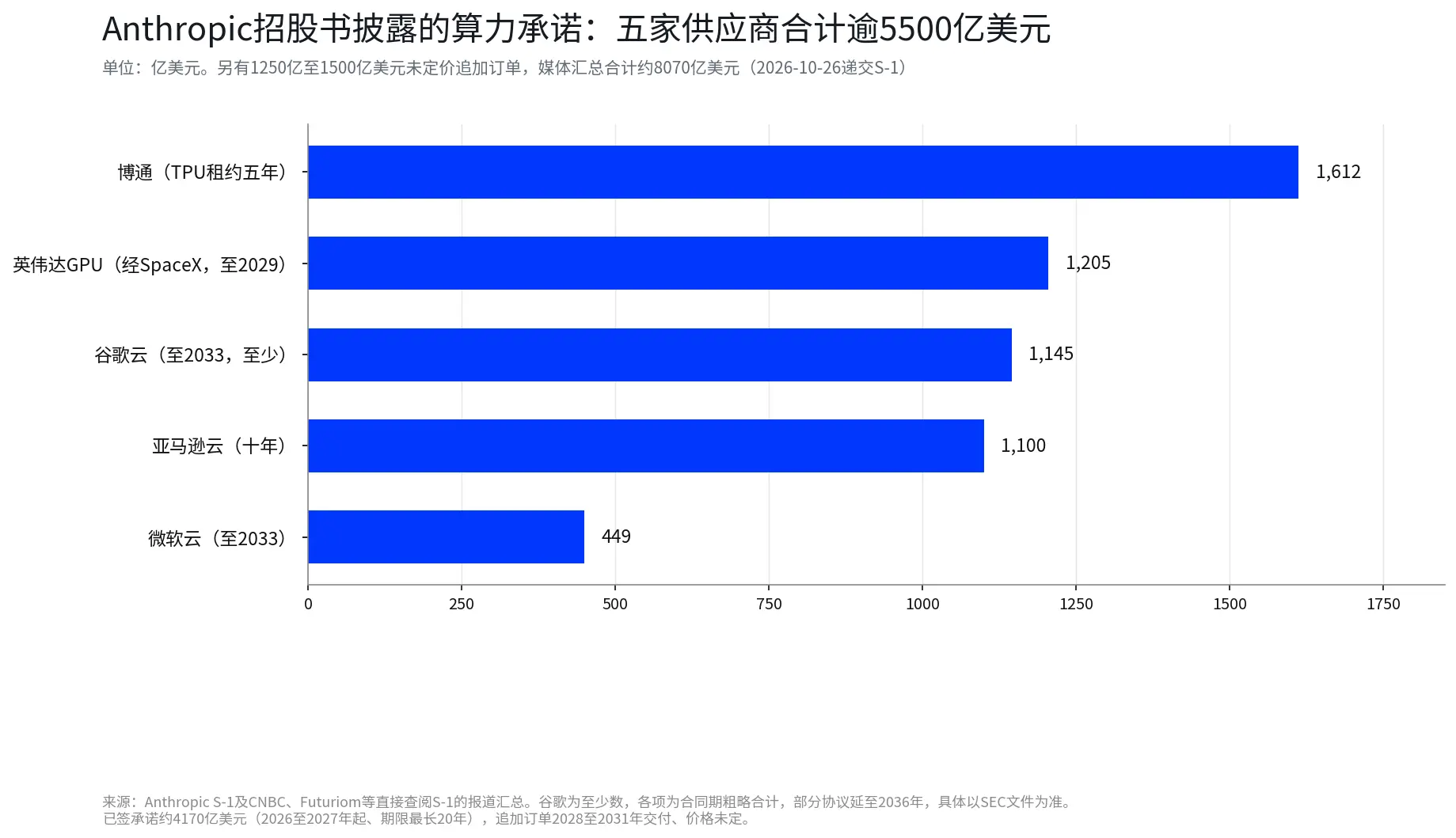
These numbers are substantial, but first, it is essential to clarify one issue: the $807 billion is an estimate of long-term expenditure arrangements compiled by the media, not confirmed revenue by Anthropic, and cannot be directly viewed as a rigid order that is fully effective and confirmed in amount. Since the S-1 did not disclose the total amount of computing commitments, different media summaries yield inconsistent results, with $417 billion and $125 billion to $150 billion being two relatively clear figures, while other reports give total scales ranging from $542 billion to $657 billion. The terms, payment conditions, and execution certainty of different agreements also vary, and some arrangements involve future deliveries or computing that are yet to be implemented.
What is truly noteworthy is that these long-term agreements change the perspective from which the market observes computing demand. In the past, investors primarily estimated chip shipments, data center construction, and supplier revenues based on capital expenditure guidance from cloud providers like Microsoft, Google, and Amazon. The long-term expenditure arrangements of model companies fill in another piece of the puzzle from the demand side: training cutting-edge models requires substantial computing power, and providing services to enterprises and consumers also necessitates continuous investment in inference resources. To ensure they can secure sufficient computing capacity in the future, model companies will pre-book resources and even undertake certain minimum payment obligations. For suppliers, this helps enhance the visibility of future revenues. At least within the scope covered by contracts, demand no longer entirely depends on customers' ad hoc decisions on how much equipment to purchase each quarter.
However, the scale of contracts still cannot be directly equated with commercial value. Signing a contract does not equal revenue recognition; multi-year agreements may require phased delivery of equipment or provision of cloud services, and related revenues will be recognized gradually as performance progresses. Long-term contracts do not eliminate customer credit risk; if the commercialization progress of model companies lags behind expectations, and revenues are insufficient to cover computing payment obligations, even if contracts remain binding, performance and financing pressures may increase. Growth in computing demand does not equate to an increase in computing investment returns; the volume of model calls can grow, but if the revenue per call is insufficient to cover computing, energy, and infrastructure costs, scaling up may not necessarily lead to better profits. Therefore, the $807 billion truly provides a reference for the scale of future demand, rather than a profit forecast. The market is willing to pay a premium for greater demand visibility, but whether this premium can ultimately be realized depends on whether model companies can convert computing into sustainable revenue.
3. $63 Billion Financing: The Computing Business Begins to Test the Credit Market
If long-term contracts answer "who needs computing," Broadcom's financing arrangement further answers "who will pay." On October 26, Broadcom announced that Bank of America, Blackstone, Citigroup, and Morgan Stanley would participate in a $63 billion financing arrangement. The related special purpose vehicle (SPV) will procure Broadcom's XPU AI accelerators and networking equipment, which will then be leased to Anthropic, with deliveries expected to start in 2027. Broadcom also provides residual value support corresponding to the first-lien financing portion.
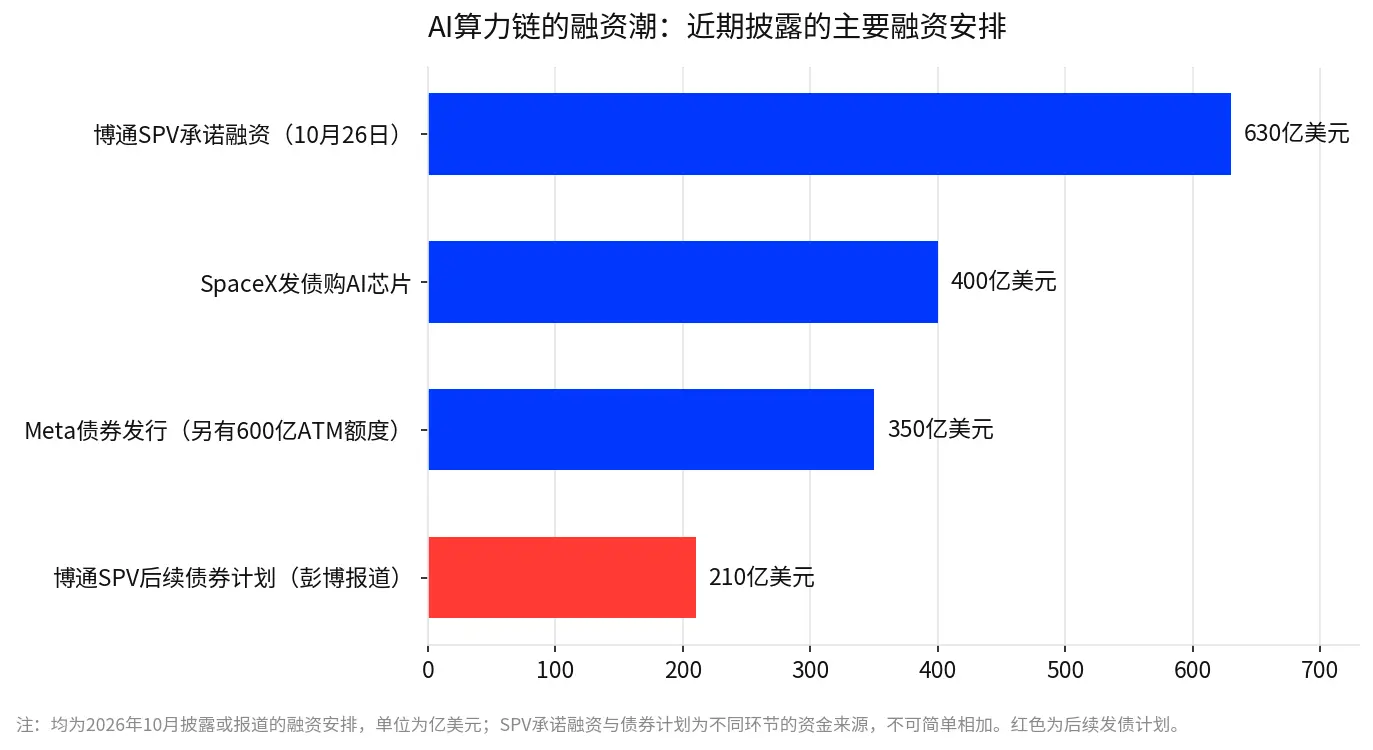
This structure connects chip procurement, external financing, equipment leasing, and residual value arrangements. For end customers, computing deployment can be funded through leasing and financing arrangements. For equipment suppliers, the funding sources and execution paths of projects are also clearer. It reflects a change in the expansion of AI infrastructure: computing investment is no longer solely a decision made by a tech company on how much capital expenditure to increase, but has also begun to become an asset financing business involving financial institutions. Recent other financing arrangements also indicate that the demand for AI infrastructure funding is spreading to the bond market and other credit channels. However, the financing scales, funding uses, and completion progress of different transactions vary, and the announced financing commitments cannot be uniformly viewed as cash that is already in place.
More importantly, the SPV does not make risks disappear. In traditional procurement models, companies directly purchase equipment and bear the corresponding financial input. Through the SPV, equipment can be held by an independent entity and then provided to end users through leasing. Such arrangements help introduce more funding sources but do not change the fact that computing projects ultimately still need to generate sufficient cash flow. If Anthropic fails to make payments as agreed, or if the second-hand value of the AI accelerators is lower than expected, the financing structure may still come under pressure. The residual value support provided by Broadcom is particularly noteworthy: it helps financial institutions assess equipment value but also means that Broadcom has not completely eliminated the value risk associated with the relevant equipment.
Whether such transactions can operate long-term depends on at least three real conditions:
Whether the financing cost is reasonable. The higher the debt interest rates and credit spreads, the more cash returns the project needs to generate.
Whether the equipment's residual value holds up. AI chips are updated rapidly, and the remaining value of long-term leased equipment is not fixed.
Whether customers can continue to make payments. If the commercial revenue of model companies does not keep pace with computing expenditures, the more complex the financing structure, the more attention may need to be paid to risk transmission.
Therefore, the significance of the $63 billion financing is not that the AI industry will no longer lack funds, but that computing expansion has gained a new way of organizing funding. It may accelerate equipment deployment or amplify fluctuations when demand or financing conditions weaken.
4. Oracle Introduces Various Chips: Inference Demand Opens Space for Competitors
On October 27, Oracle announced the expansion of the deployment scale of NVIDIA's Vera Rubin system, with related cloud infrastructure plans extending to multi-gigawatt levels. At the same time, Oracle plans to offer Google TPU computing on its cloud platform for the first time and introduce Cerebras' inference solutions, with some NVIDIA systems also using Oracle's Acceleron networking chips.
The specific transaction amounts related to these collaborations have not all been disclosed, so the multi-gigawatt deployment cannot be directly converted into confirmed orders or profits. However, this set of news at least reveals a change in cloud platform procurement strategies: the same large cloud service provider is providing more hardware options for different tasks.
This is related to the development stage of AI applications. Large-scale model training has high requirements for high-performance accelerators, high-bandwidth interconnects, and software ecosystems, and NVIDIA has established a significant advantage in this area. However, as models enter enterprise applications, the inference phase is becoming increasingly important, which is the process where models are repeatedly called to execute tasks.
Especially as AI agents begin to handle multi-step tasks, a single job may involve multiple model calls. Customers are not only concerned about whether the model can complete the task but also about response speed, unit call costs, throughput, and energy efficiency. For high-frequency, repetitive, or specific computational tasks, specialized chips may offer more competitive solutions. This creates opportunities for different architectures like Google TPU and Cerebras. They do not need to surpass NVIDIA in all tasks; as long as they can reduce costs and improve speed in specific scenarios, they may win customers. However, Oracle's simultaneous expansion of NVIDIA system deployment also indicates that this is not a story of NVIDIA being replaced. More accurately, the AI computing market is transitioning from relatively centralized hardware procurement to more detailed selections based on workload, cost, and performance, and the investment logic of different companies will also diverge accordingly.
NVIDIA needs to continue proving the overall advantages of its accelerators, systems, and software ecosystem.
Broadcom needs to convert the demand for customized accelerators and networking equipment into sustained profit and cash flow.
Companies like Cerebras need to demonstrate that their technological advantages can lead to real customer payments, scalable deployments, and sustainable profitability.
Entering large cloud platforms is an important step in commercialization, but the list of collaborations itself is not a moat. Ultimately, customers will decide the scale of procurement based on actual usage costs and business outcomes.
5. Orders and Stock Prices Are Rising, but Cash Flow Has Not Improved in Sync
The rebound on October 27 brought the AI computing chain back into the market spotlight, but the financial performance of different companies reminds investors: demand growth does not translate evenly into shareholder returns. From existing data, Broadcom and Oracle have relatively mature revenue scales and cash flow bases, while computing cloud companies like CoreWeave are growing faster but require substantial investments to purchase equipment, and Cerebras is still in the stage of expanding commercial deployment and validating its profit model.
Broadcom: Cash Flow Advantage with Additional Equipment Risks
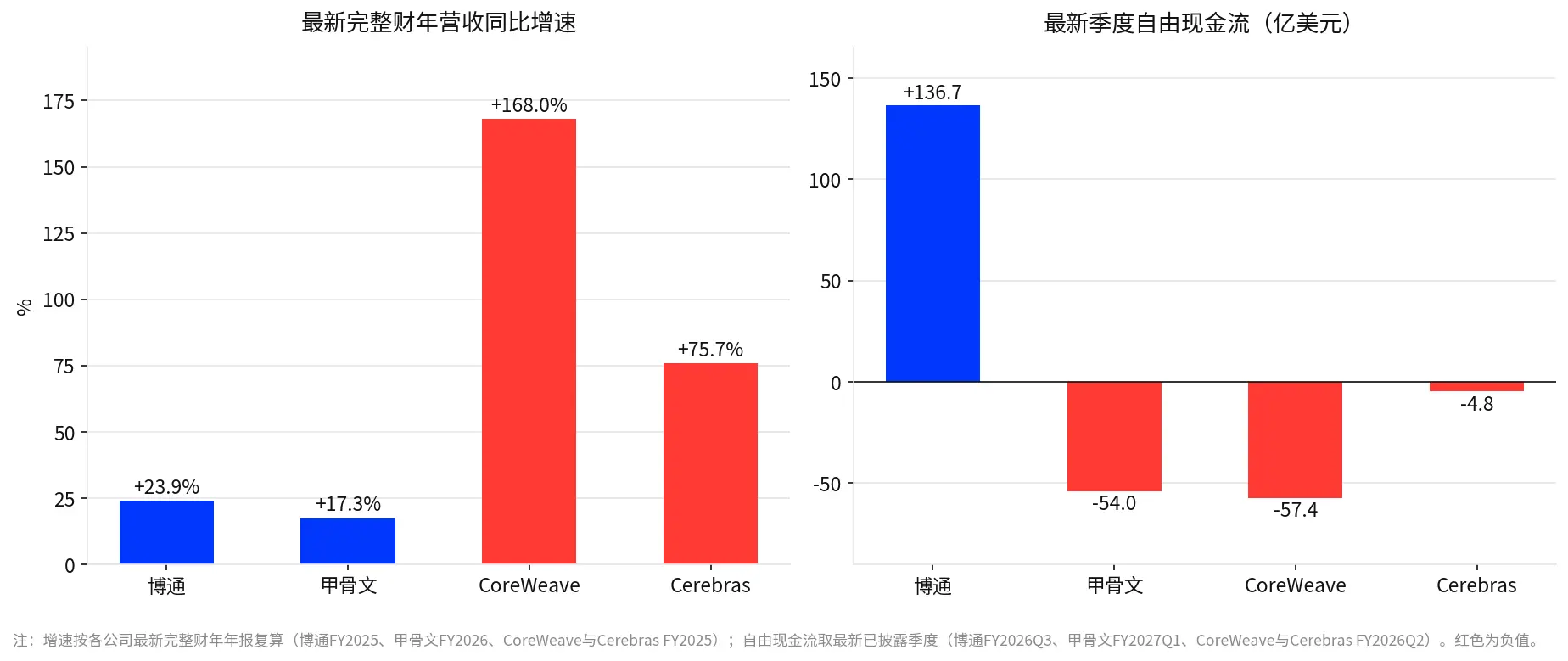
Broadcom's latest quarterly revenue is $29.591 billion, net profit is $13.088 billion, operating cash flow is $14.197 billion, capital expenditure is $532 million, and free cash flow is $13.665 billion. Its latest full fiscal year revenue is $63.887 billion, a year-on-year increase of 23.9%. This set of data indicates that Broadcom not only has growth opportunities in AI accelerators and networking equipment but also possesses a strong cash flow foundation. Compared to cloud computing companies that require significant equipment purchases, its business model does not need to bear the same scale of infrastructure capital expenditure.
However, the $63 billion financing arrangement also poses new challenges for Broadcom. Residual value support means that if equipment values decline, some risks may revert to the supplier side. Future attention needs to be paid to the delivery pace, profit margins, customer concentration, and the financial exposure that residual value support may bring. For Broadcom, the issue is not just how fast AI revenue can grow, but also whether this revenue can continuously convert into cash, and whether the new financing arrangement will alter the originally favorable risk-return structure.
Oracle: Rapid Expansion with Increasing Payback Pressure
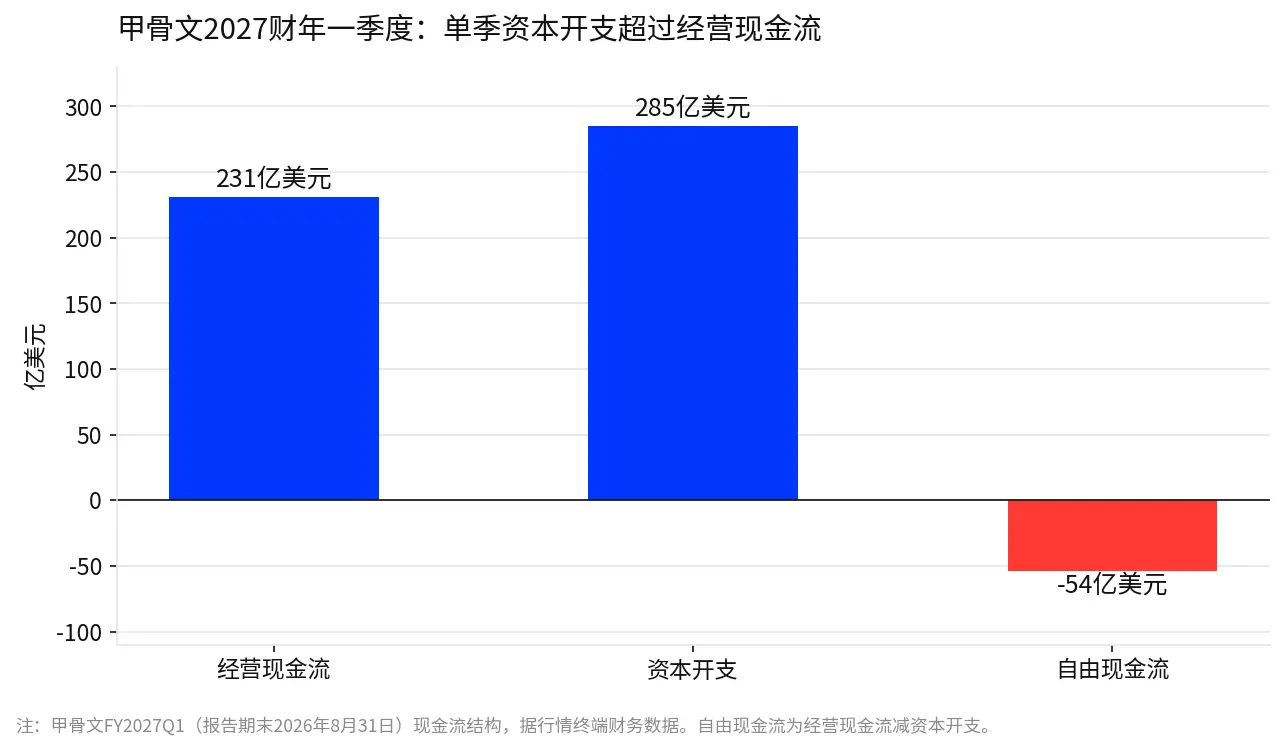
Oracle's latest quarterly revenue is $19.345 billion, operating cash flow is $23.103 billion, capital expenditure is $28.499 billion, and free cash flow is negative $5.396 billion. Its latest full fiscal year revenue is $67.358 billion, a year-on-year increase of 17.3%. The capital expenditure in a single quarter exceeds operating cash flow, indicating that Oracle is using current funds to exchange for future computing capacity. The expansion of multi-gigawatt clusters and the introduction of more chip architectures help enrich cloud service products, but also mean the company needs to continuously invest in equipment, data centers, and related infrastructure.
If the new capacity can secure customer orders and maintain high utilization rates, today's capital expenditure may form the revenue base for the future. If customer demand falls short of expectations, equipment investments will extend the payback period and further increase financing pressure. Going forward, cloud infrastructure revenue, capital expenditure, free cash flow, and customer contract fulfillment will be more worthy of tracking than merely the scale of purchases.
CoreWeave: Rapid Revenue Growth with Astonishing Funding Needs
CoreWeave's latest quarterly revenue is $2.575 billion, capital expenditure is $6.422 billion, and free cash flow is negative $5.743 billion. Its fiscal year 2025 revenue increased from $1.915 billion in the previous fiscal year to $5.131 billion, a year-on-year increase of 168%. The high growth is not hard to understand: the demand for computing power is expanding, and customers need to rent GPUs and related infrastructure, thus generating more revenue for cloud computing companies. However, this type of business requires continuous equipment purchases, data center construction, and funding for expansion.
The capital expenditure in a single quarter is about 2.5 times the revenue, indicating that revenue growth has not simultaneously converted into free cash flow. As long as demand continues, financing is smooth, and equipment utilization is sufficiently high, this model may continue to expand. However, if financing costs rise or the speed of equipment updates exceeds the cash recovery speed, growth may also put pressure on the balance sheet. For CoreWeave, while order and revenue growth are important, it is also necessary to observe whether liabilities, capital expenditure, equipment utilization, and free cash flow can gradually improve.
Cerebras: Entering Oracle's Cloud Platform Requires Customer Revenue Votes
Cerebras' collaboration with Oracle provides a new distribution channel for its inference chips. Large cloud platforms can expand the potential customer coverage and lower the threshold for customers to access new architectures. However, opening commercial channels does not equate to a validated profit model. Cerebras' latest quarterly revenue is $180 million, down from $193 million in the previous quarter, with a net loss of $451 million. Its fiscal year 2025 revenue is $510 million, a year-on-year increase of 75.7%.
The stock price rose by 10.10%, reflecting the market's positive response to new collaboration opportunities. However, compared to mature chip suppliers, Cerebras' revenue scale is still small, and the scale of losses is also significant. What to watch next is whether customers continue to use its products, whether the unit economics of inference have advantages, and whether new deployments can generate sufficient revenue and profits.
These four companies are positioned differently within the industry chain; one cannot only look at revenue growth rates or simply judge all companies' long-term value based on a single quarter's free cash flow. However, they collectively illustrate one issue: computing power orders can bring growth expectations, but only if costs are controllable and customers continue to pay can growth translate into shareholder returns.
VI. What Evidence Does the Market Need Next?
This round of rebound has restored part of the market's confidence in AI computing power demand, but for valuations to remain stable, operational data needs to keep up. First, look at the capital expenditure and cloud business revenue of large technology companies. If AI investments continue to grow, while enterprise customer demand, cloud service revenue, and profit margins improve, the growth logic for hardware suppliers will be better supported. Conversely, if capital expenditure continues to rise without corresponding improvements in revenue and cash flow, the market may still reassess investment returns.
Next, look at financing conditions. The $63 billion financing arrangement demonstrates a new way of organizing funds, but subsequent debt costs, credit spreads, equipment residual values, and the payment capabilities of end customers will all affect whether such transactions can be replicated. The larger the financing scale, the more the project itself needs to generate sufficient cash flow.
Finally, observe whether the inference business can truly make a profit. The increase in model invocation volume is merely a signal of demand growth. The unit computing costs, response speeds, energy consumption, and software adaptability of different architectures will ultimately determine whether customers are willing to pay in the long term. For specialized chips and cloud computing companies, market attention must ultimately translate into customer usage, revenue growth, and better unit economics.
Conclusion: Computing Power Demand is Clearer, Investment Returns Still Need Validation
Anthropic's long-term computing power expenditure arrangements, Broadcom's $63 billion financing structure, and Oracle's multi-architecture procurement layout showcase the changes occurring in the AI infrastructure industry chain. On the demand side, model companies are arranging computing resources in advance through long-term agreements. On the funding side, financial institutions are beginning to participate in equipment procurement and leasing financing. On the supply side, chip manufacturers and cloud platforms are competing around training, inference, and different workloads.
These overlapping changes make it easier for the market to judge how large computing power demand may be in the coming years and bring new growth opportunities to related companies. However, increased visibility of demand does not mean that risks have disappeared, and expanded financing channels do not guarantee that projects will be profitable.
The $807 billion is not revenue that has already been realized, and the $63 billion financing is not a supply of funds. They indicate that computing power demand is gaining clearer contractual arrangements and more diverse financing support, but they do not solve the capital return issues for any company.
In the next phase, the market needs to judge not just how much more money will be invested in AI infrastructure, but how much revenue these investments can ultimately create, how much cash flow they can generate, and who can maintain profits in fierce competition. Orders determine growth opportunities, financing affects the speed of expansion, and cash flow determines whether this business can be sustainable in the long term.
Data Sources and Explanations
Market: As of the close of U.S. stocks on October 27, 2026, market terminal recalculations, index data referenced from the Associated Press and TradingKey summaries.
Financials: Financial statements from market terminals, Broadcom FY2026 Q3, Oracle FY2027 Q1, CoreWeave and Cerebras FY2026 Q2, with free cash flow calculated as operating cash flow minus capital expenditure.
Anthropic's Computing Power Commitment: SEC prospectus documents and media summaries, $807 billion estimated by MarketWatch, total amount not disclosed in S-1, $417 billion in signed payment obligations and $125 billion to $150 billion in additional arrangements consistently cited by CNBC, Fortune, etc.
Broadcom Financing: Broadcom's announcement on October 26, 2026, and Reuters reports, with subsequent $21 billion bond plan reported by Bloomberg, SpaceX $40 billion and Meta $35 billion (with an additional $60 billion issuance capacity) reported previously.
Oracle Chip Collaboration: Oracle and Cerebras announcement, Reuters report on October 27, 2026.
Disclaimer: The content of this article is for general information and market commentary purposes only, compiled based on publicly available information as of the time mentioned in the text. Relevant market data, expectations, and probabilities may change with market conditions. The views and investment strategies quoted from third-party institutions, analysts, or other individuals represent the views of the relevant third parties at a specific time and do not represent the views or recommendations of BIT. This article does not constitute investment advice, investment research, an offer, solicitation, or recommendation regarding any securities, investment products, or trading strategies, nor should it be the basis for any investment decision. Financial markets carry risks, and securities prices and market performance may fluctuate; past performance and historical market trends do not represent or guarantee future results. Investors should independently assess relevant risks based on their own circumstances and seek professional advice when necessary.
 Risk warning Risk warning




Popular articles