Anthropic's filing ignites the AI market: Can the IPO craze withstand the cash flow test?

 Anthropic has filed for an IPO, providing a new catalyst for the AI market and giving cutting-edge model companies the opportunity to undergo continuous scrutiny in the public market for the first time, but this is not yet proof of a fundamental turning point.
Core Highlights: IPO Ignition, Can It Reverse the Pricing Divergence of AI Assets?
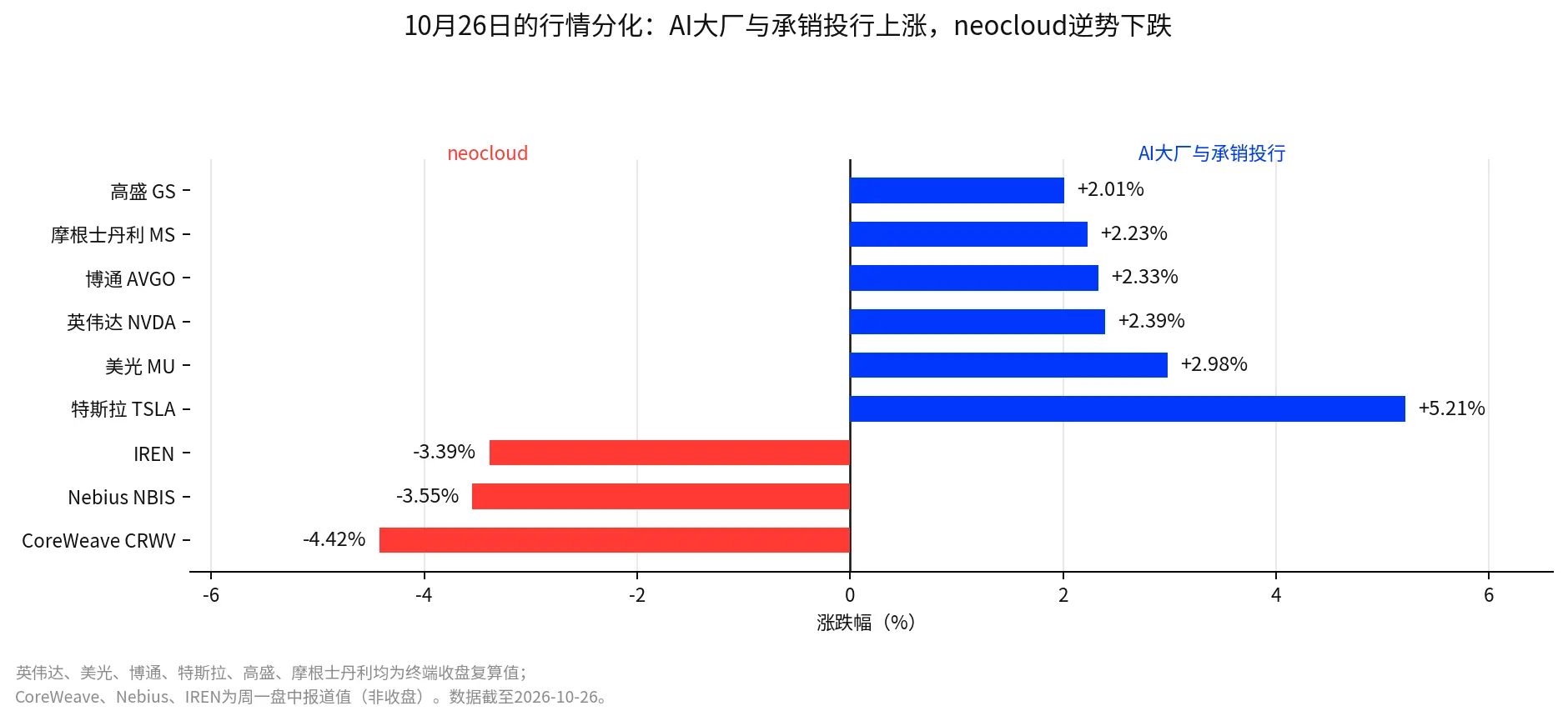
- On the night of Anthropic's filing, three types of signals regarding AI assets showed inconsistent directions. In the secondary market, major AI companies saw a broad increase, with the Nasdaq rising 0.8%. In the primary market, valuation rumors fell from a previous high of about $2 trillion to around $1.5 trillion. In the credit market, the financing costs for AI infrastructure companies remained high, and some cloud computing companies (neocloud) saw their stock prices decline against the trend that day. The filing ignited emotions, but the pricing divergence did not disappear; this is the main theme of this article.
I. Anthropic Hasn't Gone Public Yet, So Why Did AI Stocks Rise First?
On October 26, Eastern Time, Anthropic submitted its S-1 registration document to the U.S. Securities and Exchange Commission, planning to list on the Nasdaq Global Select Market under the code ANT. Goldman Sachs and Morgan Stanley are leading the underwriting, with a total of 22 banks in the underwriting group, and reports indicate the company is targeting pricing during the week of November 16.
Rumors surrounding the IPO valuation once reached as high as $2 trillion. If the final fundraising scale reaches the $100 billion level, this deal would break the record set by SpaceX in June of this year. After the announcement, the market quickly heated up: the Nasdaq rose 0.8%, the Philadelphia Semiconductor Index increased nearly 3%, Nvidia, Micron, and Broadcom all rose, and Tesla gained 5.2% in a single day, marking its largest single-day increase since early September. The drop in oil prices and the decline in U.S. Treasury yields also contributed to the risk appetite that day.
Why can an IPO document drive a rebound in the entire AI sector?
The real reason is that Anthropic is expected to open a pricing window for cutting-edge model companies in the public market. Investors finally have the opportunity to continuously observe how much capital markets are willing to pay for a rapidly growing AI company that is still making large-scale investments.
A research report from October 15 made a judgment that the monetization ability of AI is becoming stratified, and the IPO window can serve as a thermometer for observing market confidence. The valuation of model companies depends on growth and commercialization expectations, while heavy asset AI infrastructure is more easily affected by financing costs and credit spreads. The degree of differentiation between the two determines whether the AI market is merely a rebound in sentiment or has gained broader financial support. Anthropic's filing has brought this pricing test into the market's view ahead of schedule.
From the existing information, the rise on October 26 was not driven by a set of brand new operational data. The S-1 disclosed that revenue for the first half of the year was about $16.3 billion, a year-on-year increase of over 1300%, which did not show a directional change sufficient to explain the large rise in the sector compared to previously circulated presentation data.
What has truly changed is the market's imagination regarding future pricing. Before Anthropic goes public, the valuations of cutting-edge model companies mainly come from private financing rounds, and investors can only indirectly assess the value of the entire industry through financing news and the performance of a few listed companies. Once the IPO is pushed forward, the market gains an additional coordinate for public pricing, allowing investors to continuously observe the issuance pricing and trading performance post-listing. This is also why stock prices react in advance of formal pricing; some funds are not accounting for Anthropic's proven profitability but are focused on whether its listing can bring a new valuation coordinate to the entire AI industry chain. However, whether Anthropic's issuance performance can ultimately transmit to all AI stocks still depends on the revenue structure, capital expenditures, and financing conditions of different companies; a simultaneous rise does not mean the entire sector has completed a revaluation.
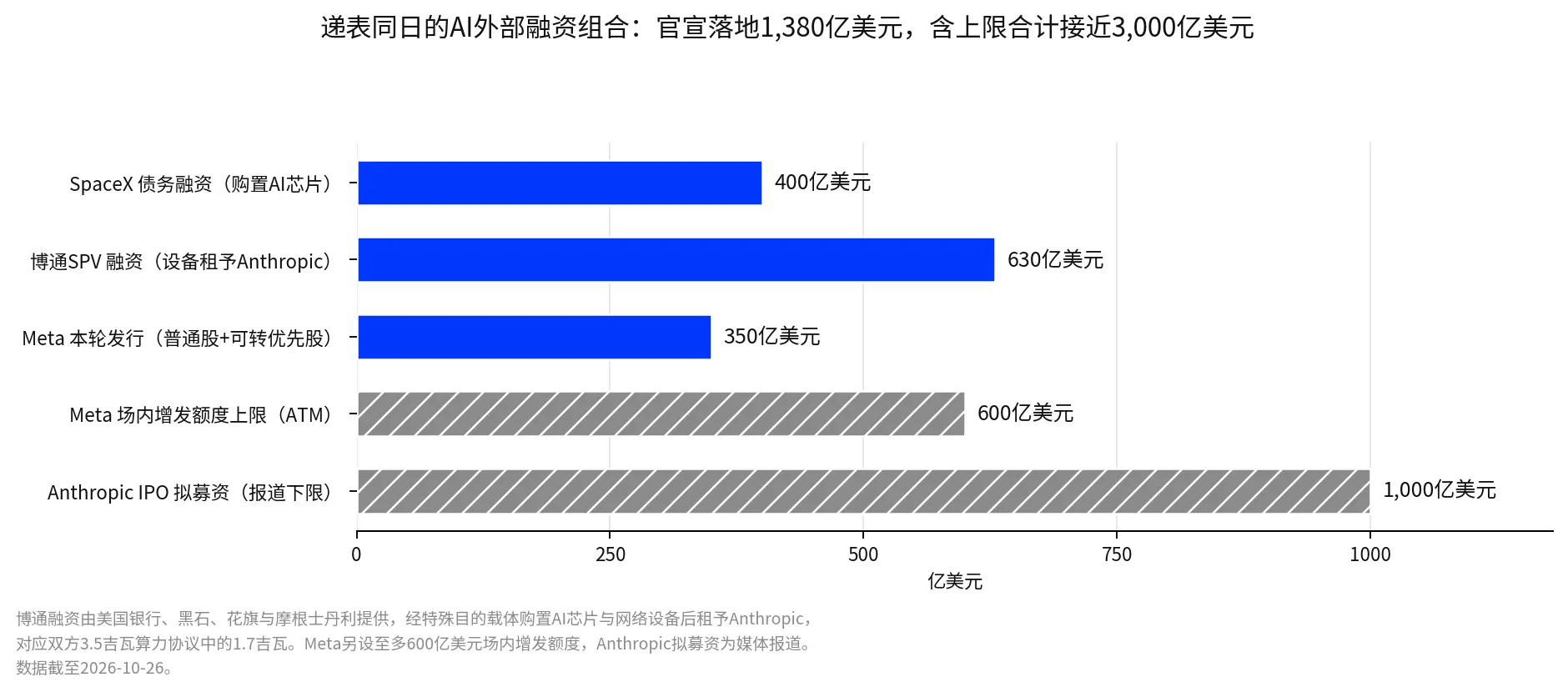
The financing news that emerged on the same day revealed another side of AI investment. Broadcom, along with Bank of America, Blackstone, Citigroup, and Morgan Stanley, finalized a $63 billion financing structure to purchase AI chips and network equipment through a newly established special purpose vehicle, which will then lease to Anthropic, corresponding to 1.7 gigawatts of the 3.5 gigawatt computing power agreement between the two, with equipment delivery starting in 2027. SpaceX completed $40 billion in debt financing to purchase AI chips primarily based on Nvidia GPUs. Meta initiated a public offering of about $35 billion, including a forward sale of $22.5 billion in Class A common stock and $12.5 billion in mandatory convertible preferred stock, with an additional on-market issuance limit of up to $60 billion, totaling an upper limit of about $95 billion. The structures and uses of these transactions vary, but they collectively indicate that the expansion of AI infrastructure is increasingly relying on external capital.
When the investment scale exceeds what operating cash flow can easily cover, equity financing and debt financing are no longer just tools for accelerating growth; they also become important variables determining the speed of expansion and financial risk.
II. The S-1 Contains More Than Just Positives: Losses, Valuation Adjustments, and Slowing Growth
The IPO has brought new pricing imaginations, but the S-1 also reminds investors that high growth and risk cannot be equated. What truly needs to be unpacked are the sources of reported losses, changes in valuation expectations, and whether revenue growth can be maintained.
Reported massive losses and operational profitability are not the same thing. The document disclosed a net loss of $80.7 billion for the first half of the year, far exceeding the $13 billion from the same period last year. According to media reports, the company attributed the huge losses mainly to changes in the fair value of convertible bonds; after excluding related impacts, the adjusted operating profit was about $1.6 billion, with specific adjustments to be confirmed by the formal issuance document. These two sets of numbers reflect different levels; changes in convertible bond valuations may amplify reported losses but cannot be directly equated with a deterioration in operational business, and adjusted profitability does not mean that cash flow and long-term profitability are without issues. The risk warning also clearly states that the company may not be able to achieve or maintain profitability in the future. For a company whose high valuation is supported by high growth, this statement should not be overlooked by market enthusiasm. There are also details on the cost side, with payments for handling fees increasing by $222 million year-on-year, professional service fees increasing by $205 million, and IT and cloud costs increasing by $223 million, indicating that revenue growth and expense inflation are occurring simultaneously.
Valuation expectations have begun to cool, and the IPO pricing faces a test. Multiple media outlets have cited insiders saying that valuation discussions have fallen from a previous high of about $2 trillion to around $1.5 trillion, with the valuation from the last private financing round in May of this year being about $965 billion. These numbers belong to market rumors at different points in time and are not formal issuance prices, but the changes themselves are worth noting. The shift from nearly $1 trillion to a higher rumored range, followed by a pullback, indicates that even the most sought-after AI assets have boundaries in how investors price future growth. For the IPO, how high the media previously reported the valuation is not important; what matters is whether the final issuance price can receive support from institutional demand. The previously proposed observation indicator is the position of the final issuance price relative to the rumored range. If the pricing is significantly lower than previously expected, the market will need to reassess the risk premium of AI assets; if issuance demand is strong and pricing approaches the upper end of the range, it indicates that confidence in the primary market remains robust. Changes in valuation rumors alone cannot determine whether the pressure in the credit market has transmitted to Anthropic.
Revenue is still growing rapidly, but the growth rate has slowed. According to previously circulated data from the presentation, Anthropic's second-quarter revenue grew approximately 1368% year-on-year, with a net revenue retention rate (NRR, a company-defined retention metric, defined according to the issuance document) as high as 900%. These numbers show a strong momentum for commercial expansion, but high growth does not mean that the growth rate can be maintained indefinitely. Market-circulated quarterly data shows that the revenue growth rate has dropped from about 140% in the second quarter to about 46% in the third quarter. It is important to distinguish between year-on-year and quarter-on-quarter; high year-on-year growth indicates that the company's scale has significantly expanded compared to last year, while a decline in quarter-on-quarter growth means that the slope of recent growth is changing, and both can coexist. For companies whose valuations are based on future high growth, changes in growth rates often have a greater impact on pricing than the current revenue scale. The IPO must answer not only how much Anthropic has grown but also how long this growth can be sustained and how much profit and cash flow it can ultimately convert into. 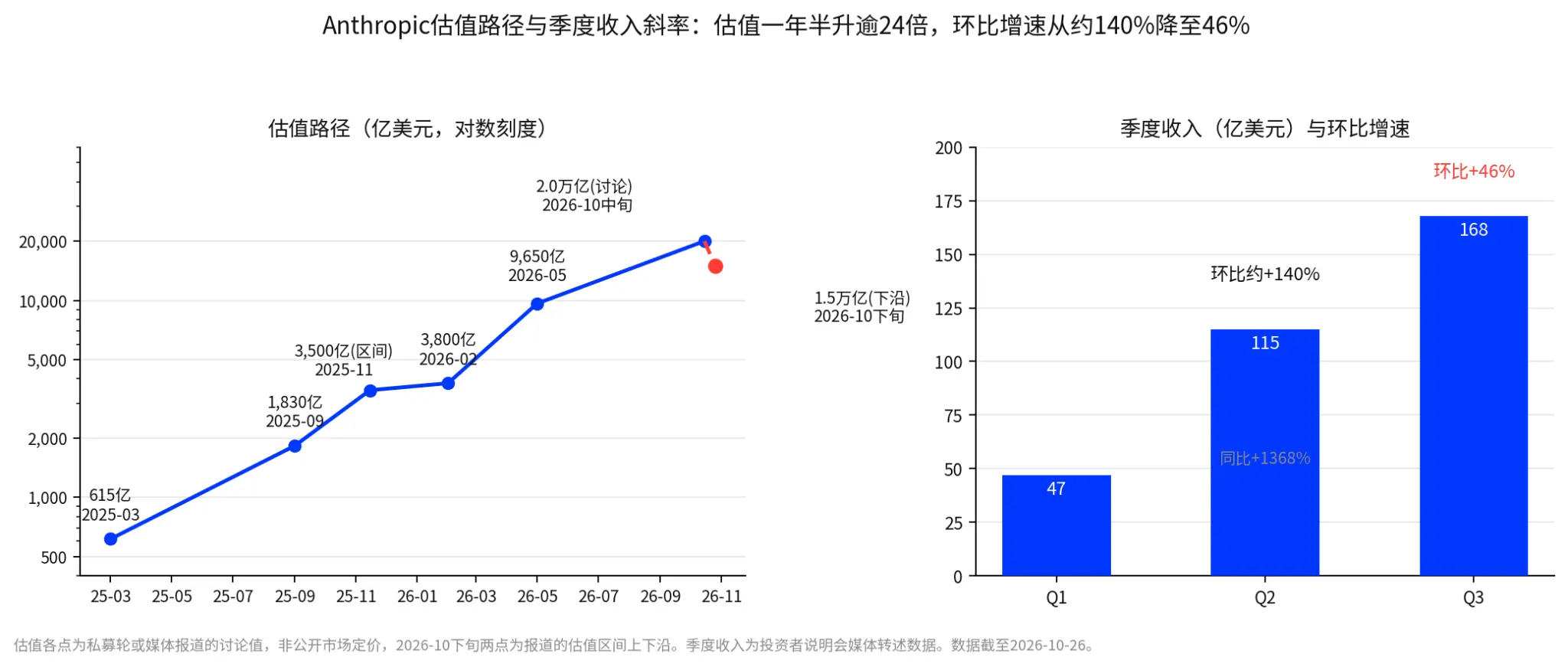
III. Can Overseas Sentiment Reach A-shares and Hong Kong Stocks, Moving from a High Opening to Increased Volume?
The overseas rebound triggered by Anthropic's filing is expected to provide emotional support for the semiconductor and AI application sectors in A-shares on October 27, which is a clear emotional variable before the market opens. However, the overnight rise is merely a signal before the market opens; whether it can form a sustained trend depends on whether local funds are willing to take over.
On the previous trading day (October 26), there was already differentiation within A-shares, with the Shanghai Composite Index rising 0.19% to close at 3,697.52 points, while the ChiNext Index fell 1.71%, and the total trading volume shrank to about 1.62 trillion yuan, indicating a shift of funds from high-tech stocks to dividend defensive assets. In this context, whether the rebound in overseas AI stocks can drive increased trading volume in A-shares is more worthy of attention than whether the market opens high.
Macroeconomic factors have not retreated either. On the same day, the central bank established a non-bank institution large redemption swap facility for the bond market, while the Federal Reserve, European Central Bank, and Bank of Japan will successively hold meetings this week, with the market generally expecting no action; these arrangements may affect liquidity and the pricing of risk assets.
This round of overseas market trends affecting A-shares and Hong Kong stocks is better understood as emotional transmission, with the fundamentals not having changed as a result. The trading volume after the market opens, the degree of internal sector diffusion, and whether funds continue to flow back are the basis for judging whether the rebound can be sustained.
IV. With November IPO Pricing Approaching, Four Signals Will Determine How Far the Market Can Go
Next, Anthropic's IPO process will provide a set of verification signals that are more valuable than a single day's stock price.
Issuance pricing is a direct test of confidence in the primary market. If the company prices as planned around mid-November, the gap between the final issuance price and the rumored range (about $1.5 trillion to $2 trillion) will help the market judge whether investors are willing to continue paying high premiums for future growth. The level of the issuance price is just one dimension; actual demand and the final issuance scale are equally important.
Credit spreads will test whether AI infrastructure is under pressure. The financing costs of AI infrastructure companies like CoreWeave are an important indicator of whether the heat of the model layer can transmit to the heavy asset segment. If Anthropic's IPO proceeds smoothly but the credit spreads for AI infrastructure companies remain high, it indicates that the market may be distinguishing between model commercialization opportunities and infrastructure financing risks, rather than being uniformly bullish on the entire AI industry chain.
The contrast in the heat of the financing market is also worth noting. While Musk is advancing SpaceX's $40 billion equipment financing, he warns that some AI cloud companies lacking independent revenue face financing difficulties and may even undergo large-scale consolidation. This contrast reveals the core contradiction in current AI investment: capital is still willing to provide funding for projects deemed to have competitive advantages, but not all computing power expansions can obtain the same financing conditions.
If the IPO is strong, the issuance pricing is firm, and the credit spreads for AI infrastructure improve simultaneously, there is reason to believe that this rebound is spreading from an emotional level to a broader recovery in risk appetite. Conversely, if the primary market is hot but the credit side remains tight, the stratified pricing of AI assets may further intensify.
Conclusion: Filing Is Just the Spark, Pricing Is the Real Stress Test
Anthropic has filed for an IPO, providing a new catalyst for the AI market and giving frontier model companies a chance to undergo continuous scrutiny in the public market for the first time, but this does not yet prove a fundamental turning point.
The rapid revenue growth in the first half of the year indicates that commercialization still has strong momentum. Massive accounting losses, declining valuation rumors, and slowing quarterly growth remind the market that high growth does not mean there are no boundaries to valuation. Meanwhile, AI infrastructure companies still need to rely on debt and equity financing to expand their investments, and the credit market's attitude may not necessarily warm up in sync with the IPO of a model company.
This filing ignites expectations for the repricing of AI assets, but it does not guarantee that all AI companies will continue to receive high valuations.
The judgment on October 15 remains unchanged; the IPO window is an indicator of market temperature, and the engine of the market is still the realization of growth and financing conditions. The issuance pricing, institutional demand, and credit spreads of AI infrastructure companies in mid-November will jointly test whether this rebound is a warming of sentiment or the beginning of a convergence between the primary market, secondary market, and credit market.
Data Explanation
Market: Fin terminal 2026-10-26 US stock closing: NVDA 216.00/+2.39%, MU 903.70/+2.98%, AVGO 329.17/+2.33%, TSLA 391.62/+5.21% (recalculated by terminal closing); Nasdaq +0.8% to 26,169, S&P +0.7% to 7,677, Dow +0.3% to 52,364 (MarketWatch summary); the semiconductor index and spot gold at $4,017.2 per ounce are media summaries; oil prices vary due to different reporting standards for terminal continuous contracts and media, specific numbers are not cited in the text; daily fluctuations are influenced by multiple factors, and the text considers the filing as one of the catalysts.
Losses: H1 net loss of $80.7 billion, confirmed by Fortune, Fast Company, and Yahoo Finance after reviewing the S-1, including changes in the fair value of convertible bonds; before publication, the currency, unit, and period must be rechecked according to SEC filing forms.
Valuation/Indicators: Approximately $2 trillion, approximately $1.5 trillion, $965 billion (May private placement round) are market rumors/private data at different points in time; rumored valuation, IPO valuation, issue price, and fundraising amount are different concepts. NRR 900% is the company's metric, as reported by the media. Growth rates are unified as percentages: H1 >1300%, Q2 approximately 1368%.
Transactions/Reports: A syndicate of 22 banks according to Barron's, the timeline may change. Broadcom's $63 billion structure, Meta's maximum $95 billion plan, SpaceX's $40 billion bond issuance, and Musk's statements are based on public reports from 2026-10-25/27 (Broadcom IR, Reuters, Bloomberg, CNBC, NYT, etc.). SpaceX's June IPO fundraising has two versions of $75 billion/$85.7 billion, both retained.
Disclaimer: The content of this article is for general information and market commentary only, compiled from publicly available information as of the time mentioned in the text; relevant market data, expectations, and probabilities may change with market conditions. The views and investment strategies of third-party institutions, analysts, or other individuals cited in the text represent the views of the relevant third parties at a specific time and do not represent the views or recommendations of BIT. This article does not constitute investment advice, investment research, an offer, solicitation, or recommendation for any securities, investment products, or trading strategies, nor should it be used as the basis for any investment decision. Financial markets carry risks, and securities prices and market performance may fluctuate; past performance and historical market trends do not represent or guarantee future results. Investors should independently assess the relevant risks based on their own circumstances and seek professional advice when necessary. BIT's Hong Kong stock trading services are not provided to Hong Kong residents or users in other restricted jurisdictions.
 Risk warning Risk warning




Popular articles