Anthropic's November: quarterly revenue of 16.8 billion USD, with issuance starting as early as the week of November 9

 4.7 billion, 11.5 billion, and 16.8 billion US dollars in three tiers represent the hardest evidence of AI commercialization to date; meanwhile, the gap between "adjusted earnings" and GAAP, along with the decline in sequential growth rate from 145% to 46%, are the parts of this evidence that require the most calm consideration.
Introduction: Last night’s closed-door meeting in San Francisco had a clear purpose: to garner support for next month’s IPO. Anthropic invited potential public market investors to its headquarters and spent the entire day discussing safety concepts, growth trajectories, and efficiency improvements. In a week when AI stocks have just experienced a significant drop and credit market alarms are ringing, this presentation delivered not just revenue data, but also a public examination of the AI commercialization story.
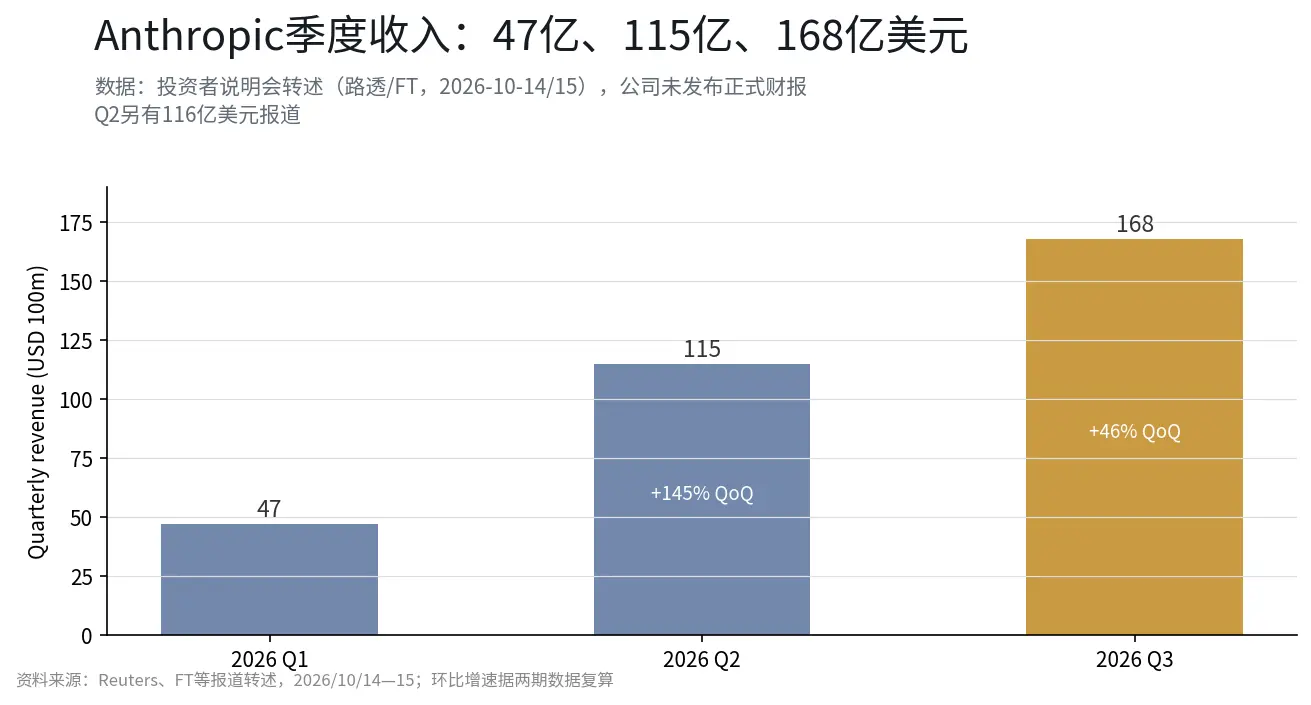
1. Revenue Steps Over Three Quarters
Arranging the numbers from three quarters in steps: $4.7 billion, approximately $11.5 billion, and $16.8 billion. Based on this, the annualized revenue run rate is approximately $67 billion; according to The Information, third-quarter revenue has already reached more than 3.6 times the total for the entire year of 2025— in other words, the entire revenue for 2025 is less than one-third of the current quarter.
The interpretation of quarter-over-quarter growth requires two perspectives. From a high level, the approximately 145% quarter-over-quarter growth in the second quarter was driven by product demand from Claude Code and others, representing a steep rise from a low base. The approximately 46% in the third quarter is based on a high base, and the decline in growth is an arithmetic result; from a low level, 46% quarter-over-quarter means that if the fourth quarter maintains a similar pace, annual revenue could exceed $40 billion, a level that surpasses most Wall Street institutions' previous expectations for revenue from the AI application layer (according to public reports, predictions from different institutions vary widely). What truly needs to be tracked is the fourth quarter: whether the quarter-over-quarter can continue to hover around 40%, which will determine whether the claim of "efficiency improvements supporting growth" is realized or weakened.
2. What’s Included and What’s Missing in "Adjusted Earnings"
The presentation provided two statements regarding earnings: adjusted earnings and positive cash flow for the quarter. The former needs to be viewed with caution— "adjusted" typically excludes certain cost items (common adjustments for such companies include stock-based compensation, restructuring expenses, etc.), but Anthropic did not disclose the specific adjustments, and the profit figures under Generally Accepted Accounting Principles will await the formal financial report; the latter is more tangible: for a company that lists chips and data centers as its largest expenses, positive quarterly cash flow means that revenue growth at least covered the cash consumption of computing power expansion during the period.
What else is missing? Three aspects: profit and gross margin levels under Generally Accepted Accounting Principles; the scale of computing power procurement commitments with cloud vendors (which determines the rigidity of future cash outflows); and the composition of revenue—how much comes from subscriptions, APIs, and product revenue, and what percentage comes from enterprise customers. These three aspects can only be filled in after the formal disclosure of the S-1 document and are the most needed inputs when institutions price this company.
3. Putting $2 Trillion Back into the Coordinate System
The revenue figures presented need to be translated into pricing, which cannot avoid a coordinate issue. First, let’s lay out the historical valuation steps: the post-financing valuation from a round of financing in March 2025 was $61.5 billion; in September 2025, after completing $13 billion in financing, the post-financing valuation was $183 billion (according to reports from Reuters and WSJ); in February 2026, the valuation further rose to $380 billion (according to public reports); the current IPO valuation discussion is above $2 trillion— from $380 billion to $2 trillion, there is a gap of more than five times.
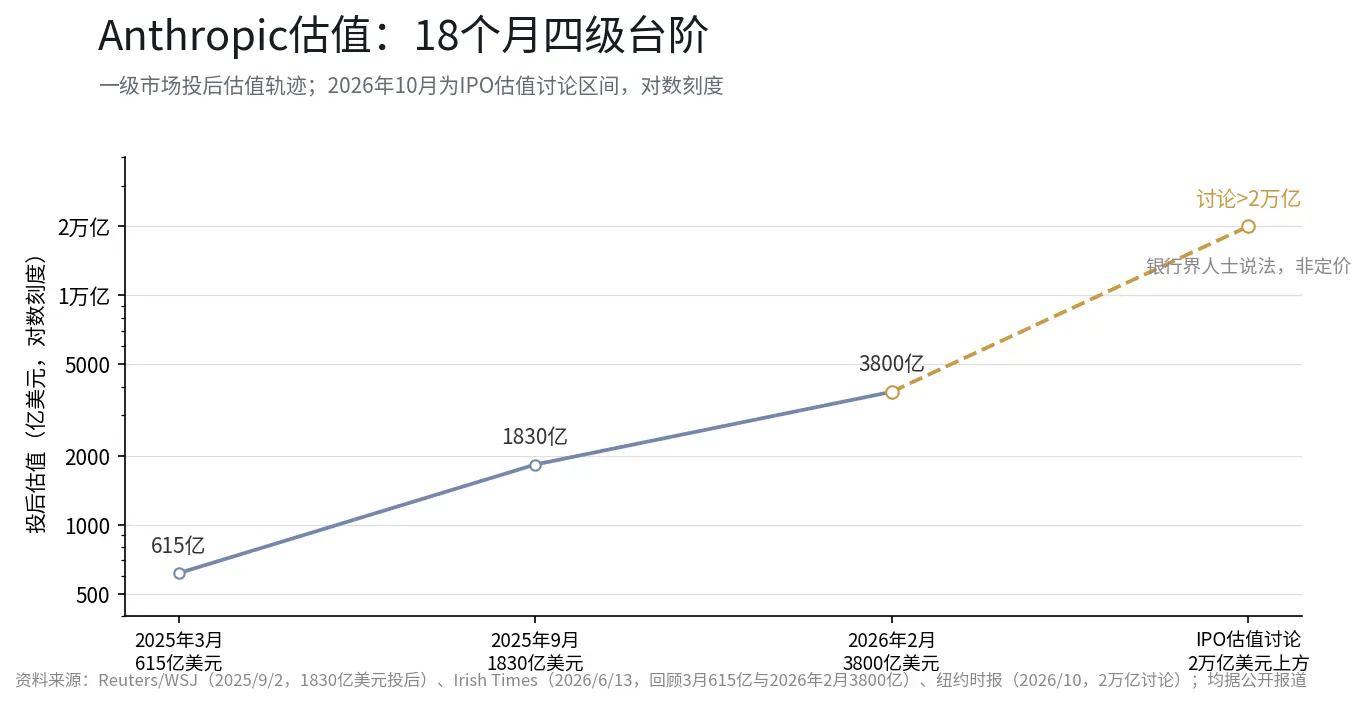
Multiples can help weigh these numbers. Based on the third quarter's $16.8 billion, the annualized revenue of approximately $67 billion means that the $2 trillion discussion range corresponds to about 30 times annualized revenue, while the $380 billion valuation from February corresponds to about 6 times— the same denominator, two pricing methods, which is precisely the question the presentation aims to answer with "revenue steps." To find another public market reference: NVIDIA's latest market capitalization is approximately $5.33 trillion, with total revenue over the past four quarters of about $253.5 billion, resulting in a price-to-sales ratio of about 21 times; the denominators differ (one is annualized, the other is disclosed performance), so it can only be a rough comparison, but the direction is clear: the discussion range implies expectations of "high growth continuing in the foreseeable future," and any reading below that expectation could be amplified at the 30 times position.
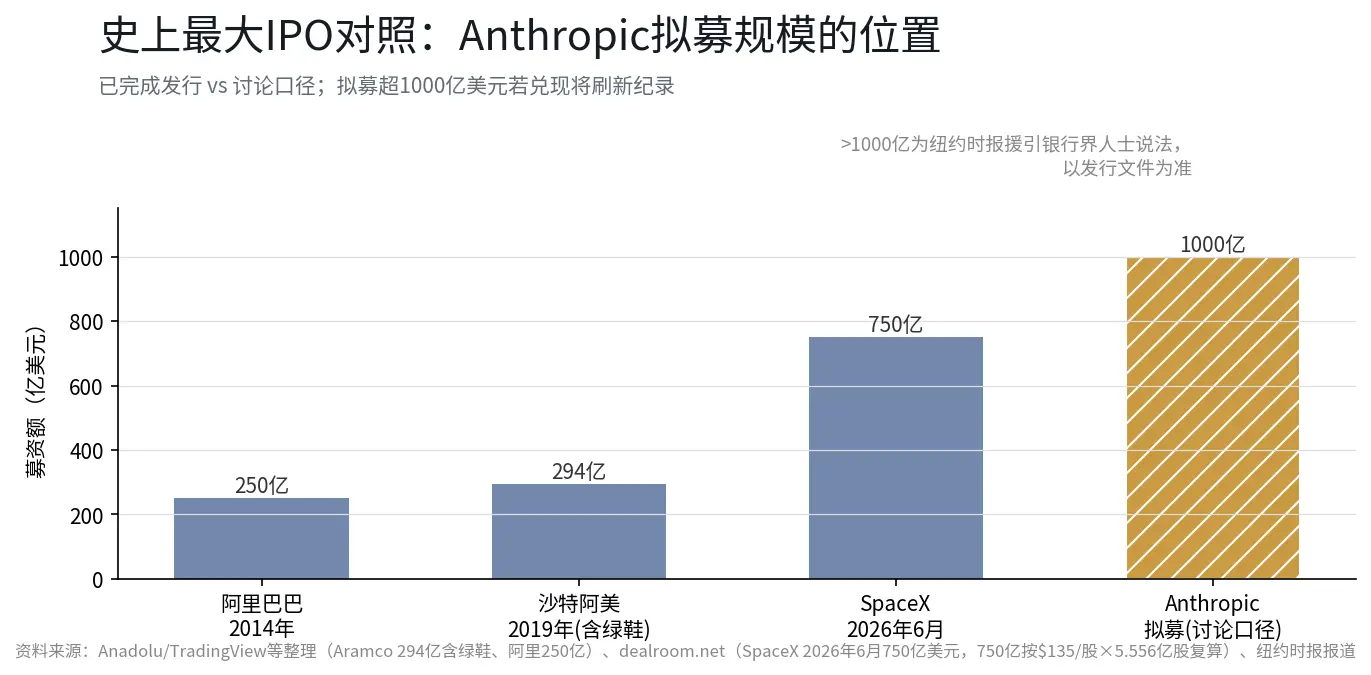
The scale of issuance also requires a coordinate system. Currently, the record for the largest IPO in history belongs to SpaceX— in June 2026, it issued approximately 555.6 million shares at $135 per share, raising $75 billion; before that, Saudi Aramco raised $29.4 billion (including greenshoe, 2019-2020) and Alibaba raised $25 billion (2014). If Anthropic raises over $100 billion, it could break the record set just this June; $100 billion also corresponds to about 5% of a $2 trillion valuation, and the dilution scale of the issuance itself and the market's capacity to absorb it are real constraints that the demand side needs to digest (historical records do not constitute a prediction of the outcome of this issuance).
4. Details of the Issuance in November: What We Know So Far
Arranging the reported schedule by time: on June 1, the S-1 document was secretly submitted to the U.S. Securities and Exchange Commission (according to Yahoo Finance reports); on October 14, the San Francisco investor presentation showcased to potential public market investors all day (according to reports from FT and others); as early as the week of November 9, formal market promotion will begin (according to Bloomberg reports cited by Yahoo Finance); the goal is to list before Thanksgiving and complete the IPO by the end of the year— the timeline may still be adjusted (according to reports from The Wall Street Journal). In terms of scale, The New York Times cited banking sources saying that the fundraising scale could exceed $100 billion, with valuation discussions above $2 trillion; if this scale is realized, it could break the issuance record set by SpaceX in June of this year (see the comparison in the previous section).
Looking at this timeline alongside the state of the market, the choice is not easy: the issuance window coincides with a significant drop in the AI sector and widening credit spreads. But from another perspective, the presentation focused on disclosing revenue and profit progress precisely to provide support in a weak window. For secondary market investors, this company will become the first directly tradable "pure AI model layer" asset after its IPO, and its issuance pricing and early performance (the initial price fluctuations after listing are worth noting) will become a new reference for the entire sector; the changes in the proportions of subscription, API, and product revenue can serve as one of the observation indicators going forward.
5. Reading in the Context of Last Night's Market
Last night’s market provided a subtle background to this report: on the same day, CoreWeave's bond yields approached 15%, and AI-related industrial stocks fell broadly, raising questions in the credit market about the "borrowing money to build AI" model; meanwhile, Anthropic announced precisely high revenue growth and positive cash flow data. The two pricing methods are not contradictory— revenue belongs to model companies, while interest belongs to debt builders. According to disclosed data, the monetizable model layer is still favored in the primary market for its high growth, while the heavy asset, high-leverage infrastructure layer is being repriced in the credit market; the price difference between the two markets is the main variable for AI pricing in the upcoming quarter.
Interpretation: The issuance pricing in November will become the most direct public reading of this differentiation. If the final pricing falls within the rumored range, it indicates that the primary market's confidence in AI monetization has not been affected by the secondary market's credit concerns; if the pricing is significantly below the rumored range or the issuance is delayed, it indicates that the repricing on the credit side has already transmitted to the primary market. Additionally, there is a reverse impact: if the issuance goes smoothly and demand is enthusiastic, the panic sentiment in the AI sector may also see some repair— the issuance process itself is one of the variables affecting sector sentiment.
Conclusion
The three-tier steps of $4.7 billion, $11.5 billion, and $16.8 billion represent the hardest operational evidence of AI commercialization to date; while the gap between "adjusted earnings" and GAAP, and the decline in quarter-over-quarter growth from 145% to 46%, are the parts of this evidence that need to be treated with caution. If the promotion starts in the week of November 9, every step of the issuance process— pricing range, demand situation, and performance on the first day of listing— will answer a question more directly than any research report: how far has the market's pricing for AI progressed.
Disclaimer: The content of this article is for general information and market commentary purposes only, compiled based on publicly available information as of the time mentioned in the text. Relevant market data, expectations, and probabilities may change with market conditions. The views and investment strategies of third-party institutions, analysts, or other individuals cited in the text represent the views of the relevant third parties at a specific time and do not represent the views or recommendations of BIT. This article does not constitute investment advice, investment research, solicitation, or recommendation for any securities, investment products, or trading strategies, nor should it be the basis for any investment decision. Financial markets carry risks, and securities prices and market performance may fluctuate; past performance and historical market trends do not represent or guarantee future results. Investors should independently assess relevant risks based on their own circumstances and seek professional advice when necessary. BIT's Hong Kong stock trading services are not provided to Hong Kong residents or users in other restricted jurisdictions.
 Risk warning Risk warning




Popular articles