The Federal Reserve remains inactive, but the market is waiting for a rate hike in December: the real suspense has changed
Introduction: The suspense over whether to raise interest rates ended on October 28, and a new suspense began that evening. The market has almost priced in a rate hike in December, yet U.S. stocks did not fall, and the dollar weakened instead. When various asset classes are sending mixed signals, data can provide a definitive answer. Tonight's preliminary GDP for the third quarter and September PCE will test the market's recent calculations regarding how long high interest rates will remain.
1. Two dissenting votes, more hawkish than the interest rate itself
 The resolution itself was not surprising; the weight lies in those two dissenting votes. In the 10 to 2 vote, two votes advocated for an immediate rate hike, indicating that there is not a consensus within the committee regarding the stubbornness of inflation. The majority chose to wait, while a minority believed the risks were already significant. For the market, waiting does not equate to a dovish shift; as long as inflation does not show a clear cooling, the rationale for maintaining high interest rates remains.
The statement's wording was also relatively firm. The assessment of economic activity was upgraded from "moderate" to "strong," and the phrase "inflation remains elevated" was retained. According to Reuters, the committee needs more data to determine the next steps, and the possibility of further tightening still exists. As long as the economy shows resilience, the Federal Reserve is not in a hurry to cut rates to support growth. Without a clear decline in inflation, premature easing would negate previous efforts to suppress inflation.
Wash's press conference continued the style of not providing a roadmap. He did not give a timeline, focusing instead on the high inflation, the effectiveness of policies, and the need for more information. Investors cannot derive a complete path from a single meeting; they must treat each inflation, employment, and consumption report as a potential turning point.
Adjustments to the meeting schedule can also be easily misinterpreted. Wash announced that there will be one meeting in 2027 and two in 2028 specifically to discuss long-term monetary policy strategy; these meetings will not involve interest rate votes or release regular policy statements (as reported by CNBC). The essence of the change is to shift some meetings from rate decisions to framework discussions. The actual impact on the market is the need to distinguish which meetings decide interest rates and which only discuss policy frameworks.
Putting the resolution, statement, and press conference together, the conclusion is that the policy direction remains open. The Federal Reserve is not prepared to raise rates immediately, nor is it shifting to easing; the next steps will be determined by inflation and economic data, and the market must continue to pay for this uncertainty.
2. Rising expectations for rate hikes, why did U.S. stocks not fall?
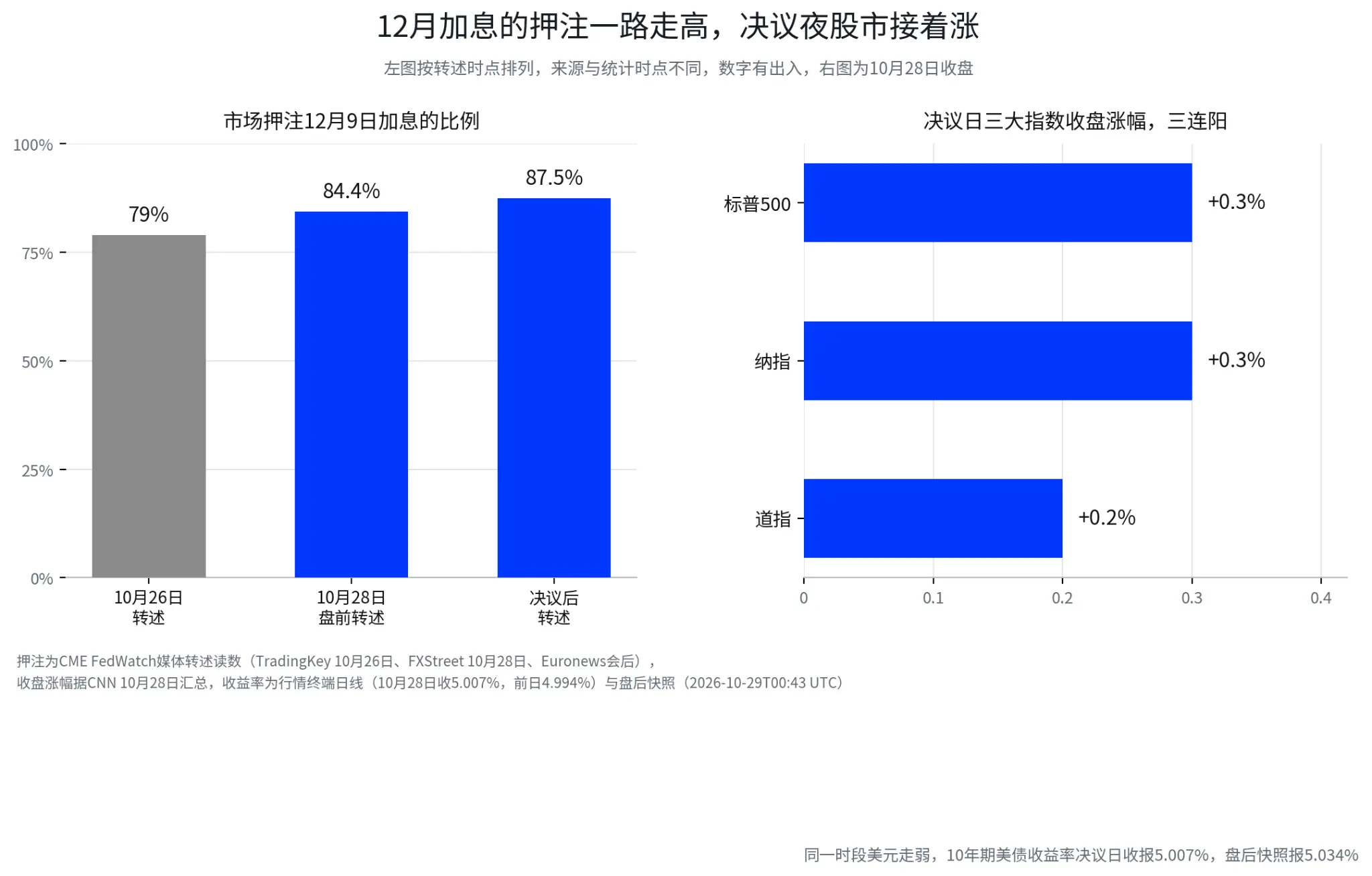
On the surface, the performance on the night of the resolution seems contradictory. The S&P 500 and Nasdaq both rose about 0.3%, and the Dow Jones increased by about 0.2%, marking three consecutive days of gains for the three major indices (as summarized by CNN). The dollar weakened during the resolution and press conference (as reported by Reuters), and Bloomberg's summary indicated that short-term U.S. Treasury bonds outperformed. If a rate hike in December is nearly certain, why didn't the stock market decline?
The resolution did not bring about new tightening that day. Even though the likelihood of a December rate hike is high, the decision to hold steady in October meant that financial conditions did not tighten further that day, allowing investors who were previously worried about unexpected policy changes to breathe a sigh of relief.
A strong economy poses both inflation risks and supports profits. High interest rates suppress valuations, while growth supports profits; both forces coexist. As long as consumer spending and business investment remain resilient, the market does not need to immediately lower profit expectations, and stock prices do not need to fall alongside rate hike bets.
Reactions should be compared to pre-meeting expectations; looking solely at direction does not reveal much. If hawkish language has already been priced in, the resolution was not more hawkish than expected, and some assets even experienced short-term rebounds. A weaker dollar cannot be directly interpreted as a decrease in rate hike expectations, as exchange rates are also influenced by the actions of other major central banks, capital flows, and changes in positions.
It is more prudent to view these reactions as signals from different dimensions. The stock market reflects growth and profits, the dollar reflects relative policies and capital flows, and bonds reflect interest rate paths, each also influenced by positions and the disturbances from the press conference wording. To assert that the market believes a rate hike is not urgent based solely on a few market movements on the night of the resolution is insufficient. The true test will come with tonight's data and subsequent interest rate pricing.
As for the approximately 87.5% betting on December, it is more appropriate to view it as a thermometer. It changes with PCE, employment data, and officials' speeches. The significance of a particular reading at a certain point is less important than the direction it takes and how far it goes after tonight.
3. High interest rates will last longer, four asset classes recalibrating
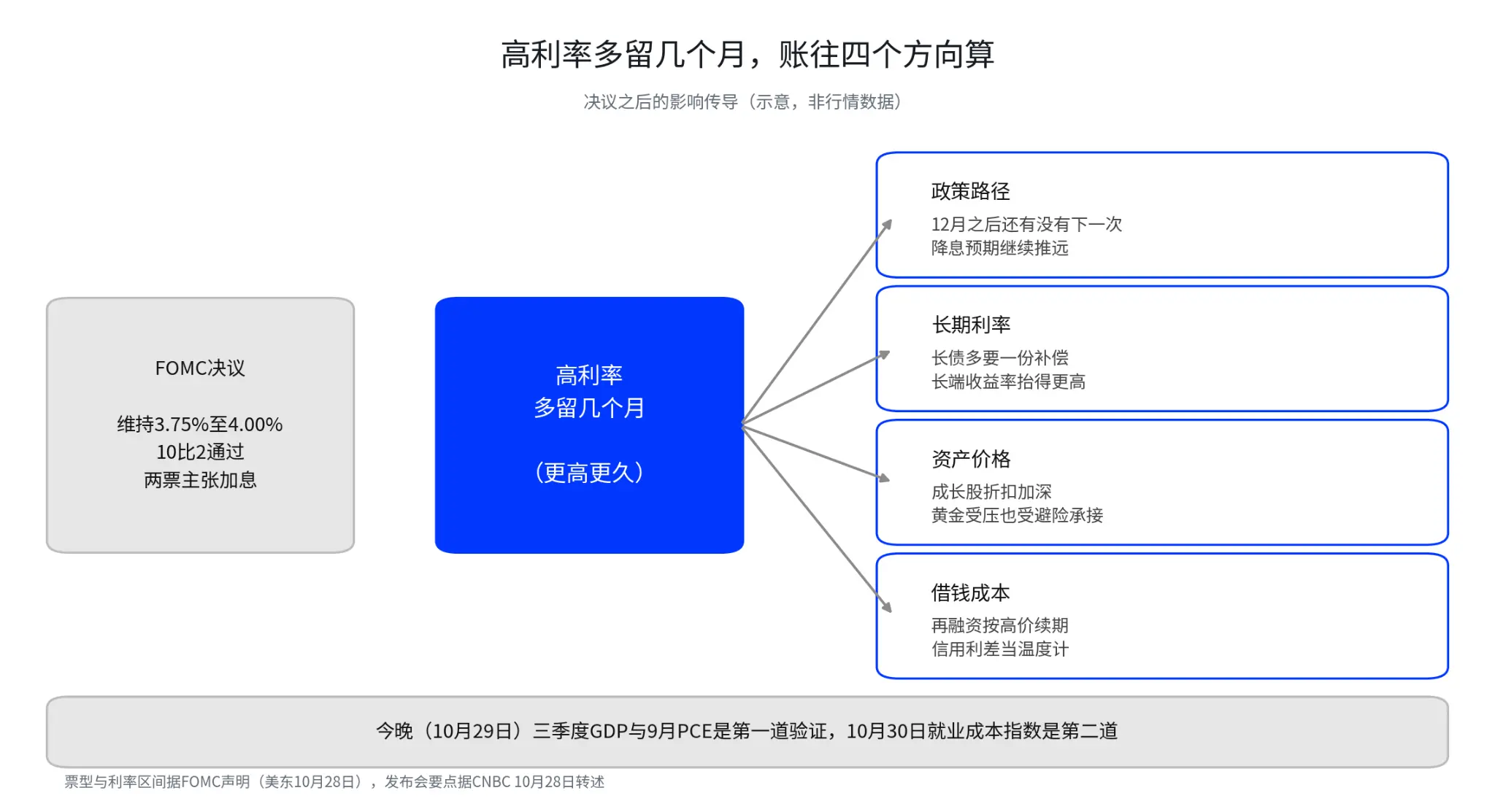
Bonds: Short-term yields closely align with policy expectations for the next few meetings, with two-year Treasury bonds being the most sensitive to the rate hike path. The ten-year bonds, in addition to the policy rate, must also absorb future inflation, growth, fiscal supply, and the unique compensation of long bonds. The more the market believes that high interest rates will last longer, the more compensation is required for the long end. There are exceptions to this relationship; when growth expectations weaken significantly, safe-haven funds may actually push down long-term yields. The terminal daily data shows that the yield on the ten-year U.S. Treasury bond closed at 5.007% on October 28, about 1 basis point higher than the previous trading day's 4.994%, and about 2 basis points higher than 4.988% on October 26, with after-hours snapshots reporting as high as 5.034% (October 29, 00:43 UTC). The long end did not change much on the day of the resolution; the longer compensation was gradually accumulated in the week leading up to the meeting.
Growth stocks: The bulk of these companies' value lies in profits several years down the line; the higher the long-term interest rates, the greater the discount applied to future profits when calculating their present value. Growth stocks are not a monolith; companies with stable cash flows, pricing power, and less reliance on financing are more resilient than those that depend on continuous financing and have not yet realized profits. What the market truly needs to reassess is how deeply current valuations depend on future growth and whether those expectations are reliable.
Gold: High interest rates raise the cost of holding non-yielding assets, which is one side of the pressure. The longer high interest rates persist, the smaller the margin for error in policy; if growth or credit issues arise, safe-haven buying and gold purchases by central banks will catch the selling pressure, which is the other side of the equation. Before the resolution, spot gold fluctuated around $4050 to $4060 (as reported on October 28), and the direction will depend on inflation data, real yields, and the dollar together providing answers.
Corporate financing: For every additional month that high rates persist, companies reliant on refinancing face another month of high costs. Companies with stable cash flows and long debt maturities have a buffer, while those with high leverage, weak cash flows, and ongoing financing needs face pressure first. Credit spreads are a window for observation; when rates are flat, widening spreads indicate that the market is beginning to demand compensation for weaknesses in the financing sector, and pressure will shift from the interest rate side to risk assets.
Growth assets in Hong Kong and A-shares are on the same chain. Long-term U.S. Treasury yields serve as a common valuation reference for global growth assets, while Hong Kong dollar assets also incorporate interest rate transmission under the linked exchange rate, though the transmission is neither immediate nor uniform. Hong Kong's AI assets need to consider two lines: how long-term U.S. Treasury rates suppress valuations and whether the company's own profits and cash flows can withstand the pressure.
4. What can tonight's GDP and PCE overturn?
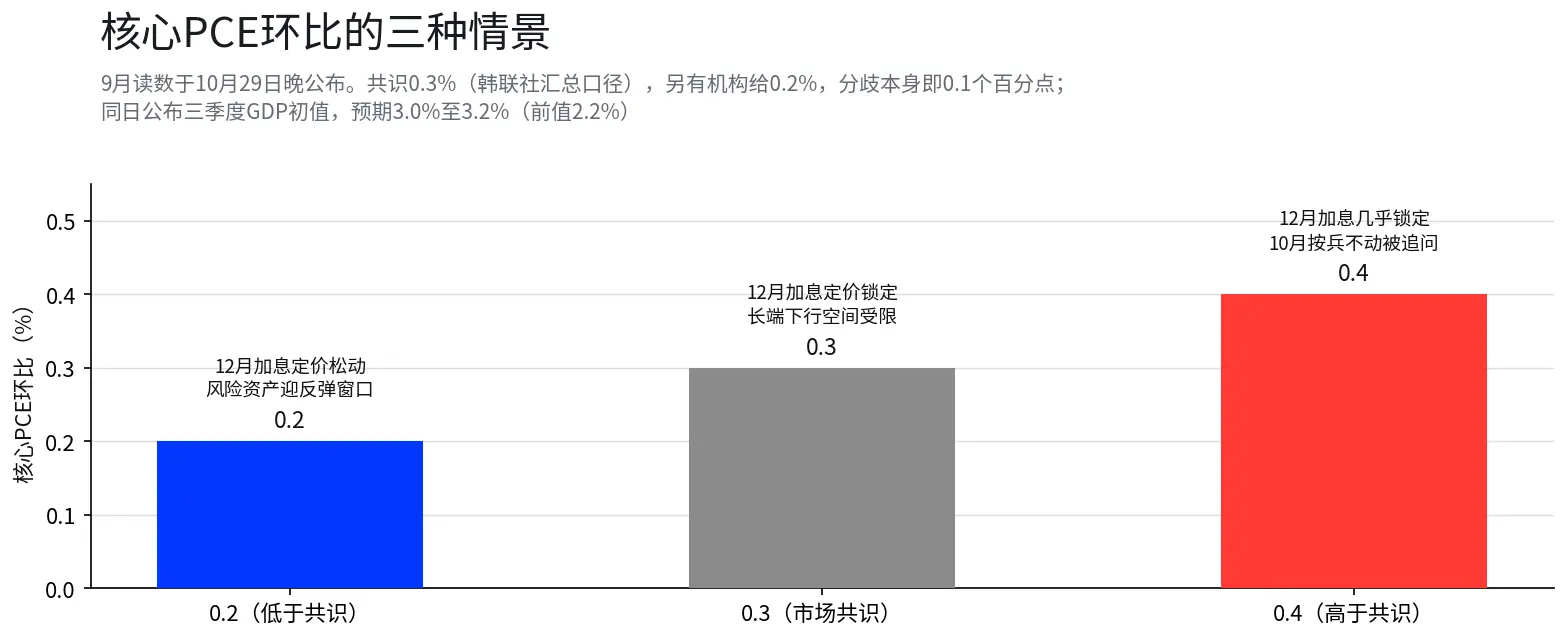
At 20:30 Beijing time on October 29, the preliminary GDP for the third quarter and September PCE will be released on the same day. GDP will answer how much resilience growth still has, while PCE will answer whether inflation has cooled. These two questions combined represent the policy mix the Federal Reserve faces. The data will emerge after the resolution, testing the market's recently completed pricing for higher and longer rates.
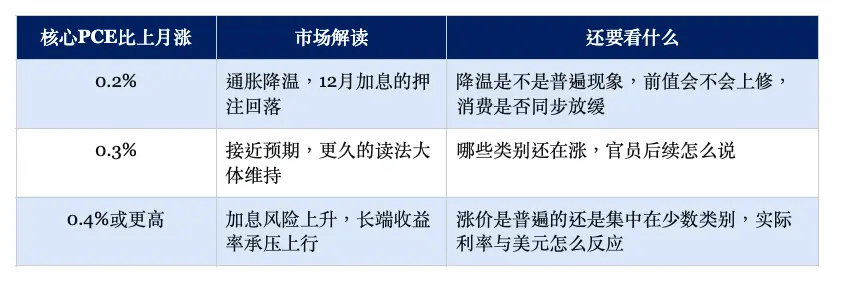
This table is not a mechanical trading signal. Monthly inflation data is influenced by category fluctuations, seasonality, and prior value revisions; 0.2%, 0.3%, and 0.4% cannot be directly equated to rate cuts, holding steady, or rate hikes. What the market truly cares about is whether the data has changed the judgment of inflation trends for the coming months.
On the GDP side, the preliminary expectation is between 3.0% and 3.2% (previous value 2.2%), focusing on actual consumption and private domestic final purchases. Strong growth and stubborn inflation provide more justification for a tightening stance, which may escalate into a necessity for continued rate hikes. Weakening growth and stubborn inflation mean the market must simultaneously face concerns about tightening and recession, making the movements of stocks, bonds, and the dollar much more complex than a one-sided tightening.
The Employment Cost Index, to be released on the evening of October 30 (expected to rise 0.8% from the previous quarter, previous value 0.9%), serves as a second verification. Labor costs help assess whether wage pressures are still being transmitted to service prices, but it alone cannot determine the policy path. Only by combining PCE, GDP, and the Employment Cost Index can it be determined whether the Federal Reserve has the space to wait or must continue to be tough.
5. Next, focus on four signals
December bets: After the PCE is released, will it continue to rise or show a significant decline, distinguishing between temporary fluctuations and sustained repricing.
Yield curve: If short-term rates rise and long-term rates follow, it indicates the market is reinforcing tightening. If short-term rates are high and long-term rates fall, it resembles concerns about growth or a rise in safe-haven demand.
Credit spreads: Whether high financing costs are beginning to evolve into broader credit risks.
Valuation transmission: The sensitivity of growth stocks and Hong Kong AI assets to long-term interest rates, and whether profit expectations can offset valuation pressures.
These signals should be read together. If inflation exceeds expectations, short-term rates rise, and the dollar strengthens simultaneously, it suggests the market is pricing in tighter policies. If inflation exceeds expectations but long-term rates fall and credit spreads widen, it indicates that concerns about growth and credit are also fermenting. The significance of hitting a single indicator is limited; discerning which scenario the market is trading is key.
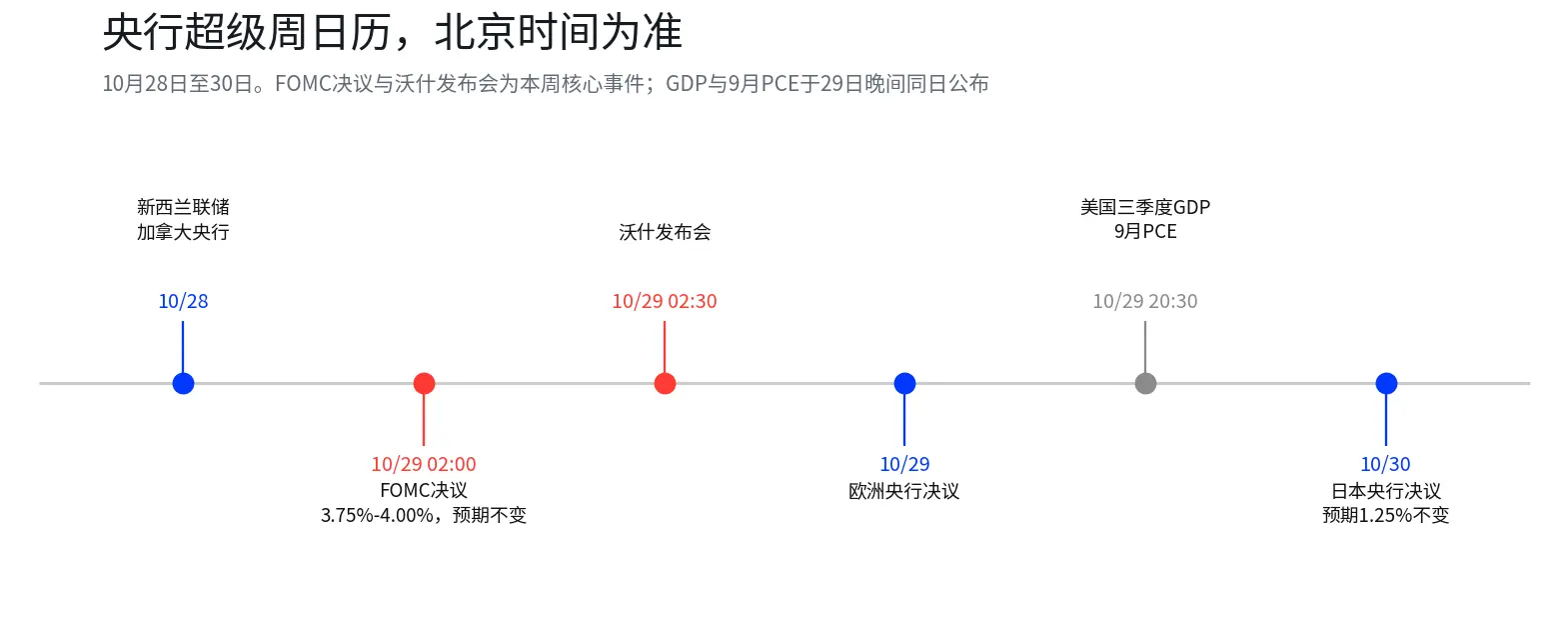
The rest of the central bank week provides supplementary information. The Reserve Bank of New Zealand unexpectedly held steady on the 28th, causing the New Zealand dollar to fall (as reported by Reuters). Decisions by the Bank of Canada, European Central Bank, and Bank of Japan will affect relative spreads and exchange rates but cannot replace U.S. inflation and growth data. The direction of the dollar, gold, and global risk assets will ultimately be determined by relative policy paths, data, and positions.
6. Holding steady is not a shift; data is the next ballot
The Federal Reserve did not raise interest rates this time, nor did it declare the anti-inflation mission accomplished. The 10 to 2 vote result, stronger economic assessment, and Wash's refusal to provide a timeline all indicate that the policy path remains open. Although bets on a December rate hike are approaching 90%, they remain a reading that changes with data, not a decision that has already been made.
The most pressing question to watch next is straightforward: can tonight's GDP and PCE change the market's judgment on the interest rate path? Strong economy and stubborn inflation provide reasons for high rates to last longer. A cooling of inflation and slowing growth would give the market reasons to reassess the necessity of tightening. Rates may not move today, but asset pricing has not stopped; the real watershed is when the market believes high rates can end and what evidence it needs to believe that.
Data Explanation
Resolution: On October 28, the FOMC maintained a rate of 3.75% to 4.00% with a vote of 10 to 2; Cook and Harmack opposed, advocating for a 25 basis point hike. As reported by CNBC, Reuters, and others.
Wording: The assessment of economic activity was upgraded from "moderate" to "strong," retaining "inflation remains elevated." As reported by Reuters and CNBC.
Meeting Arrangement: One meeting in 2027 and two meetings in 2028 will specifically discuss long-term monetary policy strategy, without voting or issuing regular statements. According to CNBC; this corrects the previous simplified statement of "reducing the number of interest rate meetings."
Press Conference: Inflation is too high, policy effectiveness, need for more information, not inclined towards forward guidance. According to CNBC.
December Bets: Approximately 87.5% after the meeting (Euronews); 79% to 84% before the meeting (TradingKey, FXStreet). Different timings, original CME page not obtained.
Market Reaction: Stock index closing and dollar movement according to CNN, Reuters; short end outperforming according to Bloomberg, investingLive.
10-Year U.S. Treasury: 4.994% on October 23, 4.988% on the 26th, 4.994% on the 27th, closing at 5.007% on the 28th; after-hours at 5.034% (2026-10-29T00:43 UTC). Based on the closing price on the terminal day, this can explain the divergence in media direction.
Data Calendar: BEA will release the preliminary value of Q3 GDP and September personal income and expenditure on October 29 at 8:30; BLS will release the employment cost index on October 30 at 8:30. Preliminary GDP expectation is between 3.0% to 3.2%, core PCE expectation is 0.3%, based on multiple surveys.
Central Bank Week: The Reserve Bank of New Zealand unexpectedly held steady on October 28 (Reuters); the Bank of Canada on October 28, the European Central Bank on October 29, and the Bank of Japan on October 30 (expected to remain at 1.25%, summarized by Dongfang Caifu).
Oil and Gold: WTI around $102, spot gold near $4050 to $4060, both reported on October 28.
Disclaimer: The content of this article is for general information and market commentary only, compiled based on publicly available information as of the time mentioned in the text. Relevant market data, expectations, and probabilities may change with market conditions. The views and investment strategies quoted from third-party institutions, analysts, or other individuals only represent the views of the relevant third parties at a specific time and do not represent the views or recommendations of BIT. This article does not constitute investment advice, investment research, an offer, solicitation, or recommendation for any securities, investment products, or trading strategies, nor should it be the basis for any investment decision. Financial markets carry risks, and securities prices and market performance may fluctuate; past performance and historical market trends do not represent or guarantee future results. Investors should independently assess relevant risks based on their own circumstances and seek professional advice when necessary. BIT's Hong Kong stock trading services are not provided to Hong Kong residents or users in other restricted jurisdictions.
 Risk warning Risk warning




Popular articles