BTC $80,678.34 -1.41%
ETH $2,375.64 -1.21%
BNB $737.40 -0.73%
XRP $1.29 -2.90%
SOL $102.22 -2.16%
TRX $0.3297 +0.08%
DOGE $0.0782 -2.04%
ADA $0.2104 -2.85%
BCH $277.20 -2.99%
LINK $11.79 -3.36%
HYPE $77.01 -1.68%
AAVE $142.94 -4.38%
SUI $0.9567 -4.39%
XLM $0.1722 -3.29%
ZEC $1,170.97 -4.61%
AAPL $347.23 +0.21%
AMZN $248.82 -0.73%
GOOGL $321.67 -0.94%
MSFT $524.28 +1.36%
META $641.47 -0.89%
NVDA $211.46 -1.50%
TSLA $372.08 -1.57%
SNDK $1,240.75 -4.52%
INTC $86.78 -1.17%
SPCX $147.61 -0.80%
MU $883.53 +0.29%
AMD $518.37 -0.04%

vote

All
Article
Flash

first_img The XRP Ledger lending code fix is close to taking effect, but the lending amendment still lacks 10 votes

The XRP Ledger vulnerability fix package named fixCleanup3_4_0 is expected to officially take effect around 09:34 UTC on October 23. This fix package has received votes from 29 validators, surpassing the threshold of over 80% approval among the network's default 35 validators, and must be maintained continuously for two weeks. The countdown has been ongoing for nine days. Since there is no margin in the vote count, if any validator withdraws support, the countdown will restart.This fix package partially addresses the unsecured lending system that Ripple has been promoting to banks and payment companies since June, but this system has not yet been activated. Currently, the lending amendment has only 19 votes, and the vault amendment for holding funds has 21 votes, neither of which has started the countdown. Therefore, even if both reach 29 votes today, the lending function will not be available until early November at the earliest.As designed, lenders will deposit XRP or other tokens into the vault, and loan brokers will then lend out the funds for a fixed term. The ledger is responsible for recording the loans and tracking repayments, while brokers assess the borrower's qualifications off-chain. Since borrowers do not need to provide collateral, the broker's judgment becomes the only guarantee for lenders against default losses. Ripple has promoted this scheme to payment companies that need liquidity during cross-border settlement. Additionally, the fix package also closes a vulnerability that allowed accounts authorized to destroy tokens to create new tokens under specific conditions and adjusts the rounding of vault amounts as well as the rules for determining loan overdue and default.

first_img The Zcash community overwhelmingly voted to accelerate transactions and maintain Bitcoin-style halving

Zcash holders voted overwhelmingly to support speeding up transaction times while retaining the Bitcoin-like halving mechanism. This governance vote was for Zcash's next major network upgrade, NU7, with nearly 2.4 million ZEC participating in the vote, accounting for about two-thirds of the approximately 3.6 million eligible ZEC at the time of the snapshot. The results were calculated based on ZEC weight, with each eligible ZEC representing one vote.Among them, 99.9% of participating ZEC supported reducing the block time from 75 seconds to 25 seconds, 98.9% supported retaining the Bitcoin-like halving mechanism, 96.6% supported postponing the fee reissuance of the Network Sustainability Mechanism (NSM) until February 20231, and 99.3% supported launching NU7 as soon as possible, giving up any unrealized features before the deadline of September 30.This vote was limited to holders of ZEC in Zcash's latest privacy transaction pool, Ironwood. The ballots were encrypted and split into 16 parts for counting, making it impossible for validators to reconstruct the specific holders' votes and balances. Previously, a sentiment survey in February for NU7 only attracted 7.25% of circulating ZEC to participate. The voting results themselves will not directly change the network; the relevant features still need to be implemented, tested, and included in the final upgrade.

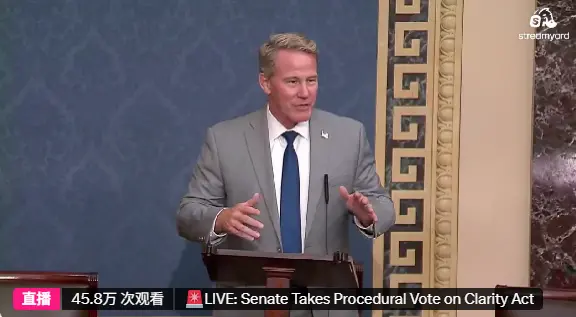
The U.S. Senate is about to conduct a procedural vote on the CLARITY Act, with a threshold of 60 votes

The U.S. Senate will conduct a procedural vote on the Digital Asset Market Clarity Act (referred to as the CLARITY Act). At 2:15 AM Beijing time on September 16, senators will decide whether to end the debate on the motion to enter the bill's review process, with a threshold of 60 votes. If the vote passes, the bill will then enter full Senate debate, amendments, and subsequent final voting, which does not equate to the bill being passed directly that night, nor does it mean it will take effect immediately.To garner bipartisan support, Senate Republicans accepted 126 substantive amendments proposed by Democrats in the final draft. The new text includes stricter ethical provisions, granting state attorneys general a clearer enforcement role; it also gives the Secretary of the Treasury the authority to intervene against potential deposit outflows triggered by payment stablecoins, and revises developer-related provisions to reduce the risk of decentralized infrastructure developers being classified as money transmission entities. Democrats are concerned that the Trump family's cryptocurrency business may create conflicts of interest, with some lawmakers hoping to add constraints such as asset divestiture or blind trusts; moderate senators like Warner and Gallego still hope to push for more amendments. Some Republican lawmakers are also under pressure from the banking industry, fearing that accounts with yield attributes linked to stablecoins could siphon off deposits from community banks.
app_icon
ChainCatcher Building the Web3 world with innovations.