BTC $77,708.85 -2.99%
ETH $2,441.01 -2.42%
BNB $690.60 -2.80%
XRP $1.38 -3.73%
SOL $104.04 -3.10%
TRX $0.3412 +0.80%
DOGE $0.0851 -3.68%
ADA $0.2019 -5.18%
BCH $246.89 -7.24%
LINK $11.38 -3.29%
HYPE $80.27 -4.17%
AAVE $121.22 -5.01%
SUI $0.7410 -4.34%
XLM $0.1782 -3.74%
ZEC $803.59 +1.29%
BTC $77,708.85 -2.99%
ETH $2,441.01 -2.42%
BNB $690.60 -2.80%
XRP $1.38 -3.73%
SOL $104.04 -3.10%
TRX $0.3412 +0.80%
DOGE $0.0851 -3.68%
ADA $0.2019 -5.18%
BCH $246.89 -7.24%
LINK $11.38 -3.29%
HYPE $80.27 -4.17%
AAVE $121.22 -5.01%
SUI $0.7410 -4.34%
XLM $0.1782 -3.74%
ZEC $803.59 +1.29%

vote

All
Article
Flash

first_img SOL rose over 44% within the month, marking the conclusion of Solana's first on-chain governance vote

SOL has risen over 8% in the past 24 hours, with a cumulative increase of about 44% this month, marking the strongest single-month performance since 2024, with prices returning above $105. This round of increase coincides with the conclusion of the first on-chain binding governance vote for the Solana network, where traders have already priced in expectations of supply contraction this week.This vote includes three Solana governance proposals (SGP). SGP-1 approves the Solana Constitution, formally establishing the future on-chain voting mechanism. SGP-2 (SIMD-550), proposed by Helius engineers, doubles the deflation rate from 15% to 30%, bringing the inflation rate down to the 1.5% lower limit by 2029, reducing the issuance of approximately 18.9 million SOL over the next six years. SGP-3 (SIMD-553), proposed by Temporal, splits transaction fees into a base fee and a resource fee, with the latter being directly burned, and the daily burn amount expected to increase from about 650 SOL to a maximum of 9000 SOL.Both economic proposals require a two-thirds absolute majority of the staked weight to pass. The Nasdaq-listed Solana Company (HSDT) supports the constitutional proposal but opposes the two deflation and burn proposals on the grounds of timing, believing that current institutional stakers value predictable returns more. The voting results are expected to be announced within a few hours after the end of epoch 1023.

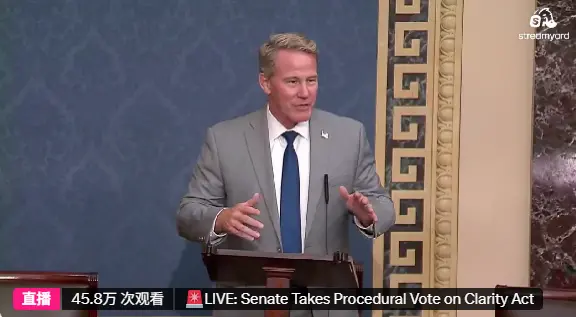
Coinbase CEO: The CLARITY Act is expected to receive 60 votes of support in the Senate on September 15

According to CoinDesk, Coinbase CEO Brian Armstrong stated that the U.S. "Digital Asset Market Structure Clarification Act" (CLARITY Act) is expected to receive over 60 votes of support in the U.S. Senate on September 15 and is confident about passing the first key procedural vote after returning to Congress.Brian Armstrong previously mentioned that the CLARITY Act has entered its final advancement stage, and the Senate procedural vote requires 60 votes of support to push the bill forward. The bill aims to establish a regulatory framework for digital assets in the U.S., clarifying the division of responsibilities between the U.S. Securities and Exchange Commission (SEC) and the Commodity Futures Trading Commission (CFTC) in the regulation of crypto assets. Armstrong believes that the clarification of U.S. crypto industry regulation is approaching, and whether the CLARITY Act ultimately passes or regulatory agencies advance through administrative rules, the market will welcome a clearer regulatory environment.Previously, U.S. President Trump also called on Congress to push the CLARITY Act through, believing that the bill is significant for establishing a regulatory system for digital assets and enhancing the competitiveness of the U.S. crypto industry. reuters.com However, the bill still faces controversy from some lawmakers regarding issues such as conflicts of interest and stablecoin regulation, and whether it can ultimately be successfully implemented still depends on subsequent negotiations in the Senate.

Optimism governance vote sparks controversy: 5.469 million OP tokens transferred from user airdrop to ecological fund

According to CoinDesk, a governance proposal from the Optimism community has been approved, reallocating 546.9 million OP tokens originally planned for user airdrops to the "Strategic Ecosystem Fund" managed by the Optimism Foundation, sparking discussions in the community about governance transparency and user rights. The OP tokens involved account for approximately 12.7% of the total supply, valued at about $49.7 million at current prices.The Optimism Foundation stated that as the ecological strategy shifts towards institutional adoption and corporate partnerships, large-scale user airdrops are no longer fully aligned with the current development direction. Unused tokens can be utilized for ecosystem incentives, partnership building, and enterprise-level project expansion. The final vote resulted in 17.974 million OP in support and 10.931 million OP against the proposal.A key turning point occurred 16 minutes and 52 seconds before the voting ended, when the Optimism core development team Test in Prod (delegate.testinprod-io.eth) cast 8.486 million OP in support, raising the approval rate from 45.77% to 61.84%, ultimately pushing the proposal through.If the vote from Test in Prod were excluded, the support rate for the proposal would only be 46.47%, which would not have passed, and the related tokens might have remained in the user allocation pool. The Optimism Foundation previously committed to disclosing the cumulative usage of the fund and related results through an annual budget report. This vote has also reignited discussions about the influence of "large delegated voting rights" in DAO governance and the balance of rights for token holders.

The U.S. Treasury Secretary urges the Senate to vote on the Clarity Act immediately and cites Satoshi Nakamoto

U.S. Treasury Secretary Scott Bessent urged the Senate on Thursday to pass the Clarity Act, stating that the House of Representatives passed the bill over a year ago, and staff from the Senate Banking and Agriculture Committees have since engaged in thousands of hours of bipartisan negotiations on the revisions. Bessent stated that the bill will strengthen consumer protections and anti-money laundering requirements, and provide regulatory certainty for digital assets. He also mentioned that the Blockchain Regulatory Certainty Act provisions in the Clarity Act will protect decentralized software developers, clarifying that they are not subject to the registration requirements of the Bank Secrecy Act.Bessent criticized Senate Democrats for delaying the vote for political reasons, stating that the relevant vote will determine whether the U.S. continues to maintain its global leadership in digital assets. At the end of his post, he quoted Bitcoin creator Satoshi Nakamoto: "If you don't believe me or don't understand, I don't have time to try to convince you, sorry." The Clarity Act aims to establish a federal framework for the U.S. digital asset market and allocate regulatory responsibilities for digital assets to the SEC and CFTC, with most crypto assets typically falling under CFTC jurisdiction. Senate Majority Leader John Thune recently stated that the bill is not expected to pass the Senate before the August recess.
app_icon
ChainCatcher Building the Web3 world with innovations.